Don Carlos of Spain had an inbreeding coefficient of 0.211. A child born to first cousins scores 0.0625. He was 3.4 times more inbred than that.
The version of Don Carlos most people carry in their heads comes from an opera. Verdi's Don Carlos, premiered in Paris in 1867, gives you the beautiful doomed prince, the forbidden love with his stepmother Elizabeth of Valois, the monstrous father, and a grand inquisitor scene that made the Spanish Inquisition look like the engine behind the whole tragedy.
Every major beat of that opera is fiction. The love story has zero documentary support. The Inquisition never touched Don Carlos.
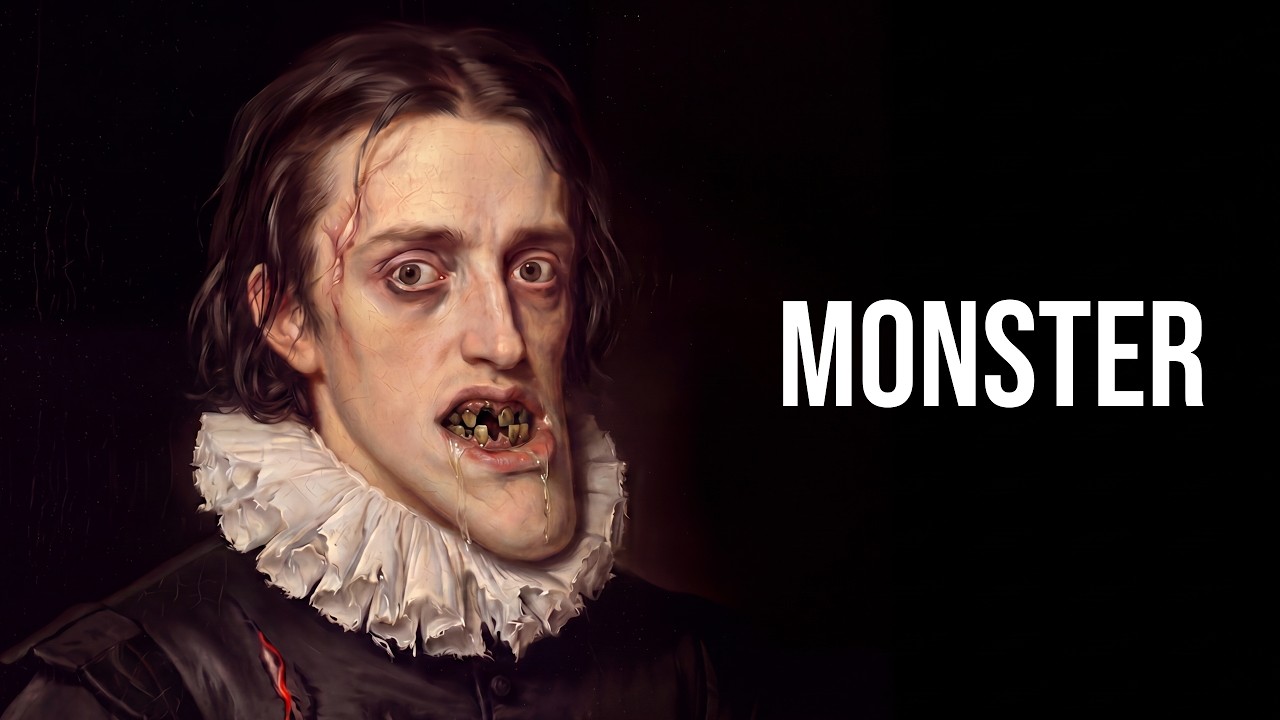
The beautiful prince was a physically deformed, brain-injured young man who kept a handwritten list of people who must die. The name at the top of his private confessions was his own father.
The real story is worse than the opera and stranger, and it starts with a family tree that loops back on itself like a knot.
Philip, then Prince of Asturias, married Maria Manuela of Portugal in 1543. They were doubly first cousins. Philip's father, Charles V, was the brother of Maria Manuela's mother, Catherine of Austria, on the Habsburg side. Philip's mother, Isabella of Portugal, was the sister of Maria Manuela's father, John III, on the Aviz side.
Instead of the normal eight great-grandparents, Don Carlos had four ancestral couples: Philip the Handsome and Joanna of Castile, Manuel I of Portugal and Maria of Aragon. Manuel I had already married two Spanish infantas before that. The Habsburg and Aviz bloodlines were tangled long before this particular wedding.
This was not an accident. This was dynastic policy. The Habsburgs married their own because they trusted no one else with the inheritance, and the Aviz did the same. The two families kept braiding themselves together until the genetic math stopped working.
Don Carlos arrived on July 8, 1545, at Valladolid. Maria Manuela died four days later from puerperal sepsis, likely a retained placenta. She was 17. Philip was 18 and a widower before he had finished being a new father.
The Venetian ambassadors who passed through Madrid over the next decade and a half left the most detailed physical descriptions we have. Federico Badoaro in 1557 called him small and weak for his age. Michele Soriano in 1559 noted fragility, intellectual slowness, and trouble speaking.
By 1563, Paolo Tiepolo was recording one shoulder higher than the other, one leg shorter, a slight hunch, and a speech impediment. Giovanni Soranzo in 1565 added the violent rages and impulsiveness.
The speech defect was not a lisp, as popular accounts repeat. It was a rotacism combined with a lambdacism. He could not cleanly pronounce L or R. His chest was deformed in what some accounts called pigeon-breasted. He limped from the leg-length difference.
These ambassadorial reports are collected in Eugenio Alberi's Relazioni degli Ambasciatori Veneti al Senato, published in Florence between 1853 and 1861. Modern historians treat them as broadly accurate, but note that Venetian diplomats had incentives to magnify oddities for a good dispatch.
A 2009 study published in PLoS One by Alvarez Caballos and Quintero calculated the inbreeding coefficients for the entire Spanish Habsburg line. Philip II himself carried a coefficient of roughly 0.123, already double the first-cousin baseline. Don Carlos sat at 0.211.
Charles II, the dynasty's terminal case, the king with the jaw so malformed he could barely chew, scored 0.254. That is higher than a child born to sibling incest. Don Carlos was the first visible fracture in that genetic arc. A century before the line collapsed entirely, you could already see the damage.
From 1561, Carlos was sent to study at Alcalá de Henares with two other boys close to his age. Don Juan of Austria, born 1547, was Charles V's illegitimate son by Barbara Blomberg, which made him Philip's half-brother. Athletic, magnetic, the kind of young man people noticed when he walked into a room. He would go on to command the Christian fleet at Lepanto in 1571, the most celebrated naval victory of the century.
Alessandro Farnese, born the same year as Carlos, was the son of Margaret of Parma, another of Charles V's illegitimate children. Disciplined, scholarly, destined to become one of the finest military commanders of the century as Duke of Parma. His reconquest of the Southern Netherlands in the 1580s would be studied in military academies for generations.
Carlos was the legitimate heir, the one with the title, the claim, the crown waiting for him, and he was outshone by both of them every single day. Gachard treats this arrangement as psychologically corrosive, and it is hard to disagree.
Place a physically impaired, intellectually struggling prince alongside two of the most gifted young men in Europe, both of them his blood relatives, both of them illegitimate, both of them effortlessly better at everything that mattered in a 16th-century court. The resentment that Carlos developed toward Don Juan especially would come back violently in the winter of 1567 and 1568.
His tutor was Onorato Juan, a humanist scholar and former student of Juan Luis Vives, who would later become Bishop of Osma. His correspondence, partially preserved at Simancas and referenced in Cabrera de Córdoba's 1619 history of Philip II, is one of the rare sympathetic voices. He described Carlos as capable of affection and genuine curiosity, but unable to hold attention for long. His household governor before the formal tutoring was García de Toledo.
The cruelty stories split cleanly into two categories. The ones that come from court correspondence, the dispatches of the French ambassador Fourquevaux and Cabrera de Córdoba, are bad enough. Whipping and beating servants between 1564 and 1567, ordering a bootmaker to eat his own ill-fitting boots, drawing a dagger on Cardinal Espinosa in 1568 because an actor had been dismissed, attempting to throw a page out a window. Those are documented.
Then there is the second tier. Roasting hares alive, blinding 20 or more horses, whipping women brought to his chambers. Those appear only in Brantôme, in Orangeist propaganda pamphlets, or in 19th-century black legend literature. The number of blinded horses shifts suspiciously between sources, which is always a tell. The diary of his outbursts is real. The most grotesque anecdotes are propaganda layered on top.
Easter Sunday, April 19, 1562, changed things permanently. Carlos fell down a narrow stone staircase in the dark at Alcalá de Henares. He was apparently chasing a young woman of the household. Some sources name her Mariana, the porter's daughter. The popular version that says she was a gardener's daughter is a conflation from later retellings.
He struck his head on a closed door at the bottom of the stairs. A stone staircase, a closed door, a 17-year-old skull with bones that may not have formed properly to begin with. The injury was severe.
By early May, he was feverish, intermittently blind, swollen, drifting in and out of consciousness. Philip II rode from Madrid and stayed at the bedside. The king of the largest empire on Earth sat watching his only male heir die in a university town, and there was nothing his power could do about it.
And then the medical team that assembled around this prince became one of the strangest gatherings in Renaissance medicine. Dionisio Daza Chacón was the royal surgeon. He left the most complete eyewitness account in his Practica y Teórica de Cirugía, published in Valladolid in 1580. This is the single most reliable medical primary source for the whole episode.
Andreas Vesalius was there, the Vesalius, the man who wrote De humani corporis fabrica in 1543, the anatomist who rebuilt the entire discipline from cadaver dissection up, who told Galen he was wrong and proved it with a scalpel. In 1562, he was serving as imperial physician to the Habsburg court. He came from Madrid, examined the prince, and argued for aggressive trepanation to relieve the intracranial pressure. The Spanish court surgeons overruled him.
His consultation on the case is referenced in C. D. O'Malley's 1964 biography, pages 287 through 291. Whether the trepanation would have helped is unknowable. The intracranial swelling was severe, and the prince was already drifting in and out of consciousness. A more aggressive intervention might have relieved the pressure and preserved brain function, or it might have killed him on the table.
The point that matters is not the medicine. The point is that the most accomplished anatomist in Europe was told to stand down by court politics, by physicians whose authority rested on proximity to the king, rather than on demonstrated competence. Vesalius would leave Spain for a pilgrimage to the Holy Land the following year and die on the island of Zakynthos in 1564. He never wrote a full account of the Don Carlos case.
There was also a man called Pintorret, and the spelling varies across sources, a Morisco bonesetter from Valencia, an algebrista, summoned because of his local reputation. He made incisions and applied poultices. Contemporary accounts are not kind about his methods.
So, you had, gathered around the same bed, the greatest anatomist of the Renaissance, a royal surgeon, and a Moorish folk healer. That is a scene most people will not have pictured when they think of 16th-century Spain.
A partial trepanation was performed. Modern medical historians disagree about whether it constituted actual trepanation or a more limited scalp and bone debridement. Either way, the prince did not improve.
When the doctors ran out of options, someone turned to the dead. The desiccated body of Fray Diego de Alcalá, a Franciscan lay brother who had died in 1463, was carried in procession from the local Franciscan convent and placed in Don Carlos's bed on the night of May 9 to 10, 1562.
Carlos began to recover. Philip II took this seriously. He personally pushed the canonization of Fray Diego for the next quarter century. Pope Sixtus V canonized him on July 2, 1588. It was the only canonization of Sixtus V's entire pontificate. The canonization bull explicitly cites the healing of the prince. El Greco painted him. Murillo did an entire cycle of his life. A saint sits in the Catholic calendar today because a half-formed prince fell down a staircase chasing a girl.
The honest assessment of what the fall did to him? It probably worsened problems that already existed. The Venetian dispatches from 1557 and 1559, years before the accident, already describe him as physically stunted and psychologically off. After 1562, the violence and the rages came more frequently.
Modern hypotheses include post-traumatic frontal lobe disinhibition, post-traumatic epilepsy, and underlying genetic conditions tied to his coefficient. No single retrodiagnosis holds up. The fall did not create Don Carlos's problems. It sharpened them.
Five years passed between the fall and the crisis. And during those five years, Philip watched his son get worse and did very little about it. This is the core of Geoffrey Parker's 2014 argument in Imprudent King. Philip's failure was not sudden cruelty but chronic indecision.
He received dispatches. He read the Venetian assessments when they circulated. He heard the reports from Carlos's household about the violence, the outbursts, the bootmaker forced to eat leather. And he deliberated.
He wrote marginal notes. He consulted advisers who told him what he already knew. He did this for the better part of three years, from 1564 or 1565 onward, while his son got progressively more dangerous and more unstable, until the gap between the problem and any proportionate response had widened past the point of repair. By the time Philip acted, the only tool left was the blunt one.
This was the pattern of his entire reign, applied to his own bloodline. Delay dressed as prudence, caution that curdled into negligence.
In August 1567, the Duke of Alba was dispatched to crush the Dutch revolt. Don Carlos had personally lobbied for that command. He wanted the Netherlands. He wanted a military role, a stage where he could prove he was more than the fragile heir everyone whispered about behind cupped hands and encoded diplomatic dispatches.
Philip refused him. He gave the command to Alba, a career soldier with decades of experience, and from a purely administrative standpoint, the decision was sound. From every other standpoint, it was the match that lit the fuse. Carlos had staked whatever remained of his self-image on getting that appointment. Losing it to a man he despised broke something in him that had been bending for years.
By late 1567, Carlos was assembling a flight plan. He intended to leave Spain without permission. The destination was uncertain: Italy, Germany, or the Netherlands. An important distinction that gets lost in most retellings, there is no surviving evidence that he planned to join William of Orange or the rebel cause. That connection was invented later by Dutch propaganda. What the documents show is a young man trying to escape his father's control.
Philip understood the danger, and he understood it in the precise terms of a man who thought about sovereignty the way accountants think about balance sheets. An estranged heir wandering Europe becomes a lightning rod for every faction that opposed the Spanish monarchy. Every rebel, every Protestant prince, every French diplomat looking for an advantage would treat Carlos as a walking invitation to destabilize the Habsburgs.
In mid-December 1567, Carlos tried to raise roughly 150,000 ducats from Spanish grandees and bankers. The letters survive at Simancas, Patronato Real, Legajo 28. Parker favors the 150,000 figure. Older sources cite 200,000, but the sourcing is weaker.
Then came the confession that decided everything. Around Christmas Eve 1567, Don Carlos went to confession with the Dominican Fray Diego de Chaves, the royal preacher. Chaves refused absolution. The reason, which eventually worked its way up the chain of court communication, was that Carlos had confessed wanting to kill a man. When pressed, he identified that man as Philip II, his own father, the king.

The same man who had ridden to Alcalá and sat at his bedside for weeks while surgeons and faith healers and Vesalius himself fought to keep him alive.
Carlos then visited other friars at the royal chapel and asked whether a person could take communion while hating another man with the intent to kill him. They agreed with Chaves, no absolution. You do not get to take the body of Christ while planning to murder your father. The confessional seal meant this information should have stayed private, but the threat against the king overrode it, and by early January, Philip knew.
After the arrest, a memorandum in Don Carlos's own handwriting was found in his rooms. A list of people categorized as under "Moria must die" and "Handevivia must live." The must die column reportedly included the Duke of Alba, Cardinal Espinosa, and Rui Gómez de Silva, who had once been his own household governor.
There is something chilling about a kill list written in the hand of a 22-year-old prince who slept above a loaded gun. It sat in his room, in his handwriting, alongside weapons. This was not a metaphor. This was a plan, or at least the skeletal architecture of one.
The final betrayal came from family. Carlos asked Don Juan of Austria, his half-uncle, two years older, raised alongside him at Alcalá, to help secure galleys for his escape. Don Juan stalled. Around January 17, 1568, he left Madrid for the Escorial and told Philip everything in person.
That same night, the king moved. After 11:00 on Sunday night, January 18, 1568, Philip II entered his son's bedchamber at the Alcázar of Madrid. He was wearing armor under his robes and a helmet. The king of Spain put on armor to go into his own son's bedroom. Think about what that tells you.
With him came Rui Gómez de Silva, Prince of Eboli, the man Carlos had placed on his must die list. The Duke of Feria, captain of the guard. Luis Quijada de Ávila, former guardian of Don Juan. Antonio de Toledo, prior of the Order of St. John.
Carlos had rigged a bell and pulley alarm system over his bed, which tells you he was expecting something. Under the bed, a loaded arquebus, two swords, daggers. A prince sleeping on top of an arsenal.
The men entered quietly, seized the weapons first, confiscated his papers and a casket of correspondence, and brought carpenters in that same night to nail the window shut from outside. By morning, the heir to the Spanish throne was a prisoner in his own rooms, and the carpenters' hammer strikes were the last sounds of his freedom.
The royal chronicler, Cabrera de Córdoba, writing roughly 50 years later from court sources rather than first-person testimony, records an exchange. Carlos asked, "Does your majesty wish to kill me?" Philip answered, "I do not wish to kill you, but to correct you." Carlos then reportedly begged Philip to kill him, said he was not mad but desperate, and tried to throw himself into the fire.
Parker reproduces this exchange but flags the provenance. Kamen leaves it out entirely. Take it for what it is, a second-hand account filtered through decades and a court chronicler's pen.
For the next six months, Don Carlos lived in expanded apartments on the upper floor of the Alcázar, not a tower, despite the legend. The word torre in some sources is loose. Six gentlemen guards rotated under Rui Gómez. Mass was said daily. No outside visitors were allowed. Philip II never entered the room again after the night of the arrest.
The guards kept daily logs. Those logs survive at Simancas, Estado Legajo 155, and Louis Prosper Gachard reproduced them in his 1863 study, Don Carlos y Felipe II, which remains the archival foundation for this entire story.
What the logs describe is a man methodically destroying himself. In one attested week of May 1568, Carlos consumed over 10 liters of iced water per day. He slept on a bed layered with ice. He swallowed a diamond ring. The papal nuncio, Castagna, confirmed that detail in a letter dated June 3, 1568. He also swallowed pearls.
He walked barefoot for hours on cold stone floors. He lay naked on the bare floor through the winter nights of January and February. He alternated between hunger strikes lasting days and gorging himself until he vomited.
The guards recorded all of this. They watched it happen, and they wrote it down, and they could not stop it because the prince was still the prince, even locked in a room with nailed shut windows.
Try to picture the daily reality of those guards. Six men rotating shifts, watching the heir to the Spanish throne eat ice and swallow jewelry and refuse food for days, and then devour everything put in front of him. They were watching a slow-motion collapse, and they were filing reports about it in neat handwriting, because that is what Philip's bureaucracy demanded. Every detail documented, every meal refused or consumed, every night spent on cold stone floors.
On July 6, 1568, the final binge: a partridge pie and four gallons of iced water in a single sitting. This is from Luis Manrique's report reproduced in Gachard. Within days, the fatal illness had begun.
By July 17, the fever was high and constant. Dysentery set in. He could not retain food or water. Delirium followed. Don Carlos died in the early hours of July 24, 1568. He was 23 years old and had spent the last six months of his life in a room with nailed shut windows.
His attending physicians were Olivares, Vega, and Gutiérrez de Santander. They could do nothing by that point. The body had been pushed beyond recovery by months of self-abuse, on top of whatever underlying damage the genetics and the 1562 fall had already inflicted.
Philip ordered an autopsy, which was unusual for the period and almost certainly calculated to get ahead of the poisoning rumors he knew were coming. He knew his enemies. He knew what they would say.
The autopsy report at Simancas, Estado Legajo 155, folio 71, described findings consistent with severe dysentery and general debility. No indicators of poison. The mainstream modern view, shared by Parker and Sánchez Granjel, is septic shock from bowel perforation on a gut that had been starved and frozen and then overloaded with cold water and rich food. The partridge pie and the four gallons of iced water on July 6 went into a digestive system that had been wrecked by months of extremes, and the system gave out. Kamen calls it suicide by degrees. That phrase is hard to argue with.
Carlos was first buried at the convent of Santo Domingo el Real in Madrid. In 1573, Philip had the body moved to El Escorial, where it remains in the Panteón de los Infantes. No full forensic study of the remains has been published. Patrimonio Nacional has been restrictive about allowing sampling.

The morning after the arrest, January 20, 1568, Philip launched a diplomatic paper flood that Geoffrey Parker has dissected in detail. He wrote simultaneously to Pope Pius V, the letter survives in the Vatican Secret Archives, explicitly stating that the case was not a matter of heresy and not an Inquisition proceeding. It concerned the prince's condition and deficiencies.
He wrote to his sister, Empress Maria, to his other sister, Princess Juana, and on January 21, he issued a circular to the cities of Castile and the grandees. In every letter, he refused to specify charges. There was no trial, no formal accusation, no Inquisition process. He held his son by royal authority alone and gave his enemies nothing but silence to work with.
They worked with it beautifully. William of Orange's apology was drafted in December 1580 by his Calvinist chaplain, Pierre Loiseleur de Villiers, and printed in 1581. It was a direct response to Philip's ban, which had placed a 25,000 ducat bounty on William's head. When a king publicly prices your assassination, you hit back with everything you have.
The apology charged Philip with murdering Don Carlos, poisoning Elizabeth of Valois, who also died in 1568 in October, just three months after Carlos, committing incest with his sister, and murdering Floris de Montmorency, Baron Montigny.
That last charge was true. Montigny had been lured to Spain on a diplomatic pretext in 1567, imprisoned and secretly garroted at Simancas in October 1570 on Philip's written order. The execution was disguised as a natural death. A fake death certificate was produced.
Having one verified murder on the list, complete with a documented cover-up, gave the fabricated charges a credibility they would not otherwise have earned. This is how propaganda works at its most effective. You anchor the lies to one checkable truth, and the audience extends its belief across the whole document.
The apology was printed in French, Dutch, German, English, and Latin within two years. A coordinated pan-European publishing campaign in an age before mass media. It worked.
Antonio Pérez, Philip's disgraced former secretary, opened the second front a decade later. He fled Spain after the Escobedo affair, a political assassination that had originally been Philip's own idea and turned into a liability, and found shelter at the courts of Henry IV and Elizabeth I.
His Relación, published between 1591 and 1598 in Pau and London, added insider detail from someone who had worked inside the royal chancery. Pérez knew the filing systems. He knew the couriers. He knew which ministers hated which other ministers and why.
He never claimed to have witnessed any murder. That was his method. Implication, not accusation. Hints planted by a man with verified access were more damaging than any outright charge, because the reader filled in the blanks with their own worst suspicions. Gregorio Marañón's 1947 study of Pérez took apart the technique with the precision of a surgeon, demonstrating how Pérez weaponized ambiguity while maintaining deniability.
The Don Carlos story was useful to everyone who needed Philip to be a monster. The Dutch revolt required proof that a king who kills his own son forfeits natural authority over his subjects. Elizabethan England, especially after the 1588 Armada, needed a villain on the Spanish throne to justify the Cold War. The French Wars of Religion fed the story into the politique critique of royal absolutism. Protestant martyrology, the tradition that John Foxe had built through his Acts and Monuments, slotted Don Carlos into its existing architecture of Spanish cruelty.
William Maltby traced this machinery in the Black Legend in England in 1971. Ricardo García Cárcel did the same for the broader tradition in La Leyenda Negra in 1992. The story persisted not because it was true, but because it was useful, and useful fictions outlast documented facts with almost no effort.
The Inquisition connection, which Verdi cemented in the public mind with his Grand Inquisitor scene, one of the most powerful bass arias in the operatic repertoire, is explicitly false. Philip's own letter to Pius V says so in plain language. The Suprema, the Council of the Inquisition, has no file on Don Carlos, not a single document.
The confusion arose because Cardinal Espinosa held two positions simultaneously, Inquisitor General and President of the Council of Castile. He sat on the commission that managed Carlos's confinement in his capacity as head of the Civil Council, not as head of the Inquisition. Later writers collapsed those two roles into one, and the conflation became permanent.
Verdi's Grand Inquisitor, blind and ancient and terrifying, telling Philip that the son must die for the faith, is magnificent theater. It is also completely invented. No churchman called for Carlos's death and no tribunal examined him. The Inquisition, which has enough genuine atrocities attached to its name, had nothing to do with this one.
The literary afterlife stacked invention on top of invention across two centuries, each generation adding a new layer of fiction calibrated to its own political needs. William of Orange in 1581 supplied the murder accusation. César Vichard de Saint-Réal in 1672 wrote Don Carlos, Nouvelle Historique, a novella that invented the love affair with Elizabeth and cast Philip as the jealous husband, with Alba as his instrument. It was a commercial hit across Europe.
Thomas Otway brought it to the English stage in 1676. By the time Schiller got hold of the material in 1787, the story had accumulated enough fictional mass to support an entirely new character, the Marquis of Posa, a man who never existed, who speaks Enlightenment ideals of intellectual freedom directly to Philip's face, and delivers the line that audiences remember long after the curtain drops. Posa was Schiller's invention, top to bottom, a vehicle for his own politics inserted into a story that was already more fiction than history.
And then Verdi staged his opera in 1867, complete with a prologue set at Fontainebleau, where Carlos and Elizabeth meet and fall in love before her marriage to Philip, and music so powerful that it made the lies permanent. The fiction had eaten the facts so completely that the real man underneath was unrecognizable.
That Fontainebleau meeting never happened. Carlos and Elizabeth did not meet before her arrival in Spain. No surviving letter between them contains anything suggesting romantic feeling. Louis Prosper Gachard, a Belgian Protestant who had every cultural incentive to convict Philip, surveyed the Simancas correspondence and found nothing. Elizabeth's own letters home to Catherine de Medici, published by La Ferrière in his edition of Catherine's correspondence, worry about Philip's moods and her miscarriages. Don Carlos does not appear in them as a romantic figure. Henry Kamen puts it flatly. There is not a shred of evidence to support the romantic fictions.
Philip lost the information war he started. He was the most centralized bureaucrat in Europe, a man who generated more paper than any monarch before him, who annotated his own ministers' reports in the margins until the margins ran out and he added separate sheets. And a single Calvinist pamphlet buried his entire diplomatic offensive in a season.
Parker's framing of him as the imprudent king catches the tragedy precisely. The careful king lost to the reckless pamphleteer because caution carried far enough becomes its own kind of recklessness.
Don Carlos lies in El Escorial in the Panteón de los Infantes, a few corridors from his father. The opera plays on. St. Diego de Alcalá, canonized because a corpse was laid in a dying prince's bed and the prince got better, remains in the calendar.
And the inbreeding coefficient that produced Don Carlos, that 0.211, was not a warning the Habsburgs heeded. They kept the bloodline closed for another five generations until Charles II with his coefficient of 0.254 could not produce an heir, could barely speak, and ended the dynasty in 1700 with a jaw that did not close.