DARMSTADT, Germany — The six American airmen were kneeling on the sidewalk, their hands empty, their flight suits still bearing the insignia of the United States Army Air Forces, when the civil defense official walked up and shot each of them in the back of the head.
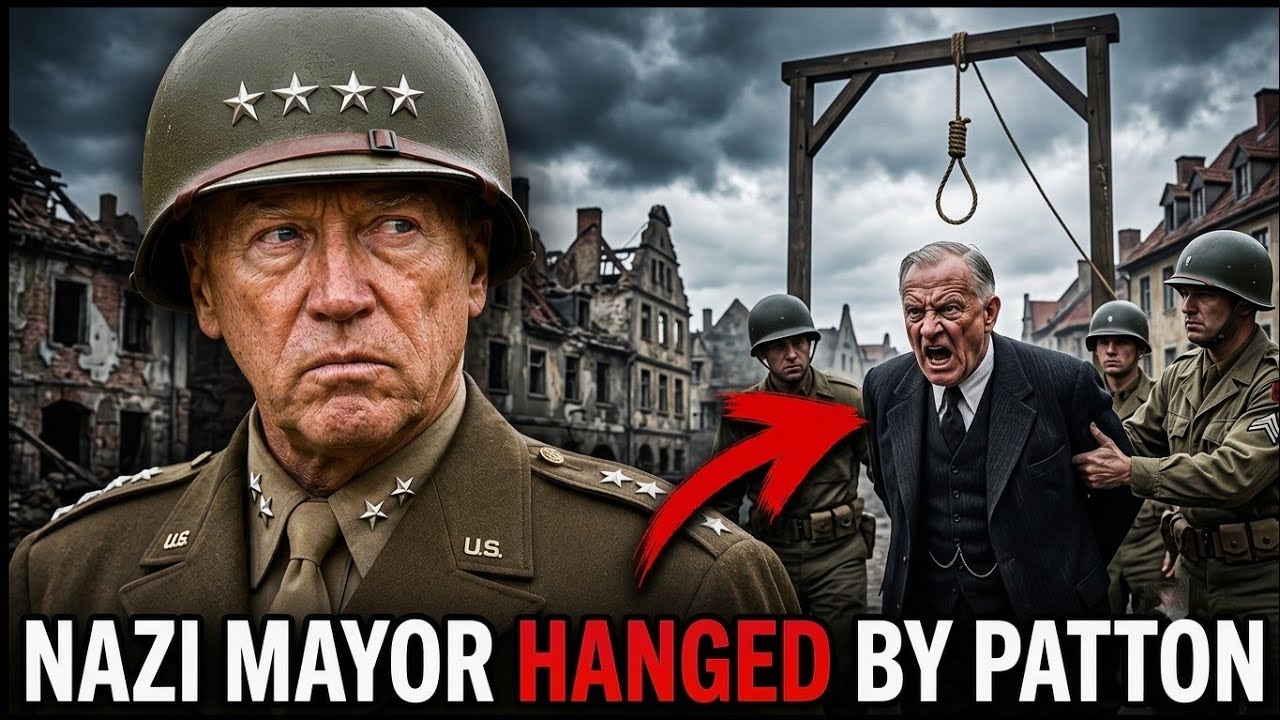
It was the morning of August 26, 1944, in the industrial town of Rüsselsheim, east of Mainz. The night before, 116 Royal Air Force Lancaster bombers had dropped more than 600 tons of explosives on the Opel automobile works and the rail lines feeding it. The streets were covered in ash and broken glass.
Walls had collapsed. Fires still burned in the factory district. Hundreds of residents had spent the night pulling bodies from the rubble.
They were exhausted, grieving, and furious.
Into that morning walked eight American pilots who had nothing to do with the bombing. They were the crew of a B-24 Liberator called “Wam Bam,” led by 23-year-old Second Lieutenant Norman Rogers of Kentucky. Two days earlier, their aircraft had been shot down over Hanover, sixty miles to the north.
All nine crew members had parachuted out. They were captured by German forces, classified as prisoners of war, and were now being marched through Rüsselsheim under guard by just two German soldiers, heading for a train that would take them to a POW camp.
They were unarmed. They were in uniform. Under the Geneva Convention, they were protected prisoners.
The people of Rüsselsheim did not see prisoners of war. They saw the men who had bombed their homes.
A woman named Margarete Wetzler stepped out of the crowd first. She looked at the American airmen and screamed at the top of her voice: “These are the terror flyers. Tear them to pieces.
Beat them to death. They destroyed our homes.” One crew member who spoke German tried to explain: “It wasn’t us.
We didn’t bomb Rüsselsheim.” No one listened. A woman threw a brick, then another.
The crowd surged forward. Within seconds, stones, shovels, and hammers rained down on the eight Americans. Three workers from the Opel plant arrived carrying iron bars and began beating the men until they fell to the ground.
The two German soldiers escorting the prisoners did nothing. They stepped back and watched.
Into this mob walked a man named Josef Hartgen. He was 43 years old. He was the civil defense official for air raids in Rüsselsheim, the civilian authority responsible for coordinating the city’s response to air attacks.
The night before, he had been awake all night organizing fire crews, directing civilians, and documenting damage. He had seen what the bombs had done to his city. He had watched people he knew die.
He was armed with a pistol.
Hartgen walked to where the American airmen had fallen from the beating. He looked at them, then lined them up along the side of the pavement and began shooting them in the head. One by one, he emptied his ammunition, and only two men remained alive.
Sergeants William Adams of Texas and Sidney Brown of Pennsylvania survived by pretending to be dead. The mob loaded the bodies onto a cart and transported them to a cemetery. Those who groaned along the way were beaten further.
Six Americans died. They were not killed in battle. They were not killed by soldiers.
They were killed by a mob in a city street after being captured. Their names: Norman Rogers, John Sekle, Hugh Tovengen, Thomas Williams, William Dumont, and Elmore Austin. They ranged in age from 19 to 26.
The two survivors hid for four days before being recaptured and sent to a POW camp. They said nothing had happened in Rüsselsheim. Not yet.
They feared that talking would lead to retaliation against other prisoners. They waited.
 Rüsselsheim buried the six bodies in a cemetery near the forest on the edge of town. No headstones, no names. Silence descended on the city about what had happened.
The people who had been on the street that morning did not talk about it. Hartgen returned to his duties as air raid official. Life continued in a half-destroyed city.
The war continued for seven more months.
Then, on March 25, 1945, soldiers of Patton’s Third Army entered Rüsselsheim. What happened in that city and what followed is among the most significant war crimes stories of the entire conflict. It became the first civilian war crimes trial in Germany, even before the Nuremberg trials.
When Patton’s soldiers entered Rüsselsheim in late March 1945, the city fell without a fight. The war was nearly over. The remaining Germans were not interested in dying for rubble.
Rüsselsheim surrendered, and Third Army units moved quickly, established occupation authority, disarmed what remained of the local defenses, and set up the administrative apparatus of an occupied city. That is when the prisoners began to talk.
Among those liberated when the Americans entered were forced laborers — French, Polish, and Russian — who had been compelled to work in the Opel plant for years. Many of them had been present in Rüsselsheim on the morning of August 26, 1944. They had seen what happened.
They had watched a crowd of German civilians beat eight American airmen, and they had watched the civil defense official draw his pistol and finish them off. They told the American soldiers cautiously, quietly at first. They were not sure they would be believed, and they were not sure it was safe to say what had happened.
Within days, the report reached Third Army headquarters. Captain Luke Rogers, 31, of Virginia, was assigned to the Third Army’s war crimes branch. He arrived in Rüsselsheim in June 1945 with a small team of investigators and a mandate from Patton’s command: find out what happened, document everything, build a case.
Rogers began by locating the graves on June 28, 1945. American investigators went to Waldorf and dug. Six feet down, they found the bodies.
Six men in American flight suits. Four of them still wore their military identification tags. Williams, Dumont, and Austin.
All but one had skulls fractured from the beating. Two of the six had gunshot wounds to the head.
Rogers stood at the edge of those graves for a long time. Then he returned to the city and began asking questions. Rüsselsheim was a town of sixty thousand people.
Most of them had witnessed what happened. Most of them did not want to talk about it. But Rogers had tools that civilian investigators did not have.
He had authority. He had the power of an occupying army behind him. And he had witness statements.
The picture was complete. The mob, the beating, the iron bars from the Opel plant, the two women who lit the fuse. And at the center of it all was Josef Hartgen, the civil defense official, the man with the pistol who finished what the crowd had started.
Hartgen was still in Rüsselsheim. When Rogers came looking for him, Hartgen had not fled. He had apparently calculated that in a city of sixty thousand people, with enough rubble and chaos and confusion, he could disappear among the crowds.
He had no idea how thorough the investigation would be, how many witnesses Rogers would find, or how carefully the case would be built. But he was wrong. Rogers tracked him down in late June.
Hartgen was arrested and transferred to the military detention center at Bad Tölz. During his first night in custody, he tried to cut his wrist with bed springs. He was found, transferred to a hospital, treated, and returned to custody.
The Army was not going to let him escape that way.
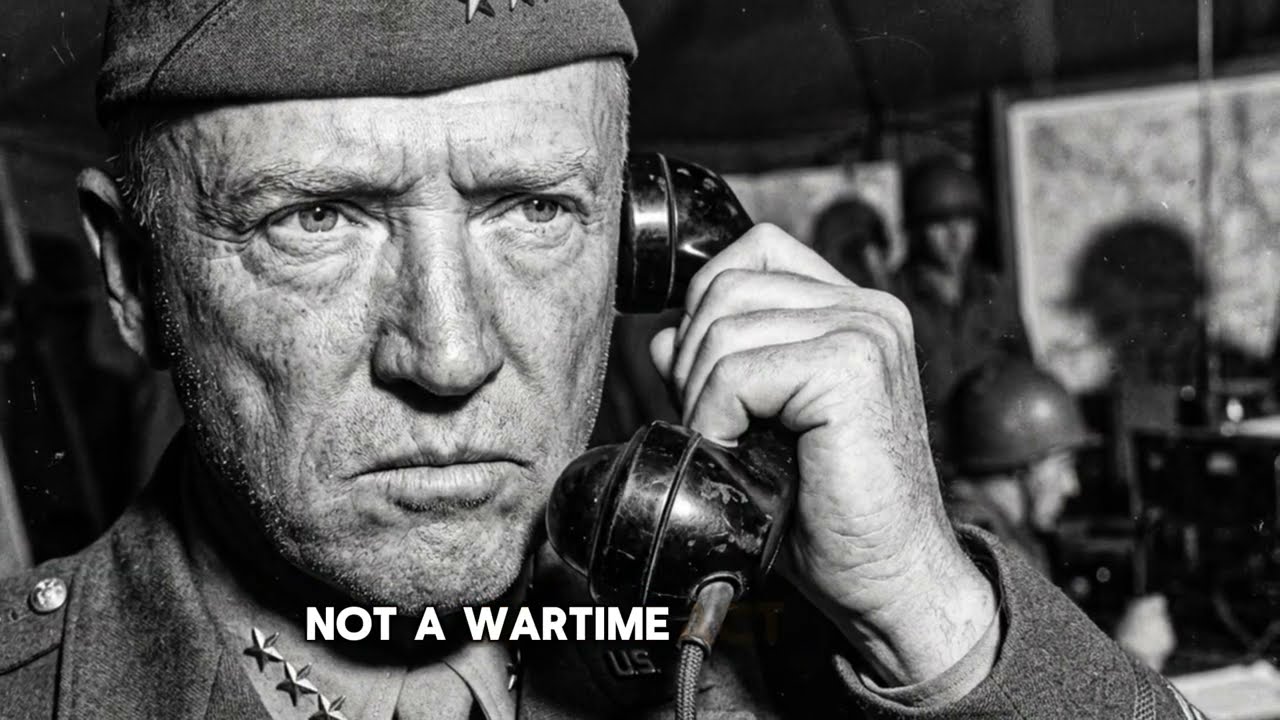 When Patton received Rogers’s full investigative report, he read it in his command office in Bad Tölz, Bavaria. His aide, who was present, later described the general’s reaction as quiet, not explosive, not theatrical — the kind of quiet that was more disturbing than shouting. Patton had seen men die in every possible way in war.
He had walked through Dachau six weeks earlier and vomited at what he saw. He was not the type to be easily moved by accounts of violence. But this time was different.
It was not about soldiers killing soldiers. It was not the industrial horror of the camps. It was a crowd of ordinary people — workers, housewives, city officials — beating unarmed prisoners of war to death in a city street in broad daylight in front of their neighbors, then burying the bodies and going back to their lives.
He picked up the telephone and called the military prosecutor’s office. He said: “I want these people tried. All of them.
Everyone Rogers can name in that scene. I want charges. I want a court, and I want it before Nuremberg.
I want the world to see that what happened in Rüsselsheim was a crime, not an act of war.” A crime. He paused for a moment.
Then he said something else: “Find me the man who pulled the trigger.” They had already caught him.
The trial was set for July 25, 1945, in Darmstadt. It would be the first civilian war crimes trial in occupied Germany. Before the International Court at Nuremberg, and before history drew the rules for what would happen later, the prosecution was led by a young lieutenant colonel from Texas named Leon Jaworski, who would spend 30 years building a reputation as one of America’s foremost lawyers before his name became known to the world in another courtroom, in another crisis, three decades later.
In July 1945, he was 39 years old, and he had to hold a group of Germans accountable for the killing of six American boys.
The trial began on July 25, 1945, in a courtroom in Darmstadt, a city that had been nearly destroyed by Allied bombing the previous year. Eleven defendants — Josef Hartgen, Johannes Seil, Philipp Gutlich, Friedrich Vogt, Johannes Ober, Margarete Wetzler, Katharina Reinhardt, and four others selected from witness statements in Rogers’s investigation — resulted from diligent and meticulous work in building a case from a crime the city had tried to erase.
The defense offered a predictable argument. Their clients were victims of war. Their city had been bombed into oblivion.
Their neighbors had died under the rubble. Goebbels’s propaganda had told them for years that Allied airmen were terrorists and criminals and killers of women and children. When they saw the American uniform on their street the morning after the worst bombing their city had ever suffered, they were overcome with grief and rage.
Was it reasonable to hold them responsible for what propaganda and grief and rage had driven them to do?
Leon Jaworski did not raise his voice when he answered that question. He was a precise and methodical man, the kind of lawyer who understood that quiet authority carries more weight than emotion in a courtroom. He stood before a panel of six colonels and one lieutenant colonel, who served as judge and jury.
He said: “They are all grown men and women. If they were asked to commit murder, which they did, they are just as responsible as any other murderer.”
He then laid out the evidence: witnesses who had watched from the edges of the crowd, forced laborers from the Opel plant who had seen everything, and the two survivors, Adams and Brown, who had spent months in a POW camp in silence and were now finally able to tell what had happened to their crewmates. The bodies in Waldorf, the military identification tags, the fractured skulls, the gunshot wounds that could only have come from a pistol fired at close range.
Jaworski then focused on Hartgen — not on the crowd, not on the anonymous rage of a bombed city, but on this specific man, the official, the holder of civil authority, the person whose job was to maintain order, protect civilians, and represent what remained of functioning governance in a besieged city. Josef Hartgen had not been swept up in mob hysteria. He had walked to where the Americans had fallen, and he had made a deliberate decision.
He had drawn his pistol and shot six men in the head. Jaworski told the panel: “This was not emotional impulse. This was an execution.”
The trial lasted six days. On August 2, 1945, the panel announced its verdicts: Josef Hartgen guilty. Johannes Seil guilty.
 Philipp Gutlich guilty. Friedrich Vogt guilty. Johannes Ober guilty.
Margarete Wetzler guilty. Katharina Reinhardt guilty. Seven of the eleven defendants were sentenced to death.
After the verdict, the sentences of two of the convicted women, Wetzler and Reinhardt, were commuted to 30 years of hard labor. Their husbands and relatives had pleaded for mercy, arguing that the only act of the two women had been screaming. The panel accepted that distinction — screaming is not shooting.
For Hartgen and the other four, there was no room for distinction.
On November 10, 1945, at Bruchsal prison, Josef Hartgen and four other participants in the Rüsselsheim massacre were hanged. That was three months before the first verdicts at Nuremberg. The Rüsselsheim trial established a principle that would echo through all subsequent war crimes trials: that individuals are responsible for their actions, even when those actions are committed in a crowd, even when they are incited by authorities, even when their city is burning and they are in deep grief.
There is no excuse. Everyone does it. There is no excuse, and we were told that.
Everyone who raised a hand against those eight Americans made a choice, and choices have consequences.
Patton never attended the trial. He had led hundreds of thousands of men over three years of war and was running a military office that consumed all his time. But he received Rogers’s final report in August 1945.
The convictions, the sentences, the details. His aide recorded that he read it without comment. Then he set it aside.
Then he said quietly: “Good.” One sentence. That was all.
Sergeant Sidney Brown, one of the two survivors, lived for decades after the war. He returned to Rüsselsheim in August 2001 when the city invited him to attend an official commemoration and apology ceremony. He was in his eighties then.
He walked the streets of the city that had tried to 𝓀𝒾𝓁𝓁 him 57 years earlier and accepted the apology of the mayor of a Germany that had spent half a century confronting its past. A journalist asked him whether he had ever understood what happened to his crewmates. Why would a crowd of ordinary people do what they did?
He thought about it for a long moment. “I understand how people get to that state,” he said. “Their homes were burning.
Their neighbors were dead. They were scared and angry. And then they saw us and made us the reason for all of it.”
Silence. But understanding how people get to that state does not make what they did anything other than what it was. He did not say murder.
He did not need to. The courtroom in Darmstadt in 1945 had said it for him.
On August 26, 2004, exactly 60 years after the killing of his crewmates, the city of Rüsselsheim unveiled a memorial at the site near the railway station where the airmen were beaten. A permanent stone engraved with their names. Norman Rogers, John Sekle, Hugh Tovengen, Thomas Williams, Elmore Austin — average age 23.
Boys from Kentucky and Pennsylvania and wherever else America sent its sons. Boys who jumped from a burning plane over Germany and expected, according to the rules that civilized nations had agreed upon, to be captured and to survive. They deserved that.
Every one of them. Patton made sure someone was held accountable for what was done to them.
The history of the Rüsselsheim massacre and the trial that followed remains one of the most important and least-known chapters of World War II. It was the first time a German civilian court — under American occupation authority — held ordinary citizens accountable for war crimes against Allied prisoners. It preceded Nuremberg.
It established the legal principle that “just following the crowd” is not a defense. And it sent a message that echoed across post-war Europe: that justice, however delayed, would find those who believed they had gotten away with murder.
The stone in Rüsselsheim still stands. The names are still legible. And the question the trial posed in 1945 — whether ordinary people in extraordinary circumstances can be held responsible for extraordinary crimes — remains as urgent today as it was in that Darmstadt courtroom nearly eighty years ago.