Alan Frederick Lascelles was born on April 11, 1887, in the small Dorset parish of Sutton Waldron. He was the only surviving son among six children and was known all his life as Tommy, a boyhood name that outlasted every title he was ever given.
His grandfather was the fourth Earl of Harewood, and through that blood he stood inside the outer ring of the royal world. He was near enough to be trusted with everything and far enough that he would always be a servant of it and never its master.
He was educated at Marlborough College and Trinity College, Oxford, where he read the classics and took a second-class degree in 1908. Those who knew him young remarked on the same things people would remark on fifty years later: a coolness of manner, a wit that could cut, and a moral seriousness that never entirely relaxed.
He was not a man built for warmth. He was built for judgment.
The First World War took his generation and remade the survivors. Lascelles went to France with the Bedfordshire Yeomanry and came back a captain with the Military Cross and a changed man underneath. He had watched friends die and watched waste on a scale that no sermon about duty could ever match.
It left in him a permanent impatience with anyone who treated life, position, or privilege as a thing to be idled away. He had learned exactly what it looked like when the gifted threw themselves away for nothing, and the lesson would shape the harshest judgment of his life.
In 1920 he married Joan Thesiger, daughter of Lord Chelmsford, then viceroy of India. The marriage tied him tighter still to the governing class of the empire. He and Joan would raise three children, a son and two daughters.
In the first years of peace he tried a little journalism and a little stockbroking. Neither took, and he lost money in the trying. He was a serious man in search of a serious task, and the ordinary careers of his class felt small to a mind that had already decided it was made for something at the center of things.
The thing he was waiting for turned out to be the strangest calling in the kingdom. It would use every quality he had: the coolness, the discretion, the exact pen, the early and unforgiving judgment.
Those who worked with him described the same man again and again. He was formidably intelligent and formidably reserved, a master of the written word, a keeper of confidences whose discretion seemed absolute. He inspired respect far more readily than affection, a difference he did not much mind.
There was one contradiction at the very center of the man. His entire creed was discretion. A courtier of his kind was meant to see all and say nothing, to carry the secrets of kings to his grave, to be in the deepest sense forgotten.
And yet Lascelles could not stop writing things down. Night after night, in a hand of exceptional clarity, he recorded what he saw: the conversations, the judgments, the contempt, and sometimes the fear. He kept the secrets faithfully while he lived. He also kept a record of every one of them.
That quiet habit, more than any post he ever held, would decide in the end how history remembered him. It would take his own death to set it loose.
The office Lascelles entered was the strangest and most invisible in the kingdom. The private secretary to a member of the royal family is not a typist and not a butler. He is the hinge on which the monarchy turns.
He decides who reaches the royal person and who is kept away. He drafts the words the royal person speaks in public and many of the words spoken in private. He negotiates with the government of the day, manages the newspapers, soothes the church, and absorbs in silence every private disaster the family produces.
It is a role with almost no formal power and almost unlimited real power. The private secretary is not elected and answers to no minister and no parliament. He holds his position entirely at the pleasure of the sovereign, and yet a strong one shapes the monarchy more than any single king or queen he serves.
One rule governed the whole of Lascelles's career. He served the crown, not the man who wore it. He did not love kings. He loved the institution, the ancient idea of the monarchy as the steady center around which a country could turn.
He judged every king and queen he served by one measure only: whether they strengthened that idea or weakened it. A monarch who understood duty had his complete loyalty. A monarch who treated the throne as a personal possession earned something colder than disapproval. It earned his opposition.
In 1920 he entered the household of the most adored young man in the world. Edward, Prince of Wales, was then in his middle twenties, and there had perhaps never been a royal figure quite like him.
He was slight, fair, and restless, with a boyish charm that seemed to reach out through the newspaper page and the newsreel screen. He had toured the empire and been mobbed by crowds wherever he went. He was the modern prince who danced and flew and wore his clothes with a careless flair.
Lascelles came into his service as assistant private secretary, and at first he shared the general enthusiasm without reserve. He once described the prince in those early days as the most attractive man he had ever met, and he meant it.
The household ran out of York House, a wing of St. James's Palace. The correspondence alone was staggering: many thousands of letters from strangers who felt they knew him. There were tours to plan months in advance, speeches to write and rewrite, engagements to arrange and cancel and arrange again.
For a serious man, it was intoxicating work. Lascelles believed he was helping to shape a great king. He believed the gifts were real and the flaws were the ordinary flaws of a young man not yet grown into his role.
But a private secretary sees his master as no one else does. He sees him early in the morning and late at night, tired, bored, drunk, in love, and afraid. He sees the gap between the man the crowds adore and the man who exists when the crowds go home.
Slowly across the early years of the 1920s, Lascelles began to see things in that gap that troubled him. Small things at first, easy to explain away. A duty skipped, a kindness that turned out to be shallow, a restlessness that no achievement seemed to settle.
By the middle of the decade, what he saw had stopped being small. The charm remained, dazzling as ever in public. But behind it lay a restlessness that curdled easily into petulance, a boredom with duty that no amount of coaching seemed to cure.
The prince would work when it amused him and vanish when it did not. He was capable of great warmth toward a person one week and a cold indifference the next, and he seemed genuinely not to understand why anyone should mind.
The drinking troubled Lascelles, and the gambling, and the late nights. But those were the vices of many young men of the age. What could not be forgiven in the private secretary's hardening view was the attitude beneath them.
The prince did not seem to feel the weight of what he would one day carry. He treated the throne that was coming to him as an inconvenience rather than a trust. To a man like Lascelles, who had watched friends die in France for far less than a crown, that carelessness was close to blasphemy.
Then there were the women. The prince moved through a series of affairs, and the one that mattered most in these years was with Freda Dudley Ward, a married woman who was his most enduring attachment of the time.
Lascelles was no prude about the private lives of great men. The scandal to him was the way the prince let a woman govern his moods and his movements, cancelling duties, sulking, arranging his whole life around a private passion while the public work of the monarchy waited.
It was a pattern, and Lascelles saw it clearly a full ten years before the world would learn its final and most famous name. The prince kept a fast and glittering set around him, the bright young people of the 1920s, and he preferred their company to almost any duty.
To the crowds, none of this was visible. They saw the smile, the ease, the apparent warmth. What they did not see was the man in the car afterward, flat and bored and complaining. The light switched off the instant it was no longer needed.
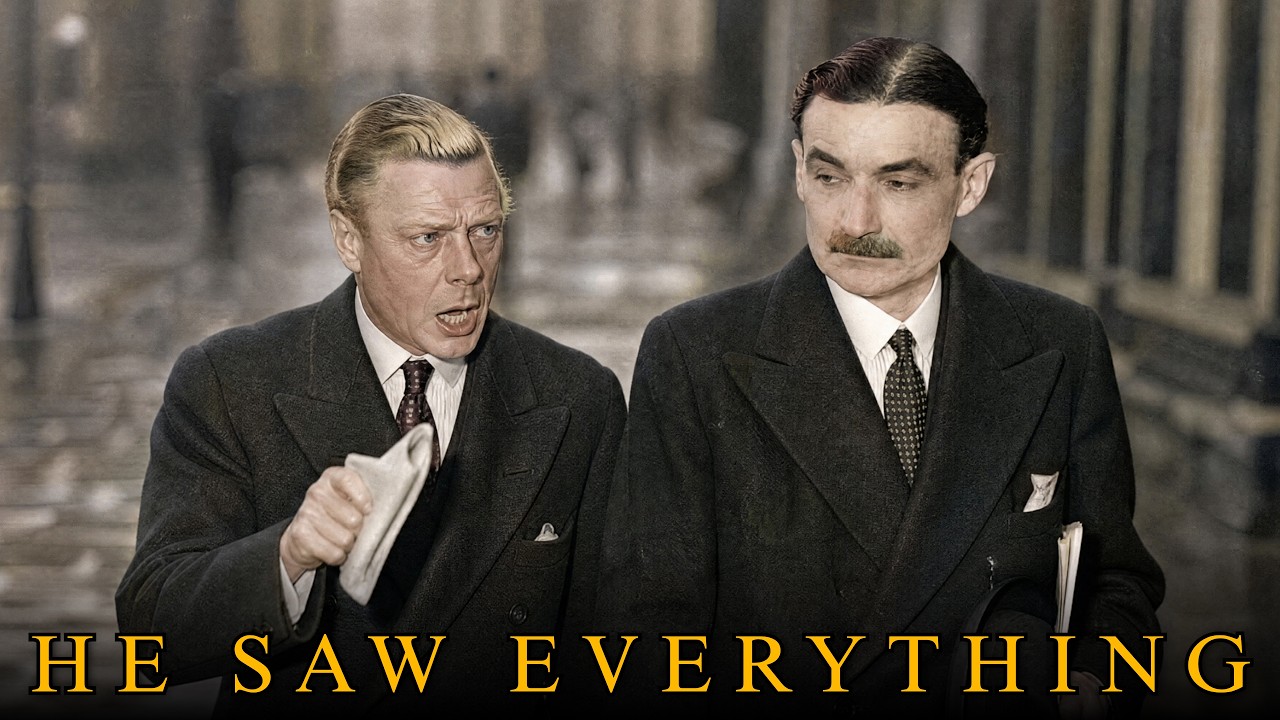
Lascelles saw that man every day, and the gap between the two unsettled him more than any single vice could have. A man who feels nothing but performs feeling perfectly is a hard man to trust.
The prince's own father, King George V, had reached a similar verdict from the throne itself. The old king, stern and baffled by his glittering son, is said to have delivered a prophecy of his own about the boy. After I am dead, he reportedly said, the boy will ruin himself within twelve months.
Two men who loved the crown, the king and the courtier, had looked at the heir and seen the same disaster coming. And the neglect was not abstract. There were the tours performed with visible boredom, the engagements endured rather than embraced, the boxes of official papers that a diligent heir was meant to read and that this one left unopened for days.
King George V was no genius and no charmer, but he understood duty in his bones. He rose early, read his papers, did his work, and held to a routine of obligations so rigid that it wearied his children and steadied his kingdom. The son who would inherit that office seemed to believe the exact reverse.
There was a larger fear underneath the personal one, and it reached to the survival of the monarchy itself. Thrones across Europe had fallen within Lascelles's own lifetime. Emperors and kaisers and tsars were swept away in a few short years. The British crown had survived not by force but by usefulness.
A monarchy that earned its place could endure. A monarchy that grew careless and selfish and remote could vanish as quickly as the others had. And the man about to inherit the British throne was careless and selfish by nature.
By the middle of the 1920s, Lascelles had begun to see the prince not as a gifted young man who needed guidance but as a fixed and finished character, and the character frightened him. What he saw was an absence.
The prince had every gift a man could be given except the one that mattered for the job in front of him: a sense of duty deep enough to master his own wants. He was clever without being wise, charming without being kind in any lasting way, brave in small physical things and a coward in the large moral ones.
In a rare moment of honesty, the prince once admitted that he was, in his own words, quite the wrong sort of person to be Prince of Wales. Lascelles thought the admission exactly correct, and more damning for being made so lightly.
In 1927, on a train crossing Canada, Lascelles finally said the unsayable to the prime minister of Britain. The Prince of Wales was touring the Dominion, and traveling with the royal party was Stanley Baldwin, the prime minister himself.
The two men fell into the kind of frank talk that a long journey and a shared burden sometimes allow. They were both charged in their different ways with the care of the same young man and the same throne.
Lascelles said that sometimes, when he was waiting to hear the result of some country race in which the prince was riding, one of the point-to-point races the prince loved and rode recklessly, he could not help a terrible thought. The best thing that could happen to him and to the country, Lascelles said of the heir to the throne, would be for him to break his neck.
Baldwin did not recoil. He did not reproach the courtier for disloyalty. Instead, he agreed. God forgive me, the prime minister replied, I have said the same thing often.
There it was, spoken aloud between two of the most responsible men in the empire: the quiet shared wish that the future king might die before he could reign. Two sober men had reached the same verdict separately and now discovered they held it in common.
The image Lascelles reached for was drawn from life. The prince loved to ride in point-to-point races, the rough cross-country steeplechases of the English countryside, and he rode them hard and dangerously. For the men around him, each race was an ordeal of waiting, because a bad fall at speed could kill the heir to the throne in an afternoon.
A broken neck on a country course would remove an unfit heir without scandal, without abdication, without the long, slow damage Lascelles feared was otherwise coming. That was the arithmetic behind the wish, and it was as cold as it sounds.
A year later, in 1928, Lascelles was in East Africa when a telegram arrived that should have sent the heir to the throne racing home. The Prince of Wales was on a long tour and safari through Kenya and Uganda, hunting and enjoying himself far from the duties of London.
Then the news came from home. King George V, the prince's father, had fallen gravely ill. The old king might be dying. The heir might be needed at once to be at his father's side, and if the worst came, to take the throne.
For any son, and above all for the son who stood next in line to a crown, there was only one possible response. Cut the tour short, go home, be there. Lascelles brought him the news and waited for the heir to do the obvious and necessary thing.
The prince did not do it. In Lascelles's account, the young man reacted to the news of his father's possible death with an indifference that the secretary found almost impossible to believe. He did not want to cut short his pleasures. He treated the telegram as an interruption rather than a summons.
The plain duty had to be urged on him. A son should not need to be told to go to his dying father. A future king should not need reminding that the throne might be about to pass to him. Yet the men around the prince found themselves pressing him toward the obvious, managing his reluctance, coaxing him toward the thing that any ordinary decency should have made automatic.
The old king did not die that time. He recovered and would reign for another seven years, and the crisis passed. But something in Lascelles did not recover.
In 1929, he asked to see the prince alone and told him exactly what he thought of him. It was an extraordinary thing for a courtier to do, a breach of every rule of deference his office was built on.
He had decided to resign, and having decided, he saw no reason to leave in polite silence. He told the prince in his own later words exactly what he thought of him and his whole scheme of life. He laid out the neglect, the selfishness, the waste of the great gifts the man had been given.
And then he said the thing that would echo across the next decade with a terrible accuracy. He told the prince to his face that he was going the way that would cost him the throne of England.
The most chilling part of the scene was the prince's response. He did not rage. He did not dismiss the impertinent secretary or defend himself with anger. He took the whole devastating verdict with a mild and almost cheerful good humor, as though it were a matter of small importance.
To Lascelles, that reaction was more damning than fury would have been. Anger would have meant the words had reached him. The mildness meant that nothing reached him, that the criticism simply slid off a surface too smooth and too shallow to hold it.
He had told a future king he would lose everything, and the future king had shrugged. Lascelles walked out of that room and out of the household, giving up the surest path to the top of his profession because he could no longer stomach the man at the end of it.
He would later describe those years with the prince as the wasting of the best years of his life. He meant it as the bitter summary of a decade poured into someone who deserved none of it.
For two years he was a man without a court. He drifted through a little journalism and a seat on a bank board, a man who had walked away from history and now watched it move on without him.
Then Canada gave him back to the crown. In 1931 he was appointed secretary to the governor general of Canada, the Earl of Bessborough, and he sailed across the Atlantic to Ottawa to take up the post. He served in Canada from 1931 to 1935 and did it well and was honored for it.
The Canadian years proved that his walking out had not after all destroyed him. The wider service of the crown was too large and too much in need of able men to discard one of its best over a quarrel with the heir. In Ottawa he was the right hand of the king's representative in a vast dominion, doing serious work at a serious level.
Late in 1935, Lascelles was called home. He was brought back to Buckingham Palace as assistant private secretary to King George V himself, arriving for the final months of the old king's life. The exile was over.

George V, worn out by his reign and his worry, died in January 1936. With his death, the thing Lascelles had dreaded and foreseen for the better part of ten years came to pass. The Prince of Wales, the man Lascelles had wished dead on a Canada train, the man he had told to his face that he would lose his throne, became King Edward VIII.
Lascelles now found himself serving inside the household of the very king he had condemned. By his own later account, he barely saw the new king in this period, kept at a distance from a monarch already absorbed in the private obsession that would undo him.
Edward VIII held the old courtiers at arm's length, distrusting their formality and their caution, and surrounded himself instead with a smaller, more congenial circle. Chief among them was the woman the establishment was already learning to dread.
Her name was Wallis Simpson, and within months of the accession she would turn Lascelles's decade of quiet dread into the greatest constitutional crisis Britain had seen in centuries.
King Edward VIII had inherited the crown in January 1936. By the autumn, it was clear to everyone inside the palace that he meant to marry Wallis Simpson, an American woman with two living former husbands. For a king who was also the head of the Church of England, a church that did not then permit the remarriage of divorced people while a former spouse lived, it was impossible.
He could have the throne or he could have her. He could not have both. And the king, faced with the choice, chose the woman.
Lascelles watched it unfold from close range, and his private judgment of Wallis Simpson was as cold and cutting as anything he ever wrote. He described her in a phrase that has outlived almost everything else about the crisis, as a shop-soiled American with two living husbands and a voice like a rusty saw.
What made the crisis so grave was the completeness of the king's attachment. This was no ordinary royal affair, the kind the establishment knew how to manage with discretion and a blind eye. The king was enthralled to her, dependent on her, unwilling to imagine a life or a reign without her at its center.
For months, while the king's relationship with Wallis Simpson filled the newspapers of America and Europe, the British press said almost nothing at all. By a kind of gentleman's agreement, the newspaper owners of Britain held their silence, and the British public remained largely ignorant of the drama unfolding at the top of their own monarchy.
Through all of it, Lascelles was one of the men in the engine room. As assistant private secretary, he was inside the machinery of the crisis, part of the small group handling the correspondence, the briefings, and the delicate traffic between the palace and the government as the establishment searched for a way out that did not exist.
The crisis moved fast once it broke into the open. The government told the king plainly that the marriage and the throne could not go together. And Edward VIII, rather than give up Wallis Simpson, gave up the crown.
On the 11th of December 1936, after a reign of less than a year, he abdicated the throne of the United Kingdom to marry the woman he loved. Lascelles had been proved right utterly and publicly in the most dramatic way a prophecy can be fulfilled.
And yet the secretary felt no triumph. What he felt by his own account was closer to grief, a deep and genuine sorrow for the institution he loved. On the night the abdication was settled, he did not celebrate his own accuracy. He walked alone round and round St. James's Park in the dark, thinking of King James II, the last British king to lose his throne.
He called the whole episode, in the plainest words, a real tragedy in his life. He described Edward as being like a child in the fairy stories who had been given every gift except a soul. He said with a bitterness that thirty years would not soften that the man had never cared about England or the English.
In his long exile as the Duke of Windsor, Edward referred to Lascelles with a single venomous word. That snake, he called him. It was a revealing insult, because it conceded the very thing the Duke could never forgive: that the cold secretary had seen through the golden prince from the beginning.
The brother who took the throne was everything the elder had refused to be. Where Edward had been dazzling and hollow, the new king, George VI, was shy and solid. He was the second son, never meant to reign, a man who had spent his life in his brilliant brother's shadow and who carried a stammer that made public speaking an ordeal.
He had not wanted the throne. It had been thrust upon him by the abdication, and he took it up not with eagerness but with a grim sense of obligation, which was precisely the quality his elder brother had lacked. In that quality, Lascelles found at last a king he could serve with his whole heart.
Lascelles gave him sixteen years of unbroken loyalty, and the loyalty was deepened, not lessened, by the memory of what had come before. He had seen the throne treated as a plaything. Now he watched it treated as a burden borne with courage, and it moved him as the golden prince never had.
He was knighted for his service in 1939, on the very edge of the war that would test them all. As the king's assistant private secretary, and from 1943 as his private secretary, he sat at one of the best-informed desks in Britain.
He saw the most secret papers of the state: cabinet decisions, military plans, the flow of intelligence that governed the war. By his own record, he knew of the existence of the atomic bomb months before it was dropped on Hiroshima, one of a tiny handful of people in the country entrusted with the deepest secret of the age.
His power in these years lay in his position at the meeting point of two strong forces, the crown and the government. That prime minister for most of the war was Winston Churchill, a man of enormous will and impulse, and the relationship between him and the king needed careful, constant tending. Lascelles was the man who tended it.
Buckingham Palace itself was struck by German bombs while the king and queen were in residence, a fact the monarchy turned into a symbol of shared endurance. Lascelles helped shape the image of a royal family that stayed and suffered alongside its people.
The war exacted a terrible price from the king, and Lascelles watched it drain him year by year. George VI drove himself through the conflict with a stubborn, self-sacrificing diligence, and it wore him down. The strain aged him and weakened him and shortened his life.
In 1943, the office of private secretary to the king, the highest post a courtier can hold, was occupied by another man, Sir Alec Hardinge. Hardinge had grown unpopular with ministers and by several accounts with the king himself. Lascelles, who believed with his usual cold confidence that he could do the job better, was instrumental in the maneuver that eased his predecessor out and put himself in.
It is the clearest evidence that the man of conscience was also a formidable operator. He became private secretary to the sovereign and keeper of the royal archives, and he held that summit of courtly power for the next ten years.
In 1950, he wrote a letter to a national newspaper, and he signed it not with his own name but with a single Latin pen name, Senex. In that letter, he set out the exact conditions under which a constitutional monarch might properly refuse a request from a prime minister to dissolve parliament and call an election.
Those conditions became known as the Lascelles Principles, and they are still cited today in Britain and across the Commonwealth whenever the question arises of when a monarch may say no to a prime minister. A private secretary, holding no office recognized by any law, writing anonymously to a newspaper, quietly set down part of the working rule book of the monarchy, and it held.
When King George VI died in February 1952, the old servant carried his loyalty to a girl of twenty-five. His elder daughter Elizabeth learned in a single moment that her father was gone and that she was queen.
Lascelles became private secretary to the new queen, Elizabeth II, and he set about steering her through the overwhelming first months of her reign. He was by now the grand old man of the palace, a figure of immense authority and experience, a living link to her father and her grandfather.
He guided her through the accession councils, the mourning for her father, and the assumption of duties she had barely begun to imagine she would carry so soon. Under his steady hand the monarchy passed from one reign to the next as smoothly as it had passed through every crisis he had seen.
Beneath the smooth performance of duty, the death of George VI was a genuine grief to Lascelles, perhaps the deepest of his professional life. He had served the shy, brave king for sixteen years, had guided him through the war and watched him give his health to the crown, and had come to love him.
The coronation was set for June 1953, and it was to be a great national ceremony, ancient and sacred, carried to the widest public a coronation had ever reached. Lascelles, in what he already knew would be his final year of service, stood at the center of the arrangements.
But the new reign carried within it from almost its first days the seeds of one more crisis. The young queen had a younger sister, Princess Margaret, spirited and beautiful and twenty-two years old, and Princess Margaret had fallen in love.

The man she loved was a decorated wartime pilot, a member of the royal household, handsome and admired and entirely unsuitable because he was divorced. His name was Group Captain Peter Townsend.
On the day of the coronation in June 1953, at the very summit of the monarchy's public glory, Princess Margaret was seen to reach up and pick a piece of lint from the tunic of Group Captain Townsend. The watching press caught it at once and understood it at once.
Peter Townsend was a genuine hero, a fighter pilot who had flown in the Battle of Britain, a man of charm and courage who had come into the royal household as an equerry, first to King George VI and then to the young queen. There was nothing shabby about him, but he had been married and he had divorced his first wife the year before.
That single fact made him, in the eyes of the Church of England, an impossible husband for the sister of its supreme governor. The church did not then allow the remarriage of a divorced person while the former spouse still lived, and the sovereign under an old law held a veto over the marriages of the royal family.
To Lascelles, the matter was a constitutional problem and nothing softer, and he approached it exactly as he had approached every other threat to the institution across thirty years, coldly and by the book. The obstacles were real, and he knew them precisely.
There was the Royal Marriages Act of 1772, which required the sovereign's consent for the marriage of a member of the royal family under the age of twenty-five, and Margaret was twenty-two. There was the church's bar on remarriage, and there was the weight of the dominions, the many nations of which Elizabeth was now queen.
When Townsend spoke to him of the relationship, Lascelles delivered the line that has followed his name ever since. You must be either mad or bad, he told the war hero, mad or bad to imagine that such a marriage could be allowed.
He advised that Townsend be removed from the scene, and removed he was. The group captain was posted abroad, sent as air attaché to the British embassy in Brussels, and his departure was arranged for the end of June 1953, brought forward so that he would be gone from the country before the princess returned from a tour.
For Lascelles, there was a terrible symmetry in the situation. Sixteen years earlier, he had watched a member of this same family put private love above the demands of the crown, and the results had been the gravest crisis the monarchy had faced in centuries. He would not let the family repeat its greatest mistake.
The separation did its slow and grinding work. For two years, the lovers were kept apart by distance and duty, and the immense pressure of the institution raged against them, and in the end it broke them.
In October 1955, Princess Margaret gave up the man she loved. She announced in a public statement of great and painful dignity that she would not marry Peter Townsend, mindful of the church's teaching and of her duty to the Commonwealth. She chose the crown over the man.
Lascelles had in fact retired from his post before the affair reached its unhappy end in 1955. He was the machinery, not the malice. And yet the machinery was merciless and the human cost was real, and a young woman's life was bent permanently around a decision that men like Lascelles made on the institution's behalf.
The cost fell almost entirely on the princess, and it was a heavy one. The bright spirited girl of the coronation became in the years that followed a more troubled and restless figure. Her later unhappiness traced by many back to this first great denial.
In the years that followed, when the old courtier and the wounded princess found themselves living within sight of one another, she is reported to have looked at him and said, There goes the man who ruined my life, and to have refused to speak to him ever again.
Lascelles left his post on the last day of 1953 at the age of sixty-six, after more than thirty years at the center of the monarchy. He went not in disgrace but in glory, loaded with the marks of royal favor.
On his retirement, he was made a Knight Grand Cross of the Order of the Bath, one of the highest honors the sovereign can bestow. Winston Churchill, who valued him, offered him a hereditary peerage, a seat in the House of Lords, and a title to pass to his heirs. Lascelles turned it down. He turned it down twice.
He held with the serene certainty that marked everything he did that the honor he already had rated higher than a peerage, and he preferred to remain plain Sir Alan Lascelles than to become a lord. It was the judgment of a man who measured rank by his own private scale and cared nothing for what impressed other people.
In his retirement, the crown gave him a grace-and-favor residence inside one of the royal palaces. His was at Kensington Palace in the old stable block, and there he lived out the rest of his long life, a servant of the crown, ending his days within the crown's own walls.
There was a bitter irony folded into the address, because Kensington Palace was also home to members of the royal family, and among them for a time was Princess Margaret herself. The man who had helped to end her great romance and the woman whose romance he had helped to end lived out their later years within the same palace grounds, in a silence that was never broken.
He filled the years with the work of a distinguished elder. He chaired public bodies, sat on boards, gave his judgment where it was wanted and withheld it where it was not. He had been born in the reign of Queen Victoria in the 1880s, and he lived on through reign after reign into the second half of the twentieth century.
He died at Kensington Palace in August 1981, at the great age of ninety-four, and he took to his grave, or so the world assumed, the vast hoard of royal secrets he had guarded for a lifetime. That was the assumption, and it was wrong.
After Lascelles died, his friend, the writer Duff Cooper, took up the vast private record he had left behind, the diaries and the letters of a lifetime, and began to edit them for publication. They came out across two decades, three volumes in all.
The first, covering his early life, appeared in 1986. The second, covering his years with the Prince of Wales and the abdication, appeared in 1989. And the third and most explosive, covering the abdication and the war and the reigns of George VI and the young Elizabeth, appeared in 2006, a quarter of a century after its author had gone to his grave.
What those volumes contained was the thing Lascelles had guarded all his life: the truth behind the palace walls, set down in his own unsparing hand. The wish on the Canada train was in there. The confession to Baldwin about the broken neck, printed at last for anyone to read.
The verdicts on Edward were in there. The child given every gift except a soul. The man who never cared about England. The contempt for Wallis Simpson was in there, and the grief of the abdication, and the cold machinery of a courtier's judgment across thirty years of the monarchy's most private history.
The man whose entire creed had been discretion became through his own pen one of the great witnesses against the masters he had served. It was the final and sharpest irony of a life built on ironies. The keeper of secrets had kept the greatest secret of all, that he was keeping a record.
In 2016, a television drama about the modern monarchy brought Tommy Lascelles back to life for an audience of many millions who had never heard of a private secretary. Played with flint-faced precision by the actor Pip Torrens, the cold and correct Lascelles became to a new generation the very image of the establishment.
The performance made him famous a second time, and it fixed him in the popular mind as a kind of villain, the hard hand of a heartless institution. Lascelles had spent his entire life in the shadows. The man who built a career on being unseen became in the end one of the most recognizable courtiers in history.
Was he the monster who broke a princess and despised a king? Or the clear-sighted servant who saw the disaster coming nine years before the rest of the country and gave his life to holding the throne together through it?
The confession on the Canada train is the key to the whole question, because a man who wishes the heir to the throne dead is either a traitor to the crown or its most desperate defender. And Lascelles was no traitor. He was a believer, loyal to the institution above any single person who wore it.
He was right about Edward. The diaries prove it, and the abdication proved it before them. The reckless prince did exactly what the watchful secretary said he would do and lost the throne of England for the sake of himself.
Whether he was right about Margaret is a harder question, and it is the one this story leaves open, because the same certainty that saw the truth about a bad king also reached into the life of a young woman who had done nothing wrong and bent it out of shape in the name of the institution.
He kept the throne steady. He also kept the receipts. And in the end, on a train crossing Canada in 1927, a devoted servant of the crown had looked at the man who would be king, wished him gone for the good of them all, and then spent the rest of his life and the whole of his silent pen proving how right and how terrible that wish had been.