Allied troops advancing through the liberated towns of Normandy and beyond in the summer of 1944 expected to find jubilation, gratitude, and the first fragile signs of normal life returning to a continent scarred by four years of Nazi occupation. Instead, in village squares and city streets across France, they encountered a spectacle that would haunt even the most battle-hardened veterans: thousands of women, their heads freshly shaved, swastikas painted on their foreheads in lipstick and tar, paraded before jeering crowds in scenes that witnesses would later describe as nothing short of barbaric.
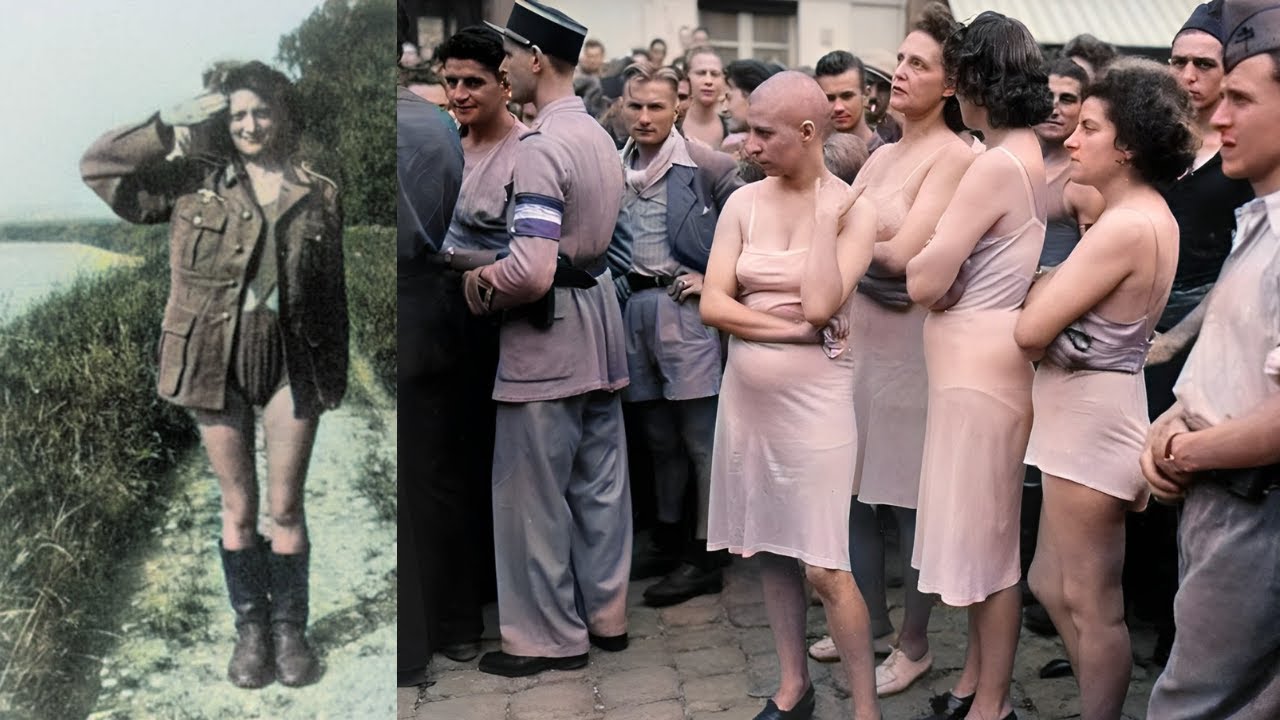
The punishment, carried out by French resistance fighters and ordinary citizens alike, targeted women accused of “horizontal collaboration” — the term coined for French women who had sexual or romantic relationships with German soldiers during the occupation. What began as an act of retribution quickly spiraled into a wave of public torture, humiliation, and in some cases, murder that unfolded in full view of the Allied forces who had come to liberate the country.
Historians estimate that at least twenty thousand women had their heads publicly shaved in the weeks and months following the D-Day invasions. The true figure is believed to be significantly higher, as countless incidents went unrecorded in the chaos of liberation. These events, which became known as the “ugly carnivals,” saw women dragged from their homes, stripped half-naked, beaten bloody, and forced to run gauntlets through crowds that spat on them, kicked them, and hurled stones and refuse.
The scenes were so 𝓈𝒽𝓸𝒸𝓀𝒾𝓃𝑔 that they drew immediate commentary from senior Allied officials. Jock Colville, private secretary to British Prime Minister Winston Churchill, witnessed one such spectacle and recorded his revulsion. “I watched an open lorry drive past to the accompaniment of boos and catcalls from the French people with a dozen miserable women in the back, every hairy and their head had been shaved off,” he wrote.
“They were in tears, hanging their heads in shame. Whilst disgusted by this cruelty, I reflected that we British had not known invasion or occupation for some 900 years, so we were not the best judges.”
The punishment itself was not new. Shaving a woman’s head as a mark of shame for adultery dates back to the Dark Ages, and the Nazis themselves had issued orders that German women accused of sleeping with non-Aryans or foreign prisoners should be publicly punished in the same manner. But the scale and ferocity of the post-liberation purges in France shocked observers precisely because they were carried out in the name of freedom, by the very resistance movements that had been celebrated as heroes only days earlier.

In town after town, crowds gathered to watch as resistance fighters cut off the flowing locks of accused women. The hair was often burned in huge piles, the acrid smell carrying for miles. Women were then forced to walk the streets while crowds kicked and beat them, sometimes severely enough to cause death.
Some were covered in tar. Others had swastikas drawn on their bodies in lipstick or paint. Many were stripped to the waist, their humiliation complete as they stumbled through streets lined with people who had once been their neighbors.
One photographer who captured these events described the surreal and terrifying atmosphere that surrounded them. “I saw four girls who had been led through the streets and I rushed towards them to take a photograph,” he wrote. “At once I found myself at the front of the procession and the local people thought I was the female soldier who had captured them or something like that, and I was kissed and congratulated at the same time as slaps and spit rained down on the unfortunate girls.”
The women in the hands of their tormentors, according to contemporary accounts, had “the look of a hunted animal.” Some were paraded on lorries through towns and cities to maximize public exposure. Others were forced to run the gauntlet while being beaten by anyone who wished to participate.
The violence was not merely symbolic. Women were kicked to death in Paris. Others died from injuries sustained during the beatings.
Prostitutes who had accepted German clients were among those killed. Even members of the aristocracy were not spared, with some shaved for being in “cahoots” with German officers.
 The motivations behind the collaboration were as varied as the women themselves. Some fell in love. Some married their German boyfriends and followed them across dangerous lands, even into prison camps.
Some took advantage of lonely soldiers for material benefit — better food, trips, more lenient treatment by German officers, and lives that were considerably more comfortable than those of their starving compatriots. Approximately two hundred thousand babies were born to German fathers and French mothers during the occupation, a figure that rose to twelve thousand in Norway and nine hundred on the Channel Islands, where the pattern of occupation and collaboration repeated itself across every territory the German army touched.
But many of the women punished were not guilty at all. Some were wrongly accused by rivals or enemies who saw an opportunity to settle personal scores by informing the resistance. Female schoolteachers living alone who had been forced to billet German soldiers in their homes were punished despite having no choice in the arrangement.
Women who had done nothing more than accept food from a German soldier to feed their starving children found themselves stripped and beaten in public squares.
The liberation of France had unleashed a wave of moral outrage that treated these women’s conduct as the greatest shame imaginable, tantamount to treason. Yet the punishment fell almost exclusively on women. While a few men were shaved for working in German factories, it was always women who were deemed the first scapegoats.
The gendered nature of the retribution was unmistakable. Women who had slept with the enemy were seen as having betrayed the nation’s honor in a way that men who had merely worked for the Germans had not.
There was also a darker, more violent dimension to the purges. Many women were executed and shot dead by French forces if they were found with German weapons in their possession, even before they had a chance to explain. There was a possibility that some of these weapons were being gathered for the resistance, but soldiers still shot women and men dead for the offense.
One report from an American lieutenant of the First Infantry Division claimed he had encountered four women in German uniforms with snipers in trees and five more inside a town, a claim that fueled fears of female collaboration at the highest levels of the military.

The scenes played out across the entire country, from the smallest villages to the grand boulevards of Paris. In some areas, the conduct between French women and German soldiers had been professional rather than romantic. But the distinction mattered little to the crowds who had suffered under occupation and now sought someone to blame.
The ugly carnivals became one of the most 𝓈𝒽𝓸𝒸𝓀𝒾𝓃𝑔 chapters of the Second World War, a moment when the victims of Nazi aggression turned on the most vulnerable among their own people.
Allied soldiers who had fought their way across Europe to liberate France were left deeply disturbed by what they witnessed. Many were sympathetic to the suffering the French had endured under German occupation, but the torture of women in public squares was something they could not reconcile with the ideals of liberation. The images of French women without hair, swastikas branded on their skin, tears streaming down their faces as crowds celebrated their degradation, remain among the most haunting photographs of the twentieth century.
The legacy of these events continues to provoke debate among historians and the public alike. Some argue that the punishment was a necessary, if ugly, expression of a community reclaiming its honor after years of humiliation. Others see it as a misogynistic campaign of violence that targeted women for crimes that were often born of desperation, survival, or love, while the men who had actively collaborated with the Nazi regime escaped similar treatment.
What is undeniable is that at least twenty thousand women — and likely many more — were subjected to brutal public torture in the name of justice, their screams echoing through the streets of a nation that had just been freed.
The ugly carnivals remain a stark reminder that liberation is not always clean, that the end of occupation does not automatically bring healing, and that in the aftermath of war, the line between justice and vengeance can blur beyond recognition. For the women who survived the ordeal, the scars — both physical and psychological — would last a lifetime. For the women who did not, their deaths stand as a grim testament to the price of survival in a world turned upside down by conflict.