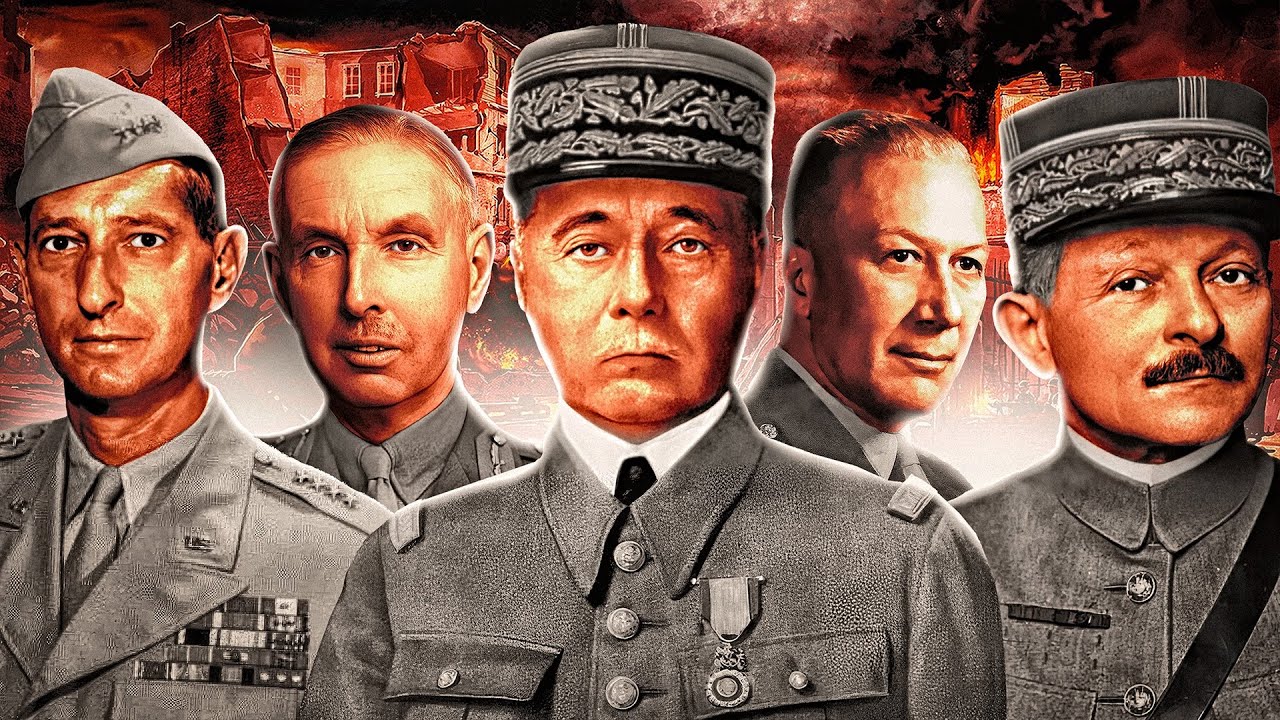
World War II produced commanders whose names are remembered for brilliance under pressure. It also produced generals whose decisions led to defeat, endangered their own troops, ignored new technology, or collapsed when tested. The following five Allied generals stand out for the wrong reasons.
Arthur Percival commanded British and Imperial troops during the British Empire's most humiliating defeat: the battles of Malaya and Singapore. His appearance in a tropical officer's uniform, captured in photographs as he surrendered Singapore to the Japanese, only reinforced the impression that he looked inept.
Percival's army in Malaya outnumbered the Japanese by two to one. Most military experts believe attackers need at least a three-to-one advantage over defensive positions, and even more when assaulting a city like Singapore. The Japanese were led by the audacious General Tomoyuki Yamashita, who drove his men and himself hard.
Percival made mistakes from the start. He underestimated the Japanese and refused to prepare strong defensive fortifications. He believed his men, already suffering low morale from the war situation elsewhere in Asia and Europe, would be further demoralized by being ordered to dig in rather than attack.
Percival also placed his men too far apart, preventing them from coming to each other's aid and allowing the Japanese to penetrate British lines and continue their drive south. Much of the time, Percival and his staff did not know where the bulk of the Japanese Army was, and they overestimated the number of men fighting against them.
As the Japanese drove down the Malay Peninsula, they outmaneuvered the British repeatedly and pushed them back to the island city of Singapore. The weeks between the fall of Malaya and the invasion of Singapore were not the result of British resistance; the Japanese were simply regrouping, resupplying, and studying the island's defenses.
The Japanese realized that assaulting the British colony from the sea would be nearly impossible, since the Royal Navy and strong fortifications would prevent a successful attack. Across from the Malayan mainland, however, lay only a narrow strip of water covered by marshland on both sides. The British had always assumed no one could attack from the rear of the city, and combined with the belief that their army in Malaya would hold, Percival and previous British commanders did not construct strong defenses there. Most of the British Army's big coastal guns faced south and could not be turned around.
Some British and Imperial units fought with tenacity, but their leadership let them down, and Singapore was overrun in a short time. Percival was filmed surrendering British forces in what Churchill called the most humiliating defeat in British history. Percival and many of his men endured great hardship in Japanese captivity until the end of the war, and many did not survive. The general, tough as nails despite his ineptitude and appearance, did survive and was at MacArthur's side at the surrender of Japan in 1945 after being liberated.
It is difficult to separate the World War II careers of Maurice Gamelin and Maxime Weygand. Both were Supreme Commanders of the French army in the first part of the war, both were First World War heroes, and France expected both to live up to their reputations in the second. But World War II was a much different conflict than World War I, and neither general realized how different it would be.
Gamelin had been the apprentice of top French generals in the early 20th century and of the military leaders of 1914 to 1918. Much was expected of him, since in 1906 he wrote what was then considered a seminal book on military strategy and tactics. In 1914, he served on the staff of French Commander General Joseph Joffre and was responsible for planning the key French victory at the Battle of the Marne, which likely saved Paris. By 1939, he was commander-in-chief of all French forces.

Unfortunately for France, Gamelin was from another time in his thinking. Like many in France and England, he believed World War II would be a war like World War I, in which attacking armies would be torn to pieces on fortifications and strong points. His mind was closed to new military thinking, such as that of Colonel Charles de Gaulle, the eventual leader of the French Resistance and president of France after the war, and of a number of British and German military thinkers who clearly saw that the future of war lay in combined arms, armored formations acting with air power and artillery, and infantry exploiting breakthroughs.
The speed of the German attack, in a place Gamelin and others judged impossible, caught Gamelin and the French by surprise. This was made worse by the fact that Gamelin's headquarters was in a chateau 10 miles from the front and had no radio. He believed radios were insecure and unreliable, so he relied on personal couriers and carrier pigeons. Many of his couriers could not even find the units they were bringing orders to, because those units had retreated, partly because they had received no orders. Gamelin was relieved of duty a couple of weeks before France fell and was succeeded by Maxime Weygand.
Weygand's appointment came at a critical time in the Battle of France, and the first thing he did was cancel the counter-offensive Gamelin had finally approved. For two days, Weygand met with diplomats and dignitaries in Paris, expecting the Germans would be stopped at least for a while, as they had been in World War I. During those 48 hours of receptions, the Germans were regrouping and resupplying. The rest is history: France fell in six weeks.
Lloyd Fredendall was the U.S. commander in the North African theater when American troops landed in western North Africa to push east and sandwich the German Africa Corps under Field Marshal Rommel between the Americans in the west and the British under Montgomery in the east. Few commanders in World War II were as skilled as Rommel, and Fredendall was not close to being in the same league.
Like Gamelin, Fredendall kept his headquarters complete with refrigerators and full meals shipped in from the United States, sometimes 100 miles behind his lines. He had his trailer buried many feet in the ground and made installing air conditioners a priority over maneuvering his troops correctly.

Unlike Gamelin, Fredendall did believe in using radios. However, when issuing orders, he not only used codes assigned to his command but also ones he seemed to have made up, assuming his officers understood them when they did not. One example was an order to have a boss report to the French gentleman whose name begins with J at a place which begins with D, five grid squares to the left of M.
Fredendall commanded U.S. troops when Rommel struck them unexpectedly at Kasserine Pass in Tunisia, inflicting a serious and demoralizing defeat on the underprepared, poorly equipped, and poorly led Americans. Fredendall was sent home in disgrace, but he did become commander of the U.S. Second Army at home, which was responsible for training, thanks to the good old boys network of West Point graduates.
Mark Clark is a controversial figure in World War II history. He led the American component of the invasion of mainland Italy in 1943 through to the end of the war. The campaign was one many Americans believed should not be fought, due to the extremely mountainous terrain, bad roads, and rainy, muddy weather of the Italian Peninsula. The Americans were finally convinced to take part because British leader Winston Churchill firmly supported the plan and believed it could lead to a swift Allied victory if the Allies could advance quickly up Italy and enter Germany from the south.
Churchill was a great war leader and some of his military instincts were correct, but many were not. The Italian campaign was a fiasco, and Allied troops were still fighting in northern Italy when the war ended. Clark did not lose any big battles and was the liberator of Rome, the first Axis capital to fall during the war. However, he had many opportunities to shorten the campaign.
Clark appointed General John Lucas, himself a candidate for this list, to command troops at the amphibious landings at Anzio. Both Lucas and Clark missed crucial opportunities to break out of the beachhead, and both believed they needed more troops. The Germans had many more than they really did, and neither was audacious enough to take a chance when the time was right. Instead, Clark especially issued orders when the time was very wrong, and his troops paid for it.
This happened again at the Salerno invasion, which was actually launched to relieve German pressure on Anzio. Both were disasters that could have been prevented had Clark acted with speed. Clark was also partially responsible for the costly campaign to take the famous monastery at Monte Cassino. The entire campaign for the monastery might have been avoided or shortened by more audacious tactics, rather than the frontal assaults Clark and other Allied generals launched.
Most of all, Clark was cautious. He preferred not to lose a battle rather than to win it. Making matters worse, most people found him pompous and irritating, with a tendency to blame others for his own mistakes. Clark did not lose to the Germans in Italy, but he likely only won because of the great advantages in men and supply he had over his enemy.