On December 20, 1944, General Dwight D. Eisenhower was the most powerful man in Europe. He commanded millions of soldiers, thousands of tanks, and the full might of the Allied air force. But on that night, at his headquarters in Versailles, France, he was a prisoner.
He was not a prisoner of the Germans. He was a prisoner of his own security guards. Armed military police stood outside his door. Every window was covered and every corridor was patrolled. He could not leave the building, drive his car, or walk in the garden.
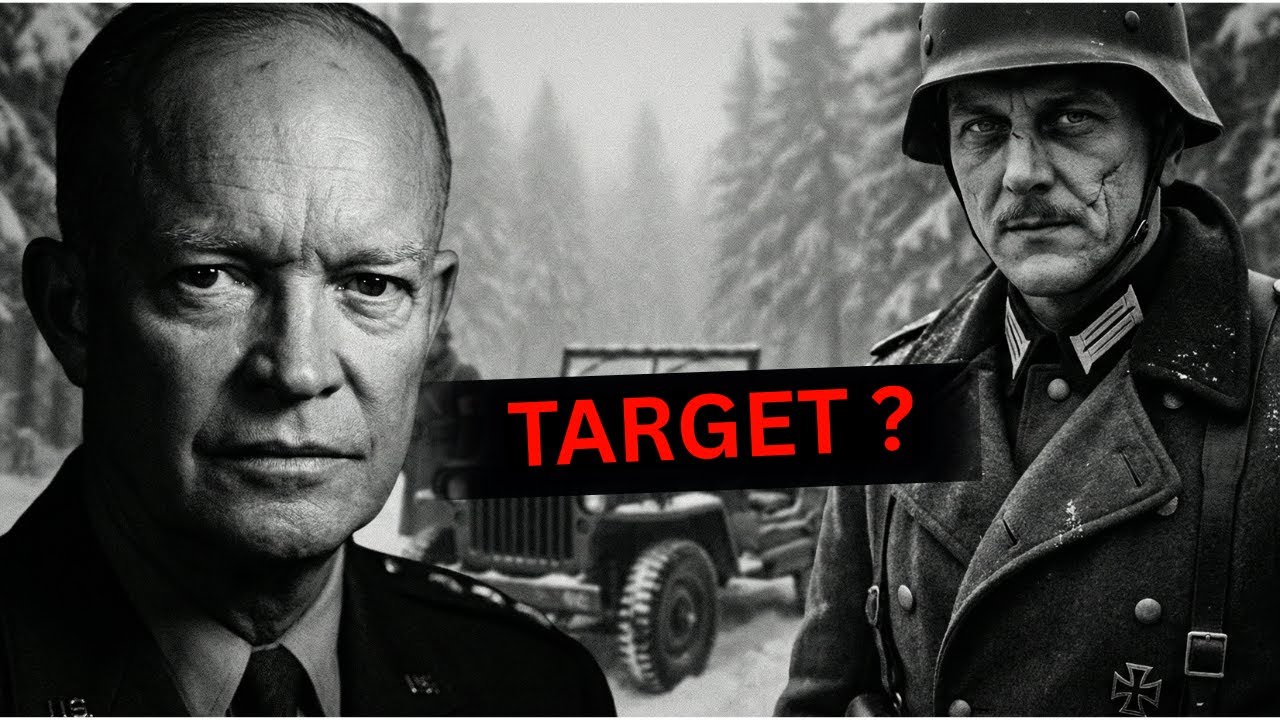
American intelligence had received a terrifying report. A team of elite German commandos was inside Paris, driving American jeeps and wearing American uniforms. They spoke perfect English. Their mission was to find General Eisenhower and kill him.
Eisenhower sat at his desk, frustrated and angry. He smoked cigarette after cigarette. He told his aide, "I feel like I am in a cage."
He did not know it yet, but the assassins were not just coming for him. They were tearing the US Army apart from the inside, creating a panic so deep that American soldiers began arresting their own generals.
To understand the panic in Paris, one has to meet the man who caused it. Otto Skorzeny was a giant of a man at six foot four, with a jagged dueling scar running down his left cheek. The Allies called him Scarface, and American intelligence called him the most dangerous man in Europe.
He was not a normal soldier. He was Hitler's favorite commando. In 1943, he had done the impossible, flying gliders onto a mountaintop in Italy to rescue the dictator Benito Mussolini from captivity. Hitler loved him.
In October 1944, as the Third Reich was crumbling, Hitler called Skorzeny to the Wolf's Lair. Hitler revealed his plan for the Battle of the Bulge, a massive surprise attack, but he needed an edge. He needed chaos.
Hitler told Skorzeny to form a special unit dressed in American uniforms, armed with American weapons and driving American jeeps. They would go behind the Allied lines, change road signs, cut telephone wires, and give fake orders.
Skorzeny smiled. It was a suicide mission. Under international law, soldiers fighting in enemy uniforms are not prisoners of war. They are spies, and if caught, they would be executed immediately. Skorzeny accepted the mission anyway. It was named Operation Greif, the Griffin.
Skorzeny scoured the German army for men who could speak English, not just English but American. He wanted men who knew slang, knew how to chew gum, and knew baseball. He found about 150 men who spoke fluent English, most of them sailors who had worked in the US merchant marine before the war or students who had studied at American universities.
The Germans gathered captured US Army equipment, including jeeps, Sherman tanks, uniforms taken from dead American soldiers, dog tags, cigarettes, and chocolate bars. Skorzeny trained his men in a secret camp, teaching them to walk like Americans, relaxed and slouching, to open a pack of cigarettes like an American, and to use American swear words. They formed the 150th Panzer Brigade.
On December 16, 1944, the attack began. While the panzers smashed the front lines, Skorzeny's jeeps slipped through the gaps. The Trojan horse was inside the gates.
The first few days were pure chaos. American units were retreating, the roads were clogged, and nobody knew who was who. Skorzeny's commandos went to work.
At a crossroads near Malmedy, an American regiment trying to reinforce the front saw an MP officer directing traffic. He waved them down the wrong road, and the entire regiment drove straight into a German ambush. The MP was one of Skorzeny's men.
In another sector, a telephone line was cut. An American commander could not call for artillery support, and his unit was overrun. The commandos were creating havoc, but then one of them got caught.
On December 17, near the town of Eupen, two American soldiers grew suspicious of a jeep carrying four men. The men wore US uniforms and had the right papers, but something was off. One of the Americans noticed that the driver was wearing German army boots.
They stopped the jeep and demanded the password. The men in the jeep hesitated. The Americans raised their rifles and ordered them out. They searched the jeep and found German pistols, radio codes, and a roll of cash worth thousands of US dollars.
The interrogation was brutal. The Americans wanted to know the plan. The German commando, terrified of being shot, spilled everything, but he added a lie, a rumor that Skorzeny had planted to terrify the Allies.
The prisoner said they were not just there to cut wires. He claimed Skorzeny was in Paris with a team of assassins, that they would meet at the Cafe de la Paix, and that they were going to kill General Eisenhower.
The report hit Allied headquarters like a bomb. The security services panicked. They believed Skorzeny was capable of anything. They imagined fifty German super soldiers armed with silenced pistols sneaking into Versailles.
General Bedell Smith, Eisenhower's chief of staff, ordered a total lockdown. He turned Eisenhower's headquarters into a fortress, surrounding the building with barbed wire, stationing tanks at the gates, and doubling the guard. Eisenhower was confined to his room.

Eisenhower was furious. He walked the halls muttering and felt ridiculous. He wrote to his wife, "I am a prisoner. I cannot go out. I cannot do my job because of some German bluff."
But the paranoia did not stop at headquarters. It spread to the entire US Army. Suddenly, every American soldier was a suspect. Papers could be forged, uniforms could be stolen, and passwords could be learned.
So the American soldiers invented a new security system: American pop culture trivia. Checkpoints were set up on every road in France and Belgium. MPs stopped every jeep, even the generals, pointed their Thompson submachine guns, and asked questions no German would know.
Who won the World Series in 1940? What is the capital of Illinois? Who is Mickey Mouse's girlfriend? What is the nickname of the Chicago Cubs? If you did not know the answer, you were arrested. It did not matter if you were a private or a colonel.
This led to one of the most famous incidents of the war. General Omar Bradley, Eisenhower's close friend, was driving to the front when an MP stopped his car and asked him the capital of Illinois. Bradley correctly replied, "Springfield."
The MP shook his head and said, "Sorry, General. You are under arrest." Bradley asked why. The MP said, "Every real American knows the capital is Chicago." The MP was wrong. Springfield is the capital, but Bradley had to sit in a detention cell for two hours until his identity could be verified.
Another general was arrested because he did not know the name of Betty Grable's husband. It was Harry James. The army was paralyzing itself. Skorzeny's plan was working better than he ever imagined. He had not even left Germany, but he had frozen the Allied command and turned every American soldier into a paranoid guard.
While Eisenhower sat in his room fuming, the American Counterintelligence Corps went on the hunt. They wanted blood. They distributed wanted posters for Otto Skorzeny, checked the papers of thousands of soldiers, and slowly started catching the impostors.
At a bridge near the Meuse River, a team of three Americans was trying to plant explosives. They wore US uniforms, but an alert guard noticed something. They were wearing their dog tags in their pockets. Real GIs wore them around their necks.
The guard raised his weapon and ordered them to put their hands up. The impostors surrendered. They were identified as Manfred Pernass, Gunther Billing, and Wilhelm Schmidt. They were interrogated and admitted they were part of Operation Greif. They admitted they were spies.
The American commanders did not hesitate. There would be no POW camp for these men. They had violated the rules of war, and the punishment was death.

On December 23, 1944, at Henri-Chapelle in Belgium, it was a cold, snowy morning. Three wooden posts were set up against a stone wall. The three German commandos were marched out, still wearing the American uniforms in which they had been captured, though the US insignia had been ripped off and a large white target was pinned over their hearts.
Hundreds of American soldiers gathered to watch. They were angry. These were the men who caused the panic and made them doubt their own brothers. The Germans were tied to the posts. A chaplain said a short prayer, and a black hood was placed over their heads.
A firing squad of twelve American riflemen formed up. The order was given: ready, aim, fire. The three spies slumped forward. Justice was served. The Americans filmed the execution and took photos. They wanted the Germans to know that if you wear our uniform, you die.
Over the next few weeks, more of Skorzeny's men were caught. Eighteen of them were executed by firing squad. The rest fled back to Germany, ditched their American uniforms, and put their German ones back on. The mission was over.
Back in Versailles, the news of the executions reached Eisenhower, but the security detail was still nervous. They still thought Skorzeny himself was out there.
On Christmas Day 1944, Eisenhower could not take it anymore. He walked out of his office and told his guards, "I am going home to my quarters, and I am walking." He walked through the snow, defiant. He refused to be a prisoner of fear.
A few days later, a German spy was captured who revealed the truth. There was no assassination squad. Skorzeny never left Germany. The rumor about the cafe was a lie planted by the Germans to create panic. Eisenhower had been locked up for two weeks for nothing.
He laughed when he heard it, but it was a bitter laugh. He respected the trick. Skorzeny had played a mind game and he had won.
Otto Skorzeny survived the war. He surrendered to the Americans in May 1945, walking out of the woods tall, scarred, and arrogant. He expected to be executed. He was put on trial at Dachau for the improper use of enemy uniforms. The prosecutors wanted to hang him, arguing that Operation Greif was a war crime.
But Skorzeny had a surprise witness, a British commando leader named Forest Yeo-Thomas. The British officer testified that British commandos often wore German uniforms to deceive the enemy. The court was stunned. If the British did it, they could not hang Skorzeny for it. Skorzeny was acquitted and walked free. The most dangerous man in Europe died in his bed in 1975.
Operation Greif was a military failure. It did not capture any bridges and did not stop the Allied advance. But as a psychological weapon, it was a masterpiece.
A few dozen men in stolen jeeps managed to paralyze the entire US Army. They made generals fear privates, made MPs arrest their own commanders, and put the Supreme Allied Commander in a cage. It proved that in war, fear is just as powerful as a tank, and sometimes a lie can travel halfway around the world while the truth is still putting on its shoes.