In the summer of 1944, as Allied armies broke into fortress ports and field hospital complexes across Normandy, German military nurses began falling into American hands in groups. They came out of bunkers with their hands raised, wearing gray uniforms with Red Cross armbands. They had been told exactly what capture would mean.
Germany's propaganda had prepared these women for atrocity. Enemy soldiers, they had been taught, would treat captured women as spoils. More than one nurse later admitted she had kept a means of suicide within reach as the front closed in.
What actually happened to them was so far from the expectation that their own accounts, gathered after the war, read like a single testimony written by many hands. They were saluted, fed, and quartered. They were guarded for their protection rather than against their escape. In a great many cases, they were put back to work at the thing they knew: nursing, inside the hospitals of the army that had captured them.
The gray uniform held a specific institution. The German military employed tens of thousands of women in its medical services, including career Red Cross sisters and wartime volunteers trained as nurses and attached to military hospitals from the Channel Coast to the Russian front.
They were not combatants. Under the Geneva Convention of 1929, they belonged to a special category that most people, including many soldiers, had never heard of. Medical personnel, doctors, orderlies, chaplains, and nurses were designated protected personnel.
Captured, they were not even prisoners of war in the strict sense. They were to be respected, safeguarded, allowed to continue caring for the wounded, and where their services were not required, returned. The clause existed on paper in every army's regulations.
The summer of 1944 tested whether the American army would honor that paper under fire, with enemy women in the middle of the bloodiest campaign it had ever fought.
The test came first at Cherbourg in the last week of June 1944. The port fortress fell after savage fighting, and its underground hospital galleries surrendered with everything inside them: hundreds of German wounded, their doctors, and their nursing staff.
The American units that took the surrender walked into tunnels lined with casualties and found the German medical staff still working, because wounded men do not pause for capitulations.
The American response set the pattern for the rest of the campaign. The hospitals were left functioning. German doctors and nurses kept their patients, now under American authority, with American medical officers supervising and American supplies flowing in.
The German staff noted those supplies with professional envy: plasma, penicillin, whole blood, quantities of everything their own system had been rationing for years. The nurses who had braced for assault found themselves instead in a handover between colleagues. Medicine outranked uniform in the first hour of captivity.
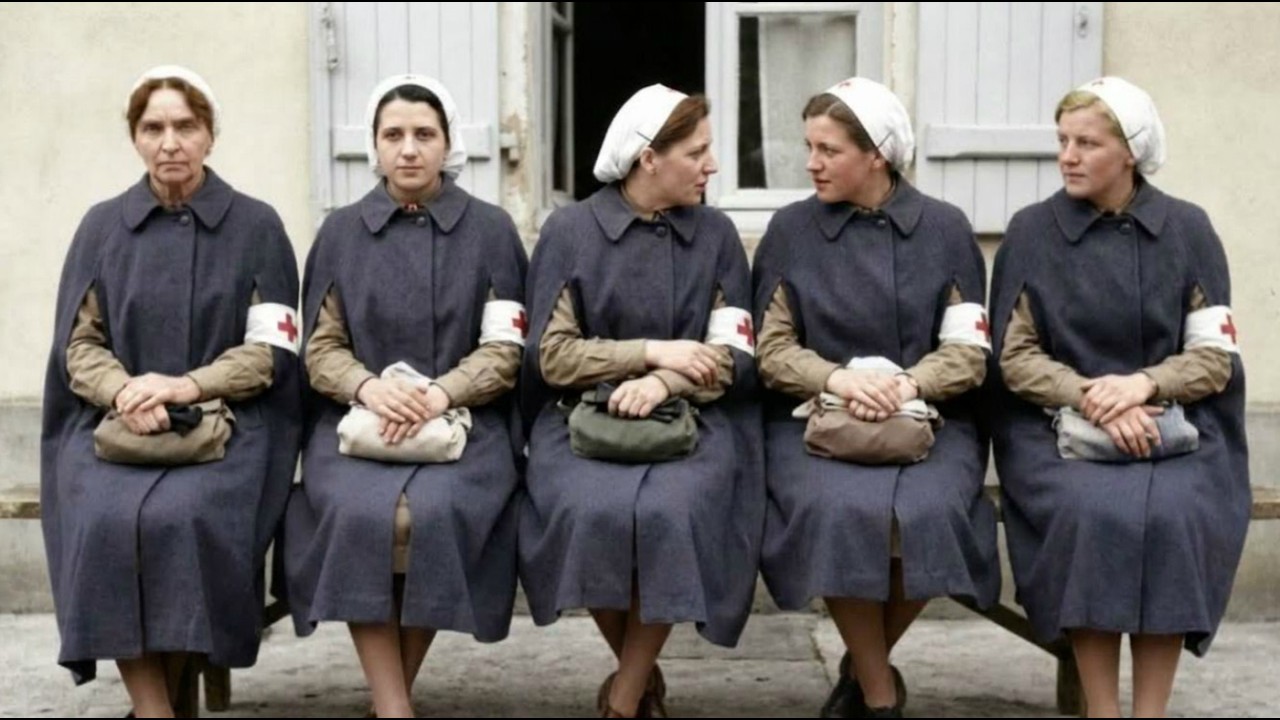
The system that received them improvised honorably around a situation its planners had barely imagined. The American prisoner of war machinery was built for men in numbers approaching half a million. The women arriving in its intake tents numbered in the dozens and then the hundreds, a rounding error with special legal status and no dedicated facilities.
The solutions were assembled case by case. Nurses were housed separately, often in requisitioned buildings or partitioned hospital quarters, with female oversight where the army could arrange it and with guards whose orders emphasized protection.
Their treatment was governed by the protected personnel rules, which meant pay for work performed, correspondence rights, and, decisive for what came next, the presumption that their proper place was in a ward. Into the wards they went, because the summer of 1944 was drowning every hospital in Normandy in casualties, and a trained surgical nurse was worth more than her guard's rifle.
German nurses worked on German wounded in American-run prisoner hospitals, side by side with American medical staff under American doctors. The working relationship in account after account found its level within days. The wounded did not sort themselves by politics, and neither at the bedside did the staff.
American nurses and their German counterparts traded technique across the language barrier: sulfa protocols, plaster methods, the eternal shop talk of the profession. American medical officers wrote evaluations of their captive colleagues that read like staff references, describing them as diligent, skilled, and tireless with the patients.
Some German nurses, hardened by years on the Eastern Front, privately rated the American hospitals as the best equipped they had ever stood in. They said so in letters home that the censors passed, one imagines, with some satisfaction.
The fear these women carried had been manufactured deliberately. German propaganda in the war's last years worked the theme of enemy atrocity with industrial persistence, and it wrote special material for women: broadcast warnings, whispering campaigns run through official channels, atrocity stories from every front served up as previews of what surrender would bring.
The purpose was military and explicit in the regime's internal logic. A population that expects annihilation fights to the end, and the nurses of the Western garrisons were consumers of that product. Young women in bunkers were told nightly that the men landing on the beaches practiced horrors as policy.
Some of it referenced real events from other armies and other fronts, sharpened and generalized. Most of it was invention with a schedule to keep.
The measure of its effectiveness is in the capture accounts themselves: the hidden scalpels, the pacts, the disbelief lasting weeks after the food and the courtesy began. A fear built that carefully does not dissolve at the first held door.
Honesty about scale belongs here too. The German nurses who passed through American hands numbered in the hundreds and low thousands, not the hundreds of thousands of their male comrades. Most were processed, employed, and repatriated within the theater in France, Britain, and later occupied Germany, rather than shipped to the camps of Texas and the Midwest, which held a female population close to zero.

Their story is small in the war's ledger of bodies. That is precisely why it carries weight in the ledger of conduct. Systems reveal themselves at their edges, in the cases their planners never drafted for.
Half a million male prisoners had a machine waiting for them, built, budgeted, and inspected. A few hundred captured women in Red Cross armbands had only a treaty clause and the character of the units that took their surrender. The clause held because the people on the ground chose, hundreds of separate times in the middle of a merciless campaign, to read it as written.
The wards where this played out deserve their texture on the record, because the daily scenes are the evidence. A prisoner hospital in Normandy or England in that summer was a bilingual institution improvising its own manners.
German nurses learned the American charting system, American penicillin schedules, and the layout of supply rooms stocked at a density they walked through slowly on the first day, shelf after shelf of things that were myths at home.
American ward officers learned that their captive staff would work double shifts unasked when convoys of wounded arrived, and learned to spend that willingness carefully. The patients, German soldiers waking from surgery to a countrywoman's voice, got the one mercy a hospital can add to medicine: their own language at the bedside.
American commanders valued the nurses for exactly that effect: calm wards, cooperative patients, fewer of the small disasters that fear breeds in a surgical ward. Records of these hospitals note the oddity that everyone stopped noticing within a week. Enemy staff holding keys, handling instruments, moving unescorted between buildings, an arrangement built entirely on a red armband and a treaty. And the arrangement holding.
The nurses were not the only German women the advance swept up, and the contrast marks how specifically the protection worked. The German military employed tens of thousands of uniformed female auxiliaries: signals operators, headquarters staff, searchlight and flak helpers.
When these women fell into Allied hands, they entered a different legal maze, treated variously as internees or as prisoners depending on role and paperwork, sorted case by case. The nurses alone carried the medical protection, and the capturing units, to their credit, generally knew the difference on site and applied it.
An armband in that summer functioned as the most literal document of the war, read at rifle range, honored on the spot. The auxiliary women's story ran adjacent and rougher in places, though in American hands it too settled quickly into safe, dull custody. The horrors the propagandists promised failed to materialize for them either.
The regime had told its women that surrender meant savagery. The files record instead a bureaucracy, forms in triplicate, and in the nurses' case, a duty roster by the end of the first week.
The expectations these women had carried into captivity deserve their own paragraph, because the gap between fear and fact is the actual subject. Nazi propaganda in the war's later years described the approaching Allies in terms designed to make surrender unthinkable, and it aimed particular horror stories at women.

The nurses' postwar interviews returned to the same confession. One had hidden a scalpel in her boot. Another had agreed with two colleagues on a pact they did not name in detail. A third recorded that when an American sergeant addressed her as ma'am and held a door, she had no framework for it and concluded it was a trick that would end when the officers left.
The trick never ended. The meals kept arriving, the quarters stayed guarded, the work continued. Somewhere in the first weeks, each woman performed the same quiet revision of everything she had been told, the identical revision their male comrades were performing on trains in Texas at that very hour. The regime's picture of the enemy did not survive contact with the enemy's hospitals.
The pay clause completed the strangeness of their status. Protected personnel who worked were entitled to compensation. So the United States Army kept payroll accounts for captured German nurses, credited monthly and settled at repatriation.
The surviving ledgers record the fact in the flattest administrative prose: enemy medical staff, wages earned, balance carried forward. The women had entered captivity expecting to lose everything. They left it with references and back pay.
Repatriation wrote the final clause, and it wrote it early. Because protected personnel were not ordinary prisoners, the machinery for sending them home ran ahead of the great postwar returns. Boards reviewed which German medical staff were still needed in the prisoner hospital system, and those surplus to need were repatriated in stages.
Some went home even before the war's end through neutral channels. Most followed soon after the surrender, arriving back into the wreckage of Germany with an experience almost nothing in that wreckage would let them describe honestly. A woman who said the Americans had treated her with courtesy and put her to work healing German soldiers was contradicting years of official truth. Many simply kept the story for later, for the interviews and memoirs of the 1970s and 1980s, where it now sits in the archives, consistent across witnesses who never met.
A small number wrote a different ending altogether. Scattered through postwar immigration records are German nurses who, having seen American medicine from the inside as captives, immigrated in the following decade and finished their careers in it by choice, in the hospitals of a country they had first entered under guard.
The wards produced one more scene worth keeping, recorded in the accounts of the mass casualty days. When the fighting surged and the prisoner hospitals overflowed, the sorting at the receiving tents ran on wounds, not uniforms. German nurses found themselves at the height of such days working over American wounded alongside everyone else, because triage recognizes no flag, and no one on a flooded ward was checking armbands against patients.
American medical officers noted it in the tone of men reporting whether the captured staff worked on whoever the stretchers brought. The moment stands as the quiet outer edge of this whole story: an enemy nurse holding pressure on an American artery in an American tent in the middle of the largest battle in the west. Both of them, patient and captive, safer with each other than the propaganda of either country would have believed possible.
Hold the doorway at Cherbourg one last time. Women in gray coming up out of the concrete with their hands raised, braced for the worst story they had ever been told. In front of them, an army that, whatever else it did in that brutal summer, looked at the Red Cross on their sleeves and read it as instructions.
The convention was forty lines of legal text in a treaty most soldiers never saw. In those tunnels, it was the difference between the war these women expected and the one they got. They spent the rest of their lives telling anyone who asked which of the two had turned out to be real.