The largest cash robbery in American history took place on December 11, 1978, at Kennedy Airport in Queens, New York. Just after 3:17 a. m. , six masked men entered the Lufthansa cargo terminal and walked out 45 minutes later with $5.
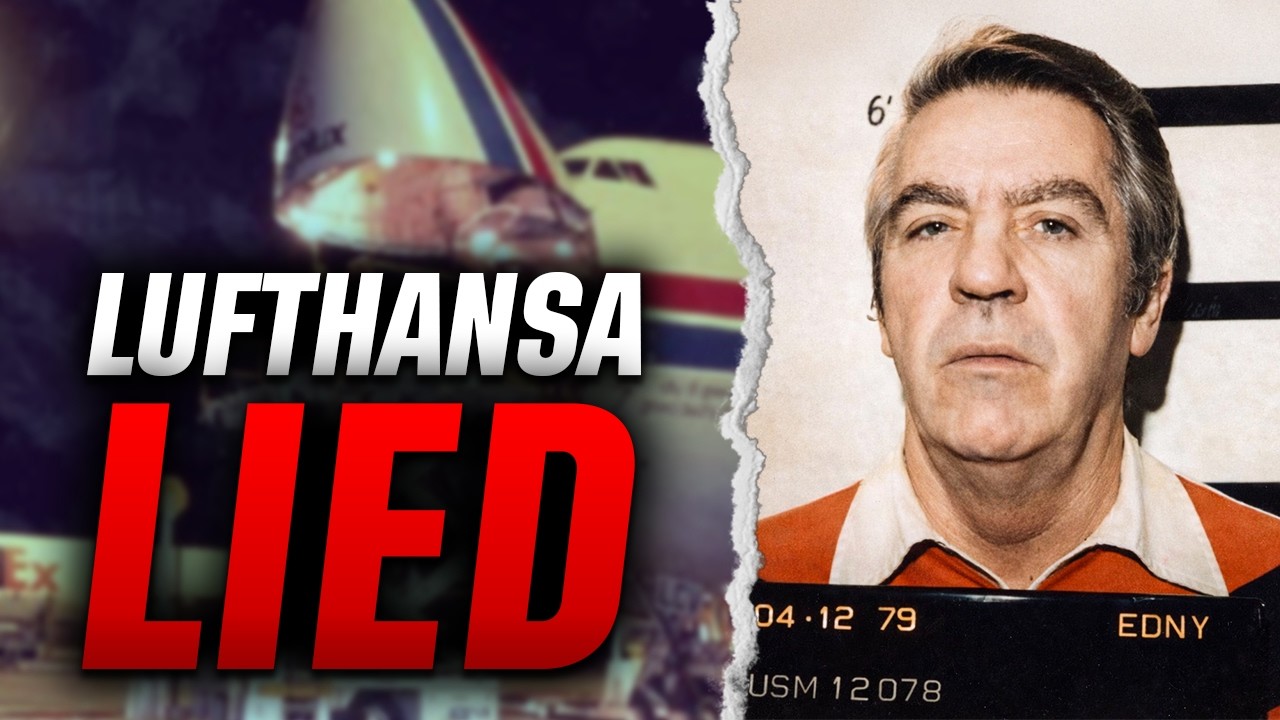
8 million in cash and $850,000 in jewelry. No shots were fired, no alarms were triggered, and the money was never recovered. For decades, the story of the heist has been largely understood through Martin Scorsese’s 1990 film Goodfellas, which centered the narrative on Henry Hill. The movie showed a nervous Hill watching the job from the outside, crew members recklessly spending their shares, and a string of murders carried out to cover the crime.
But the film was a dramatized and simplified version that obscured the true story. Henry Hill was not the architect of the heist, and he was not inside the terminal that night. He was a facilitator who connected people. The real architect was a deeply indebted Lufthansa cargo supervisor named Louis Werner.
At 47 years old in 1978, Werner worked at the Lufthansa terminal earning $15,000 a year while supporting an estranged wife, a girlfriend, and three children. He also had a gambling habit that cost him roughly $300 a day. By 1978, he owed $18,000 to bookmakers, and the interest was piling up weekly. Werner had robbed Lufthansa before.
In 1976, he and a coworker, Peter Gruenwald, stole $22,000 in foreign currency and got away with it completely. That success gave him confidence and a detailed understanding of the terminal’s vulnerabilities. He knew the alarm codes, the vault location, the employee schedules, and the blind spots in the security layout. He had been sketching plans for months.
He also knew that every few weeks, the Commerce Bank of Frankfurt shipped large amounts of American dollars, exchanged abroad by tourists and military personnel, through the Lufthansa cargo vault overnight. The money was untraceable, with no serial number records or dye packs. What Werner lacked was muscle and connections. He reached out through his bookie, who knew a bookmaker named Martin Krugman.
Krugman knew Henry Hill, and Hill knew Jimmy Burke. Once Burke became involved, Werner lost control of his own plan. Werner deliberately stalled a Brink’s armored car on December 8, ensuring the money sat in the vault through the weekend. His cut was supposed to be 10 percent: $500,000.
He never saw a dime of it and was the only person ever convicted for the heist, receiving a 15-year federal prison sentence on February 28, 1979. The men who walked out with the money walked free. The crew inside the terminal that night included Tommy DeSimone, who was the primary muscle inside the building. An employee reportedly caught a glimpse of a maskless face with expensively styled hair and polished shoes, almost certainly DeSimone’s.
Angelo Sepe was there for intimidation, a Burke enforcer with 14 prior arrests who would spend the next six years helping clean up the evidence. Two Kennedy Airport workers, Joe Buddha Manri and Robert Frenchy McMahon, knew the terminal layout from their own employment and helped the crew move efficiently in the dark. Louis Cafora was a driver who left the scene after meeting his wife a few blocks away. Both would disappear within weeks.
Their bodies were never found. The crew also included Paolo LiCastri, a name Goodfellas completely omitted. LiCastri was a Sicilian enforcer sent by the Gambino crime family to represent their interests. The Gambinos were entitled to a $200,000 cut, and LiCastri’s presence was a condition of Burke receiving the family’s blessing to operate at that scale.
LiCastri took the subway home after the heist. On the night of the robbery, a black Ford Econoline van pulled up to the terminal at 2:55 a. m. with six men inside wearing ski masks.
Four entered the front of the building while two stayed with the van and cut through the security fence at the rear, replacing the lock with their own. Inside, the crew grabbed senior cargo agent John Murray and marched him to the lunchroom, where employees were stacked face down on the floor. They called night shift supervisor Rudy Eirich upstairs, tricking him with a fake call from Frankfurt. When he arrived, he walked straight into guns.
The crew told him they had men outside his house ready to kill his family if he did not cooperate. One employee, Kerry Whalen, tried to run and was pistol-whipped. With all 10 employees secured, Eirich was forced to disable the alarm system and open the vault. Inside were 72 cartons, each weighing roughly 15 pounds, containing the cash and jewelry.
The crew loaded everything in under 30 minutes. At 4:21 a. m. , the van pulled away.
The crew drove to a garage in Canarsie, Brooklyn, where Burke was waiting. The contents were transferred into two cars. Parnell Stacks Edwards was left behind with one job: drive the van to a New Jersey junkyard and have it crushed before dawn. Instead, Edwards drove to his girlfriend’s apartment, smoked cocaine, and fell asleep.
The van sat on the street for three days until a cop noticed it parked too close to a fire hydrant and had it towed. Forensic technicians found fingerprints on the steering wheel, door handles, and gearshift belonging to Burke’s crew. The van unraveled the heist and effectively signed death warrants. Goodfellas got several details provably wrong.
The movie repeatedly references $6 million as the total take; the accurate figure confirmed by federal prosecutors and court documents is $5. 8 million in cash and $850,000 in jewelry. The movie also framed Henry Hill as a central participant, when he was actually an intelligence connection. And the film buried Werner’s role, briefly mentioning him as a name and a sentence, despite the fact that without him, the heist never happens.
Burke, the executor of the plan, made a calculation after the robbery. Roughly 20 people knew about the heist, and each was a potential witness. Burke began killing them. Parnell Stacks Edwards was first.
On December 18, seven days after the heist, Tommy DeSimone and Angelo Sepe entered his apartment at 6:17 a. m. DeSimone fired six shots from a . 38 caliber revolver, hitting Edwards five times in the face and chest.
He died instantly at 28 years old. Martin Krugman was next. The bookmaker kept asking for his cut and kept showing up at Robert’s Lounge when FBI surveillance cars were parked outside. He disappeared in early January 1979.
Henry Hill claimed Burke and Sepe killed him and dismembered the body. His remains were never found. Louis Cafora and his wife were seen wearing a full-length mink coat weeks after the heist, defying Burke’s order to lay low. Both vanished with no trace.
Joe Manri and Frenchy McMahon were found on May 16, 1979, shot execution style in the back of the head while sitting in a parked Buick in Brooklyn. Paolo LiCastri was found in June 1979, burned, naked, and shot multiple times, his body left on a trash heap. Richard Eaton and Tom Monteleone, Florida businessmen accused of skimming heist money, also died: Eaton’s body was found hog-tied in a refrigerated meat truck, and Monteleone disappeared. Teresa Ferrara, connected to crew members and accused of involvement in the skimming, had her headless torso wash ashore in New Jersey.
By the summer of 1979, nine people connected to Lufthansa were dead or missing. Burke was always likely to kill most of these people. The van gave him a convenient excuse to make the first move, but dead men don’t testify. The murders were strategy, not paranoia.
Not one dollar of the Lufthansa money was ever recovered. The FBI spent years trying to trace it. The cash was designed to be untraceable, and it was. Investigators pieced together that Burke likely moved it through multiple hands.
Some went to Paul Vario, his Lucchese family capo, as tribute. Some was earmarked for the Gambino family’s $200,000 cut, though LiCastri never lived to deliver it. Some was laundered through Florida businesses Burke controlled. The rest Burke kept and spent slowly and carefully.
Werner served his time in prison. Burke died in prison in 1996 from lung cancer, never charged with the robbery itself. Hill died in 2012 after decades in and out of witness protection. In 2015, 37 years after the heist, Vincent Asaro was tried for his alleged role in the robbery and acquitted.
The heist remains officially unsolved. The real story of Lufthansa is not a tale of criminal genius. It is a story of desperation: Werner needing to pay off gambling debts, Krugman needing to stay in good standing with bookmakers, and Burke needing a score after years in prison.
The heist was the collision of all those weaknesses at exactly the right moment.