On August 2, 1876, James Butler “Wild Bill” Hickok walked into Nuttal & Mann’s Saloon No. 10 in Deadwood and sat down to play poker. Within hours, one of the most famous lawmen of the Old West was dead, shot from behind by Jack McCall. The hand of cards linked to that moment became known as the “dead man’s hand.
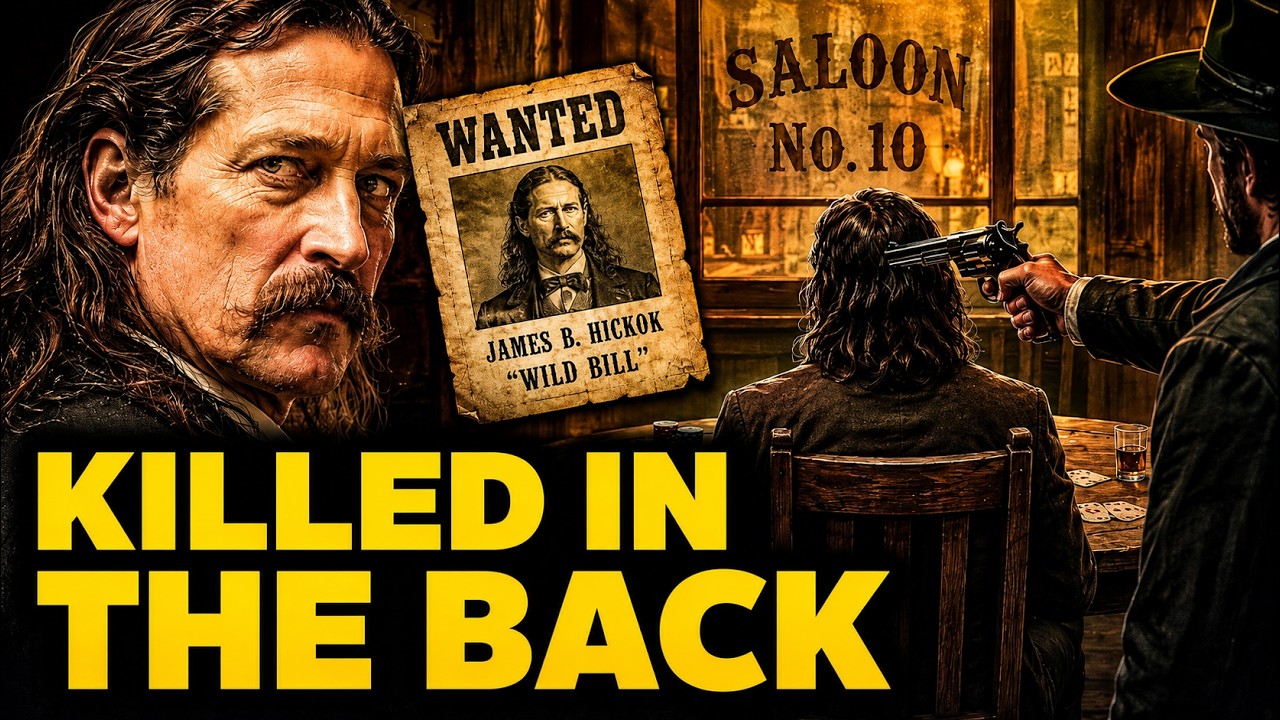
” But the real story is darker, more complicated, and far less certain than the legend. Hickok was 39 years old, had spent only a few weeks in the Black Hills, and was not working as a marshal, sheriff, or deputy. In Deadwood, the famous lawman was living mostly a gambler’s life, trying to improve his finances. He joined a card game already in progress and sat in a chair that left his back exposed to part of the room.
That detail would soon become the focus of the story. The exact sequence of events that day is not fully recorded. No reliable document proves that Hickok knew he would die that day. Later writers added warnings, premonitions, and last letters because those details made the event seem complete.
The actual record is simpler and less dramatic. A nationally famous figure walked into an ordinary saloon in a frontier camp, sat down with several other men, and began playing cards. Jack McCall was also in Deadwood that day. He was not a notorious outlaw, a significant gunman, or a known enemy from Hickok’s years as a lawman.
He was an obscure drifter, and his earlier life is not well documented. Within a short time, the unknown man’s name became permanently attached to one of the most famous figures of the American West. Deadwood grew inside the Black Hills during one of the fastest gold rushes in frontier history. The legal situation was complicated but critical.
Under the 1868 Treaty of Fort Laramie, the Black Hills were part of the land reserved for the Lakota people. In 1874, a military expedition led by George Armstrong Custer entered the region and confirmed reports of gold. Word spread quickly, and miners began pouring into the hills even though the land was not legally open to them. Federal authorities made some attempts to keep prospectors out, but the influx became too large to control.
By 1876, camps were springing up along the creeks and ravines where miners believed gold could be found. Deadwood grew next to Whitewood Creek in a narrow, tree-filled gulch. The dead trees that gave the settlement its name were everywhere. It was not so much a town as a fast-moving construction site.
Tents, log structures, and rough board buildings appeared in close quarters, housing stores, boarding houses, gambling parlors, and saloons. People arrived to dig for gold, haul supplies, sell food, provide entertainment, and buy claims. The camp drew experienced miners, merchants, laborers, immigrants, former soldiers, gamblers, lawyers, and drifters. Among them were men wanted elsewhere.
The Deadwood camp was crowded, rough, and filled with strangers who had little reason to trust one another and many reasons to watch their backs. Hickok had spent years watching doors, reading faces, and staying alert around men who might want to build a reputation. But on that day, he sat in a position that allowed another man to approach him easily from behind. Hickok was likely the most famous man in the room, but he was also a man who had let his guard down at precisely the wrong moment.
The shot came from McCall, who fired once at close range. The bullet struck Hickok behind the ear and killed him almost instantly. The famous lawman never saw his killer. When the gunfire ended, Hickok was dead on the floor.
The cards he had been holding scattered, and the story of the dead man’s hand began to take shape. The two aces and two eights, with the five of diamonds, became part of Western lore, but some details were only added later by storytellers. McCall did not flee far. He was captured quickly and brought before a miners’ court, a rough form of frontier justice that had no legal standing under federal law.
The proceedings were short and informal. The camp was not a legally incorporated town, and the court had no official authority. McCall was found not guilty, and the verdict was accepted by the crowd at the time. The acquittal did not last.
McCall was later arrested again, this time for the murder of a federal officer. The case was taken seriously because Hickok had at various times served as a federal marshal. A grand jury indicted McCall, and he was brought to trial in the Dakota Territory. The second trial ended with a guilty verdict.
On March 1, 1877, McCall was hanged for the killing. The legend continued to grow after that. The saloon in Deadwood became a landmark, and the chair Hickok was sitting in became part of the story. The details of that day were retold so often that the legend began to replace the facts.
Writers added dramatic touches, and the story of the dead man’s hand became famous across the country. But the truth is that Wild Bill Hickok died in a crowded saloon, shot in the back by a man whose motives were never entirely clear. The most famous lawman of the American West was not killed in a duel. He was not facing down an enemy who had challenged him.
He was simply playing cards in a saloon when an obscure drifter walked up behind him and fired a single shot. The act ended one life and created a myth that would outlive everyone in that room. The dead man’s hand, the warning signs, the dramatic final words, all of it was shaped by the tellers of tales who came after. The real story is the one that happened in that cramped, dusty saloon, where a famous man sat with his back to the door and a stranger with a gun changed the course of history.
The full account of that day remains incomplete, but the known facts are clear enough: Hickok died in Deadwood, McCall was hanged, and the legend carried on far longer than the man himself. The story of the dead man’s hand has been told and retold, with each telling adding to the myth. But the truth is more ordinary, and in its own way, more tragic. A man who had survived years of danger was killed by a single act of violence in a place where life was cheap and death was common.
The final known outcome of the story is not a mystery. Wild Bill Hickok was killed in a Deadwood saloon, and Jack McCall was executed for the crime. The rest is the stuff of legend, shaped by the need to make sense of a sudden and senseless death. The dead man’s hand remains a symbol of the Old West, a reminder that even the most famous figures can meet an ordinary end.
The record is incomplete, but what is known is enough to tell the story: a famous man, a crowded saloon, a shot from behind, and a legend that never died. The camp of Deadwood was not a city, but it was a place where fortunes were made and lost, where men came to find gold and often found trouble instead. Hickok was part of that world, and in the end, it was the same world that killed him. The story of that day has been told many times, but the truth is simpler than the legend.
Wild Bill Hickok was shot in the back, and the man who did it was hanged. The world moved on, but the name of the lawman, and the story of the hand he was holding, remained. The dead man’s hand became part of the American story, a symbol of luck running out and lives cut short. The full tale of what happened in that saloon will never be known with certainty, but the outline is clear enough.
A famous man walked into a bar, sat down with his back to the door, and never walked out. The man who killed him claimed he acted in self-defense, but the evidence did not support that claim. McCall was not a killer who had been wronged by Hickok. He was a drifter who saw an opportunity and took it.
The exact reason for the shooting remains unclear, but the outcome was not. Wild Bill Hickok was dead, and the West had lost one of its most enduring figures.