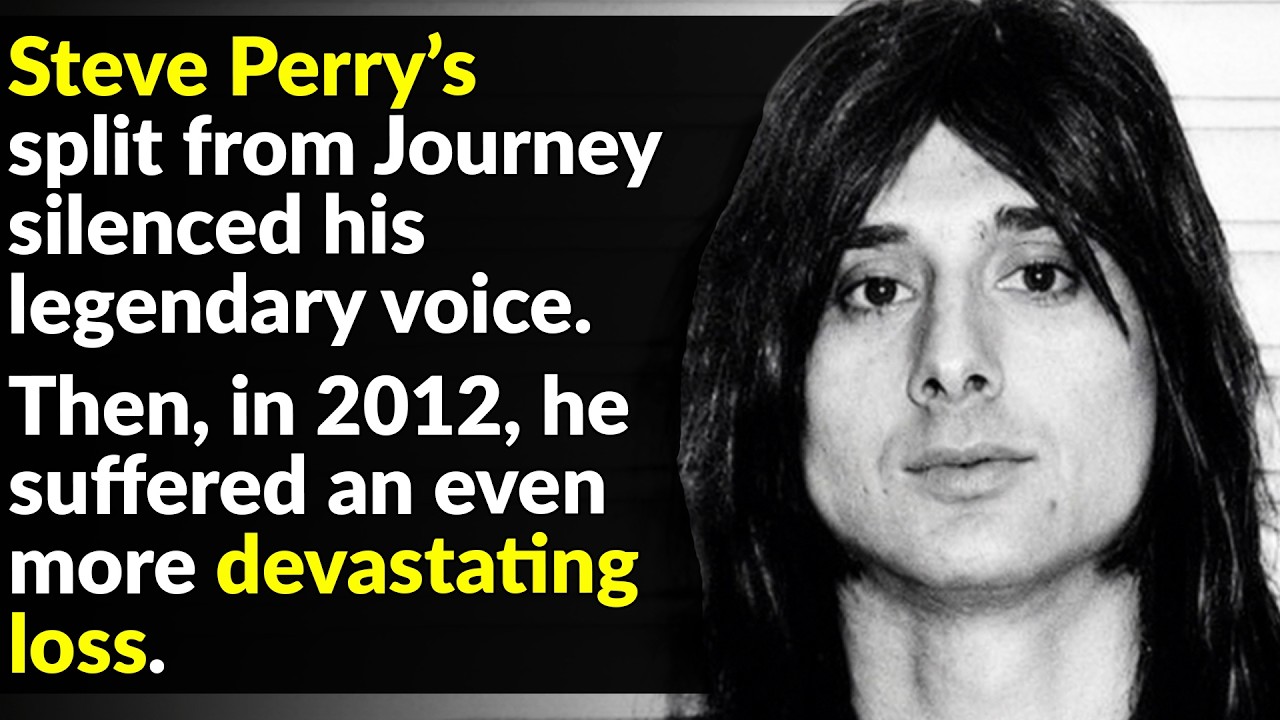
Steve Perry’s strained relationship with Journey left him heartbroken and silenced his famous voice. But in 2012, he suffered a loss far more tragic, and his reaction was truly devastating. Steven Ray Perry belted out his first note on January 22, 1949, in Hanford, California. As the only child of Portuguese immigrant parents, his father, Ray Perry, was no ordinary working-class dad.
Ray sang classic songs like “Pennies from Heaven” at local theaters and even co-owned a radio station. Music, it turned out, ran in Perry’s veins. Whether the family liked it or not, Perry’s maternal grandfather wanted no part of a son-in-law who was a singer. He considered music a hereditary condition, a family curse that Perry himself would suffer the worst effects of.
Long before Perry was singing about being a dreamer, his parents believed in love. The young couple eloped and married in secret. Perry’s grandfather turned out to be somewhat right about the curse. It may not have been music’s fault, but Perry’s parents’ marriage didn’t last.
By the time Perry was just eight, his parents had split. His mother packed up and moved them to Lure, California, where his grandparents ran a dairy farm. It was rural, quiet, and about as far from the rock stage as a kid could imagine. With his father out of the picture, Perry’s grandparents stepped in to raise him.
But it was his stepfather who taught him life’s harshest lessons. His stepfather made him work on construction sites to help pay the family’s bills. He carried some struggles with him, ones he kept to himself even after his rise to fame. At age nine, something happened to Steve Perry.
Something he never fully explained. Whatever it was, it left deep and lasting scars. In a 2018 interview, he described himself as an invisible, voiceless child, and offered the only explanation he would ever give. Things happened to me as a kid.
There was no place to talk about them, so I sang to express myself instead. And sing, Perry did. When Perry turned twelve, his mother gave him a gift that would stay with him through every twist of his legendary career. It was a small gold musical note necklace.
Inexpensive and simple, it was his mother’s way of saying, long before he sang the words, that she would never stop believing in him. Perry wore it for years, considering it a lucky charm. And it worked. Around that same age, Perry was riding in his mother’s car when a song came on the radio.
It was Sam Cooke’s “Cupid. ” Something about the smooth, soulful voice of the iconic singer touched his heart, and from that moment, everything changed. Right there in the passenger seat, Perry decided he wanted to sing for the rest of his life, and he immersed himself in the music of Cooke, Otis Redding, and the Kingston Trio. The music bug had found its next victim.
Steve Perry showed musical talent right from the start. At sixteen, after listening to the Beatles’ “I Need You” from their “Help” album, Perry felt something was off. The song relied heavily on a bossa nova rhythm. But Perry’s ear heard something different.
He said it called out to him in an R&B style. Decades later, he finally got his chance to prove it, reworking the song on his 2018 album “Traces. ” But it took a while for his brilliance to emerge. In his early twenties, Steve Perry landed in Sacramento and formed a band called Ice with future music producer and businessman Scott Mathus.
They managed to gain enough momentum to score a session at the legendary Record Plant studio in Los Angeles in 1972, where Stevie Wonder would be taking over the studio after them. However, luck wasn’t on their side, and the band broke up shortly after. It was a very bad experience. Back in the small town of Lure, Perry continued to write and play, eventually landing a gig with a band called Pieces.
They had a different sound, bluesier and heavier than Ice, and they started building a following in the Central Valley. They then got a lucky break when they landed a coveted spot in a battle of the bands at the famous Fillmore West in San Francisco. It was a huge deal for a local act, and a triumph in their area. But the triumph would be short-lived.
The very next day, Pieces received a call that would change everything. The band was offered a record deal, but there was a catch. The deal was for the band’s guitarist, and the label wasn’t interested in the band’s current lineup. For Perry, it was another cruel twist in a career marked by heartbreak.
His father-in-law’s prophecy about music being a curse seemed to be coming true. He watched as his bandmates accepted a development deal without him, leaving him behind as they headed to Los Angeles to record demos. Perry was crushed. He was so broke he couldn’t afford to follow them anyway.
When the deal fell through and the guitarist began recording what he thought would be his solo album, he had to call Perry to come and sing on the demos. Perry jumped at the chance, and it led to a life-changing meeting with two guys named Neal Schon and Gregg Rolie, who had just left a band called Santana. They were putting together a new group with a guitarist friend of theirs. The guitarist they brought in had a sound that was a perfect match for Perry’s voice.
When they all got together to jam, it was magic, and the new band, Journey, was born. The success was immediate, but it came with its own set of problems. The band was working at a relentless pace, recording one album after another and touring constantly. Perry was driving himself to the brink, and his voice was suffering.
It got so bad that in 1986, after a tour, Perry was diagnosed with a severe vocal condition. He had a nodule on his vocal cords, and the doctor told him the worst possible news: if he didn’t stop singing immediately, he might never sing again. He was forced to walk away from the band he had given everything to, and Journey had to find a new lead singer. It was a dark period, and Perry retreated into seclusion.
In the late ’90s, after recovering from surgery and with his voice slowly returning, Perry began working on a solo album. He had also reconnected with a woman named Kellie, whom he had met years earlier. Their relationship deepened, and she became the love of his life. He called her the love of his life.
In 2012, after taking the time to write and record an entire solo album’s worth of material, he was excited to share it with Kellie. He played her a few tracks, and she said he didn’t look like himself. He wasn’t smiling, his eyes weren’t lit up, and he was just staring into space. She thought he looked sad, and she asked him to play it again, more carefully and louder.
When she said that, he knew it was over. After they listened, he said she was right. He realized that his heart wasn’t in it. The lyrics were just a wall he was hiding behind, and he confessed he couldn’t even remember what the songs sounded like.
He put the music away, shelved the project, and didn’t think about it again for years. The record, she had helped him make, was never released. That was in 2012. Then, tragically, in December of the following year, just before the holiday season, Kellie passed away suddenly.
She was only 52 years old. It was a devastating, unexpected loss for Perry. He went into seclusion, canceling all his plans. He took time off to process his grief, but the pain of losing her didn’t subside.
In 2015, after two years of isolated grieving, he received an unexpected call from his former Journey bandmates, Neal Schon and Jonathan Cain. They had heard about his loss and sensed his pain. They told him they had written a song, “We’ll Meet Again,” and they wanted him to hear it. He was deeply moved by the gesture and decided to step back into the recording studio with them for the first time in decades.
He traveled to work on the song, and it was emotional for him. The song felt like a letter to Kellie, but it also helped Perry heal. As he worked with Schon and Cain, the old chemistry returned. They suggested recording more music together, and Perry agreed.
They wrote “City of Stars,” a song about a city holding too many memories. For Perry, that city was Los Angeles, the place where he had watched his dreams first come together and fall apart. When he listened to the song’s final mix, he broke down. He realized it was the closest he had come to being able to express his true feelings to his lost love.
The album became “Traces,” his first with new music in decades. The collection dealt heavily with his memories of Kellie and the fracturing of his bond with his former bandmates. It was a deeply personal catharsis. But the pain was still raw.
During the promotional tour for the album, Perry noticed a familiar ache in his hands. He had been experiencing discomfort for a while, but he had chalked it up to old age. When he started to have trouble doing the simplest tasks, like holding a guitar pick, he decided to see a doctor. The diagnosis was a terrible blast from his past: he was suffering from a severe case of tendinitis.
The doctor told him that if he wanted to play again, he would have to stop performing and go through intense physical therapy and surgery to fix the damage. It was a painful echo of the 1986 prediction that he might never sing again. Perry faced an agonizing choice: risk the chance of losing his voice again to pursue a full-fledged comeback, or put his hands first and walk away from music. He was in a crossroads, and he didn’t know what to do.
A close friend of his gave him some simple, practical advice. His friend’s words were, “You don’t have to do anything. You don’t have to live up to anyone’s expectations, including your own. ” Those words lifted an incredible weight off Perry’s shoulders.
He realized he didn’t owe anyone a farewell tour or a grand final statement. He had given his all to music for five decades. It was a hard decision, but he took himself out of the public eye once more, canceling all his tour plans and focusing on healing his hands. Instead of performing, he spent his time in the studio, where he could sit and produce and work with other artists, and focus on a different kind of creativity.
In 2021, he joined the duo LeBrock as a featured vocalist on their single “Let Me Fall. ” He was collaborating and creating again, but on his own terms. Looking back at his life and his career, Perry seems at peace with the path his own musical career took. Acting on a lifelong dream, he joined the ranks of the Rock and Roll Hall of Fame in 2005, but he was not alone.
He was inducted alongside his former bandmates. It was a moment of great validation for the singer who was told he would never last. He had finished what he started. He may not have wanted the spotlight anymore, but the story of his voice touched the lives of millions.
It was the voice that made the world listen, even when he chose to remain silent. A supergroup carefully crafted a brand new sound, but the band just didn’t have the magic without Perry’s voice. Instead, the lead singer of the supergroup went on to join another band, and they found massive success with a sound that was a near-perfect copy of Journey’s. But deep down, this only proved how special the original was.
It was the same pattern that haunted Perry for years. A wave of imitators and look-alikes, all trying to capture the lightning in a bottle that was his vocal style. He tried to warn them. Early in his career, a well-known music producer told him the band would never make it.
They had no identity, no hooks, nothing that stood out. He told Perry to his face that they were a “bar band of no consequence” and dismissed them. Perry took that criticism personally, and he spent his whole life trying to prove that producer wrong, a challenge he accepted every time he stepped up to the mic. Every time he nailed a difficult run, he flashed back to that moment, fueled by the memory of being told they would never succeed.
He completely retired from the road in 2018, but he hasn’t stopped creating. While he declined to be part of Journey’s forays without him, he still gets questions about why he isn’t in the band. He says that his inner circle is lucky, they got to play on his names. After years of silence, in 2022, Steve Perry surprised fans with a new release.
The news hit the internet and sent fans into a frenzy. He dropped a new song called “What Am I Here For. ” The song was clearly inspired by his friend, the late actor and comedian, who also had a deep-rooted passion for the same things. The song’s lyrics seem to be a direct address to the struggles of depression and the search for meaning.
The creative process was a part of him that he couldn’t turn off, even when he thought he had.