Ingerborg Dönitz received the telegram every German mother dreaded in May 1943, learning that her younger son Peter, just 20 years old, had perished in the North Atlantic when U-954 was sunk with all hands on his first patrol.
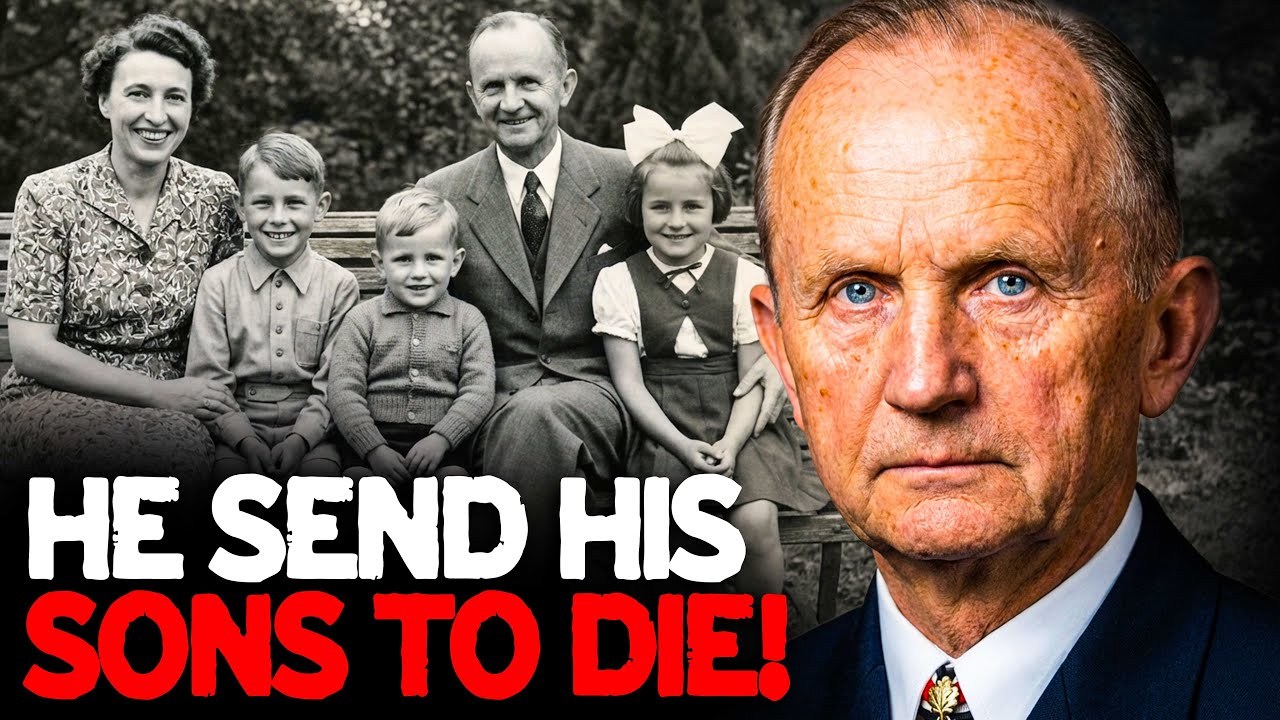
The loss struck the family of Grand Admiral Karl Dönitz, commander of Germany’s U-boat fleet, as he was ascending to the pinnacle of naval power. Peter had followed his father into the submarine service with youthful enthusiasm, eager to prove himself in the force his father had built and commanded.
By 1943, the North Atlantic had become a killing ground. Allied air power and improved detection methods were turning the Battle of the Atlantic decisively against Germany. U-boats that once hunted in wolfpacks now became the hunted, sunk faster than they could be replaced.
Peter died in those cold waters, one of approximately 30,000 U-boat men who would perish during the war. For Carl and Ingerborg, the loss was devastating, a personal sacrifice exacted by the very strategy Carl had designed and championed.
Hitler, recognizing the family’s sacrifice, issued an order that if a senior officer lost a son in combat and had other sons still serving, those sons could withdraw from active duty. Klaus, the older brother, was immediately forbidden from any combat role.
At 23, Klaus was ordered to leave the military and begin studying to become a naval doctor. He would be safe, removed from the war, preserved for his grieving parents. Klaus accepted this decision, grudgingly perhaps, but accepted it nonetheless.
For nearly a year, he studied medicine, preparing for a career that would keep him far from the fighting. But on May 13, 1944, Klaus turned 24. His friends were preparing to take the E-boat S-141 on a raid against Selsey on the English coast.
E-boats were fast motor torpedo boats, deadly in hit-and-run attacks but vulnerable to superior enemy forces. Klaus asked, begged perhaps, to go along just this once, just for his birthday. His friends relented.
They should not have.
The boat went out that night and encountered the French destroyer La Combattante. In the engagement that followed, S-141 was sunk. Six men were rescued from the water.
Klaus was not among them. He died on his 24th birthday.
Despite Hitler’s order, despite his father’s position, despite everything that should have protected him, Klaus was gone. Ingerborg received the second telegram barely a year after the first. Both sons dead.
The grief was annihilating.
For Carl Dönitz, the losses came at a time when he was ascending to even greater power and responsibility. In January 1943, shortly before Peter’s death, he had been promoted to Grand Admiral and replaced Erich Raeder as commander-in-chief of the entire German Navy.
He was coordinating U-boat operations across the Atlantic, the Mediterranean, and the Arctic. He was in daily contact with Hitler, making strategic decisions that affected hundreds of thousands of men. And yet, his own sons were dying in the war he was helping to prosecute.
The Dönitz family had never been large. Carl and Ingerborg had married on May 27, 1916, during World War I. Carl was serving as a submarine officer.
Ingerborg Weber was the daughter of General Erich Weber, a career military man who understood the demands of service.
She had trained as a nurse, modern for her time, and was described as having a mind of her own. They raised three children as Protestant Christians: daughter Ursula, born in 1917, and sons Klaus, born in 1920, and Peter, born in 1922.
The family lived the peripatetic life of a naval officer’s household, moving as Carl’s career advanced through the interwar Reichsmarine and into the Nazi era’s Kriegsmarine. In 1937, Ursula married Günther Hessler, himself a U-boat commander and eventual recipient of the Knight’s Cross.
The marriage connected two submarine warfare families, binding them together in the tight community of naval officers who would fight the Battle of the Atlantic. Ursula and Günther had three children together: two sons named Peter and Klaus, named undoubtedly for Ursula’s brothers, and a daughter named Ute.
The family expanded even as war approached, creating a new generation that would grow up in the shadow of their grandfather’s and father’s service. Carl Dönitz was a dedicated Nazi who admired Hitler openly, praised his leadership, and believed in the righteousness of the cause.
In August 1943, months after Peter’s death, he spoke of Hitler’s foresightedness and confidence, declaring that anyone who thinks he can do better than the Führer is stupid. On German Heroes Day in March 1944, just two months before Klaus died, Dönitz gave a speech warning that without Hitler and National Socialism, Germany would be beset by the poison of Jewry and destroyed.
These were not the words of a reluctant follower or a professional soldier simply doing his duty. They were the words of a true believer. Ingerborg’s political views are less documented, but she lived within this ideology, raised her children in it, and accepted the framework it provided for understanding the world.
The Dönitz household was not one of quiet resistance or private doubts. It was a Nazi household committed to the regime, bound up in its military apparatus, benefiting from the privileges Carl’s position provided. The family lived well during the war years, insulated from the worst privations that ordinary Germans faced.
Then came April 1945. Hitler, trapped in his bunker beneath Berlin as Soviet forces closed in, chose Carl Dönitz as his successor. In his last will and testament, Hitler named Dönitz the new President of the Reich and Supreme Commander of the Armed Forces.
Joseph Goebbels was named Chancellor, creating what became known briefly as the Flensburg Government after Dönitz established his headquarters in that northern German city. Hitler committed suicide on April 30. Dönitz, still reeling from the loss of both his sons, suddenly found himself responsible for a nation in its death throes.

Dönitz held power for 23 days. In that time, he attempted to negotiate separate surrenders to the Western Allies while keeping German forces fighting in the east. He hoped to save as many German soldiers and civilians as possible from Soviet captivity, to facilitate an orderly withdrawal, to preserve what could be preserved.
On May 4, German forces in the Netherlands, Denmark, and northwestern Germany surrendered to Field Marshal Bernard Montgomery. On May 7, Alfred Jodl signed the unconditional surrender at Reims. The war in Europe was over.
On May 23, Allied forces dissolved the Flensburg government and arrested Dönitz and his cabinet. He was taken into custody, held as a prisoner of war, and eventually transferred to Nuremberg to face trial as a major war criminal.
For Ingerborg and Ursula, the arrest meant uncertainty. Carl was gone, imprisoned, facing charges that could result in execution. They had no income, no protection, no clear future.
The family property, whatever they had accumulated during Carl’s career, was subject to confiscation.
They were the wife and daughter of a man about to be tried for war crimes, labeled as Nazi leadership, associated with a regime that had brought catastrophic destruction to Europe. Yet, unlike the families of Heydrich or Bormann, they were not fleeing occupation zones or hiding their identities.
Carl Dönitz had been a military officer, not SS, not party hierarchy. His crimes, if he had committed any, were those of a naval commander, not a genocide administrator. The International Military Tribunal at Nuremberg indicted Dönitz on three counts: conspiracy to commit crimes against peace, war crimes, and crimes against humanity.
The prosecution argued he had planned and waged aggressive war, had violated the laws of war through unrestricted submarine warfare, and had used concentration camp labor in shipyards. Dönitz’s defense centered on his role as a professional military officer following orders.
He claimed ignorance of Nazi atrocities, denied knowledge of concentration camps beyond their mere existence, and argued that his naval operations were standard military practice employed by all sides. The trial revealed uncomfortable truths.
American Fleet Admiral Chester Nimitz submitted testimony that the United States Navy had conducted unrestricted submarine warfare against Japan in the Pacific, torpedoing merchant vessels without warning. If Dönitz was guilty of war crimes for ordering U-boats to attack Allied shipping without warning, then by the same standard, American commanders were equally guilty.
The judges, recognizing this moral equivalency, declined to convict Dönitz solely on the submarine warfare charges. However, they found him guilty of waging aggressive war and of war crimes related to his role in the overall German military machine.
On October 1, 1946, the tribunal sentenced Carl Dönitz to 10 years imprisonment. It was the lightest sentence given to any major Nazi leader convicted at Nuremberg, aside from those fully acquitted. He had escaped execution.
Unlike Göring, Ribbentrop, Keitel, and nine others who were hanged on October 16, Dönitz would live. He was sent to Spandau prison in Berlin along with six other convicted Nazis: Rudolf Hess, Walter Funk, Erich Raeder, Baldur von Schirach, Albert Speer, and Konstantin von Neurath.
For Ingerborg, the sentence brought relief mixed with continued hardship. Ten years. Her husband would be nearly 70 when released, if he survived imprisonment.
But he would survive. She could visit him, write to him, wait for him.
She moved to a small town near Hamburg, living quietly, supported by whatever savings remained and possibly assistance from Ursula and Günther. The years of waiting began. She watched as other Spandau prisoners were released: Neurath in 1954, Raeder in 1955, while Carl’s sentence continued.
She grew older, her health declining, the losses of her sons aging her beyond her years. Dönitz proved a difficult prisoner. He maintained his Nazi beliefs, refused to express remorse, and insisted he had done nothing wrong.
In April 1953, he told Albert Speer that if it had been the Americans’ choice and not the Jews’, he would have been released already. The remark revealed his continuing anti-Semitism, his refusal to acknowledge the Holocaust, his determination to see himself as a victim rather than a perpetrator.
Prison did not change him. If anything, it hardened his convictions, confirmed his sense of persecution, reinforced his belief that he had been unfairly judged. On October 1, 1956, after serving his full 10-year sentence, Carl Dönitz walked out of Spandau prison.
He was 65 years old. Ingerborg was 63. They reunited after a decade of separation.
Both aged, both marked by loss and imprisonment, both facing an uncertain future in a Germany that had moved on without them.
They settled in Aumühle, a small village near Hamburg in northern West Germany. It was quiet, isolated, far from the centers of power where Carl had once operated. They lived on a government pension, the same pension paid to any retired military officer.
Dönitz spent his retirement writing. In 1958, he published his memoirs, “Ten Years and Twenty Days,” recounting his decade commanding U-boats and his 20 days as Germany’s head of state. The book maintained his innocence, insisted he had known nothing of Nazi atrocities, and portrayed himself as a professional naval officer caught up in events beyond his control.

The memoir sold well in Germany and was translated into multiple languages. In 1968, he published a second volume, “Mein wechselvolles Leben,” which attacked the Nuremberg trial process more directly and defended his Nazi ideology more explicitly.
Ingerborg died in 1962, six years after Carl’s release, at 69. She had lost both her sons, watched her husband’s imprisonment, and rebuilt a modest life, only to have a handful of years before her death.
Carl died on December 24, 1980, at 89. His funeral drew thousands, including approximately 100 holders of the Knight’s Cross. The German government forbade military uniforms, fearing the funeral would become a neo-Nazi rally.
He was buried at Waldfriedhof Cemetery in Aumühle.
Ursula, the sole surviving child, lived a quieter life than her father. She and Günther Hessler raised their three children, Peter, Klaus, and Ute, in the post-war years, navigating the complexities of being a U-boat commander’s family in a nation trying to distance itself from its military past.
The boys were named after Ursula’s dead brothers, keeping their memory alive in the next generation, ensuring that Peter and Klaus Dönitz would not be forgotten even as the family tried to move forward. Günther died in 1968 at 58. Ursula survived him by more than two decades, dying in 1990 at 73.
She witnessed the complete transformation of Germany: the economic miracle, the building of the Berlin Wall and its eventual fall, the reunification of the nation her father had briefly led. The Hessler grandchildren faced the question all descendants of Nazi officials faced: what to do with that inheritance?
Their grandfather had been a naval officer, a submarine commander, someone who fought a military war rather than organizing civilian exterminations. This distinction mattered to some, allowed a degree of moral separation. But Dönitz had also been a Nazi, a Hitler loyalist, someone who gave speeches about the poison of Jewry and praised the Führer’s uncompromising ideology.
He had been tried, convicted, and imprisoned for his role in the regime. The grandchildren could not escape that reality. Unlike some children of Nazis who publicly repudiated their fathers or others who defended them vocally, Ursula and her children chose relative silence.
They did not give interviews to journalists, did not write memoirs exploring their complex inheritance, did not engage in public debates about their grandfather’s legacy. They lived ordinary lives, removed from historical controversies, letting Carl Dönitz remain a figure of history rather than a living family connection actively discussed at dinner tables.
This silence may have been strategic, a way to avoid the judgment and questioning that publicity would bring. Or it may have been simple exhaustion, a desire to move forward rather than constantly looking back at a past they could not change.
The contrast between the Dönitz family’s experience and that of other Nazi families is instructive. They did not scatter into anonymity like the Bormann children. Carl faced trial, served his sentence, and lived openly afterward.
His family stayed with him and absorbed the social stigma, but they also benefited from his military rather than political role, from the moral complexity of naval warfare versus genocide. This calculus was always questionable.
Dönitz knew about concentration camps from 1934 by his own admission. He ordered 12,000 concentration camp prisoners to work in shipyards in 1944, knowing where those prisoners came from. He gave speeches praising Hitler and condemning Jews with language that revealed his ideological commitment, not just professional obedience.
He waged war until the last moment, sacrificing thousands of U-boat crews in operations with no strategic value, simply to maintain pressure on the Allies while Germany collapsed. These were choices, not just military necessity. They were ideological commitments that resulted in suffering and death.
Yet Nuremberg and German society afterward treated him more leniently than other Nazi leaders. He had not directly participated in the Holocaust’s machinery of death. His crimes occurred in the context of conventional military operations that all sides practiced to some degree.
This leniency meant the family could rebuild together rather than being torn apart by execution or permanent imprisonment. It meant Ursula could know her father in his final decades, could visit him in Aumühle, could bring her children to meet their grandfather.
But it also meant they never had to fully reckon with what he had supported. Never had to acknowledge the complete moral weight of his choices. Never had to apologize or seek forgiveness.
The story raises questions about collective responsibility and inherited guilt that German society wrestled with for generations. Should Ursula have borne responsibility for her father’s actions? Should her children have been expected to publicly condemn him?
Ursula was an adult during the Nazi period, married to a U-boat commander, presumably supportive of her father and husband’s roles in the war effort. But she was also a daughter who lost two brothers, a sister who mourned, a woman navigating an impossible situation where family loyalty and historical judgment pulled in opposite directions.
Her silence after the war could be read as complicity or simply as survival, as protecting her own children from the burden of their grandfather’s name and the endless questions that would follow any public statement.
The grandchildren were even further removed. Born after the war or in its final years, they had no agency in the events that defined their grandfather’s life. They inherited a name and a history, nothing more.

German society’s expectation that they should publicly atone for crimes they did not commit was both understandable and deeply unfair. They could acknowledge the history, educate themselves about it, ensure they did not repeat the patterns of denial and nationalism that had enabled the Third Reich.
But they could not change what had happened, could not undo their grandfather’s choices, could not escape the biological fact of their descent from Carl Dönitz. Postwar Germany struggled with how to treat families of Nazi leaders.
The legal system generally sided with compassion. Children were not prosecuted, denied education, or formally ostracized. But social consequences remained.
The Dönitz family navigated this by maintaining low profiles, allowing the name to fade from immediate public consciousness even as historians continue to study Carl’s role.
The deaths of Peter and Klaus remained tragic centerpieces of the family story. They died young, in their early 20s, fighting for a cause that would bring nothing but devastation to their nation. They died believing in that cause, or at least believing in their duty to serve it.
Their deaths devastated their parents and sister, left holes in the family that could never be filled. Yet they also died as soldiers in a war their father helped prosecute. Casualties of the very strategy Carl Dönitz designed and commanded.
The irony was inescapable. The architect of U-boat warfare lost his own son to that warfare, and then lost his second son when Klaus defied protective orders to participate in a raid that achieved nothing strategic.
For Ursula, the loss of both brothers meant she became the sole bearer of the family legacy. She was the only child who survived to see her father released from prison, the only one who grew old, the only one who had children to carry the Dönitz name forward.
This placed enormous psychological weight on her. She was the repository of family memories, the link between Carl’s youth and his old age, the person who remembered Peter and Klaus as living brothers rather than memorialized casualties.
Her decision to remain silent about her family’s history, to avoid public discussion of her father’s role or her brothers’ deaths, may have been the only way she could carry that weight without being crushed by it.
Today, Carl Dönitz is remembered primarily as a naval commander and Hitler’s brief successor. Historians study his U-boat tactics, debate the effectiveness of the convoy system versus the wolfpack strategy, analyze his role in the final days of the Nazi regime.
He appears in documentaries about submarine warfare, books about Nuremberg, studies of the Battle of the Atlantic. His family rarely appears in these accounts except as biographical details. Wife Ingerborg, daughter Ursula, sons Peter and Klaus killed in action.
They are footnotes, supporting characters in his story rather than protagonists of their own. But they had their own story, one of loss and grief, of loyalty tested by imprisonment, of survival in a nation that had to remake itself after catastrophic moral failure.
Ingerborg lost her sons and her husband’s freedom, buried her boys, and waited through a decade of separation. She finally had a few brief years with Carl before her own death. Ursula lost her brothers and then her father to imprisonment.
She raised her own children in the shadow of that loss. She navigated the impossible terrain between family loyalty and historical judgment. The grandchildren grew up knowing they were descended from a grand admiral and a convicted war criminal, two facts that coexisted uneasily in their family history.
The Dönitz family story reminds us that history is not just about the great men who make decisions and give orders. It is also about the families who live with the consequences of those decisions, who mourn the dead, who wait for the imprisoned, who carry names that become synonymous with events they did not control.
It reminds us that judgment is complicated, that naval officers who fought conventional wars occupy a different moral category than genocidal bureaucrats, even when both serve the same monstrous regime. It reminds us that leniency has its own costs.
Carl Dönitz lived a long life, died peacefully at home, and was honored by thousands at his funeral. This outcome was controversial then and remains controversial now. Some argue he got off too lightly, that 10 years for waging aggressive war and using concentration camp labor was insufficient punishment.
Others argue that as a military officer following orders in wartime, he was no more culpable than any commander on any side. The debate continues unresolved because there are no easy answers to questions about command responsibility, about the difference between legal orders and illegal ones, about where professional duty ends and personal criminality begins.
His family, Ursula, the grandchildren, lived in the space between these competing narratives. They could not fully embrace either position without betraying some part of their own experience. They could not say Carl was simply a soldier doing his duty because he gave speeches about Jewish poison and praised Nazi ideology with evident conviction.
But they couldn’t say he was a monster because he was also a husband and father who mourned his dead sons, who showed them affection, who provided for them. They lived with the contradiction, carried it through decades, and mostly chose silence over explanation.
That silence was its own form of answer, a refusal to defend or condemn, an acknowledgement that some questions have no satisfying resolution, that some wounds never fully heal, that history’s judgment and personal memory sometimes cannot be reconciled.