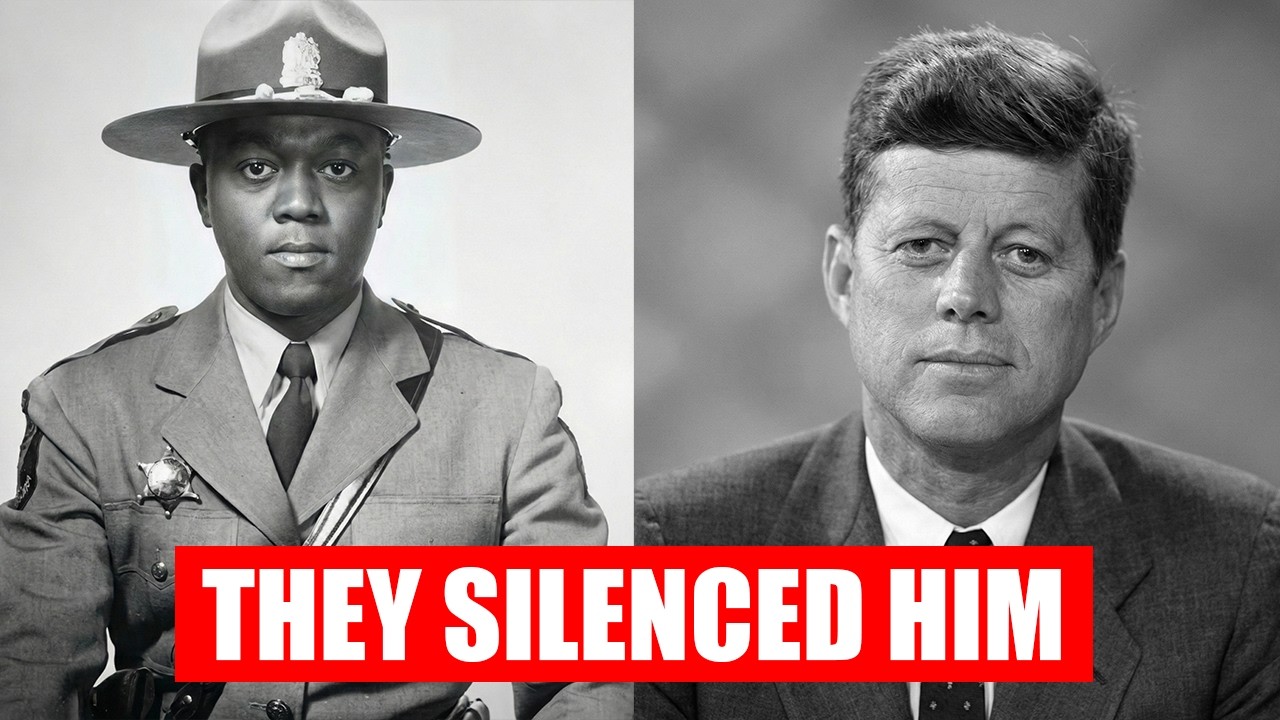
In April 1961, a 26-year-old Black Illinois State Trooper named Abraham Bolden was standing guard at a restroom door in a Chicago convention center. He had recently transferred to the Secret Service, and the duty was routine and unglamorous. Then President John F. Kennedy walked up to him and asked a question that would change both their lives.
Kennedy asked whether there had ever been a Negro Secret Service agent on White House detail in Washington, D.C. Bolden replied that there had not. Kennedy smiled and asked if Bolden would like to be the first.
Two months later, Bolden arrived at the White House. Kennedy introduced him to the team as the Jackie Robinson of the Secret Service. It should have been the proudest moment of his life. Instead, it became a nightmare.
What Bolden discovered inside the White House terrified him. When he tried to expose it and tried to save the president, the system destroyed him. This is not a conspiracy theory. It is the documented story of a whistleblower who saw an assassination coming and paid the price for trying to stop it.
In June 1961, Bolden arrived at the White House as the first Black agent on presidential detail. He found racism, hostility, and terrifying incompetence. White agents refused to work with him and called him slurs. One told him directly that they did not need any on this detail.
Worse than the racism was the negligence. Agents drank heavily on duty, partied late, showed up hungover, cut corners on security, and treated the job like a social club. Bolden reported it and warned his superiors that the president was in danger. He told them drunk agents could not react in emergencies. They told him to shut up and stop causing trouble.
So Bolden kept quiet and watched Kennedy's security deteriorate. By October 1963, he had been reassigned to the Chicago Secret Service office, doing routine counterfeiting work, away from the White House and away from the racism.
Then, on October 30, an FBI teletype arrived. It was urgent and classified. It described a plot to assassinate President Kennedy in Chicago. A four-man Cuban hit squad with high-powered rifles was scheduled to strike on November 2.
Kennedy was flying to Chicago for an Army-Air Force football game at Soldier Field. The motorcade route had been published in newspapers, running from O'Hare Airport to downtown through the Northwest Expressway, past tall buildings that offered perfect sniper locations.
The FBI teletype described four Cuban exiles, anti-Castro radicals, armed with scoped rifles. They planned to shoot Kennedy from an elevated position as his motorcade passed. The Chicago Secret Service office went into emergency mode and mobilized all agents. They had 72 hours to stop an assassination.
On October 31, a landlady called Chicago police. She had rented a room to four men. When she entered to clean, she found automatic rifles with telescopic sights spread across the bed and a map showing Kennedy's motorcade route through Chicago. Police raided the room and found the rifles, but the four men had disappeared.
Then came a second threat: Thomas Arthur Vallee. Vallee was an ex-Marine, an expert marksman, a right-wing extremist, and publicly hostile to Kennedy. He had requested time off work specifically for November 2, the day of Kennedy's visit.
Investigators discovered that Vallee worked in a warehouse along the motorcade route, on the top floor, with a direct line of sight to where Kennedy's limousine would pass. In Vallee's car, they found an M1 rifle, a handgun, and 3,000 rounds of ammunition. The profile was the Dallas playbook, three weeks early.
On November 2, 1963, at 9:00 a.m., two hours before Kennedy was scheduled to land at O'Hare, Chicago police arrested Thomas Vallee on a pretext, a minor traffic violation. They got him off the streets and secured his weapons. But the four Cuban gunmen were still missing, still armed, and still dangerous.
Maurice Martineau, the special agent in charge of the Chicago office, called the White House. His message was clear: the president's life was in grave danger, and the trip should be canceled. At the last minute, the White House announced that Kennedy would not be coming to Chicago. The official excuse was that the president had a cold and that an urgent situation in Vietnam required his attention.
The Army-Air Force game went on without him. The crowd wondered where Kennedy was. The press accepted the official story. But Abraham Bolden knew the truth. The trip was canceled because of an active assassination threat. Kennedy had been saved, for now.
On November 22, 1963, in Dallas, Texas, Abraham Bolden was in Chicago working counterfeiting cases. When the news broke, he was standing in the Secret Service office. President Kennedy had been shot. Bolden's blood ran cold.
He grabbed the nearest agent and demanded to know whether the Chicago information had been sent to Dallas, and whether the Dallas office had been warned about the threats. The answer was no. The FBI teletype about the Chicago plot was never sent to Dallas. The details about Thomas Vallee, the ex-Marine sniper with the building overlooking the motorcade, were never relayed.

The pattern, a Cuban hit squad, high-powered rifles, and an elevated shooting position, was identical to what happened in Dallas. And Dallas agents had no idea it was coming. Bolden watched the television coverage and saw reports about Lee Harvey Oswald, an ex-Marine, communist sympathizer, who worked in a building overlooking the motorcade route and shot Kennedy with a scoped rifle. It was Thomas Vallee, same profile, same method, three weeks later.
Bolden realized Dallas was the backup plan. Chicago had failed, so the operation moved to Texas. By September 1964, the Warren Commission was wrapping up its investigation. Its conclusion was that Lee Harvey Oswald acted alone, with no conspiracy.
Abraham Bolden could not believe it. The Chicago plot, documented, investigated, and foiled, was not even mentioned in the Warren report. The Commission had no idea it had happened. So Bolden decided to tell them.
In May 1964, while attending Secret Service training in Washington, Bolden called Warren Commission counsel J. Lee Rankin from a White House phone. He said he had critical information about an assassination attempt in Chicago, information that proved there was a conspiracy. Rankin agreed to meet him. It was a fatal mistake, because someone was listening.
The same day Bolden called Rankin, he was pulled out of training class and told there was an emergency in Chicago and that he needed to return immediately. On the plane back, Bolden sat between two agents who were not colleagues but escorts. At Chicago O'Hare, they drove him directly to the U.S. Attorney's office. When he asked to call his wife, they refused.
Inside, Justice Department officials interrogated him, then arrested him. The charge was accepting a $50,000 bribe from a counterfeiter in exchange for confidential files. Bolden was stunned. The accusation was absurd. He had never taken a bribe in his life.
But the prosecution had witnesses. Joseph Spagnoli, a convicted counterfeiter, testified that Bolden had solicited money from him. Another witness, Frank Jones, corroborated the story. Bolden's defense was that he had been framed, and that the counterfeiter was being used by mobsters to silence him before he could testify to the Warren Commission.
The jury did not believe him. He was convicted and sentenced to six years in federal prison. Only later did the truth emerge. Joseph Spagnoli admitted he lied. Under oath, he confessed that he had fabricated the bribe story and said he was pressured by government officials and mobsters to destroy Bolden's credibility. Frank Jones also recanted and admitted his testimony was false.
But by then, Bolden had already served three years. His career was destroyed, his reputation ruined, and his warnings about Kennedy's security buried forever. Why frame Abraham Bolden? Because he knew too much, and powerful people needed him silenced.

Bolden had evidence of the Chicago assassination plot, Secret Service negligence and drunkenness, the similarity between Vallee and Oswald, and the failure to warn Dallas. If he testified, he would destroy the lone gunman narrative, prove multiple attempts had been planned, and expose systemic security failures. He would ask why, if they stopped Chicago, they did not stop Dallas.
The man who framed Bolden had mob connections. Richard Cain, a Chicago cop and outfit made man, was involved. Cain worked for both the police department and the CIA, had anti-Castro connections, and was reportedly in Dallas on November 22. The same forces that killed Kennedy silenced Bolden.
For decades, Bolden fought to clear his name. He wrote "The Echo from Dealey Plaza" and testified before the House Select Committee on Assassinations in 1978. The HSCA confirmed Secret Service failures but could not prove the Chicago plot because Secret Service records had been destroyed.
In 2022, President Biden granted Bolden a full and unconditional pardon. Bolden was 87 years old. In 2025, at age 90, Bolden finally testified before Congress, describing the Chicago plot, the security failures, and the frame-up. Congresswoman Anna Paulina Luna apologized on behalf of the Secret Service.
She said she did not believe Bolden was guilty of a crime and did believe he was falsely framed. On behalf of the U.S. government, she apologized to him and his family, saying that is not how people are supposed to be treated in this country.
Abraham Bolden tried to save JFK. He reported security failures. He investigated the Chicago plot. He attempted to warn the Warren Commission. And the system destroyed him, not because he was wrong, but because he was right.
The Secret Service did not want to admit their agents were drunk on duty. The Warren Commission did not want evidence of a conspiracy. The mob and intelligence agencies did not want their involvement exposed. So they silenced the whistleblower, framed him, imprisoned him, and made sure his warnings were never heard.
If Bolden had been allowed to testify in 1964, history might be different. The Chicago plot would have been investigated. The pattern would have been recognized. The forces behind Dallas might have been exposed. Instead, Bolden spent three years in prison while the conspirators walked free.
Abraham Bolden represents something crucial. He is proof that people saw the assassination coming and tried to stop it, and proof that powerful forces ensured they failed. The truth does not disappear. It waits. And sometimes, 62 years later, it finally speaks.