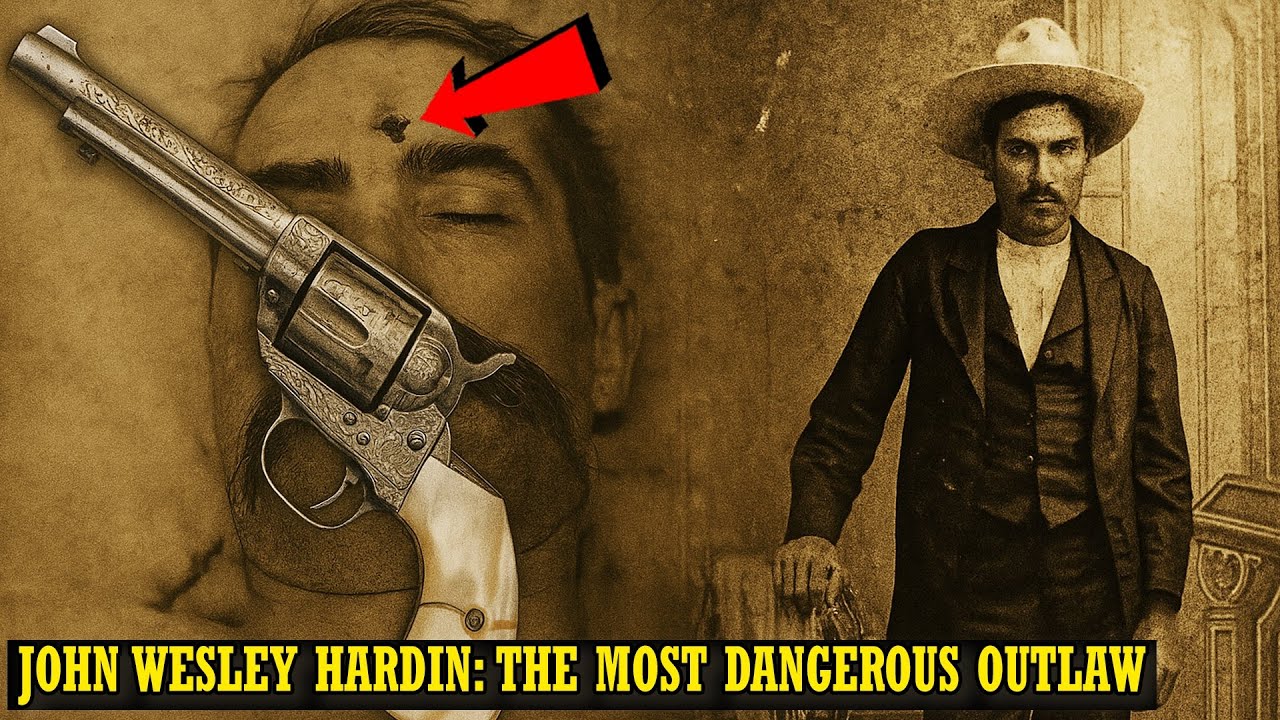
John Wesley Hardin remains one of the most feared and controversial figures of the American Old West. Part outlaw, part folk legend, he was a gunslinger so deadly that even seasoned lawmen hesitated to cross his path.
His story sits at the intersection of truth, myth, and the harsh realities of frontier life. Was he a cold-blooded killer or a product of a violent era? The record offers evidence for both views.
Hardin was born in 1853 near Bonham, Texas. His father, James Gibson "Gip" Hardin, was a Methodist minister and traveling preacher. His mother, Mary Elizabeth Dixon, came from a well-respected background and was described by Hardin as refined and compassionate.
He was named after John Wesley, the founder of the Methodist movement, reflecting the family's strong religious roots. In 1859, the family relocated to Sumpter in Trinity County, Texas, where Gip Hardin continued his ministry and opened a school.
John was the second surviving son among 10 children. The Hardens carried significant social and political influence, with relatives who served as congressmen, senators, and military officers. When the Civil War began, his father was elected captain in the Confederate Army, and young John, at just 9 years old, attempted to leave home and join the Confederate forces.
In 1867, while attending a school run by his father, Hardin became involved in a serious altercation with a fellow student named Charles Slater. The dispute began when Slater accused Hardin of writing a crude poem on the schoolhouse wall that insulted a girl in their class.
The confrontation escalated when Slater allegedly approached Hardin with a knife. In the struggle that followed, Hardin used his own knife to defend himself, causing serious injury to the other boy. Slater survived, but the incident nearly resulted in Hardin's expulsion.
A year later, in November 1868, a more tragic episode unfolded. According to Hardin's later autobiography, he had challenged Major Mage Holleshausen, an African-American man formerly enslaved by a relative, to a wrestling match that he claimed to have won.
The next day, Hardin wrote, the man allegedly confronted him on horseback, waving a stick and shouting. In response, Hardin used a firearm to protect himself. The man was seriously injured and died three days later.
Hardin later stated that he sought help for the wounded man immediately after the incident. His father, fearing that the charged political and racial climate of post-Civil War Texas would prevent a fair legal process, advised his son to go into hiding.
Hardin described being located weeks later by Union authorities who sent three soldiers to take him into custody. He claimed he was warned in advance by his older brother and decided not to surrender. At a nearby creek crossing, he recounted that he resisted arrest and that the encounter turned deadly.
By his own account, Hardin stated that this event marked a turning point in his young life. He wrote that by the end of 1868, he had been involved in multiple fatal confrontations and had sustained an injury to his arm. He also claimed that local sympathizers concealed the victims' bodies nearby to shield him from immediate capture.
Much of what is known about these early episodes comes from Hardin's own autobiography, written years later. Historians often view these accounts with caution, as they tend to blend fact with embellishment.
Hardin understood that returning home would almost certainly result in his arrest. As a result, he remained on the move. Early in his time as a fugitive, he traveled with Frank Polk, an outlaw wanted for the death of a man named Tom Brady.
The pair were active in the Pisca area of Navarro County, Texas, but were soon tracked by soldiers dispatched from Corsicana. While Hardin managed to avoid capture, Polk was caught and briefly held in custody.
During this period, Hardin claimed to have taught school for a short time in Pisca. In one of his more unusual stories, he recounted that he won a bottle of whiskey by taking part in a reckless wager that allegedly left a man seriously injured. Like many of Hardin's tales, this account lacks independent verification.
On January 5, 1870, while in the town of Towash in Hill County, Texas, Hardin was playing cards with a man named Benjamin Bradley. According to Hardin, his consistent winning upset Bradley, who became verbally threatening.
Tensions escalated, and Bradley reportedly armed himself with both a knife and a pistol. Hardin claimed he was unarmed at the time and stepped away to avoid a direct conflict. Later that night, however, Hardin stated that Bradley sought him out and allegedly fired a shot that missed.
In response, Hardin retrieved his pistols and returned fire. Bradley did not survive the incident. Eyewitnesses later confirmed aspects of the encounter, including the distinctive way Hardin wore his guns sewn into his vest with the handles angled inward. This setup allowed him to cross his arms to draw quickly, a method he practiced routinely and later described as the fastest draw possible.
In later admissions, Hardin acknowledged responsibility for the deaths of two men in Hill County during this general time frame. He also claimed that when a group of 15 men attempted to apprehend him, he managed to intercept two of them, disarm them, and send them back to their group with instructions to wait.
Later that same month, on January 20 in Horn Hill, Limestone County, Hardin reported being involved in another fatal dispute. The incident allegedly followed an argument at a circus, though again contemporary evidence is lacking.
In January 1871, Hardin was taken into custody in connection with the death of Laben John Hoffman, the city marshal of Waco, Texas. Hardin consistently denied any involvement in the incident.
After his arrest, he was temporarily held in a log-built jail in the town of Marshall while awaiting transfer to Waco for a formal hearing. While confined there, Hardin later claimed he was able to purchase a revolver from another inmate.
Two members of the Texas State Police, Captain Edward T. Stakes and an officer named Jim Smalley, were assigned to escort the 17-year-old Hardin to Waco. According to Hardin's own account, he was tied to a horse without a saddle for the journey.
During the trip, they stopped to rest in camp. Hardin alleged that while Captain Stakes stepped away to tend to the horses, he was left alone with Smalley. He claimed that Smalley began to treat him harshly and struck him repeatedly.
Hardin stated that he pretended to cry and slumped against his pony to appear harmless. Concealing his movements behind the horse, he said he managed to retrieve a hidden firearm and used it to escape custody.
Harden also recounted that shortly after this event, he was detained again, this time by three men in Bell County, Texas. He claimed that the men grew careless after consuming alcohol and that he used their own weapons to facilitate another escape.
Following the events in Bell County, he found shelter with his cousins, the Clemens family, who were living in Gonzales in South Texas. They encouraged him to consider joining a cattle drive to Kansas as a way to earn income and distance himself from legal troubles.
Taking their advice, Hardin began working with Jake Johnson and Columbus Carroll, two cattlemen operating in the region. He later claimed he was given a leadership role as trail boss. The group gathered a herd for the journey north in early 1871.
During the summer of 1871, Hardin was part of a cattle drive along the Chisholm Trail heading toward Abilene, Kansas. Along the route, tensions reportedly arose between Hardin's group and a separate herd managed by Mexican vaqueros.
As the drive progressed, the herds came too close together, leading to disputes over space and control. Near the end of the trail, Hardin recalled exchanging sharp words with the leader of the other group while both men remained on horseback.
According to Hardin, the situation escalated when the opposing herdsman allegedly fired a shot that passed through Hardin's hat. Attempting to return fire, Hardin found that his own pistol was malfunctioning due to its worn condition. He dismounted and carefully operated the weapon manually, ultimately firing a shot that struck the other man in the leg.
Following this encounter, both groups agreed to withdraw and avoid further conflict. However, Hardin later stated that he borrowed a functioning firearm from a friend and sought out the man he had previously clashed with. In Hardin's account, the second encounter resulted in the man's death.
The situation escalated into a broader exchange between the two camps. Hardin later claimed that six vaqueros lost their lives during the confrontations and that he was responsible for five of those fatalities. However, historical analysis suggests that this number was likely exaggerated. Contemporary reports indicate that three Mexican cowboys were killed, a figure more widely accepted by historians.
The Bulls Head Tavern in Abilene, Kansas, was co-owned by former lawman Ben Thompson and gambler Phil Coe. As part of a bold marketing strategy, they had a mural painted on the side of the building featuring a bull with anatomically exaggerated features. This display drew complaints from local citizens who found it offensive.
Town marshal Wild Bill Hickok was asked to intervene. When Thompson and Coe declined to alter or remove the image, Hickok took it upon himself to modify the artwork. This act upset the tavern owners, particularly Thompson, who attempted to stir up resentment by appealing to regional loyalties.
Thompson tried to involve Hardin, who was traveling under the alias Wesley Clemens but locally known as Little Arkansas. He told Hardin that Hickok was a Yankee who picked on rebels, especially Texans, to kill. Despite Thompson's attempt to provoke him, Hardin reportedly held Hickok in high regard and responded coolly, asking why Thompson did not kill Hickok himself.
Later that evening, Hickok personally approached Hardin. He informed him that local ordinances prohibited wearing firearms within town limits and instructed him to surrender his weapons. According to Hardin's account, he complied, but not in an ordinary fashion. He allegedly lifted the revolvers from their holsters and offered them to Hickok with the barrels briefly turned forward in a manner that momentarily startled the marshal.
However, the situation de-escalated and no further conflict occurred. At that point, Hickok was unaware of Hardin's true identity or his status as a wanted fugitive. Instead, he gave Hardin general advice to keep a low profile and avoid drawing attention while in town.
The two men would cross paths again in August 1871 during another cattle drive. This time, Hickok allowed Hardin to wear his pistols while inside Abilene, something he rarely permitted for others. Hardin, still using an alias, appeared to enjoy the privilege and the association with Hickok, who was already a legend of the American frontier.

On the night of August 6, 1871, Hardin, his cousin Gip Clemens, and their friend, a rancher named Charles Cougar, stayed at the American House Hotel in Abilene, Kansas. After spending the evening gambling and drinking, the three men retired for the night. Hardin and Clemens shared one room while Cougar slept in the adjacent room.
Later that night, Hardin was awakened by the sound of loud snoring coming from Cougar's room. Reportedly irritated and still under the influence of alcohol, Hardin shouted several times for Cougar to roll over and quiet down. When there was no response, Hardin, by his own admission, fired multiple shots through the wall between the rooms, apparently in an attempt to wake him.
One of the bullets struck Cougar, hitting him in the chest and resulting in his immediate death. While there is debate over whether Hardin intended serious harm, the act clearly violated city laws prohibiting the discharge of firearms within town limits.
Still partially dressed and reportedly intoxicated, Hardin and Clemens fled through a second-story window onto the roof of the hotel. From there, Hardin saw Marshal Wild Bill Hickok arrive on the scene with several officers. In his autobiography, Hardin wrote that he believed Hickok would not wait for explanations and feared the lawmen would kill him on sight.
A local newspaper reported the next day that a man was killed in his bed at a hotel in Abilene by a desperado called Arkansas, and that the murderer escaped. Hardin claimed he escaped by jumping from the roof and hiding overnight in a nearby haystack.
The following morning, he said he took a horse and rode approximately 35 miles to a cow camp outside the city. There, according to Hardin, he surprised a small group of lawmen who had been sent after him. He said he did not harm them, but forced them to remove their clothing and walk back to Abilene on foot.
Shortly afterward, Hardin left Kansas for Texas and never returned to Abilene. The entire incident quickly became part of his growing legend, with one popular version branding him as the man who shot someone for snoring. Years later, Hardin himself expressed frustration with the way the story had spread, reportedly saying that while he had killed one man for snoring, claims that he had killed six or seven were untrue.
Interestingly, in his 1896 autobiography, Hardin gave a very different account. He omitted any mention of the snoring and claimed instead that the man he shot had tried to stab him with a dagger during a burglary attempt. He also stated the incident happened on July 7, not in early August, an inconsistency that has raised questions among historians about the accuracy of his storytelling.
On January 20, 1875, the Texas legislature authorized Governor Richard B. Hubbard to offer a $4,000 reward for the capture of John Wesley Hardin. A significant sum at the time, it reflected the seriousness of the state's efforts to bring him to justice.
Around this time, an undercover Texas Ranger named Jack Duncan intercepted a letter sent to Hardin's father-in-law. The message had been written by Hardin's brother-in-law, Joshua Robert Brown Bowen, and it contained a crucial lead. Hardin was reportedly living near the Alabama-Florida border, working at a lumberyard under the assumed name John or James W. Swain.
In his later writings, Hardin acknowledged adopting this alias from Henry Swain, a town marshal from Brenham, Texas, who had married one of Hardin's cousins. While living under this false identity, Hardin continued to find himself in trouble.
In March 1876, he was involved in an altercation in Florida that resulted in injuries to a man who had attempted to intervene during a dispute. Later that same year in November, he was briefly detained in Mobile, Alabama, on accusations of using marked playing cards.
In mid-1877, two men, Jake Mensel and Robert Borup, both of whom had once been enslaved by Hardin's father, attempted to apprehend Hardin in Gainesville, Florida. The confrontation turned serious and the outcome left one man dead and the other permanently injured. This event, based largely on Hardin's own account, has been met with scrutiny by historians, especially given its racially charged context and limited independent documentation.
The effort to arrest Hardin finally succeeded on August 24, 1877, when Texas Rangers and local law enforcement officers confronted him aboard a train in Pensacola, Florida. According to reports, Hardin attempted to draw a firearm, a .44 caliber Colt cap-and-ball revolver, but struggled to free it from beneath his suspenders. Before he could act, the officers subdued him.
Two of Hardin's associates were also taken into custody during the operation. A third, identified as a man named Mann, reportedly held a pistol and was shot and killed by Ranger John B. Armstrong in the confrontation. Hardin later offered his own version of the events, claiming he had been calmly smoking his pipe when the officers approached and insisting he was not armed at the time of his arrest.
Hardin was brought to trial for the death of Brown County Deputy Sheriff Charles Webb. On June 5, 1878, he was convicted and sentenced to 25 years of incarceration at Huntsville Prison in Texas.
In 1879, Hardin and a group of 50 other inmates were discovered just hours before they could complete a tunnel that would have given them access to the prison armory. This was one of several escape attempts attributed to Hardin during his early years behind bars.
While serving his sentence, Hardin faced additional legal consequences. On February 14, 1892, he was convicted of manslaughter for the earlier shooting of J.B. Morgan, receiving a two-year sentence to run concurrently with his existing term.
Over time, Hardin began to adjust to life in prison. He spent a significant amount of time reading religious literature and eventually became superintendent of the prison's Sunday school. He also studied law, an effort that reflected his growing interest in reshaping his public image and possibly preparing for life after release.
Despite his efforts at rehabilitation, Hardin struggled with poor health throughout his imprisonment. In 1883, an old injury sustained years earlier during a confrontation with a man named Sublett became infected. The condition left him bedridden for nearly two years and contributed to his ongoing physical decline.
By 1892, prison records described Hardin as approximately 5 feet 9 inches tall, weighing 160 pounds, with hazel eyes, a fair complexion, and dark hair. He bore numerous scars from old wounds on various parts of his body, including his knee, thigh, side, and shoulder.
Tragedy struck that same year when, on November 6, 1892, Hardin's first wife, Jane, passed away while he was still incarcerated. The couple had remained married throughout his time in prison, and her death reportedly affected him deeply.
During his confinement, Hardin also began writing his autobiography. The memoir served both as a reflection on his life and an attempt to control the narrative surrounding his reputation. However, historians have long noted that the book contains numerous exaggerations and unverified claims.
In one particularly reflective passage, Hardin recalled witnessing an act of fatal violence as a child in 1861, when he saw a man named Turner Evans stabbed during an altercation. The incident, he wrote, left a lasting impression on him. Hardin used the story as a moral lesson for his readers, warning them about what drink and passion could do and urging them to be temperate and control their passions.
On February 17, 1894, Hardin was released from prison after serving 17 years of a 25-year sentence. He was 40 years old when he returned to Gonzales, Texas, attempting to re-enter society and start a new chapter in life. Shortly after his release, on March 16, he received an official pardon from the state.
Just a few months later, on July 21, Hardin passed the Texas Bar Examination, earning his license to practice law. Despite his controversial past, he had studied extensively during his time in prison and sought to establish himself as an attorney.
However, troubling stories continued to follow him. A newspaper article published in 1900 alleged that not long after his release, Hardin accepted a $5 bet that he could knock a man off a soap box with a single shot. The man reportedly died not from the bullet itself, but from the resulting fall. Though details are sparse and the incident is difficult to verify, the story contributed to Hardin's continued notoriety.
In January 1895, Hardin married Callie Lewis, a 15-year-old girl. The relationship was short-lived and ultimately ended, though no formal divorce was recorded. Later that year, Hardin moved to El Paso, Texas, where he became involved in a series of confrontations.
One notable incident began when John Selman Jr., a local lawman, arrested a woman known to be an associate of Hardin's. The arrest led to a confrontation between Hardin and Selman Jr. Some reports claim that Hardin may have physically assaulted the young officer, though accounts vary and are not uniformly confirmed.
Tensions escalated further when Constable John Selman Sr., Selman Jr.'s father and a former outlaw with his own reputation, confronted Hardin in public on August 19, 1895. The two exchanged harsh words that afternoon.
Later that evening, Hardin went to the Acme Saloon in El Paso, where he began playing a game of dice. His final recorded words, according to witnesses, were reportedly "four sixes to beat." Just before midnight, Selman Sr. entered the saloon and approached Hardin from behind.
What happened next is still debated, but Selman shot Hardin, who died instantly. Several more shots were fired after Hardin fell, though the exact number and sequence are subject to conflicting reports. At the time of the incident, Hardin's hand was resting on the grip of a holstered Smith and Wesson Frontier model .44 revolver.
Hardin was laid to rest the next day in El Paso's Concordia Cemetery, where his grave remains a local historical site. Constable Selman Sr. was arrested and charged with murder. He claimed that he acted in self-defense, stating that Hardin reached for his weapon when Selman entered the saloon.
At trial, the jury could not reach a unanimous verdict, resulting in a mistrial. Selman was released on bond pending a new trial. Before the case could be retried, Selman himself met a sudden end on April 6, 1896. He became involved in a dispute with U.S. Marshal George Scarborough following a card game. The argument escalated and Selman was fatally shot, bringing to a close the final chapter in one of the most volatile feuds in post-Civil War Texas history.
On August 27, 1995, exactly 100 years after Hardin's death, a dispute took place at his grave site in Concordia Cemetery in El Paso. The conflict involved two opposing groups.
One group was made up of several of Hardin's great-grandchildren who wanted to relocate his remains to Nixon, Texas. Their intention was to have him reburied beside his first wife, Jane, to honor what they saw as a more appropriate final resting place based on family ties.
The second group consisted of El Paso residents and local preservationists who were strongly opposed to the move. They believed Hardin's burial in El Paso was historically significant and part of the city's heritage.
When the two sides met at the cemetery, tensions escalated. Hardin's descendants presented a legal permit for disinterment, authorizing the exhumation of his remains. In response, the El Paso group produced a court injunction that prohibited any attempt to remove the body.
Both parties accused the other of being motivated by financial interests. Hardin's descendants suggested El Paso officials were more concerned with protecting tourism revenue. El Paso claimed the family wanted to capitalize on his legacy in another location.
Legal action followed. An initial court ruling favored keeping the remains in El Paso, but this decision was later overturned on appeal. Despite the legal back and forth, Hardin's remains were ultimately never moved and continued to rest in Concordia Cemetery.
John Wesley Hardin did not just live dangerously; he made danger his legacy. With a trail of bodies, daring escapes, and courtroom drama that reads like fiction, he stands alone as one of the most feared gunslingers of the American frontier.
Whether seen as a cold-blooded killer or a product of a violent era, one thing is certain: his story is soaked in gunpowder and written in blood.