On December 17, 1944, Battery B of the 285th Field Artillery Observation Battalion was moving south through the Ardennes toward Ligneuville, Belgium. The 113 men were not frontline troops. They were artillery observers, trained to spot enemy gun positions and radio coordinates back to the batteries behind them, and they had seen relatively little combat.
At about 1:00 p.m., the lead elements of Kampfgruppe Peiper came around a bend in the road near the Baugnez Crossroads. The column was commanded by SS-Obersturmführer Joachim Peiper, leading the armored spearhead of the 1st SS Panzer Division toward the Meuse River as part of Germany's last major offensive in the west.
Peiper's column was behind schedule and low on fuel. His guns opened up on the American convoy without warning. Trucks burned, jeeps overturned, and men dove into ditches. Within minutes it was over.
The Americans who had not been killed raised their hands. Roughly 113 unarmed men surrendered and stood in a field with their hands above their heads in the gray December afternoon. The SS collected them, searched them, and took their watches, rings, and whatever was in their pockets.
The prisoners were assembled in rows in the open field. A tank and some infantry were left to deal with them while Peiper pushed on ahead.
What followed was not heat of battle, confusion, or misunderstanding. A German pistol fired once into the crowd of prisoners, and then the machine guns opened up. The SS soldiers fired into the assembled Americans until the men stopped moving, then walked through the field and shot anyone who appeared to still be alive.
Some of the wounded tried to run and were shot running. Some played dead and lay still in the blood-soaked Belgian mud while SS soldiers walked among them with pistols. When it was over, 84 American soldiers were dead in that field.
Forty-three survived by running, by hiding in a ditch, or by lying still under the bodies of men who had not been fast enough or lucky enough. They made their way back to American lines near the town of Malmedy, arriving in ones and twos, bleeding, shaking, and barely able to speak.
The story moved through the American front lines like fire through dry timber. By nightfall on December 17, every unit in the sector knew what had happened at the Baugnez Crossroads. By the following morning it had reached division headquarters, and by December 18 it was in American newspapers, from Stars and Stripes to Life magazine.
The Battle of the Bulge had already pushed the American lines to the breaking point. The German offensive had struck in the worst possible weather, with fog so thick that Allied air support was grounded completely and temperatures dropping toward zero. Men were fighting in summer uniforms without winter gear because nobody had expected an attack in that place at that time of year.
Units were cut off, supply lines were severed, and towns were being lost. The psychological pressure was immense. And now word was spreading that the SS was machine-gunning prisoners.
Every American soldier in the Ardennes asked himself the same question once Malmedy became known: if I get surrounded, if my position is overrun, if I have no ammunition left and no way out, if I raise my hands, what happens to me?
The answer Malmedy provided was not the answer men needed to keep fighting. It was the answer that made men think about running instead of surrendering when the situation became impossible, and it attacked the fragile psychological architecture that made organized resistance possible.
Patton understood this immediately. He had built his command philosophy around the will to fight, the specific and sustained refusal to stop when stopping seemed like the only logical option. Malmedy was a direct attack on that will, not just on 84 men in a Belgian field but on every American soldier who heard about them and began doing the mathematics of what surrender meant.
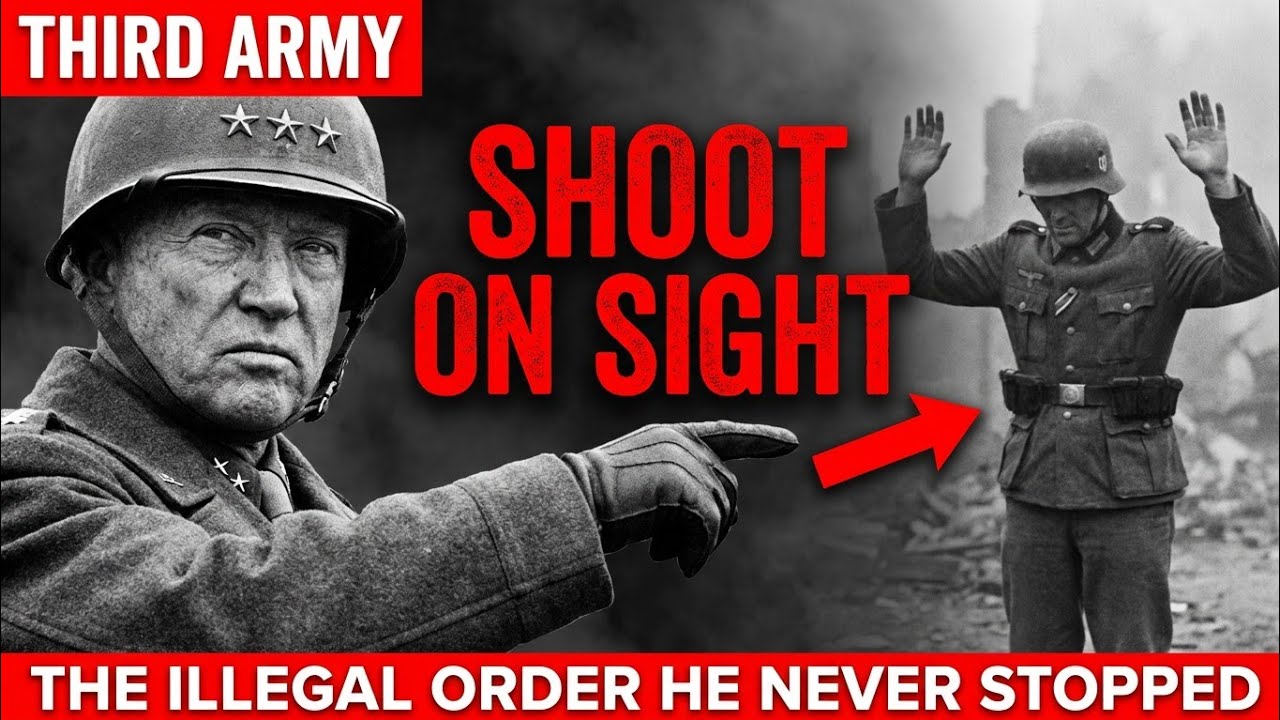
On December 21, 1944, four days after the massacre, the headquarters of the 328th Infantry Regiment issued an order. It was written down, distributed through the chain of command, and unambiguous: no SS troops or paratroopers would be taken prisoner, but would be shot on sight.
It was an illegal order, and every officer who signed it knew it. The Geneva Convention was explicit that surrendered soldiers were protected regardless of the unit they belonged to or the crimes their unit had committed. You could not execute a man for the actions of other men in the same uniform.
The order went out anyway, and it was not the only one. Across the American front in the days after Malmedy, unit commanders issued variations of the same instruction through different channels, some written, some verbal, some implied simply by the way senior NCOs talked to their men before attacks. The formal language varied. The meaning did not.
Patton read the reports and spoke to the officers. He understood exactly what was happening in the units under his command and exactly what it meant legally. In his diary, in his own hand, he wrote about it with the pragmatism of a man who had already made his peace with the gap between what the rules said and what the war required. He did not condemn the orders. He worried about whether they could be concealed.
The bodies at the Baugnez Crossroads remained in the field for almost a month. The crossroads stayed in German hands until January 14, 1945, and the 84 men who had been machine-gunned lay in the Belgian snow through Christmas, through New Year's, through the worst weeks of the battle, frozen into the position they had fallen.
When American forces finally retook the ground and graves registration units went in to recover the dead, what they found confirmed everything the survivors had described: head wound evidence, bound hands and ankles, bodies clustered in the rows where the machine gun had cut across them, and the scattered shapes of men who had tried to run. The documentation was meticulous, the photographs were taken, and the evidence was gathered.
On January 1, 1945, two weeks after Malmedy, soldiers of the 11th Armored Division captured approximately 80 German prisoners near a small Belgian village called Chenogne. They marched them to a field and machine-gunned them. SS soldiers had walked among the American bodies at Baugnez, shooting the wounded. American soldiers walked among the German bodies at Chenogne doing the same thing.
Eighty-four Americans at Malmedy, 80 Germans at Chenogne. The mathematics of revenge is rarely precise, but it is rarely far off.
Patton found out about Chenogne and wrote about it in his diary in the way a man writes about a problem he needs to make disappear rather than a crime he needs to address. "I hope we can conceal this," he wrote.
It was the same instinct and the same calculation he had shown in 1943, when he had written, "Tell them to say they were trying to escape," about Biscari. The language was different. The logic was identical. Patton was not a man who agonized. He was a man who decided.
The Malmedy massacre trial opened at Dachau on May 16, 1946. Seventy-four SS members stood in the dock, Joachim Peiper among them. The charges covered not just the Baugnez Crossroads but the entire pattern of atrocities Kampfgruppe Peiper had committed across Belgium from December 1944 to January 1945, including 362 American POWs and 111 Belgian civilians killed.
The prosecution argued premeditation, Hitler's orders for a ruthless campaign, and a deliberate policy of terror. The defense argued heat of battle, confusion, and young soldiers acting without orders in chaotic conditions.
On July 16, 1946, the tribunal delivered its verdict. All 74 defendants were found guilty. Forty-three were sentenced to death by hanging, including Peiper. Twenty-three received life sentences, and the rest between 10 and 20 years.
Then the sentences began to unravel. The defense claimed the SS men had been tortured into their confessions, subjected to mock trials, and had family members threatened. The accusations spread into the American press and into Congress. Investigations were launched, and procedural irregularities were found, not enough to exonerate anyone but enough to create the legal and political space for commutation.
By 1951 most of the men were free. In 1956, Joachim Peiper walked out of Landsberg prison. The man whose unit had machine-gunned 84 American POWs in a Belgian field 12 years earlier walked into the morning air of postwar West Germany and went home.
He lived quietly for 20 years. On July 13, 1976, his house in Traves, France, was set on fire in the night, and Peiper's body was found in the ruins. The group that claimed responsibility called themselves The Avengers. They were never identified and never charged.
The men who had survived the Baugnez Crossroads by playing dead in the frozen mud were old men by 1976. Some had been following Peiper's postwar life for years. Some knew exactly where he lived. None of them ever said anything publicly about July 13, 1976.
The Chenogne massacre was never prosecuted. Not a single American soldier was charged for the 80 German prisoners killed in that Belgian field on January 1, 1945. The official US military history of the Battle of the Bulge acknowledged that Germans attempting to surrender in the days after Malmedy ran a greater risk than they had before, then stated that there was no evidence American troops had followed explicit orders to kill prisoners.
Patton had written, "I hope we can conceal this," in his diary, which was published after his death. He died on December 21, 1945, one year to the day after the 328th Infantry issued its order to shoot SS soldiers on sight. He died in a military hospital in Heidelberg from injuries sustained in a car accident on a routine road in Mannheim.
He had survived the entire war. He had crossed the Rhine, driven through the heart of Germany, stood at the gates of the Reich, and brought his army home. He died on a quiet German road in peacetime. The diary entry about Chenogne became part of the historical record. Nobody was ever charged.
What the Malmedy massacre produced was this: 84 Americans machine-gunned in a field; an illegal order to shoot SS soldiers on sight distributed through an American division within four days; a responding massacre of 80 German prisoners two weeks later; a war crimes trial that convicted 74 men and then systematically released every one of them within a decade; a commanding general who wrote about concealing American reprisals in his personal diary and died before anyone could ask him about it; and a former SS colonel who lived quietly in France for 20 years until his house burned down in the night.
The line between justice and war crime is supposed to be clear. Malmedy is the story of what happens when both sides erase it at the same time and then spend 30 years arguing about who erased it first.
Was Patton right to look the other way when his men killed SS prisoners in response to Malmedy? Or does looking the other way make you responsible for what happens in the dark? Patton never answered that question. He wrote, "I hope we can conceal this," and moved on to the next problem. The Avengers who burned Peiper's house in 1976 had their own answer.