On the morning of April 4, 1945, General George S. Patton walked through the gates of a camp near the German town of Ohrdruf. He wore a polished helmet and carried a riding crop under his arm. He was the commanding general of the Third Army, a man who had broken through at Avranches, raced across France, and turned his army ninety degrees in forty-eight hours to relieve Bastogne.
He walked in like a conqueror. Then his posture changed. By the time he reached the center of the camp, his riding crop was at his side and his shoulders had dropped.
Two miles away, in the clean medieval town of Ohrdruf, Mayor Andreas Mhler was having breakfast. He had heard the Americans were at the camp and was not worried. He had already decided what he would say if anyone asked. He had not known. No one in the town had known.
By the end of that day, he would be standing inside those gates. By the following morning, he would be dead.
Patton had been at war his entire adult life. He had studied it, trained for it, and believed it was the truest test of what a human being could endure. He had seen thousands of dead men across North Africa, Sicily, France, and Germany. He was not a man who flinched.
April 1945 felt like spring. The Allied armies were racing across Germany, the trees were blooming, and the weather was warm. Then the smell hit them. It came before the camp was visible, a thickness in the air that made soldiers gag and their eyes water.
Patton's command car stopped. He sniffed the air and thought it might be a chemical factory or a glue factory processing dead horses. He ordered his officers to find out what it was.
A few hours later, a jeep came back fast. The officer inside was pale and his hands were not steady. He told Patton he had to come see it.
The camp was called Ohrdruf. It was a subcamp of Buchenwald and the first Nazi concentration camp liberated by the United States Army on the Western Front. The SS guards had fled before the Americans arrived, but not before trying to clean up what they had left behind. They had not had enough time.
Patton arrived at the gate with Generals Omar Bradley and Dwight Eisenhower. Between them, they had sent millions of men to war and believed they understood what war cost. They were wrong about what they were about to see.
Inside, Patton saw the roll call square. Bodies were stacked like cordwood, naked, starved, and shot in the back of the neck. They were arranged with the specific efficiency of men who had done this many times before.
Patton walked up to the nearest pile and stood in front of it. A survivor crawled toward him, a man in striped clothing who weighed perhaps thirty-five kilograms, his eyes enormous in his sunken face. He reached toward Patton's boots.
Patton stepped back gently, then reached down and helped the man stand. He had tears in his eyes.
Then they found the shed. Inside was a whipping block, its wood dark with old blood absorbed over years. There were hooks on the wall where men had been suspended until they suffocated. A prisoner who spoke English explained quietly what the guards had done in that room, not under orders but for entertainment.
Eisenhower's face went white. He stood completely still. Bradley could not speak.
Patton walked to the back of the shed. His staff could see his shoulders from behind, heaving. The toughest general in the American army stood there for several minutes. When he came back, his face was controlled, but his voice was different. It was not the voice of a general giving orders.
He walked to a young military policeman and asked whether the people in the town knew about this. The MP answered carefully that they said they did not, that they thought it was a prison for criminals.
Patton looked at him for a moment, then laughed, a short, dark, bitter sound. The smell alone covers the whole county, he said. They knew.
Patton did not wait for permission. He did not consult Eisenhower. He called the provost marshal and pointed his riding crop toward the town of Ohrdruf two miles away.
Go into that town, he ordered. Find the mayor, his wife, the bankers, the doctors, the leading citizens. Bring them here, all of them, today.
The MP hesitated and asked what if they refused. Patton touched the ivory handle of his revolver. They won't refuse, he said. Use trucks. Use bayonets if you have to. But every single one of them is going to tour this camp today.
Two miles away, Andreas Mhler had finished his breakfast. He was in his office when the trucks arrived. When the MPs knocked on his door, he was composed. He had his story prepared. He had not known. The town had not known.
He was still composing his denial when they put him in the truck.
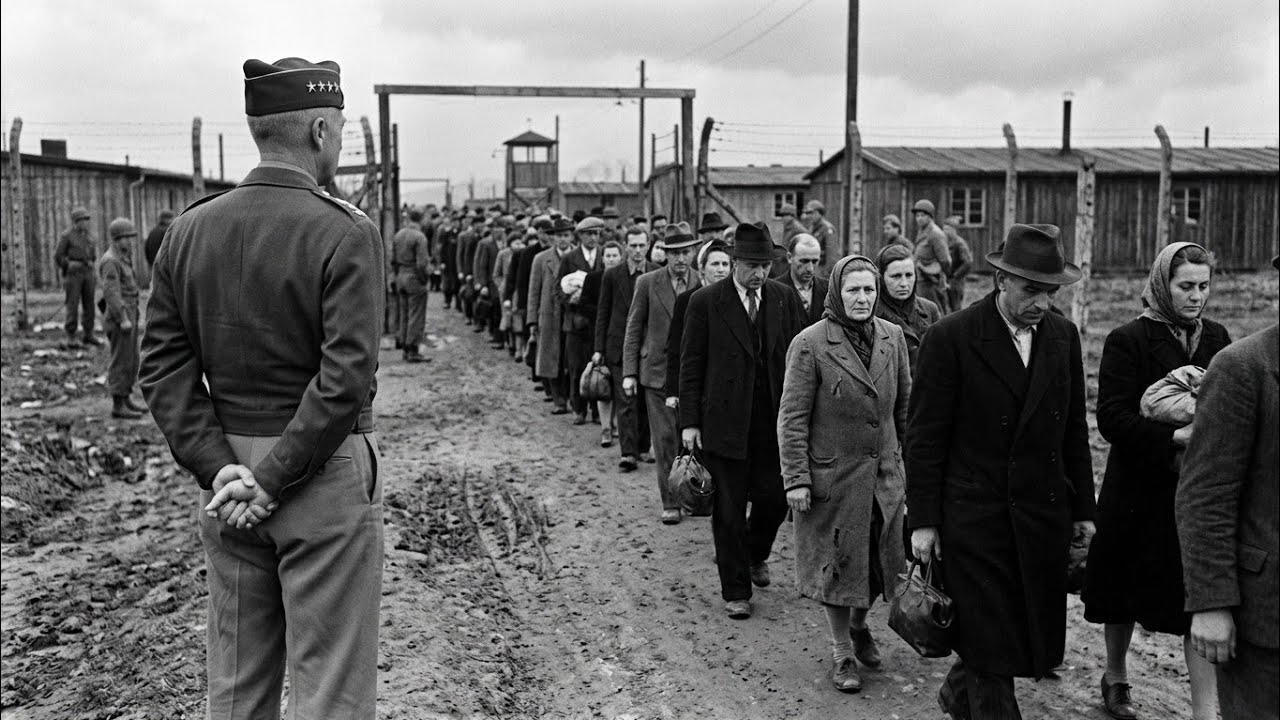
The citizens of Ohrdruf arrived at the camp gates the following morning. They had dressed carefully, men in suits and ties, women in coats and dresses. Some complained about the smell. Some held handkerchiefs to their noses. They were annoyed and offended, their arrogance intact.
Patton watched them climb down from the trucks. He ordered the MPs to form a line. March them through, he said. Don't let them look away. Make them look.
The tour began. The civilians were led to the first pile of bodies. The chatting stopped. The complaining stopped. The handkerchiefs dropped. There was only the wind and the sound of flies.
One woman fainted. The MPs pushed the group forward. They were led to the whipping block, to the hooks on the wall, to the ovens where the remains of human beings had been processed like material.
Patton walked behind them, watching their faces, looking for the specific moment when denial became something else. At first they looked shocked. Then horrified. Then he saw it in some of the faces. Guilt. Not surprise, not discovery, but guilt. The expression of people confronting something they had always known was there and had chosen every single day not to look at directly.
Some of the men started weeping. Some of the women were hysterical. Some just looked at the ground.
Patton walked up to Andreas Mhler. The mayor was trembling. The composure was gone, and the prepared denial was gone. Patton looked him in the eye. You knew, didn't you?
The mayor said nothing. He shook his head. Tears were running down his face.
Patton turned to his staff. They are not the master race, he said. They are just people who lost their souls.
The tour lasted two hours. By the end, the arrogance was gone from every face. The suits and dresses were covered in the dust of the camp, and the smell had settled into their clothing. They were loaded back onto the trucks and driven back in silence to the clean streets and the flower boxes.
Patton watched the trucks leave. He wrote to his wife that night that he had never felt so angry, but he believed they had taught them a lesson they would never forget.
Andreas Mhler went home with his wife. They entered their house and sat in their living room. What they said to each other is not known. Whether they talked for hours or sat in silence is not known. Whether they slept is not known.
What is known is what American soldiers found when they knocked on the door the following morning. No answer. They knocked again, then kicked the door open. The mayor and his wife were dead. They had taken their own lives during the night. Beside them was a note written in German. We cannot live with this shame.
When Patton was told, he did not show pity. He nodded once. Well, that is two less Nazis we have to feed.
It sounds cold. It was cold. But Patton had stood behind that shed twenty-four hours earlier. He had seen what the mayor's silence had made possible. He had helped a thirty-five-kilogram man stand on legs that could barely hold him. He had no tears left for the people who had chosen not to look.
Eisenhower left Ohrdruf a different man. He understood immediately that what he had seen would be denied, that people in the future would call it propaganda, and that the specific horror of those gates would be softened by time and distance.
He issued a command to every unit in the area. Bring cameras, bring journalists, photograph everything, film everything. He ordered thousands of American soldiers to tour the camp. He wanted them to know what they had been fighting. He wanted it witnessed by enough people that denial would become impossible.
Ohrdruf was small compared to what the Allies would find in the weeks that followed. But it was first. It was the camp that arrived before the world had built the language to describe what it was looking at. It was the place where three generals walked through a gate in polished helmets and came out the other side permanently altered.
The mayor's note sat in an American intelligence file, filed, archived, and forgotten by most, but not by everyone.
Go back to April 4, 1945, at nine in the morning. Patton walking through those gates, polished helmet, riding crop, looking like a conqueror. He had been to war his entire life and had seen everything war produced. He walked in completely certain of who he was and what he had seen.
He was wrong about the second part.
Two miles away, a man was having his breakfast. Flower boxes on the window sill. Clean streets outside. A prepared denial ready for anyone who asked. By the following morning, that man was dead.
Not because Patton killed him, but because Patton made him look. That is the thing the mayor could not survive. Not the Americans, not the consequences, not the punishment. Just the looking.