The telephone line crackled with barely suppressed fury as General Omar Bradley gripped the receiver in Luxembourg City on December 20, 1944. Across the wire came Dwight Eisenhower's measured voice, delivering an order that would test their friendship to its breaking point.
Two American armies, the First and the Ninth, were being placed under British command. Under Montgomery's command.
"By God, Ike, I cannot be responsible to the American people if you do this," Bradley erupted, his Missouri composure finally shattering. "I resign."
The supreme commander's response came cold and precise. "Brad, I, not you, am responsible to the American people. Your resignation, therefore, means absolutely nothing."
Bradley paused, made one more protest, then fell silent.
This moment, buried in the chaos of Hitler's Ardennes offensive, crystallized three years of mounting American frustration with a British field marshal who seemed determined to prove he alone could win the war.
Bernard Law Montgomery, victor of El Alamein and hero of Britain, had become the most divisive figure in the Allied command structure. But the question that haunted American headquarters from Tunisia to Germany was simpler and more damning.
Why did a coalition fighting for survival against Nazi tyranny find itself torn apart not by the enemy, but by the personality of one man?
The answer lay not in a single incident, but in an accumulation of moments, decisions, and clashes that began in North African sand and ended in the mud of Northwest Europe. This is the story of how military genius became military burden, how national pride collided with Allied necessity, and how the Americans came to view their most prominent British battlefield commander with emotions ranging from exasperation to something approaching loathing.
The mathematics of Allied command were deceptively simple but politically complex. By late 1944, American forces in Europe outnumbered British troops by substantial margins. American industrial output dwarfed Britain's war-stretched economy.
Yet Field Marshal Bernard Law Montgomery seemed constitutionally incapable of acknowledging these realities or adjusting his behavior accordingly.
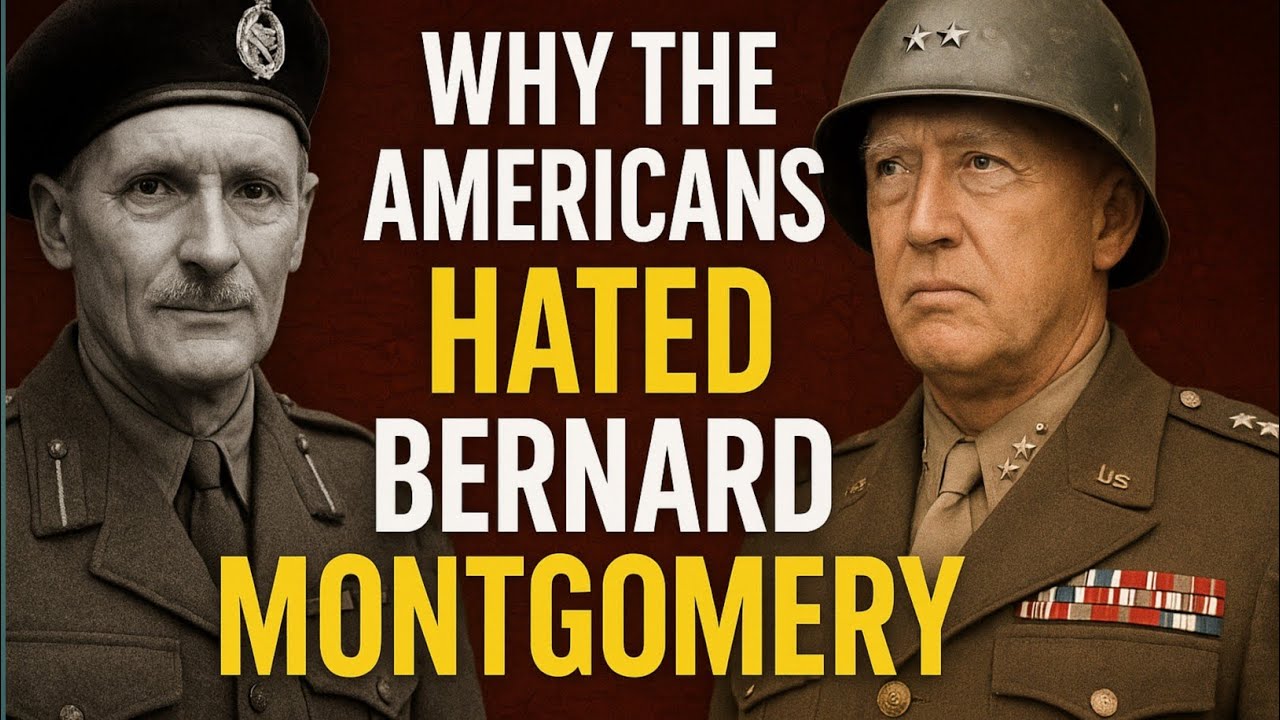
To American eyes, Montgomery represented everything they had fought a revolution to escape. Aristocratic presumption, colonial condescension, and an unshakable belief in British superiority.
But Montgomery was no caricature. He was genuinely brilliant, meticulous in preparation, careful with his soldiers' lives in ways that endeared him to his troops. His victories were real, his tactical acumen undeniable.
British soldiers, battered by early war defeats, had found in Montgomery a commander who won battles while keeping casualty lists manageable. Churchill cherished him. The British public adored him.
None of this mattered to American commanders who found themselves repeatedly sidelined, patronized, and publicly diminished by a field marshal who seemed to view them as enthusiastic amateurs requiring British guidance.
The friction began not with grand strategic disputes but with something far more personal. Respect, or the lack thereof.
From their first encounters in North Africa through the final victory in Germany, American commanders would discover that Montgomery's treatment of them revealed assumptions about American competence, American courage, and American worth that cut deeper than any battlefield disagreement.
On March 6, 1943, at Kasserine Pass in Tunisia, the desert wind carried the acrid smell of burned vehicles and defeat across the Tunisian landscape. Lieutenant General George S. Patton stepped off his plane, arriving to assume command of the battered Second Corps.
Twenty days earlier, German forces under Field Marshal Erwin Rommel had savaged American units in their first major engagement with veteran Wehrmacht troops. The defeat had been comprehensive, humiliating, and instructive.
What greeted Patton was not merely a demoralized command, but a British command structure that viewed American forces as unreliable auxiliaries requiring careful supervision.
General Sir Harold Alexander, the new British commander of 18th Army Group overseeing all Allied ground forces in Tunisia, had drafted a report on American combat performance that read like an indictment. American commanders lacked experience. American troops lacked discipline. American units required extensive British oversight before they could be trusted with significant responsibilities.
The report was not entirely unfair. Kasserine Pass had exposed genuine deficiencies in American leadership, tactics, and combined arms coordination. But Alexander's response went beyond corrective criticism. In his view, Second Corps should be assigned supporting roles while British forces executed the primary attacks.

Patton understood immediately what was at stake. This was not merely about defeating Rommel. It was about proving that American arms could stand alongside their British counterparts as equals. His diary entries from this period documented British presumption and his determination to prove American worth through aggressive action.
Montgomery, commanding the British Eighth Army approaching Tunisia from the east, embodied the British assumptions Patton resented. The victor of El Alamein carried himself with the confidence of a commander who had reversed Britain's fortunes in the desert.
He had driven Rommel across North Africa through methodical, carefully prepared operations that emphasized overwhelming material superiority rather than tactical flair. His soldiers trusted him because he won without wasting their lives unnecessarily. But his manner suggested that he alone understood modern warfare, and that others, particularly Americans, had much to learn.
Alexander's operational plan for the final Tunisia campaign reflected these assumptions. Montgomery's Eighth Army would deliver the primary blow against the Mareth Line, the Axis fortifications in southern Tunisia. Patton's Second Corps would conduct supporting attacks, drawing German attention away from Montgomery's main effort.
The Americans would serve as Montgomery's shield while the British won the glory of breaking through to Tunis.
The plan had military logic. Montgomery commanded veteran troops with proven success against German armor. Patton led formations still learning their trade. But the allocation of missions carried implications beyond tactical prudence. It established expectations that would haunt American commanders throughout the war.
British forces taking the lead, American forces providing support, British commanders receiving credit while American achievements went unnoticed or minimized.
Patton launched his offensive toward El Guettar on March 17, 1943, determined to prove American competence through aggressive action. His orders reflected his personality, mixing tactical guidance with demands for aggressive leadership. Officers would lead from the front. American troops would show the same aggressive spirit that had characterized their entry into the First World War. Whatever the cost, II Corps would demonstrate that it deserved to be treated as a combat force rather than occupation troops.
The Battle of El Guettar provided vindication. On March 23, fifty German tanks of the 10th Panzer Division emerged from mountain passes into the valley, executing a dawn attack designed to shatter American defenses.
What followed shocked the German commanders. American artillery, emplaced with careful attention to overlapping fields of fire, unleashed devastating concentrations on the advancing armor. Tank destroyers, positioned to exploit terrain advantages, engaged the Panzers at ranges that negated German tactical superiority.
By day's end, the battlefield was littered with destroyed German vehicles, and the 10th Panzer Division had been stopped cold. For the first time, American forces had defeated experienced German armored units in sustained combat.

But the victory carried a bitter aftertaste. Alexander's headquarters, focused on Montgomery's operations against the Mareth Line, paid minimal attention to II Corps success. British staff officers continued to issue detailed instructions to Patton, micromanaging American operations in ways that suggested persistent doubts about American competence.
More galling still, Alexander repeatedly changed II Corps's objectives, shifting priorities in ways that appeared designed to ensure American forces remained auxiliary to British operations. Patton would be ordered to advance, then halt, attack with armor, then lead with infantry. Each change disrupted American operations and signaled that Second Corps existed primarily to facilitate Montgomery's plans rather than to achieve independent objectives.
When Montgomery finally attacked the Mareth Line on March 20, his initial assault made little progress against determined German resistance. He adapted by shifting his main effort to an outflanking maneuver, demonstrating the flexibility that characterized his best operations. But the modification required time, allowing German forces to establish new defensive positions. By the time Eighth Army broke through, the opportunity for a decisive pursuit had passed.
Second Corps continued its supporting attacks in central Tunisia, drawing German reserves away from Montgomery's front. American forces advanced steadily, taking objectives and inflicting casualties on Axis forces. But these achievements went largely unacknowledged in British reporting. Montgomery's breakthrough received extensive publicity. Patton's contribution, equally important to the overall campaign, merited minimal mention.
When the victory parade was held in Tunis on May 20, 1943, with General Eisenhower, Alexander, and French General Henri Giraud taking the salute, the narrative emphasized British and French achievements, while American contributions received cursory acknowledgement.
For American commanders, Tunisia provided lessons that went beyond tactics and logistics. They learned that fighting alongside the British meant fighting for recognition as well as victory. They discovered that Montgomery, whatever his military talents, seemed incapable of treating American forces as genuine partners rather than promising apprentices.
And they began to suspect that this attitude reflected not just Montgomery's personality, but a broader British unwillingness to accept that the balance of power in the alliance had shifted irrevocably toward Washington. These lessons would prove prophetic when the Allies turned their attention to the next objective, Sicily.
On July 10, 1943, the largest amphibious assault in history to that point rolled toward the shores of Sicily as Operation Husky, the invasion of Italy's largest island, commenced in darkness and heavy seas. Over eight divisions, divided between General Bernard Montgomery's British Eighth Army and General George Patton's American Seventh Army, stormed beaches from Cape Scaramia to Syracuse in an operation that would test Allied unity as thoroughly as it tested German and Italian defenses.
The plan for Operation Husky had been contentious from its inception. Initial proposals envisioned landings dispersed across Sicily, seizing ports quickly to ensure adequate supply for subsequent operations.
Montgomery detested dispersed landings. His experience in North Africa had convinced him that concentration of force was paramount, that scattering troops invited defeat in detail. On April 24, 1943, he articulated his objections and proposed an alternative. Concentrate all landings on Sicily's southeastern corner, giving Eighth Army the clear mission of driving straight to Messina, the island's northeastern port and the gateway to mainland Italy.
Air Marshal Arthur Tedder and Admiral Andrew Cunningham, responsible for air and naval operations respectively, opposed Montgomery's plan. It would leave thirteen Axis airfields operational, posing unacceptable risks to the invasion fleet. It would require ships to remain concentrated in limited waters vulnerable to air attack. Their objections carried weight. Both men commanded respect earned through successful operations.
Montgomery's response revealed the full force of his personality. He threatened with Churchill's backing to resign rather than execute a plan he considered fundamentally flawed.
Faced with a crisis that threatened to derail the entire invasion, Eisenhower called a conference for May 2 to resolve the dispute. The meeting exposed fault lines that would widen throughout the war. Montgomery presented his case with confidence bordering on arrogance. Tedder and Cunningham pushed back, defending the importance of airfields and naval security. Eisenhower, attempting to balance military necessities against coalition politics, ultimately sided with Montgomery. The landings would be concentrated in southeastern Sicily.