On the night of October 16, 1944, a German column moved south along the Aachen–Vaalserquartier road in western Germany. The infantry walked; the vehicles rolled without lights, blacked out against the threat of American aircraft and artillery observers. Ahead of them, three miles to the south, the glow of Aachen burned on the horizon.
The fires consuming the city had been visible from the surrounding countryside since the Americans began the final reduction of the garrison on October 13. The men of the 246th Volks Grenadier Division marched toward that glow on a relief mission, understanding that every hour of delay meant another hour of attrition for the defenders inside.
They did not know that American forward observers on the high ground to the northwest had been watching them for the past hour. The observers plotted the column's position and movement on the artillery map, reported to the fire direction center, and prepared the mission that was about to end the march.
Aachen was the first German city contested on German soil in the Second World War, and its symbolism exceeded its military value. It was the city of Charlemagne, the ancient capital of the Carolingian Empire, where more than 30 German kings and Holy Roman emperors were crowned between 936 and 1531. Charlemagne himself is buried beneath the Gothic choir of Aachen Cathedral.
Hitler had declared Aachen a Festung, a fortress to be defended to the last man and the last shell. The garrison under Colonel Gerhard Wilck was ordered to hold until relief arrived, fighting in the rubble, cellars, and streets rather than surrender the city that German propaganda called irreplaceable.
The 246th Volks Grenadier Division had been ordered to break the American encirclement and relieve the garrison. The higher command understood the political and symbolic cost of losing the first German city, and it communicated that urgency down the chain of command.
The American observers watching the column were forward artillery observers from the 30th Infantry Division's artillery, working with VII Corps artillery. The Long Tom 155 mm gun battalions had been positioned on the high ground north and west of Aachen since the encirclement operation began in early October.
The observer's job was to see the target, report its location in grid coordinates, call for the type and amount of fire, assess the first shells, and adjust the following rounds onto the target. Tonight the target was moving at the pace of infantry on a road march, perhaps three miles per hour.
That meant the observer had to estimate the column's speed and direction and report a predicted position — where the column would be when the shells arrived about 30 seconds after the guns fired. The math was not complicated, and the observer had trained for exactly this.
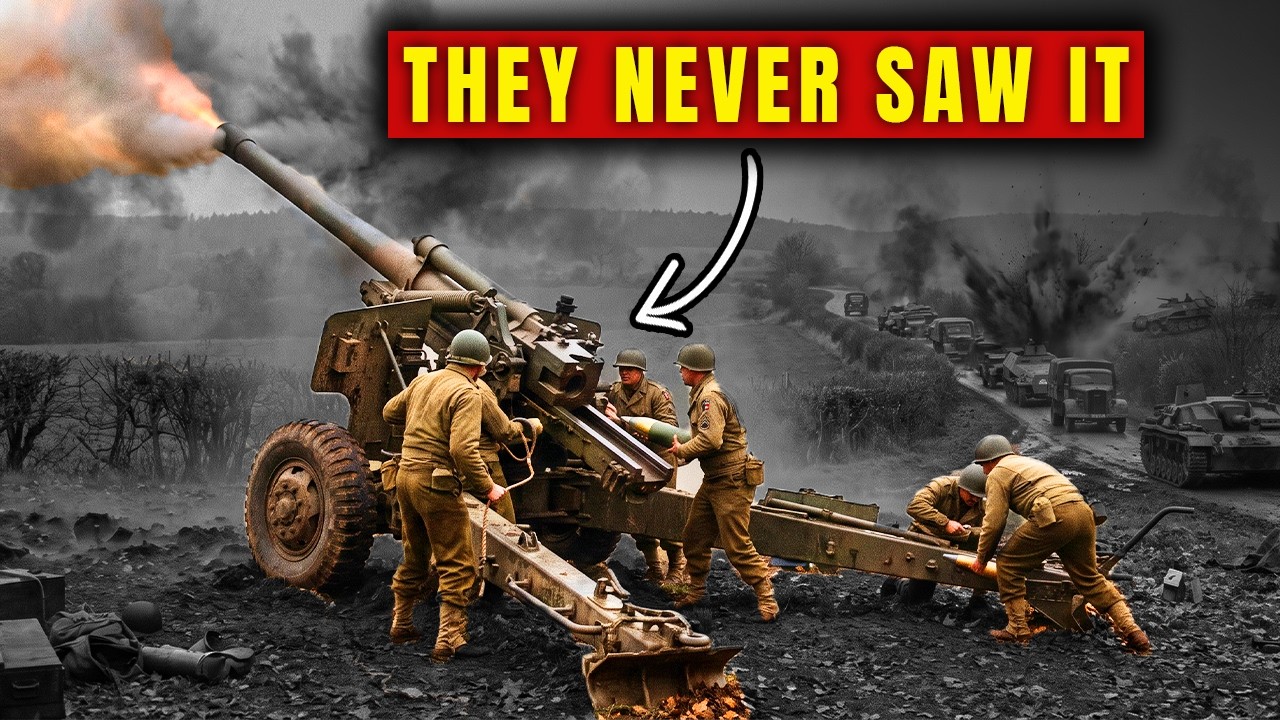
The Long Tom was the M1 155 mm gun, a weapon whose nickname came from its most obvious physical characteristic: a 20-foot barrel that was very conspicuous on the gun line. With its split-trail carriage, eight-man crew, and prime mover truck, it was the largest and most powerful towed field artillery piece in the American Army's standard inventory.
Its maximum range of 25,715 yards — nearly 14.5 miles — made it the core weapon of choice for deep interdiction. It could strike roads, rail lines, and assembly areas where German reinforcements were forming, reaching into the enemy's rear to make movement and concentration expensive and disruptive.
The M1 fired a 95-pound projectile, the M101 high-explosive shell. Its effect came from blast overpressure, from fragmentation as the steel shell body broke into roughly 1,500 high-velocity fragments, and from the psychological impact of a heavy shell arriving without warning from a gun perhaps 10 or 12 miles away.
The German soldiers on the road that October night did not hear the Long Toms fire. The muzzle blast had dispersed into the ambient noise of the night, and the sound waves traveling the miles from the gun line arrived too late. They did not hear the shells in flight at supersonic speed.
The first indication of fire was the ground erupting as the 95-pound rounds detonated against the road surface or in the soft earth of the verge. Fragments covered an area 50 meters in every direction from the point of detonation. The blast wave could knock a man off his feet at 30 meters and was lethal at 15.
Then came the next shell, and the next, simultaneously across a quarter mile of road.
The 30th Infantry Division, commanded by Major General Leland Hobbs, had been the primary American formation encircling Aachen from the north and east since October 7. Its advance south from the Vaals area linked with elements of the 1st Infantry Division pushing north to close the ring around the city.
Hobbs commanded what many in the American army considered one of the finest divisions in the European theater. It had fought continuously since D-Day, crossed Omaha Beach on June 6, fought through the bocage of Normandy in July, helped close the Falaise Gap in August, and battled in the Siegfried Line and German border region since September.
Through that campaign the division had developed the institutionalized skill of an American infantry division working alongside its artillery support for months. Forward observers, fire direction centers, and gun battalions had built the communication and trust that turned artillery into a responsive and precise weapon.
The corps artillery supporting the Aachen operation — the artillery of VII Corps under General J. Lawton Collins and First Army's general support artillery — included multiple 155 mm gun battalions. Their Long Toms had been emplaced on the high ground north and west of the city since the first days of October.
Their wheels were chocked, their base plates set, and their aiming circles registered on survey control points that allowed the fire direction center to compute missions in any direction without additional survey work.
The fire direction center coordinated these weapons. It was an organized intelligence collection and fire coordination apparatus whose product was the artillery mission that sent Long Tom shells onto a specific grid coordinate at a specific time. It had been tracking German movement on the roads around Aachen continuously since the encirclement began.
On the night of October 16, a forward observer had eyes on the 246th Volks Grenadier Division's column and called in the fire mission. Gunnery sergeants in the fire direction center worked the deflection, elevation, and charge tables that converted the observer's grid coordinates into gun settings.
Inside Aachen, Wilck's garrison had been fighting the 1st Infantry Division's infantry for nine days in costly urban combat. The rubble provided cover for the defender, and every block had to be cleared by the attacker at the price of casualties.
The sounds the garrison heard to the north — the distant crump of Long Tom shells falling on the approach roads — were the sounds of the relief that was not arriving.
The fire mission went to the 240th Field Artillery Battalion and coordinating 155 mm gun battalions whose Long Toms were emplaced on the high ground north of Aachen. The first shells were in the air within minutes of the observer's call and the fire direction center's computation and transmission of the gun data.
At maximum range the Long Tom's trajectory was long and high. The gun fired at a high elevation angle, sending the 95-pound shells on a flight path that arced to an apogee of more than 10,000 feet before falling steeply onto the target. The entire flight took approximately 30 seconds.
In those 30 seconds the column moved perhaps 50 feet — not enough to escape the impact area if the observer's prediction was accurate, which it was. The fire direction center had computed corrections for ballistic conditions: the muzzle velocity of each specific gun, propellant temperature, wind speed and direction at estimated shell altitude, air density, and the rotation of the Earth over a 30-second flight.
At this range the gun crews set elevation, deflection, and charge. The Long Toms were loaded and aimed. Battery commanders checked the settings on the elevation and direction dials. The fire order came from the fire direction center over the radio.
Eight guns. Eight simultaneous fire commands. The crews executed the loading drill that put the 95-pound projectile in the chamber, the powder charge behind it, and the primer in the breech. The range clock in the fire direction center timed the firing sequence so that all rounds would arrive simultaneously.
The battery commanders gave the order. Fire.
The shells arrived in the pattern of a time-on-target mission, an artillery technique whose name describes its purpose. Multiple batteries at different distances fired at carefully calculated times so that all shells arrived at the target simultaneously, regardless of the different distances they had traveled.
The result was the transformation of the sequential thumps of individual rounds into the simultaneous devastation of a massed artillery strike that no individual soldier's reaction time could respond to.
On the Aachen–Vaalserquartier road that night, the time-on-target mission produced exactly the result the technique was designed to produce. The German column, spread over a quarter mile between the vehicles at its head and the rear guard at its tail, received the first shells simultaneously across its entire length.
There was no warning and no time for individual survival instinct to find cover before the fragmentation pattern swept the road surface.
The men of the 246th Volks Grenadier Division were not ordinary soldiers by Wehrmacht standards of 1944 — and by October 1944 those standards had declined significantly from the professional army that invaded France in 1940 and the Soviet Union in 1941.
The Volks Grenadier designation indicated a formation reconstituted after heavy losses from the division that previously carried its number. It was rebuilt around a cadre of veterans and filled with replacement soldiers drawn from disbanded naval and air force ground personnel and rear-area formations, made available by the German army's catastrophic manpower losses since Stalingrad.
These men had rifles, machine guns, and the tactical training the conversion process provided. Many had not been in ground combat before. The 246th had been fighting on the Aachen front since September and had accumulated some experience in defensive fighting along the West Wall.
The division attempted the relief mission with the preparation the LXXXI Corps staff had assembled in the two weeks since the encirclement began: route reconnaissance, artillery support coordination, and infantry-engineer coordination for breaching the American line.
But the formation that preparation could produce was organized for the tactical mission of the march and the assault. It was not organized to absorb the simultaneous arrival of corps artillery shells across its entire frontage, without warning, in the dark, on a road with a drainage ditch on one side and a stone wall on the other — and no dispersal possible without abandoning the road, the only route to Aachen.
The German attack did not stop with the artillery fire. Soldiers who had been told the garrison depended on them pressed forward through the barrage with costly determination. Their mission objective was not to survive the artillery fire but to reach Aachen despite it.
The survivors of the initial Long Tom barrage — men who had been in the ditches at the moment of impact, men far enough from direct impact points that fragmentation reached them below the lethality threshold — did not wait for officers to regroup the disrupted formation. NCOs immediately began gathering the men around them and pushing forward.
They understood that the men inside the city were waiting for them, that Wilck's garrison had been holding since October 7 against American infantry and direct-fire artillery, and that every day of continued resistance was a day closer to relief. The alternative to forward motion was not retreat. The alternative was the garrison's destruction.
The 246th reorganized under fire with the capability of a veteran infantry formation whose cadre had learned to maintain unit cohesion under artillery fire. Its surviving companies pushed into the Wieden district north of Aachen and established contact with German positions in the industrial area.
It was a momentary penetration that threatened to break the American encirclement from the north and, if exploited and reinforced, could open a corridor to the trapped garrison.
It was also the moment when the Long Tom's limitations were most apparent. The close urban terrain of the Wieden district was exactly the environment where the 155 mm gun could not fire without endangering American soldiers. The German soldiers who had survived the open-road bombardment were now in cover that the artillery could not follow them into.
The American response was immediate and layered. The 30th Infantry Division's infantry battalions — specifically the 119th Infantry Regiment under Colonel Walter Johnson, whose positions north of Aachen in the Wieden district and the Crucifix Hill area had been holding the encirclement line since October 16 — engaged the German penetration with direct-fire weapons at close range.
The 119th's rifle companies, dug into the houses and factory buildings of the industrial terrain north of the city, engaged the advancing German infantry at ranges where individual marksmanship and squad fire discipline were decisive, not the 155 mm gun on the ridge 14 miles away.
The 57 mm anti-tank guns of the regimental anti-tank platoon, the M4 Sherman tanks of the 743rd Tank Battalion attached to the 30th Division, and rifle squads firing from every window and doorway produced close infantry fighting in the urban and suburban terrain north of Aachen.
Coal mine headframes, walled factory yards, and a dense street grid provided cover for both sides and eliminated the Long Tom's range advantage in the most absolute way available: by putting enemy and friendly troops in the same city block at close range, inside the 2,000-meter minimum range below which the trajectory of the Long Tom's high-angle fire could not be safely managed over friendly troops.
The Long Tom could not fire into the Wieden district without endangering American soldiers. This was the weapon's tactical limitation in the urban fight, and it was a real constraint that the German soldiers in the district exploited by staying close to the American lines.
But at the distances where German reinforcement columns were assembling and moving on the approach roads — from Vaalserquartier three kilometers north of Aachen, from Aldorf to the northeast, from Eschweiler along the rail line, from the assembly areas around Vaalserquartier station — the Long Toms were still reaching out.
They were still computing fire missions as the intelligence picture updated with observer reports and aerial reconnaissance, still sending 95-pound shells into the assembly areas and march routes where German units were concentrating for the next relief attempt.
The fire coordination center that managed the Long Tom battalions during the Aachen battle was the product of the American army's institutionalized investment in artillery support. That investment began with the First World War's lessons about artillery's role in modern combat and was refined through North Africa, Sicily, Normandy, and the pursuit across France.
The VII Corps artillery program — multiple artillery battalions under a corps headquarters, with communications equipment, fire direction personnel, survey control infrastructure, and meteorological support — converted the gun tables' theoretical trajectories into the actual trajectories the real atmosphere produced.
It represented the American doctrinal solution to the problem of fires at the operational level: not individual battalions firing independently at their own targets, but integrated fires of multiple battalions coordinated by a higher headquarters against the most important targets in the corps zone.
General Courtney Hodges, commanding First Army from his headquarters at Spa, Belgium, had been using the corps artillery in exactly this way since the Siegfried Line campaign began in September, massing the fires of multiple Long Tom battalions against the targets the tactical situation and intelligence picture identified as decisive.
The methodology was that of the artillerist who understood the most valuable use of long-range heavy artillery was not the general support mission that put shells into a target area, but the specific, intelligence-driven mission that put shells onto a specific target at the specific time when that target was most vulnerable.
In October 1944, as the Aachen encirclement produced the urgent targeting opportunity of German relief columns that had to move on a limited number of roads to reach the trapped garrison, the decisive targets were those columns on the roads outside Aachen.
The German LXXXI Corps made four separate relief attempts between October 16 and October 21. Each was directed against the American encirclement line north and east of Aachen at the Wieden corridor, the closest point between the relief force and the trapped garrison.
Each was subject to the same intelligence collection and fire mission cycle that had been producing Long Tom bombardments since the encirclement began. The 49th Infantry Division and elements of the 3rd Panzer Grenadier Division, in addition to the 246th Volks Grenadier, were committed to the relief attempts across that five-day period.
The intelligence picture available to the American corps artillery's fire direction center reflected the movements of all of them: aerial reconnaissance photographs from IX Tactical Air Command aircraft, prisoner interrogations conducted by the 30th Division's intelligence staff within hours of capture, signals intelligence intercepts processed and distributed by First Army's intelligence section, and forward observer reports from men with radios in forward positions who could see the roads and report what was moving on them.
The legacy of what the Long Tom 155 mm guns did to the German columns outside Aachen in October 1944 was the legacy of American artillery superiority as the decisive tactical factor in the Siegfried Line campaign and in the broader European campaign First Army was fighting from the Belgian border to the German heartland.
German command at every level, from division commanders filing after-action reports to Field Marshal Gerd von Rundstedt at OB West, identified American artillery superiority as the single most important element of the American combat advantage that the Wehrmacht could not match in 1944.
German after-action reports from the Aachen battle, the subsequent Hürtgen Forest fighting, and the Roer River campaign consistently identified American corps artillery — and the 155 mm Long Tom specifically — as the weapon system German units could not protect themselves against in the field.
They could not replicate it with their own artillery resources, whose ammunition supply was inadequate for sustained fire. They could not avoid it, because the American intelligence collection system — forward observers, aerial reconnaissance, signals intelligence — kept finding them regardless of their efforts at concealment.
The Long Tom's 14.5-mile maximum range meant that hiding from it required moving out of a 14.5-mile arc in any direction from the gun line. On the Aachen front in October 1944, where the American gun line was in Belgium, the Netherlands, and the western fringe of Germany itself, that meant moving out of the operational zone entirely — which is what a unit that moves out of the operational zone to avoid artillery has in effect already surrendered.
The German army had excellent artillery by any objective technical standard in October 1944. The 150 mm sFH 18 heavy field howitzer was a capable and proven weapon. The 170 mm Kanone 18 was a powerful long-range gun that outranged the Long Tom in its maximum range specification. German artillerymen were well-trained professional soldiers whose technical skills the American artillerymen respected.
What German artillery could not match was the American corps artillery's organizational framework: fire direction centers with trained gunnery personnel and computing equipment, radio communications infrastructure linking forward observers to the fire direction center and the fire direction center to the gun line in a reliable chain, survey accuracy maintained across the VII Corps zone so every gun could fire at every target without individual survey, and the sheer weight of ammunition the American logistical system maintained at the Long Tom gun line.
Aachen fell on October 21, 1944. Colonel Gerhard Wilck, commanding what remained of the garrison, emerged from the basement of the Hotel Quellenhof to surrender to Lieutenant Colonel Daryl Daniel of the 2nd Battalion, 26th Infantry Regiment, 1st Infantry Division, in a formal military surrender that the American Army photographed and distributed to the press as documentation of the first German city's fall.
The last organized German resistance in the city center had been eliminated over the preceding three days by infantry assault, direct fire, and 155 mm artillery from M12 self-propelled gun motor carriages firing at point-blank range into German-held buildings — the devastating application of the heavy artillery shell at 200 yards that urban fighting requires when defenders will not yield to small arms.
The 1st Infantry Division's methodical block-by-block clearance was contested by German defenders with costly determination, soldiers who had been told that surrender meant dishonor and survival meant continuing to fight in the rubble.
The German relief attempts had failed. The 246th Volks Grenadier Division had pushed to within 1,200 meters of the city perimeter before being stopped by the combination of American infantry resistance and artillery fire whose coordination had improved with each successive relief attempt. The Wieden penetration of October 17 through 18, the closest the relief force came to breaking the encirclement, was contained and pushed back by October 18.
The human cost of the battle for Aachen was documented on both sides, though German records of October 1944 are incomplete in the ways that a disorganized retreat and the communication failures of a losing army make inevitable.
The German garrison of approximately 12,000 soldiers lost an estimated 5,000 killed or wounded before the surrender, with 5,600 taken prisoner when Wilck's formal surrender order was transmitted to the isolated pockets of resistance still holding out in the city's ruins.
The 30th Infantry Division and the 1st Infantry Division together suffered approximately 2,000 killed, wounded, and missing in the encirclement and reduction operation.
The German relief force — the 246th Volks Grenadier, the 49th Infantry Division, and the 3rd Panzer Grenadier Division elements committed to the four relief attempts — suffered casualties that German records of the period do not fully preserve, but that American after-action reports and prisoner interrogations document as severe enough to leave all three formations significantly degraded for subsequent operations on the Siegfried Line.
The Long Tom battalions' contribution to those casualties was specifically identified in post-battle analysis and VII Corps artillery after-action reports. Artillery fire on the approach roads and assembly areas was credited with disrupting the relief attempts at the critical moments when German formations were most vulnerable: moving in column on open roads at night, concentrated in assembly areas for the assault without the dispersal and cover a defended position provides.
The corps artillery's fire mission log for the October 16–21 period documents the specific engagements: the column on the Aachen–Vaalserquartier road on October 16, the assembly area at Vaalserquartier on October 17, the road junction at Velenhe on October 18, and the approach route from Aldorf on October 19 and 20.
Each engagement represented the intelligence collection and fire mission cycle operating against a target the German command could not conceal from American observers and could not route around American observation coverage.
What the Long Tom 155 mm guns did to the German column outside Aachen on October 16, 1944 was what American artillery had been doing to German units since the North African campaign of 1942, the Sicilian campaign of 1943, and the Normandy breakout of 1944.
It was done with the accumulated institutional skill of an army that had been investing in artillery organization, fire direction training, and ammunition logistics since the First World War's catastrophic lessons about the decisive role of massed artillery fires in modern ground combat.
It was done with the growing weight of American industrial production that had been filling the ammunition depots and forward supply points of First Army with the 155 mm shells the Long Toms fired, in quantities the Wehrmacht's logistical system — struggling under Allied strategic bombing and the fuel shortage produced by the loss of the Ploiești oil fields — had not been able to match since 1942.
The German soldiers who died on the Aachen–Vaalserquartier road died because the American army understood something fundamental about modern warfare that the men on that road could not change and that the German command could not offset with the resources available in October 1944.
The side with more guns, better organized into the corps artillery framework, better supplied with ammunition from the industrial system, and better directed by fire direction centers whose training and equipment converted an observer's report into accurate gun data won the artillery duel. And when you win the artillery duel in sustained combat, you win the battle.
In October 1944, outside Aachen, American artillery superiority over the German was the superiority of an army that had been preparing for this moment for three years — investing in the organization, training, equipment, and ammunition supply the corps artillery program required.
That preparation had produced, in the M1 Long Tom, the weapon that delivered that superiority at 14.5 miles' range onto the roads the German army needed to use to save Aachen and could not protect.