On the night of August 14, 1934, Ellsworth Raymond Johnson stood alone under a streetlight on Lenox Avenue in Harlem. He was not moving. He was looking down at his right shoe.
The leather was polished. He had done it himself that afternoon, working a cloth in slow circles until the surface held a reflection clear enough to see his own face in. But on the toe of that shoe, barely larger than a coin, was a mark that had not been there when he left his apartment.
It had been placed there deliberately, in front of 40 witnesses, by the most powerful white gangster operating in New York City. Johnson did not wipe it away. He needed to look at it. He needed to let the full weight of what it meant settle into him before he decided what to do next.
The decision he made in the next hour would either define him or destroy him. There was no middle ground.
Three hours earlier, the night had not made up its mind about what it intended to become. The Cotton Club opened its doors at 9 p.m. to the particular crowd that gathered there on summer nights in 1934.
White socialites came uptown from downtown Manhattan in their good clothes and their borrowed confidence. Black musicians and dancers built the entertainment those socialites consumed, and were paid at a rate that bore no relationship to what they produced. Men from the city's criminal underworld moved through the room with the quiet authority of people who understood that the real business of any establishment was never what it appeared to be on the surface.
Johnson had taken a table near the back wall at half past nine. He was 28 years old, a man of average height with a distinctive natural formation at the back of his skull, a bump that had accompanied him since birth and given him his name long before the streets gave him anything else.
He wore a dark suit pressed that afternoon. His shirt was buttoned to the collar. He ordered bourbon and let it sit untouched. He was not there to drink.
He was there because Stephanie St. Clair, the woman who controlled the largest numbers operation in Harlem and employed Johnson as her chief enforcer, had sent him with a single instruction: watch the room and note who enters it.
That instruction existed because of a problem that had been growing for several months. A problem named Arthur Flegenheimer, known in every corner of New York's criminal geography as Dutch Schultz.
Schultz had built his organization during Prohibition by taking control of beer distribution across the Bronx, combining organizational efficiency with a capacity for brutality that exceeded what most competitors were willing to match. Now Prohibition was finished, and Schultz needed new revenue at the scale he had grown accustomed to.
He had decided that Harlem's numbers operations, the underground lottery system that functioned as the economic backbone of black Harlem throughout the Depression, were the most attractive available target. The system employed thousands and generated profits that rivaled legitimate businesses.
Schultz had begun moving toward that target with the patience of a man who had never encountered an obstacle he could not remove by spending enough money or applying enough force. What he had not encountered yet was Bumpy Johnson.
The two men were separated by a room full of candles and music when Johnson first registered Schultz's entrance at approximately 10:30. He identified Schultz the way he identified everything significant, not by looking directly at him, but by reading the way other things responded to him.
The slight adjustment in posture among the wait staff near the door. The almost imperceptible shift in conversational volume around the center of the room. The quality of attention that moved through the crowd like a current beneath still water.
Johnson tracked these signals to their source and found Schultz standing near the entrance with four men arranged behind him. All of them carried weight beneath their jackets that was not a wallet. All of them scanned the room with the systematic vigilance of professionals paid to make certain their employer's confidence in his own safety was justified.
These were two men who had never been formally introduced and had never needed to be. In the world they both occupied, reputations arrived before people did.
What separated them was not information. It was philosophy. Schultz operated on the principle that power was a thing you purchased and displayed until other people accepted the display as reality. He had bought police officers, city officials, and judges in quantities sufficient to make him effectively immune to legal consequence.
Johnson operated on a different principle entirely. He had spent time in prison. He had worked every level of Harlem's underground economy from the bottom, from running errands for people who did not know his name to the position he currently occupied. He understood power not as something you bought, but as something you built carefully from the accumulated consequences of consistently correct decisions made under pressure over a long period of time.
One man confused the appearance of power with power itself. The other had no interest in appearances at all.
Schultz crossed the room toward Johnson's table at 20 minutes to 11. It was not the movement of a man walking somewhere. It was the movement of a man making a point before he arrived.
He paused slightly at a table near the center to let a group of white socialites register his presence and adjust accordingly. By the time he reached Johnson's table and stood over it, looking down, the three men who had followed him across the room had arranged themselves in a loose arc behind him.
The orchestra was playing. Johnson's bourbon sat on the table, the ice dissolved now into the whiskey, the glass sweating faintly in the August warmth. Johnson sat with his hands resting on the table and looked up at Schultz with an expression that gave away nothing.
Not because he felt nothing, but because he had spent enough years in dangerous rooms to understand that the face is a negotiating position, and that a negotiating position revealed too early is a negotiating position surrendered.
What Schultz said over the next several minutes was not improvised. Johnson recognized the structure of it immediately: the progression from general insult to specific threat, the volume calibrated to carry precisely as far as he intended it to carry, the language chosen not to communicate information but to establish a public record of dominance that the room could witness and report.
Schultz called Johnson's presence in the establishment an anomaly that required explanation. He described the numbers operation St. Clair controlled as a business operating on a foundation that was about to be removed. He said the transition of Harlem's criminal economy into his management was already underway and would be completed within six months, regardless of whatever resistance anyone chose to offer.
The people who might have protected black operators in Harlem, he said, had already been approached and had already reached the correct conclusions about where their interests lay.
Johnson did not respond. He sat in a stillness so complete that several people nearby who were watching from the corners of their eyes became uncertain whether he had heard.
The stillness was not passive. It was the stillness of a spring under compression, of something holding an enormous amount of potential energy in a very small space. Johnson heard every word. He processed every word. And beneath the processing, in the part of him that operated below language and above instinct, something was building with a heat and a pressure that he had learned, at considerable cost in his younger years, to treat as information rather than instruction.
Then Schultz bent forward slightly and spat on the floor. The small wet sound of it landing near Johnson's right shoe was the loudest thing in the room.
Several people at adjacent tables drew audible breath. The orchestra continued playing, but two of the dancers on the floor had stopped entirely, standing in the middle of the floor with their hands no longer moving, watching.
Schultz straightened and pointed at the floor at Johnson's feet. He said, loudly enough that no one in the immediate area could claim they had not heard, that Johnson needed to demonstrate that he understood his position. The appropriate demonstration, right now, in front of this room, was to get on his knees and use his tongue to clean the floor where Schultz had just marked it.
Inside Johnson's chest, something moved that had no polite name. It was not simply anger. Anger was too small and too personal a word for what ran through him in that moment, a current of accumulated history.
Every version of this scene that had been performed in every room across every decade that men like Schultz had decided to make their point in front of an audience. Every instance of calculated public humiliation designed not to wound one man, but to demonstrate to everyone watching that a certain category of person had no recourse, no standing, no place to go with what had just been done to them.
Every nerve in his body organized itself around a single directive. He did not follow it. He sat with his hands on the table for three full seconds.
Three seconds in which the entire room held its breath and waited for the story it expected: the explosion, the overturned chair, the confrontation that would resolve into violence and give everyone watching something to tell afterward.
Then Johnson pushed his chair back with a slow and deliberate motion and stood. He was shorter than Schultz by several inches, and the physical contrast seemed, to the people watching, to confirm the conclusion they had already drawn about how this moment was ending.
Johnson looked at Schultz directly, holding his gaze for just long enough that there was no ambiguity about whether he had chosen this. Then he turned and walked toward the rear exit of the club at a pace that was neither fast nor slow. He did not hesitate. He did not look back.
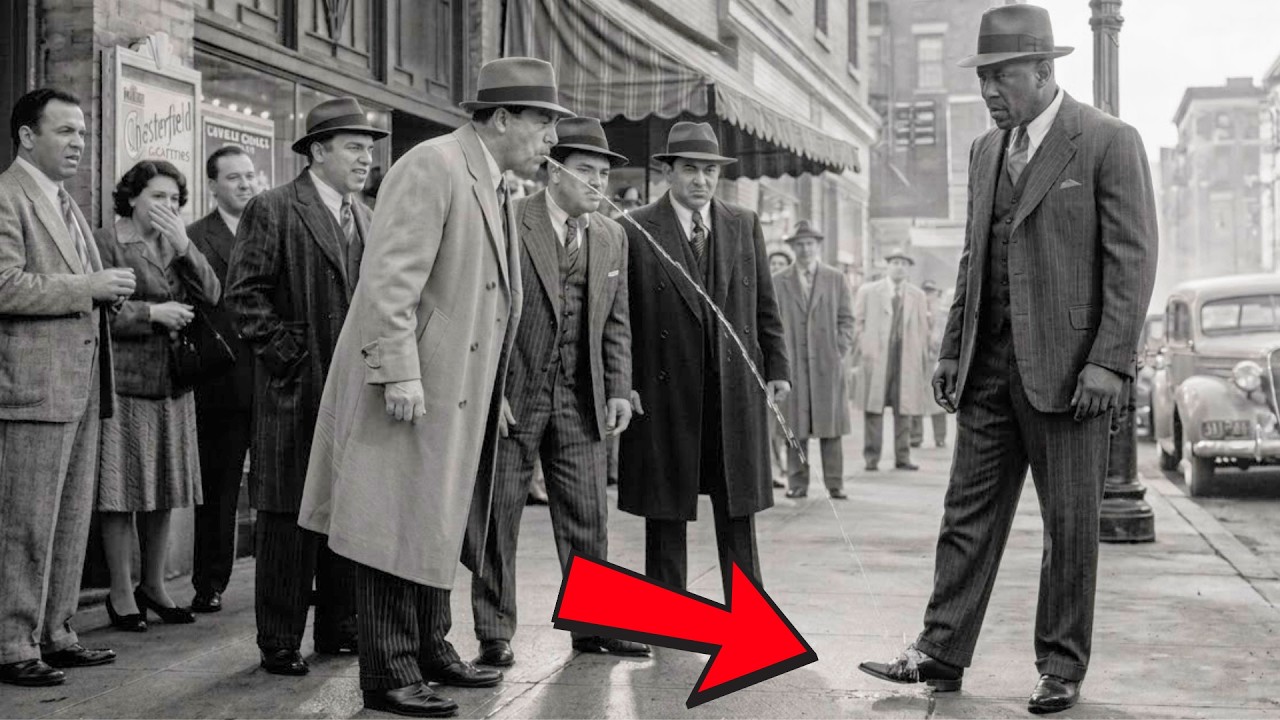
He pushed the door open and walked out into the August night. Behind him, rising through the door before it swung shut, came the sound of Dutch Schultz laughing.
Three blocks north was where he stopped. The streetlight on Lenox Avenue was where he stood. This is where the story that Harlem would tell about that night ended: a man walking out of a room where he had been publicly humiliated without raising his hand, his voice, or any visible defense of the dignity that had just been stripped from him in front of 40 witnesses.
That story traveled through Harlem the way stories about a man's breaking always travel, quickly, with enthusiasm, and with very little of the complexity that would have made it accurate.
What the story omitted was everything that happened in the space between the door of the club and the streetlight three blocks north. It omitted the quality of thinking occurring inside Johnson as he walked those three blocks.
Not panicked thinking, not wounded thinking, but the kind of cold and systematic analysis that only becomes possible when a man has learned to treat his own pain as a resource rather than a distraction. He was not asking himself how to respond to what Schultz had done. He was asking himself what Schultz had actually done, which is a different question entirely.
The answer was clarifying in ways that changed the entire shape of the problem. Schultz had not humiliated him. Schultz had revealed himself.
He had shown, in full public view, the precise nature of his strategy: the belief that black operators in Harlem could be broken through spectacle, that their standing in their own community was fragile enough to collapse under the weight of a single witnessed moment of submission, that the economics of the underground world they operated in depended entirely on a reputation that could be destroyed in an evening if the destruction was theatrical enough.
This was not the thinking of a man who understood the community he was trying to take over. It was the thinking of a man who had purchased so much cooperation from the outside world that he had never needed to understand what held the inside world together.
Johnson stood beneath that streetlight and let the full shape of Schultz's error become clear to him, the way a photograph becomes clear in a developing tray, gradually, then all at once.
Schultz had handed him something that night. He had handed him a reason, visible to every person who had been in that room, that was larger than personal grievance and more politically durable than territorial dispute.
He had made it impossible for any black operator in Harlem to remain neutral about what was happening in their neighborhood, because neutrality, after tonight, would look like endorsement of exactly what that room had witnessed.
Johnson had walked out of the Cotton Club because walking out was the only move available to him that preserved both his life and his strategic position. Every other available response, physical, verbal, any form of immediate retaliation, would have given Schultz exactly the justification he needed to escalate into open warfare under circumstances where Schultz's purchased protections made him effectively invulnerable to consequence, and where Johnson had no comparable protection to rely on.
Walking out looked like defeat. It was not defeat. It was the refusal to fight on ground that had been selected specifically because it guaranteed his loss.
He turned away from the streetlight and began walking north toward 139th Street, where Stephanie St. Clair would be awake and waiting, because she was always awake when there was something worth waiting for.
Behind him, three blocks south, Dutch Schultz was returning to his table at the Cotton Club, satisfied that a message had been sent and that the message had been received without resistance. He was correct on both counts. What he had miscalculated was the nature of the receiver.
Harlem thought that Bumpy Johnson had walked out of the Cotton Club that night with nothing. What Harlem could not see was that he had walked out with everything he needed: a clear picture of his enemy's logic, a political wound that would bleed in his favor for months, and the one advantage that no amount of money could purchase, the knowledge of exactly what kind of war this was going to be and exactly how to fight it.
The story Harlem told about that night was the story of an ending. It was, in every way that mattered, the story of a beginning.
St. Clair's apartment on 139th Street was the kind of place that revealed its owner's mind before she said a single word. The books on her shelves were organized by subject, not by size or color. The papers on her desk were sorted into categories that made sense only to someone who thought in systems rather than in moments.
A map of Harlem was pinned to the wall with markings in three different colors of ink. The markings were not decorative. They represented territory, revenue, exposure, and risk, each category coded and cross-referenced with the precision of a woman who had built an empire not by being the most feared person in the room but by being the most prepared one.
She was 62 years old that night, a woman who had come from Martinique with a particular clarity of vision that sometimes develops in people who have been forced to understand a country from the outside before they are permitted to inhabit it from within.
When Johnson arrived at her door at half past eleven, she was already awake, already at her desk, already waiting. She listened to everything he told her without interrupting, which was her custom when the information being delivered required its complete shape to be understood before any response was constructed.
When he finished, she was quiet for a long time. The only sound in the apartment was the distant noise of the street three floors below and the soft ticking of a clock on the mantelpiece.
Then she said, "He did exactly what I expected him to do. The question is whether we do what he expects us to do next."
They worked through the night. By 2 a.m., the map on her wall had new markings, and the papers on her desk had been reorganized around a set of objectives that, taken individually, each appeared modest and disconnected. Taken together, they constituted the most sophisticated campaign that Harlem's criminal underground had ever directed against an outside power.
What passed between them over the next three hours was not the conversation of a wounded man planning revenge. It was the conversation of two engineers examining a structural problem and identifying, with methodical precision, every point at which the structure could be made to fail without touching the points it was designed to defend.
The campaign they designed had five components, each intended to create pressure from a direction that Schultz's existing defenses were not positioned to address.
The first was the construction of alliances with other criminal organizations that carried their own unresolved grievances against Schultz, specifically the organization controlled by Charles Luciano, who maintained a nominally cooperative relationship with Schultz but whose patience with Schultz's recklessness had been eroding for months.
The second was the mobilization of Harlem's community institutions, its churches, its civic organizations, its political clubs, against the presence of an outside criminal enterprise in their neighborhood.
The third was economic: a sustained campaign to make Schultz's Harlem operations progressively less profitable through price competition, worker recruitment, and the systematic disruption of his collection systems.
The fourth was legal, involving the careful delivery of detailed financial information about Schultz's tax practices to prosecutors with the ambition and the appetite to use it.
The fifth was personal and granular, a targeted effort to make every individual who worked for Schultz in Harlem understand, through accumulated personal experience, that the compensation they were receiving did not adequately account for the cost of the position.
St. Clair looked at the map when they had finished and said, "None of this works if we rush it. He has to feel the pressure building before he can locate its source. And by the time he locates it, it has to be arriving from enough directions simultaneously that addressing one of them does nothing to relieve the others."
Johnson looked at the map alongside her. "How long are we talking?"
"As long as it takes to do it without mistakes," she said. "We are not in a hurry. He is. That is the first advantage we have, and we should not give it away by behaving as though we are."
That distinction, between a man who believed time was confirming his dominance and a man who did not yet know it was being turned against him, would prove to be the most consequential asymmetry in the entire conflict.
Johnson left her apartment before dawn, carrying a clear sequence of tasks, a precise understanding of their interdependencies, and the specific kind of steadiness that comes to a mind that has successfully converted an unbearable situation into a set of solvable problems.
The first person Johnson brought into the work was Nathaniel Pettigrew, 26 years old, whose most valuable quality was not courage or physical capability but an almost preternatural gift for gathering accurate information from environments that had been designed to withhold it.
Johnson gave Pettigrew one assignment: map Schultz's entire Harlem operation from the ground up. Every runner, every banker, every enforcer, their names, their home addresses, their daily routines, their relationships within the organization. And most critically, the specific fears and financial pressures that shaped their individual decisions.

Pettigrew spent three weeks on this work and produced a document that Johnson studied the way a surgeon studies an anatomy diagram before an operation, identifying not just the parts but the relationships between them, and the precise locations where an intervention would produce effects far beyond the immediate site of contact.
What followed was a campaign of pressure so carefully calibrated that its most important quality was its invisibility. Beginning in the last week of August, Schultz's workers in Harlem began experiencing a series of misfortunes that arrived with a frequency and consistency that defied ordinary explanation but could not be traced to any identifiable source.
A runner who collected bets across a 10-block corridor near 125th Street returned to his apartment one evening to find it had been entered and methodically emptied. Nothing was damaged. No message was left. The thieves had taken everything of value and departed without a trace.
Two days later, his car failed to start. The day after that, two men he had never seen before fell into step beside him on the street and had a quiet conversation with him about the general wisdom of reconsidering certain professional commitments. Speaking in the carefully constructed language of men who understand that an implication, being unprovable, is more durable than a statement, the runner quit within the week.
His supervisor, investigating the departure, could find no single cause sufficient to explain it, only a cluster of unrelated misfortunes that individually meant nothing.
This pattern was reproduced across Schultz's organization with variations tailored to the specific circumstances of each target. No single incident constituted an act of war. The accumulation of incidents, distributed simultaneously across the entire width of the operation, created something more damaging than any individual confrontation could have produced: a pervasive atmosphere of vulnerability that eroded confidence, generated friction between workers and management, and introduced into the daily operation of Schultz's Harlem enterprise a persistent low-grade dysfunction that his accountants could document in declining productivity figures but his leadership could not explain or correct, because the cause remained invisible.
Within six weeks, four runners had resigned. Three others had demanded hazard adjustments to their arrangements. Two administrators had begun looking for alternative employment without yet acting on that interest. The cost of running Schultz's Harlem operation was rising measurably, and the revenue it produced was declining, and nobody inside the organization could construct a satisfactory account of why either of these things was happening.
It was at precisely this moment that St. Clair introduced the element of the campaign that Dutch Schultz was most completely unprepared to face, because it was the element that his entire model of acquiring and maintaining power had never required him to consider.
She went to church. Not to pray, though she was a woman of genuine faith, but to speak to ministers. She visited the pastors of Harlem's largest and most influential congregations one by one.
The conversations she had with them were not about criminal operations or territorial disputes or the economics of the numbers business. She spoke to them about their communities. She described, in specific and documented detail, what the displacement of black-controlled economic networks by an outside white criminal organization would mean in practical terms for the people those churches served.
The jobs that would disappear. The money that would be extracted from the neighborhood rather than circulated within it. The particular texture of helplessness that settles over a community when even its informal economy is controlled by people who have no investment in its survival and no accountability to its residents.
She gave each minister not an argument but evidence. Specific incidents. Specific names. Specific dollar amounts representing what Schultz's operation had already taken from the neighborhood in the months since his arrival. She asked for nothing except that they speak truthfully to their congregations about what was happening in their streets the following Sunday.
The pulpits of Harlem became something that no amount of Schultz's money could have anticipated or purchased. Ministers who had never addressed organized crime from the front of their churches spoke to their congregations about economic sovereignty, about the difference between illegal enterprises that served a community's needs and criminal organizations that preyed on them, about what it meant for outside forces to arrive in a neighborhood with the intention of taking what that neighborhood had built.
They named no names. They cited no specific operations. They spoke in the language of principle and community obligation, which is the most durable language available. And their congregations, tens of thousands of people who attended services every week with a trust and attentiveness they brought to few other spaces in their lives, heard them with the full weight of that trust behind every word.
Dutch Schultz had spent years and considerable sums of money purchasing protection at every level of New York City's formal power structure. He had police commissioners and city councilmen and assistant district attorneys who owed him obligations they were in no position to refuse. He had relationships with judges that had made him effectively immune to legal consequence for nearly a decade.
He had, in short, bought every form of authority that money could reach. But he had never bought a single minister in Harlem. It had not occurred to him that he would need to. The assumption embedded in that oversight, that the collective moral voice of black congregations in a black neighborhood was not a form of power that required management, was the single most expensive miscalculation of his career.
Within three weeks of the first Sunday sermons, city council members were receiving written petitions from community organizations demanding action against white criminal enterprises operating in black neighborhoods. Political figures who had previously accepted Schultz's hospitality with comfortable discretion were finding that discretion increasingly difficult to maintain in public settings where community leaders were asking direct questions and expecting recorded answers.
The police commissioner's office was receiving complaints from constituencies it had not previously needed to take seriously and was struggling to explain its inaction in terms that satisfied anyone.
Schultz responded the way he had always responded to pressure he could not locate or understand: by applying force to the most visible available target. In the first week of October, two of St. Clair's numbers banks were raided by men working on Schultz's behalf. The people inside were roughed up. Money was taken. The establishments were wrecked with the particular thoroughness of men who wanted to leave a message that survives the cleanup.
Several days later, a runner working for St. Clair was found seriously hurt in an alleyway, having been attacked without warning by men who left nothing behind that could be used to identify them.
The message Schultz intended to send was the same message he had been sending his entire career: the cost of resistance exceeds its benefits, and any rational person will adjust their behavior accordingly.
What Schultz did not understand, could not understand, given the model of human motivation he had built his entire operation around, was that Johnson had been waiting for exactly this response. Every act of force Schultz directed at Harlem's black residents now landed inside a community that had been prepared, through weeks of sustained organizing, to interpret it not as an isolated criminal incident but as confirmation of a pattern that their ministers had already named and their civic organizations had already begun to document.
Johnson made certain that the details of each incident reached the newspapers serving Harlem's black readership. He made certain they reached the ministers, who addressed them from their pulpits the following Sunday with the specific moral authority that comes from having predicted something before it happened. He made certain they reached the political figures who had been growing nervous about their association with Schultz, providing those figures with the precise information they needed to ask, in public forums and on the record, questions that nobody in a position of authority wanted to answer.
Schultz was pushing against a wall that kept extending. Every act of force he applied generated consequences that spread in directions he could not track and could not stop. He was fighting a campaign whose architecture he had never encountered and whose logic he was constitutionally unable to appreciate, because the logic depended on understanding a community as something with its own intelligence and its own capacity for coordinated response. Schultz had never needed to understand any community as anything other than a market to be captured.
Then Johnson took $60,000, and everything accelerated.
Pettigrew had identified the warehouse in the second week of September: a building on the edge of Harlem where Schultz consolidated cash from his numbers collections before transporting it to the Bronx. Johnson watched it for five weeks. He learned the guards' schedules, their habits, the specific windows of time when the building's oversight was thinnest.
He was in no hurry. He waited until the moment when the action would produce the maximum number of simultaneous consequences, which is a different calculation from waiting until the moment when the action is merely possible.
On the night of October 18, Johnson and five men, including Pettigrew, entered the warehouse through a side window. They found the money in a locked cabinet. They took all of it, $60,000 representing several weeks of collections from Schultz's Harlem operation. They left no evidence. They did not harm the guards, a decision as deliberate as everything else about the operation. Johnson wanted Schultz to know the money was gone without giving him a justification for the kind of extreme retaliation that would have changed the political dynamics of the conflict.
The $60,000 did not stay in Johnson's possession for more than two weeks. Most of it was distributed throughout Harlem to families whose members had been injured in Schultz's retaliatory actions, to the churches sustaining the community organizing effort, to civic organizations maintaining the political pressure campaign. St. Clair ensured that everyone who received any portion of it understood clearly where it had come from.
The story traveled through Harlem with the speed and emotional intensity of something a community had been waiting to hear. Not just that Schultz could be taken from, but that what was taken could be returned.
The narrative transformed overnight. Schultz was not an invincible outside force extracting from a powerless community. He was an exposed operation whose money could be found and redistributed by people who understood his weaknesses better than he understood their strengths.
Inside Schultz's organization, the effect was different and equally devastating. Charles Luciano had been monitoring the deterioration of Schultz's Harlem venture for months, watching a series of setbacks accumulate without satisfactory explanation. The warehouse robbery provided something all the previous setbacks had lacked: a number, clean and unambiguous, representing a loss that no competent organization should have been unable to prevent.
A man who could not secure $60,000 in a guarded building did not control the territory he claimed to control. Luciano's assessment of Schultz, which had been shifting for some time along dimensions that were harder to quantify, the recklessness, the political exposure, the inability to adapt his methods to environments that required something other than force, crystallized around that number into something more actionable than a general dissatisfaction.
Johnson's approach to Luciano's organization came in February 1935, arranged through three layers of intermediaries and conducted in a location chosen for its neutrality. Johnson went to that meeting not as a petitioner seeking protection but as an analyst presenting a case to someone with the resources and the motivation to act on it.
He laid out, with the precision of a man who had spent months assembling evidence rather than arguments, exactly what Schultz had cost Luciano, not just in Harlem but in the broader attention that Schultz's methods had been drawing from federal investigators whose interest, once fully engaged, would not remain limited to Schultz alone.
He described the tax evasion case being constructed by a prosecutor named Thomas Dewey, a young man building a reputation on the prosecution of high-profile organized crime figures who would not stop at Schultz if Schultz gave him enough material to continue.
He did not ask for anything explicit. He made clear, with the careful indirection of a man who understands that some conclusions are more powerful when the listener reaches them independently, that the problems Schultz represented had grown beyond what any single organization should be expected to absorb without consideration of alternatives.
Luciano listened carefully and asked two questions, both of them precise, both of them indicating that he had understood not just the surface of what Johnson was presenting but the structure underneath it. Johnson answered both questions directly.

Then Luciano said, in the measured language of a man who has made decisions of this kind before, that certain problems, when they reach sufficient scale and sufficient visibility, tend to find their own resolution, and that the timing of such resolutions is rarely as unpredictable as it appears from the outside.
What happened next was not a surprise to Johnson, though it arrived faster than he had anticipated. Schultz, cornered by Dewey's prosecution, by the collapsing economics of his Harlem venture, and by the political exposure that had made his New York operations untenable, proposed to Luciano's organization a solution to the Dewey problem that was so reckless, so nakedly catastrophic in its implications for every criminal organization operating in New York, that it functioned as the final piece of evidence Luciano needed to reach a conclusion he had been approaching for months.
Schultz wanted Thomas Dewey killed. Luciano, whose organization had survived and grown precisely because it understood the boundary between manageable risk and existential exposure, made a decision.
On the night of October 23, 1935, Dutch Schultz was shot in a restaurant in Newark, New Jersey. He died the following day.
Johnson was in Harlem when the news arrived. He was sitting in a diner on 125th Street, drinking coffee, reading a newspaper. The man who delivered the information said two words. Johnson folded the newspaper, finished his coffee, left money on the counter, and walked out into the afternoon without changing his expression.
There was nothing theatrical to feel. There was only the quiet, specific satisfaction of a calculation confirmed, 14 months of work arriving at the destination that had been identified on a map in St. Clair's apartment on a night when the outcome had been anything but certain.
Dutch Schultz died without ever knowing whose hands had shaped the conditions of his ending. He died believing he had been undone by his own organization's politics, by the ambitions of men who had used his mistakes as justification to remove him.
He never knew about the warehouse, about the ministers, about the information delivered to Dewey's office through intermediaries that could not be traced. He never knew that the man he had publicly humiliated in the Cotton Club 14 months earlier had spent every one of those months building, with invisible precision, the exact structure of circumstances that made his death a rational business decision rather than an act of vengeance.
And the not knowing was not an accident. It was the final component of a plan that had been designed from the beginning to win without ever appearing to fight.
Dutch Schultz died believing he had simply run out of luck. What he never understood, and what would have been incomprehensible to him even if someone had explained it, was that his luck had not run out on its own. It had been taken from him, carefully, patiently, piece by piece across 14 months, by the man he had told to kneel on the floor of the Cotton Club and demonstrate his place in the order of things.
The war was over. Bumpy Johnson had never thrown a single punch in it. That, more than anything else about what had happened, was the thing that the people who understood it would never stop thinking about.
On the evening of November 12, 1935, Ellsworth Raymond Johnson walked into the Cotton Club at half past nine. He wore a dark suit. He had pressed it that afternoon. His shoes were polished, worked with a cloth in slow circles until the leather held a reflection clear enough to see his own face in.
He walked to the table near the back wall, the same table, and sat down. He ordered bourbon and allowed it to rest on the white tablecloth before him, the glass catching the candlelight the way it had caught it 15 months earlier, on a night that Harlem had decided was the end of him.
The room was different and the room was the same. The orchestra occupied the same stage. The candles threw the same soft light across the same Art Deco mirrors. White socialites from downtown Manhattan sat at the same tables with the same borrowed confidence.
But the quality of attention that moved through the room when Johnson entered was not the same. The club's manager crossed the floor to greet him personally, with the particular deference that is extended not to men who demand it but to men who have earned it in ways that cannot be argued with.
Several men at other tables, white men, men who worked within Luciano's organization and understood precisely what the past 14 months had produced, acknowledged Johnson with a nod that carried its full weight. Nobody approached his table uninvited. Nobody needed to be told not to.
Johnson sat quietly and watched the room and drank his bourbon slowly. If he was thinking about the last time he had occupied this chair, his face gave nothing away. That, too, had not changed.
What had changed was everything underneath the surface: the entire architecture of power in Harlem's criminal geography, restructured not through a single dramatic confrontation but through the slow and patient application of pressure across 14 months and five simultaneous fronts.
The numbers operations that Schultz had spent nearly two years attempting to seize were back under black control, operating with an autonomy that had been formally negotiated and was now maintained by an agreement that Luciano's organization had every practical reason to honor.
The community institutions that St. Clair had mobilized during the conflict had not disbanded when the conflict ended. They remained active, providing Harlem with a political infrastructure that had not existed before Schultz arrived and would outlast everyone who had built it.
The ministers who had spoken from their pulpits about economic sovereignty had discovered, in the process of speaking about it, that their congregations were more politically capable than anyone had previously credited them with being.
A war that Schultz had started in order to take something had ended by leaving the community it targeted more organized, more connected, and more capable of defending itself than it had been the day he arrived.
This was not the outcome that anyone watching the Cotton Club on the night of August 14, 1934, would have predicted. The man who had walked out of that room had looked, to every witness, like a man who had accepted a verdict delivered in public and had nothing left to say in his own defense.
What he had actually done was refuse to let someone else's verdict define the terms of his response. That refusal, sustained across 14 months of disciplined and invisible work, had produced a result that no amount of immediate rage could have achieved.
Rage would have given Schultz the justification he needed. Patience gave Johnson the outcome he required.
The lesson embedded in that result was not complicated, but it was rare, because the knowledge of it is entirely useless without the self-discipline to act on it when the moment demands the opposite. The discipline to absorb a public humiliation without immediate reaction, to treat your own anger as a resource rather than a directive, to think in months when every instinct is screaming at you to think in seconds, is among the most difficult things a person can develop.
Johnson had not been born with it. He had built it at considerable personal cost across years of making the wrong decisions and understanding, with unflinching clarity, exactly why they had been wrong. The Cotton Club had not tested a quality he already possessed in full. It had revealed one he had been quietly constructing without being entirely certain it was there for the better part of his adult life.
Power, Johnson understood by the time he sat at that table on that November evening, is not a possession. It is not something you take from someone and keep in a locked cabinet. It is a consequence, the accumulated consequence of being the person in any given situation who most clearly sees what is actually happening and most consistently makes the correct decision about what to do next, even when the correct decision is the hardest one available.
Schultz had possessed money, connections, and the capacity for force in quantities that Johnson could not match on any direct accounting. What Schultz had not possessed was the ability to see his own situation accurately, to recognize that the community he was attempting to absorb had resources he had never bothered to understand, that the man he had humiliated in public was not diminished by that humiliation but in some essential way sharpened by it, and that the absence of an immediate violent response was not the evidence of weakness he had taken it to be but evidence of a quality of strategic thinking that his own methods had never required him to develop and therefore had left him entirely unable to recognize or defend against.
Johnson had not won by becoming stronger than Schultz. He had won by understanding Schultz more completely than Schultz had ever understood himself, and then constructing, carefully and without visible urgency, the precise set of conditions under which that understanding became the only thing that mattered.
He finished his bourbon and set the glass down gently on the white tablecloth and sat for another moment watching the room with the unhurried attention of a man who has nowhere more important to be.
The orchestra was playing something slow and intricate. The dancers moved between the tables in their careful patterns. The candles threw their soft light across the mirrors, and the mirrors reflected back a room full of people who were each, in their own way, performing some version of themselves for an audience of their choosing.
Johnson was not performing anything. He was simply present in a room that had once been designed to diminish him, occupying his chair with a quietness that required no explanation and invited no challenge.
He left a tip on the table and walked out into the November night without hurrying. The air was cooler than it had been in August. The streetlights on Lenox Avenue burned with their steady, indifferent brightness. He walked north at an even pace, his shoes making a quiet and regular sound on the pavement, and behind him the Cotton Club continued its evening without interruption, the music carrying through its walls and out into the street, fading as he walked until it was gone entirely.
When Johnson died in 1968, 34 years after that night, the story was still being told in Harlem. Young men who had not been born when it happened knew its details with the intimacy that people bring to stories carrying something they genuinely need.
They knew about the Cotton Club and what Schultz had done. They knew about the walk out the door and the 14 months that followed. They knew how it ended. And the version of the story they carried was not the version about humiliation. It was the version about what a man does with humiliation when he is disciplined enough to refuse to let it be the last word, when he is patient enough and clear-eyed enough and strong enough in precisely the ways that do not show, to transform the worst moment of his public life into the foundation of everything that came after it.
The bravest thing Bumpy Johnson ever did was not something anyone saw him do. It happened three blocks north of the Cotton Club, beneath a streetlight on Lenox Avenue, in the silence between what had been done to him and what he chose to do next.
He chose to think instead of react. He chose the architecture of a long victory over the brief satisfaction of an immediate one. He chose, standing alone on a dark street with his dignity apparently in ruins and the laughter of his enemies still audible in the distance, to be the last one standing rather than the first one to move.
He was, and in the end, that was the only thing that mattered. Not who struck first, not who was louder or larger or better protected by the corrupt machinery of the city's power. What mattered, as it always does when the noise finally settles, was who was still there, clear-eyed, unhurried, and entirely undefeated when everything else had run its course.