On the afternoon of February 6, 1952, at Sagana Lodge in the foothills of Mount Kenya, a 30-year-old man in khaki walked into a room where his wife was resting and told her that her father was dead. The room was simple, with white walls and wooden shutters. Outside, the equatorial light was still bright.
The woman was 25. She had been a princess when she woke that morning. She was a queen now.
The man standing in front of her was Prince Philip. In the same moment, without yet understanding it, he was the person who had the most to lose from the words he had just spoken.
The public version of what followed is well known. A young queen returned to Britain. A nation mourned. A coronation was planned.
The private version is different and harsher. Behind the pageantry and the photographs, a struggle was already forming. It was not between enemies, but between two people who both believed they were protecting the same institution.
A husband who wanted to modernize the monarchy. And a mother-in-law who intended to preserve it exactly as her dead husband had left it.
This is the story of Prince Philip's first years as royal consort, and the woman who ensured that his name, his home, and his place in the dynasty would be taken from him before the crown was barely on his wife's head.
By the early 1950s, the House of Windsor was not merely a surname. It was a settlement, a political fact dressed in ermine and presented as tradition, though it was barely 35 years old.
George V had proclaimed it in 1917 during the worst of the First World War. Anti-German sentiment in Britain made it dangerous for the royal family to carry its actual dynastic name, Saxe-Coburg and Gotha, inherited through Prince Albert.
The change was practical, swift, and permanent. The family would be Windsor. The name was drawn from the castle, which was drawn from the landscape, which was drawn from something that felt to the British public as English as anything could feel.
Windsor was not a genealogical description. It was a national reassurance. It said that whatever else was happening in Europe, whatever thrones were falling, this family was English. This family belonged here. This family was yours.
What followed over the next three decades cemented the name into something far more powerful than a royal decree. George V stabilized the monarchy through personal conservatism and a gift for appearing ordinary in an age of revolutionary upheaval.
His son Edward VIII nearly destroyed everything, abdicating in 1936 for Wallis Simpson, an American divorcee. The abdication was not merely a scandal. It was a proof of concept that the wrong man with the wrong instincts could bring the entire settlement crashing down.
The private damage went deeper than the constitutional crisis. Elizabeth Bowes-Lyon, the Duchess of York, had built a quiet, contented life with a husband who never expected to reign. She then found herself queen consort to a man visibly buckling under a burden that was never meant to be his.
George VI's stammer worsened under the pressure of kingship. His health, never robust, began its long decline. The Duchess, now Queen Elizabeth, blamed Edward and Wallis Simpson with a conviction that became a permanent feature of her moral landscape.
That lesson lodged itself deep into the Windsor consciousness. It became the founding trauma of the modern monarchy. Anyone who arrived at the palace carrying a whiff of novelty, foreignness, or personal ambition would be measured against the ghost of the uncle who had walked away.
And then George VI rebuilt it. Married to Elizabeth Bowes-Lyon in 1923, he found in her a partner whose social gifts compensated for his painful stammer and natural reserve. Together they constructed a public image of decency, warmth, and domestic stability.
When war came in 1939, they refused to leave London. Buckingham Palace was bombed nine times during the Blitz. The King and Queen walked through the wreckage of the East End, visited factories, and comforted the bereaved.
By the time the war ended, the Windsors had earned a moral authority that went far beyond title. They had earned it through endurance, and endurance had become the family's central value. Continuity, steadiness, the refusal to crack. That was what Windsor meant by 1952.
And that is the fortress Philip was walking into.
Royal domestic life after 1945 sat inside a Britain still governed by austerity. Rationing, restrictions on building materials, a national mood that was simultaneously proud and exhausted.
Philip's modernizing instincts, his desire to make royal life functional and efficient, were being applied inside a household that could not easily spend its way to change. The arguments that would erupt after the accession were never simply about taste or temperament.
Buckingham Palace was the sovereign's official residence and working headquarters, vast and formal, run by a household of courtiers whose hierarchies had calcified over generations. Clarence House was the intimate, habitable London home where Elizabeth and Philip made their first married life and where their children were born.
Sandringham in Norfolk was the private estate where the family gathered for Christmas and where George VI would die. Balmoral and the smaller Birkhall in the Scottish Highlands held the pre-1952 memory of family continuity.
Royal Lodge in Windsor Great Park had been George VI and Elizabeth's weekend retreat. Broadlands, the Mountbatten family seat in Hampshire, linked Philip to the patronage and ambition of his Uncle Dickie.
Each of these places would play a role in the territorial struggle that followed the accession, but one mattered more than the rest. Clarence House was where Philip had built something. It was where his children had been born, where his domestic vision had taken physical form.
It was the house that would be taken from him and given to the woman who represented everything he was fighting against.
The value system that governed this world can be stated plainly. Continuity over novelty, Englishness over cosmopolitanism, duty over self-expression, and deference to the established court process over spousal instinct.
The Queen Mother, Queen Mary, Churchill, Lascelles, and the broader palace machinery did not have to coordinate their opposition to Philip in any formal sense. They were already aligned by temperament, by training, and by the institutional memory of what had gone wrong with Edward VIII.
Philip was not entering a conspiracy. He was entering a worldview, and the worldview had just survived both abdication and war. It believed the next task was preservation. Philip believed the next task was adaptation. Both sides believed they were defending the monarchy.
Prince Philip, Duke of Edinburgh, was born on June 10, 1921, on the island of Corfu. He was the only son and fifth child of Prince Andrew of Greece and Denmark, and Princess Alice of Battenberg.
The title sounds grand. The reality was exile. Philip was barely 18 months old when a military coup forced the Greek royal family from the country. According to family legend, the infant prince was carried to safety in an orange crate aboard a Royal Navy cruiser.
His father drifted into a restless expatriation on the French Riviera, increasingly absent and emotionally remote. His mother suffered a severe mental health crisis in the late 1920s and was committed to a sanatorium in Switzerland, where she remained for years.
Philip, still a child, was effectively parentless. He was passed between relatives and guardians, including his grandmother at Kensington Palace and his uncle Lord Louis Mountbatten, who became patron, mentor, strategist, and the closest thing Philip had to a consistent anchor.
The boy who would become the most visible consort in British history grew up without a settled home and without the sustained presence of either parent. He was sent to Cheam Preparatory School, then briefly to Salem in Southern Germany, and then to Gordonstoun in Scotland.
At Gordonstoun, the ethos was cold showers, physical endurance, community service, and the absolute suppression of self-pity. Philip thrived. He became head boy, captain of cricket and hockey, a natural leader in a system that rewarded toughness and penalized vulnerability.
What could not be measured was the loneliness, the unprocessed grief of a fractured family, and the particular defensive edge of a boy who had learned that charm and competence were the only reliable currencies.
He went from Gordonstoun to the Royal Naval College at Dartmouth in 1939, and from Dartmouth into the war. His service was genuine and distinguished. He was mentioned in dispatches after the Battle of Cape Matapan in 1941 and was present in Tokyo Bay for the Japanese surrender in 1945.
By the war's end, he was a lieutenant with a legitimate career, a man who had found in the Navy the structure and sense of earned belonging that his childhood had denied him. He was also a man hypersensitive to exclusion. The idea that he might be denied a place inside his own marriage caught at something older and deeper than pride.
Elizabeth Bowes-Lyon, the future Queen Mother, was born on August 4, 1900. She was the ninth of 10 children of the 14th Earl of Strathmore and Kinghorne, raised between St. James's Square in London and Glamis Castle in Angus.
Her childhood was Edwardian in texture. Governesses, house parties, the ordered rhythms of the Scottish landed gentry. But the First World War gave it weight. Glamis was converted into a convalescent home for wounded soldiers, and the young Elizabeth helped tend them.
She learned that duty was not abstract. It had a physical form. It smelled of antiseptic and sounded like the muffled groans of men in pain.
Her marriage to the Duke of York in 1923 was reportedly preceded by two refusals, which suggested that she entered royal life with her eyes open and her expectations clear. The life she chose was not forced upon her, and that distinction mattered.
When the abdication forced her husband onto the throne, Elizabeth became the emotional engine of the monarchy's reconstruction. She was the warmth beside George VI's reserve, the public ease beside his private struggle, the visible courage during the Blitz.
She understood instinctively that the monarchy survived on the appearance of unshakable calm. That understanding would define her widowhood as completely as it had defined her marriage.
She was also, in ways that the public image of gentle warmth obscured, a woman of considerable political instinct and social steel. She cultivated relationships with courtiers, politicians, churchmen, and the wider aristocratic network with a skill that kept her at the center of things.
She entered widowhood in 1952 not diminished, but fortified. Her grief was genuine. So was her authority. She was not merely a grieving mother. She was the keeper of the dead king's legacy, and she intended to keep it.
Sir Alan Lascelles, known as Tommy Lascelles, had served as private secretary to George VI and continued under the new queen. He was the permanent government of the palace, the man who controlled access, shaped advice, and managed the flow of constitutional business.
He was also profoundly conservative, suspicious of innovation, and quietly hostile to the Mountbatten orbit. His opposition to Philip was not personal hatred. It was institutional reflex. The court existed to protect the sovereign from disruption.
Winston Churchill, who returned to the premiership in October 1951, was in Downing Street when the accession occurred. Churchill was a romantic monarchist, attached to the crown with a sentimentality that was half genuine and half strategic.
He saw the monarchy as the emotional keystone of national unity. He had no patience for anything that threatened to unsettle it, least of all a dynastic name change that would erase the word Windsor from the institution's identity.
His agreement that the house would remain Windsor gave Philip's defeat the authority of the state. It was no longer a family argument. It was government policy.
Queen Mary, George V's widow, was 84 years old and frail by early 1952, but her influence was undiminished. When Lord Mountbatten was heard to boast that the House of Mountbatten now reigned, her reaction was immediate, cold, and decisive.
Her death in March 1953, just weeks before the coronation, removed the oldest guardian of the Windsor name from the stage. By then the decision had already been sealed.
Lord Louis Mountbatten was the shadow behind Philip that made the sunlight harder to see. He was brilliant, vain, ambitious, and possessed of a vision for the Mountbatten family's place at the center of British power that alarmed everyone who detected it.
He had been Supreme Allied Commander in Southeast Asia, the last Viceroy of India, and the man who had recovered the post of First Sea Lord that his father had been forced to surrender. He saw Philip's marriage as a restoration. The old guard saw it as an attempted coup.
Princess Margaret was 21 years old when her father died. She would move with her mother to Clarence House and become part of the alternative household that formed around the Queen Mother's widowhood.
She mattered less as a combatant than as a presence, volatile and glamorous, emotionally vivid in ways that contrasted with Elizabeth's controlled stillness. It was a household, it had life, and it occupied the house that had been Philip's.
Princess Alice, Philip's mother, had by the 1950s re-emerged from her years of illness into a life of austere religious devotion, founding a nursing order of Greek Orthodox nuns in Athens. During the German occupation, she sheltered Rachel Cohen and her two children at documented personal risk.
Yad Vashem would later recognize her as righteous among the nations. The family line the court distrusted was also the line that had produced a woman of extraordinary moral courage.
Elizabeth herself was born on April 21, 1926, at 17 Bruton Street in Mayfair, and raised inside a close, loving household that the abdication crisis had transformed into a national symbol.
Her childhood before 1936 had been sheltered and happy. The abdication changed everything. At 10 years old, she became heir presumptive, and from that point forward every significant relationship in her life was shaped by the knowledge that she would one day be sovereign.
At 18, she joined the Auxiliary Territorial Service, learned to drive and maintain military vehicles, and became the first female member of the royal family to serve in the armed forces. It was a modest contribution in military terms, but it mattered to her.
She loved Philip with a constancy that never wavered. She also loved the institution she inherited, and the two loyalties would pull against each other in ways that defined her reign and, in the early years, her marriage.
The meeting at Dartmouth in July 1939 set the shape of everything. The Royal Naval College, a formal visit by the King, the Queen, and their two daughters. An 18-year-old cadet assigned to entertain the princesses while the adults toured the grounds.
Philip was tall, blonde, athletic, and self-assured. Elizabeth was 13. The accounts disagree on details, but they agree on the outcome. She decided.
The letters began. They continued through the war, through the years of separation, through the slow transformation of girlish attachment into adult commitment. By the summer of 1946, when Philip proposed at Balmoral, Elizabeth's answer was not a decision. It was a confirmation.
George VI insisted on delay. He loved his daughter, and he was protective. He understood what the marriage would cost her, not in money, but in privacy and autonomy. He also understood that Philip's background carried complications that the court and the press would not ignore.
There were whispers about Philip's sisters, all four of whom had married German princes, some with connections to the Nazi Party. There were questions about his rootlessness, his lack of independent means, his Mountbatten associations.
The engagement was not announced until July 1947. Philip had already renounced his Greek and Danish titles, become a naturalized British subject, adopted the surname Mountbatten, and been created Duke of Edinburgh, Earl of Merioneth, and Baron Greenwich.
He arrived at the altar at Westminster Abbey on November 20, having shed every external identity he possessed except the one the British state was willing to give him. Two thousand guests attended the ceremony.
Post-war Britain consumed the wedding as a balm. Something beautiful amid austerity, something to celebrate after years of loss and gray. Philip understood the public mood. He also understood that the surrenders were just beginning.
He had given up his nationality, his family's titles, and his sisters' ability to attend his wedding. None of them were invited because the proximity to wartime Germany was judged too sensitive. And his name.
What he had received in return was a title, a uniform, and a wife who loved him. Whether that would be enough depended on a question that nobody in November 1947 was yet asking. What would happen when the wife became queen?
Clarence House became their home. And for a few years it was a genuinely happy one. The house on the Mall, adjacent to St. James's Palace, had been built in the 1820s by John Nash for the Duke of Clarence.
When Elizabeth and Philip moved in after their wedding, it was in poor condition. The plumbing was Victorian, the wiring inadequate, and the heating barely functional. Post-war restrictions meant the renovation was modest by royal standards.
Philip threw himself into the project with the practical energy of a man who had spent years making naval vessels work under difficult conditions. He oversaw the modernization of wiring, heating, and plumbing. He arranged furniture with an eye for function rather than formality.
The result was a residence that bore Philip's stamp more clearly than any royal property would again. It was clean-lined, efficient, and livable. It was not a museum. It was not a monument to precedent. It was a home.
Charles was born there on November 14, 1948, in a room that Philip had helped redesign. Anne followed on August 15, 1950. A nursery was established on the upper floors, staffed by nannies, but visited constantly.
Visitors to Clarence House in those years reported an atmosphere of surprising informality, laughter in the corridors, toys on the stairs, a young family doing what young families do behind walls that happened to belong to the crown.
And that is what makes what came next so painful. Clarence House was not just a house Philip had renovated. It was the physical proof that his idea of family life, his idea of monarchy, could exist. When it was taken from him, it was not just an address that changed hands. It was an argument that was lost.
Philip was still serving in the Royal Navy during this period, posted to Malta for stretches between 1949 and 1951, first as first lieutenant aboard HMS Chequers, and later in command of HMS Magpie, a frigate.
Elizabeth joined him there whenever royal duties permitted, staying at the Villa Guardamangia, the rented home of Philip's uncle Dickie and his wife Edwina. Those months were remembered by both of them as the happiest of their marriage.
Elizabeth attended polo matches at the Marsa Sports Club, went swimming in the warm shallow bays of the island, danced at the Hotel Phoenicia, and lived for the only sustained period of her life something approximating the existence of a naval officer's wife.
She could walk through Valletta without a police escort. Philip had command, purpose, a ship that answered to him, and a wife who was visibly, uncomplicatedly happy. It was a life that worked.
But even in Malta, the future was pressing in. Elizabeth's visits grew shorter as her father's health declined. Philip was called back for royal duties more frequently. The ideal had a clock on it, and the clock was running down.
George VI was dying. The lung cancer diagnosis came in 1951, and though the full truth was managed and softened, the trajectory was unmistakable. Elizabeth was pulled back into royal duties. Philip left active naval service reluctantly, permanently, and with a sense of loss.
In late January 1952, they departed on a Commonwealth tour on behalf of the king, because the king could no longer travel. They flew first to Kenya. They visited Sagana Lodge and the Treetops viewing platform.
They left Britain as a princess and her husband, with two small children at home and a father whose illness everyone understood in the way families understand such things. Obliquely, through adjustments and silences.
The next time they returned, one of them would be sovereign, one of them would be consort, and the woman waiting in London, grieving, formidable, and more powerful in widowhood than anyone yet realized, would begin the quiet, relentless work of ensuring that the monarchy her husband had rebuilt would not be remade in anyone else's image.
They arrived in Kenya on February 1, 1952. The tour had the texture of borrowed duty, a Commonwealth itinerary assembled for a king who could not travel, handed to a princess and her husband because someone had to go.
But Kenya, at least in the opening days, carried a lightness that the couple had not felt in months. The weather was warm. The landscape was vast and vivid. For a few days, the machinery of monarchy loosened its grip just enough to let Elizabeth and Philip feel like a young married couple on an adventure.
They stayed at Sagana Lodge, a wedding gift from the Kenyan government, a low white bungalow set in the green foothills of Mount Kenya, surrounded by tropical gardens and crossed by a trout stream that Philip took to immediately.
He fished. Elizabeth watched him fish. They filmed wildlife with a cine camera, the kind of amateur footage that royal couples accumulated on tours. The two of them laughing at something the microphone did not catch.
On February 5, they drove to the Treetops Observation Lodge in the Aberdare forest, a modest wooden structure built into the canopy of a giant fig tree overlooking a watering hole. They spent hours there watching elephants, rhinoceros, and warthogs come and go in the afternoon heat.
It was the kind of afternoon that stays in memory precisely because it carries no weight, no ceremony, no obligation, no performance. Just two people watching wild things move through a landscape older than any dynasty.
By the time they returned to Sagana Lodge that evening, George VI was already dead. He had died peacefully in his sleep at Sandringham House in the early hours of February 6. His body was found by a valet who had come to draw the curtains. He was 56 years old.
The lung cancer that had been diagnosed the previous autumn and the surgery that had removed his left lung in September had not saved him. His heart had given out in the night, and with it the reign that had held the monarchy together through abdication, war, austerity, and the slow exhausting work of being a king who had never wanted the crown.
The news took hours to reach Kenya. A chain of coded telegrams, scrambled telephone calls, and increasingly frantic messages relayed through Government House in Nairobi. Philip's equerry, Mike Parker, heard first, picking up a report on the radio and then receiving confirmation by telephone.
It fell to Parker to tell Philip, and it fell to Philip to walk into the room where his wife was resting and tell her that her father was dead, that she was queen, and that the life they had been living was finished.
Within minutes of Elizabeth being told, the tour was canceled. Within hours, suitcases were being packed, cars arranged, the Sagana Lodge staff standing in uncertain silence as the couple who had arrived as guests departed as sovereign and consort.
Elizabeth changed into the black mourning clothes that had been packed as protocol invariably demanded for exactly this contingency. The palace never sent a member of the royal family abroad without mourning attire, because the possibility of a king's death was always in the logistical calculations of the household.
The fact that they were ready said everything about the world Elizabeth had inherited. A world that planned for grief the way other households planned for weather.
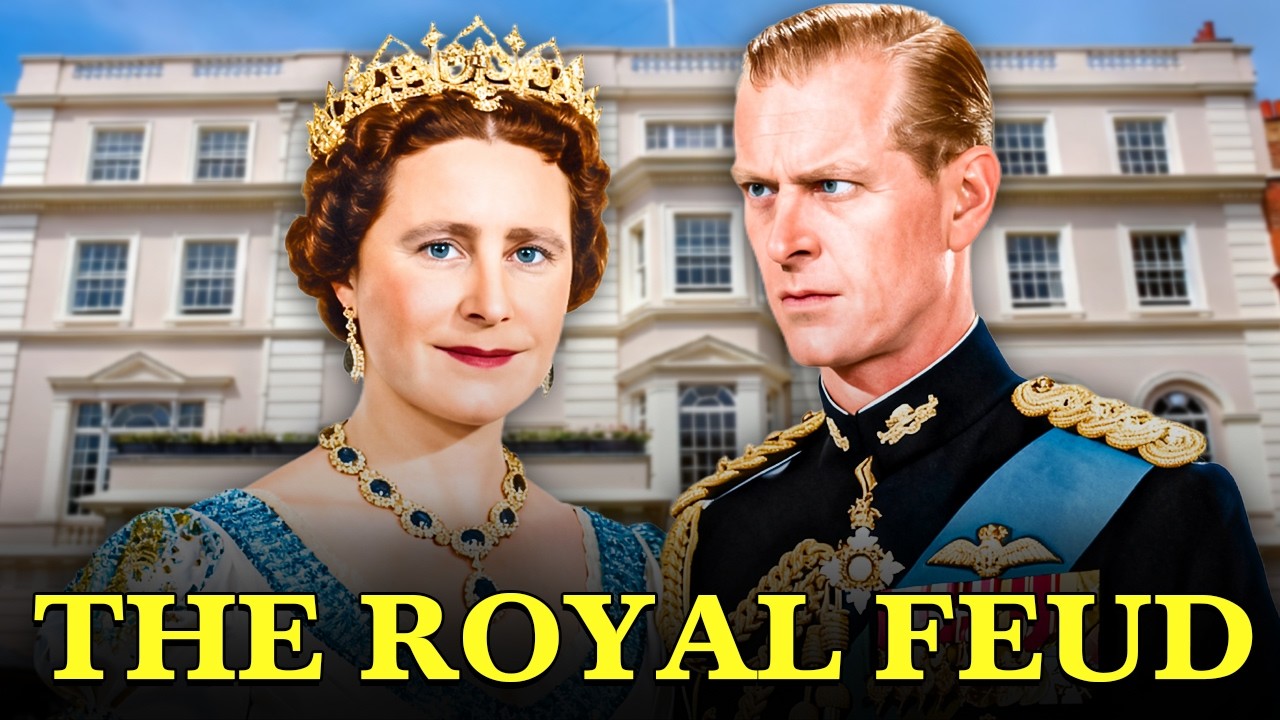
Philip, by every account, was subdued, practical, and already receding into the supporting role that the moment required of him. Mike Parker would later recall that Philip looked as though the world had collapsed around him.
He was not wrong. The world that Philip had known, a world in which he was the central figure in his wife's domestic life, the man with the plan, the officer in command of the household, was over. It ended not with an argument or a decree, but with a death in Norfolk.
The flight home on February 7 landed at London Airport in the late afternoon under a sky that was low and gray. Elizabeth descended the aircraft steps in black. She was 25 years old. She had been queen for approximately 36 hours.
On the tarmac below, lined up in dark coats and somber faces, stood the machinery of state. Winston Churchill, 77 and visibly moved. Anthony Eden, the Foreign Secretary. Clement Attlee, the leader of the opposition. Lord Woolton, the Lord President of the Council.
Philip walked behind her. He would spend a great deal of the next 50 years walking behind her, and the geometry of that position, close enough to be present, far enough back to be subordinate, was established here on a runway in the failing light of a February afternoon.
Elizabeth was driven to Clarence House, where she would stay briefly before the move to Buckingham Palace, and where the first of the many decisions that would define her reign was already waiting. The first question was not grief. It was identity.
Martin Charteris, Elizabeth's private secretary, had asked it while they were still in Kenya in the scramble of the accession's first hours. What name would she reign under? Elizabeth's answer was quick and on the surface unremarkable. Her own name, of course. Elizabeth.
But the simplicity of the answer masked the complexity of the question it opened. A queen's name is not merely personal, it is dynastic. It carries the house, the line, the legal identity of succession. The name Elizabeth was settled. The name of the house was not.
And the question of which house now reigned, Windsor or Mountbatten, was already forming in the space between official condolences and private conversations, in the studies and drawing rooms of the people who understood that the death of one king and the accession of a married queen had created a constitutional ambiguity that someone would have to resolve.
Lord Mountbatten was not silent. He was, by several accounts, exultant. In the days immediately following the accession, Mountbatten told dinner guests, friends, and anyone who would listen that the House of Mountbatten now reigned.
His nephew's wife was queen. The Mountbatten name, which his father Prince Louis of Battenberg had been forced to adopt during the anti-German panic of the First World War, and which Mountbatten himself had spent a lifetime rehabilitating, was now, in his triumphant interpretation, the name of the British royal house.
He was not being subtle about it. He was being Dickie Mountbatten, which meant he was being grandiose, indiscreet, and strategically transparent all at once. He saw Philip's marriage as the culmination of a long game, and he wanted the world to know it.
The world, or at least a part of the world that mattered in this context, reacted with something close to alarm. The horror was not purely snobbish, though snobbery was certainly present. The horror was constitutional.
If the House of Mountbatten now reigned, then the settlement George V had created in 1917, the settlement that had been defended through abdication and a world war, was effectively annulled. A single marriage had undone it.
A man who had arrived as a foreign prince with no private fortune, and a name that was itself an Anglicization of a German original, had, through his wife's succession, renamed the British royal house without anyone voting on it, debating it, or agreeing to it.
Queen Mary, 84 years old and in the final year of her life, summoned her fury with the cold precision of a woman who had spent half a century defending the dynastic principle. She had been George V's wife. She had stood beside him when he created the House of Windsor.
She was not about to watch it dissolved by Mountbatten presumption. Her intervention was direct and forceful. She communicated her opposition to the Prime Minister's office, to the palace household, and to anyone in her circle who might carry the message further. Queen Mary did not campaign. She pronounced.
The Queen Mother, still raw with grief, was equally resolute. Her husband had been a Windsor. He had died a Windsor. The monarchy he had rebuilt from the wreckage of abdication was Windsor to its moral foundations.
She had spent 16 years as Queen Consort defending that inheritance, and the suggestion that it could be renamed within weeks of her husband's death, renamed by the family of the son-in-law she had never entirely trusted, was intolerable.
She made her feelings known. She did not need to make them known loudly. The Queen Mother's influence operated through intimacy rather than volume. A word to the right person, a silence in the right room, a gentle expression of concern to a daughter who was still learning the weight of the crown she wore.
Churchill agreed, and Churchill's agreement transformed the matter from a family disagreement into a constitutional settlement. The Prime Minister's position was not merely sentimental, though Churchill was sentimental about the monarchy in a way that bordered on the devotional. It was a matter of state.
The name of the royal house was a public identity woven into legislation, Commonwealth relationships, and the emotional fabric of national life. The cabinet was consulted. The Lord Chancellor offered his view. The consensus was swift, unanimous, and uncompromising.
The house would remain Windsor. There would be no Mountbatten dynasty. Philip's name would not be elevated. The dead king's settlement would endure.
Lascelles, from inside the palace, reinforced the same conclusion. He did not need to argue. He needed only to ensure that the right advice reached the Queen through the right channels at the right time, and that the Mountbatten alternative was never presented as a serious constitutional option.
By the time the formal decision was made, there was nothing left to decide. The consensus had hardened around the Queen before Philip could mount a sustained counter-argument.
Philip fought it. He fought it privately, within the channels available to a man whose constitutional position gave him proximity to the Queen but no formal mechanism for influencing the advice she received.
He argued that it was natural and customary for a wife to take her husband's name, and that the convention applied as much to a queen as to a shopkeeper's daughter. He argued that his children should bear his name.
He argued that no man in the country, from the humblest laborer to the most distinguished peer, was denied the right to pass his surname to his descendants, and that denying him that right reduced him to something less than a husband and father.
He argued with logic, with passion, and with the particular fury of a man who had already given up everything that could be given up, and was now being asked to give up the one thing he had thought was inalienable.
The arguments were reasonable. They were, in the terms of ordinary family life, unanswerable. But this was not ordinary family life. This was the British monarchy in the aftermath of the most dangerous succession crisis in living memory.
Philip's logic, however sound, was overmatched by the combined weight of the prime minister, the lord chancellor, the privy council, the palace household, his mother-in-law, his wife's grandmother, and the ghost of a dead king whose legacy no one was prepared to see diminished.
On April 9, 1952, two months after her father's death, Elizabeth issued a declaration through the privy council. She and her descendants would be known as the House and Family of Windsor. The declaration was formal, public, and unambiguous.
It settled the matter with the finality of constitutional law. It also delivered to Philip a defeat that was simultaneously political, constitutional, and intimate. A public statement endorsed by the Queen herself that his name was not worthy of the dynasty he had married into.
Philip absorbed the blow. He did not make a public scene. He did not give an interview or issue a statement or break ranks in any way that the press could seize upon. But the bitterness was real and lasting.
He told people he was the only man in the country not allowed to give his children his name. He described himself, in a phrase that has survived in multiple accounts, as little more than an amoeba. A single-celled organism whose sole biological function was reproduction without identity, contribution without legacy.
Philip was not a man given to self-pity. He was proud, sharp-tongued, physically formidable, intellectually restless, and temperamentally allergic to weakness in any form. For him to reach for a metaphor of such complete self-erasure suggests the depth of a wound that went far beyond political disappointment.
This was not a man losing an argument about nomenclature. This was a man being told by the institution he had married into and the wife he loved that his identity did not matter enough to survive into the next generation.
He had given up his nationality, his foreign titles, his naval career, his sisters' presence at his wedding, his home, and his domestic autonomy. Now he had given up the one thing that might have connected him through his children to the future of the institution he served.
He was present in the marriage. He was absent from the dynasty. And the woman who had done more than anyone to ensure that absence was about to move into the house he had built.
The move from Clarence House to Buckingham Palace, which happened in stages through the spring and early summer of 1952, completed the geography of loss. Clarence House had been Philip's project, the house he had modernized with his own eye for what worked.
Buckingham Palace was something else entirely. It was the sovereign's official residence and working headquarters. 775 rooms, a staff of several hundred, corridors that seemed to go on forever, and a household administration that operated according to procedures laid down decades earlier.
Philip arrived in the palace as the queen's consort, which sounded elevated and was, in constitutional terms, entirely subordinate. There was no job description for what he was supposed to do. There was no precedent from which to build one.
Prince Albert had carved out a role in the Victorian era, but that was a century ago, under a different kind of monarchy and a queen who had actively desired her husband's involvement in affairs of state.
Elizabeth was constitutionally dutiful in a way that did not easily create space for a partner's initiative. She listened to her private secretaries. She read her boxes. She followed the advice of her ministers. The system around her was designed to serve the sovereign, not to accommodate the sovereign's husband.
The people who ran that system, Lascelles chief among them, but the broader household too, treated Philip with a formal courtesy that carried beneath its polish the unmistakable implication that he was a guest in a house that answered to someone else.
Philip would later describe the experience in remarks that biographers preserved as being constantly squashed, snubbed, and ticked off. The language was characteristically blunt, but the experience it described was more insidious than bluntness could capture.
It was in the scheduling, audiences and engagements arranged for the Queen without consulting Philip, decisions about the royal calendar communicated to him after they had already been made. It was in the architecture of access.
It was in the small humiliations of precedence, being directed to sit in a particular place, being excluded from a particular meeting, being reminded through the elaborate protocols of court life that his position derived entirely from his wife's status and carried no independent authority whatsoever.
Elizabeth was caught between them, and her position was more painful than any public account suggested. She loved Philip. She had chosen him against the reservations of her father, the skepticism of the court, and the subtle resistance of a mother who had never fully warmed to the match.
She saw his frustration. She understood, at least in part, what it cost him to be brilliant and energetic and purposeful in a system that treated purpose as a form of impertinence. But she was also the queen.
She had inherited a constitutional structure built by her father, maintained by her grandmother, and reinforced by Churchill and Lascelles and the entire apparatus of the state. And she could not dismantle it simply because her husband was unhappy.
The advice she received from every official quarter pointed in one direction. Continuity. The name was Windsor. The court would operate as it had always operated. Philip would be given a role in due course, but the role would be defined by the institution, not by him.
In every major decision of the early reign, the naming question, the household structure, the move to Buckingham Palace, the court's operating procedures, the outcome favored the old guard and diminished Philip.
Elizabeth's signature was on the declarations. Her voice delivered the decisions. But the decisions themselves bore the fingerprints of the people who had surrounded her before Philip arrived and who intended to remain there after he had been put in his place.
The Queen Mother's widowhood, meanwhile, was not the retreat that widowhood might have been for a lesser figure or a less determined one. In the weeks and months after George VI's death, she occupied a position of extraordinary emotional authority.
She was the mother of the sovereign. She was the widow of the man who had saved the monarchy. She was the woman who had walked through the Blitz in her best hat and made stoicism look like grace. And she was a woman whose grief was genuinely devastating.
She had lost not just a husband, but a partner in the most demanding joint enterprise in British public life. The collapse of that partnership left her at 51 without the role that had given her life its structure and its meaning.
For a brief period, there were fears that the Queen Mother might withdraw entirely. She retreated to Scotland to Birkhall on the Balmoral estate, and the silence from her quarters alarmed those who depended on her presence.
A grieving, invisible Queen Mother would be a waste of one of the monarchy's greatest assets, her warmth, her social skill, her ability to make people feel that the crown cared about them personally. Churchill wrote to her. Friends visited.
Slowly, over the spring and summer of 1952, she re-emerged, not as a diminished figure clinging to the edges of public life, but as a woman who had found a new form for her old authority.
Clarence House was designated as her new London residence, along with Princess Margaret, who was 21 and unmarried and whose emotional volatility made her a vivid presence in any household she inhabited.
The decision to place them both at Clarence House made logistical sense. The Queen and her consort were at Buckingham Palace, and the house was available. But Philip felt the symbolism like a blade.
The home he had built, the house whose wiring he had modernized, whose rooms he had arranged, whose nursery had held his infant children, was being handed to the woman who had helped ensure that his name would never appear on the dynasty he served.
The Queen Mother would move in shortly before the coronation, and she would make it her own with a thoroughness that erased Philip's brief domestic tenure as completely as if it had never existed.
She would remain at Clarence House for the rest of her life, nearly half a century, during which the house became the most famous private royal residence in London, synonymous not with Philip's modest post-war experiment in functional living, but with the Queen Mother's legendary hospitality.
In the spring of 1952, the immediate landscape was this. Elizabeth was queen, installed at Buckingham Palace, surrounded by courtiers who had served her father and who regarded her husband with varying degrees of suspicion, condescension, and institutional caution.
Philip was consort, a role without a job description, a position without independent authority, a title that derived entirely from his wife's status and could be enhanced or diminished at the institution's pleasure.
He had lost the naming fight. He was losing Clarence House. The court was hostile. His Uncle Dickie's indiscretions had made him radioactive by association. And his mother-in-law was consolidating a position from which she could ensure that the monarchy remained what her husband had made it.
On September 18, 1952, the Queen issued a formal declaration granting Philip place, preeminence, and precedence next to her on all occasions except where otherwise provided by Act of Parliament.
It sounded generous. It was, in constitutional terms, a significant honor, but it was also, in its own way, a confirmation of the problem. Philip's status had to be given to him by proclamation because it did not arise naturally from the system.
He was beside the sovereign by decree, not by right. The monarchy was granting him rank while withholding inheritance. It was saying you may stand here, but you may not name what stands after you.
And yet he was not finished. The easy narrative, the defeated husband, the sidelined consort, the man crushed by the weight of the Windsor establishment, misses the part of Philip that never accepted defeat as permanent.
He was wounded. He was bitter. He was for a period genuinely unhappy in a way that those closest to him could see even when the public could not. But he was also a man who had survived a fractured childhood, the loss of both parents to absence and illness, a European war, and the systematic stripping of every identity he had ever carried.
He had survived all of it by finding a new lane when the old one closed. The naming fight was lost. Clarence House was about to be lost. The court was hostile. But the monarchy was about to stage the most ambitious public event in its modern history, the coronation of Elizabeth II.
And the question of how that event would be presented to the British people and the watching world was still unresolved. It was a question that played directly to Philip's strengths, his instinct for modernity, his understanding of what mass media could do for an institution that feared it.
The coronation commission was established in the spring of 1952, charged with planning every detail of the ceremony that would formally crown Elizabeth II at Westminster Abbey. It was, in organizational terms, a vast enterprise.
The Earl Marshal, the Duke of Norfolk, held overall responsibility, as the Norfolks had done since the 17th century. The Archbishop of Canterbury would conduct the religious ceremony. The Prime Minister's office would manage the political and constitutional dimensions.
And Philip, who held no hereditary role and no formal constitutional function in the proceedings, was appointed to the commission, a position that gave him a seat at the table without giving him authority over it.
It was in many ways the perfect summary of his situation. He was present but not central. He was consulted but not commanding. He was married to the woman at the heart of the entire enterprise, and yet in the commission's hierarchy, he ranked below the Earl Marshal, the Archbishop, and the Prime Minister.
But Philip did not approach the commission as a man accepting his limitations. He approached it as a man who had identified the one fight he might actually win. The fight was over television.
The question of whether the coronation should be broadcast on live television had been circulating in government and palace circles since the accession, and the positions had hardened quickly along predictable lines.
The traditionalists, Churchill, Lascelles, the Archbishop of Canterbury, and the senior court household, were opposed. Their objections were partly practical. Television cameras were intrusive. The equipment of the early 1950s was bulky and unwieldy.
The intense lighting required for the cathode ray technology of the era would turn the solemn interior of Westminster Abbey into something resembling a film set. The heat from the lighting rigs would be considerable, and the prospect of the Queen visibly perspiring during her own coronation was to the palace unacceptable.
But the practical objections were in truth secondary. The deeper resistance was philosophical, and it ran to the heart of what the old guard believed monarchy was for.
The coronation was a religious ceremony, the most sacred act in the constitutional calendar of the Church of England. It included the anointing of the sovereign with holy oil, a ritual whose origins were medieval and whose theology was mystical.
To broadcast that moment into pubs and front parlors and the flickering gray screens of a nation that was still, in 1952, learning what television was, struck the traditionalists as a violation of something essential.
The mystery of monarchy depended in their understanding on distance. You did not bring the sacred into the living room. You preserved it behind stone walls and closed doors, and the nation's relationship with its sovereign was deepened by what it could not see, not by what it could.
Churchill put it in characteristically grandiloquent terms. He was not opposed to the modern world. He was opposed to the vulgarization of something that derived its power from its separateness. If you let the cameras in, you let the mystery out, and once the mystery was gone, it would not come back.
Philip saw it differently. He saw it with a clarity that the older men around him could not match, because he understood something about the post-war world that they did not. The deference was dying, and a monarchy which relied on deference alone would die with it.
His argument, advanced within the commission through his allies and through every channel of influence available to a man married to the sovereign but excluded from her constitutional council, was that the coronation represented the single greatest opportunity the monarchy had to secure its relationship with the modern public.
Television was not a threat to the institution. It was a delivery mechanism. Millions of people who would never stand in the streets of London or peer through the gates of Westminster Abbey could, through television, witness the moment their queen was crowned.
They could see the pageantry, the solemnity, the beauty of the ritual. They could feel a part of it, and in feeling a part of it, they would be bound to the monarchy by a connection that no amount of newspaper coverage or radio commentary could replicate.
The debate was not resolved quickly. Churchill's opposition was formidable, not merely as prime minister, but as the last surviving figure of genuine Victorian grandeur in British public life. The Archbishop, Geoffrey Fisher, was equally resistant, particularly regarding the anointing.
Lascelles, predictably, sided with restraint. And Elizabeth herself was by temperament and training more cautious than her husband. She did not relish the idea of performing the most intimate religious act of her life under the scrutiny of television cameras.
But Philip pressed. He pressed through the commission, where his arguments found allies among the younger and more practically-minded members who could see that the public mood was running strongly in favor of broadcasting.
He pressed through Mike Parker, his equerry and closest confidant, who shared Philip's conviction that the monarchy needed to adapt or face a slow decline into irrelevance. He pressed through the younger members of the household who would inherit the institution after the Lascelles generation retired.
By 1952, there were already over a million and a half television sets in Britain, and the number was growing rapidly. The coronation, Philip argued, was not merely a ceremony. It was an opportunity, perhaps the greatest a monarchy would ever have, to bind a new generation to the crown through the most powerful communication technology in history.
What is known is the outcome. In the late autumn of 1952, the decision was confirmed. The coronation would be televised. The cameras would be admitted to Westminster Abbey. The ceremony would be broadcast live to the nation and through relay links and recorded transmissions to the Commonwealth and beyond.
The sole exception was the anointing itself, which would remain unfilmed. A concession to the Archbishop's insistence on preserving the sacred core of the ritual from the public gaze. It was a compromise, but it was overwhelmingly Philip's kind of compromise.
It was Philip's first significant victory since the accession, and it was not a small one. The decision to televise would transform the coronation from a ceremony witnessed by 7,000 people inside Westminster Abbey into a shared national experience of unprecedented scale.
On the day itself, June 2, 1953, 27 million viewers in Britain would watch the broadcast, the largest television audience the country had ever seen, far exceeding the number who listened on the radio.
Families who had never owned a television set would crowd into the homes of neighbors who did. Pubs would install sets for the occasion. The BBC would deploy 21 cameras inside the Abbey and along the processional route. The broadcast would run for more than seven hours.
Philip had made that possible. His instinct that the monarchy could be strengthened by being seen, not weakened, would prove to be one of the most consequential judgments of the 20th century crown.

But it was a victory won inside a larger defeat, and Philip knew it. He had won the argument about how the coronation would be seen. He had not won the argument about what the coronation would mean, for the dynasty, for the name, for his place within the institution.
The ceremony would still be a Windsor ceremony. He would still kneel before his wife and swear homage as a subject, not as an equal. The nation would watch him do it.
And the woman who had helped ensure that the house remained Windsor, the woman whose grief and authority had tipped the scales against him, would watch from a position of honor in the Abbey.
During the year of coronation preparations, the Queen Mother completed her migration into the territory Philip had built. She moved into Clarence House in the spring of 1953, shortly before the coronation, with Princess Margaret.
The house that Philip had modernized, where he had installed working plumbing and functional heating, where Charles had learned to walk and Anne had been carried from the hospital in a nurse's arms, became overnight someone else's home.
The Queen Mother did not simply occupy the house. She remade it room by room, floor by floor, with the thoroughness of a woman who understood that a home is an argument about how life should be lived and who intended to win that argument completely.
She brought her own furniture, her own paintings, her own decorative sensibility, a style that favored warmth over austerity, comfort over efficiency, the soft accumulation of beautiful objects over Philip's spartan functionalism.
She hung her collection of paintings by Augustus John, Walter Sickert, Duncan Grant, and other 20th century British artists. She filled rooms with flowers, massive extravagant arrangements that became one of the visual signatures of her household.
She installed her staff, her routines, and her particular rhythm of daily life. Morning correspondence, afternoon engagements, evening entertaining on a scale that made Clarence House one of the most active social centers in London.
And then there was the room. Philip had used a room on the ground floor as his study. It was his working space, his private operational domain within the household, the room where he had sat at a desk and planned the modernization of a house.
When the Queen Mother took possession of Clarence House, she converted that room into her morning room. Philip's desk was removed. His papers, his naval memorabilia, his working apparatus, all of it was cleared.
In its place, the Queen Mother created a reception space of quiet elegance. Pale walls, comfortable seating, the floral arrangements that accompanied her everywhere, a room designed for receiving visitors, for intimate conversation, for the particular kind of social performance at which she was without equal.
The study, the man's room, the working room, the room that had said this household has a husband who does things, became a room that said this household has a hostess who receives.
On one level, it was simply a practical matter, a widow renovating a new residence to suit her taste as any new occupant of any house would do. On another level, it was a territorial act of quiet, devastating completeness.
The Queen Mother did not merely move into Philip's house. She erased the room that had been most distinctly his and replaced it with a room that was most distinctly hers.
Whether she did this with conscious symbolic intent or simply with the instincts of a woman who had spent 30 years shaping domestic spaces to reflect her own vision of grace is a question that cannot be answered from outside the relationship. But the effect was the same either way.
Philip's physical claim on Clarence House, the last tangible evidence that his vision of royal domestic life had once existed in those walls, was gone. The morning room was the Queen Mother's now.
It would remain hers for nearly half a century, and visitors who sat on its sofas and admired its paintings and accepted its drinks would never know that the room had once held a desk where a young naval officer had tried to build a different kind of royal home.
Margaret's presence in the household deepened its character and its gravitational pull. Princess Margaret was 22 by the time of the coronation, and she was everything that Elizabeth in her sovereign restraint was not.
Vivid, mercurial, glamorous, emotionally volatile, and possessed of a social magnetism that made her the most talked about young woman in London. She smoked from a long cigarette holder. She drank whiskey. She stayed out late at nightclubs and private parties.
She was witty in a way that her sister never attempted to be, sharp in a way that could cut, and beautiful in a way that photographers competed to capture. She was also, beneath the sparkle, profoundly affected by her father's death and by the sudden transformation of her sister from confidant into sovereign.
At Clarence House with her mother, Margaret found a household that suited her temperament in ways that Buckingham Palace never could. The Queen Mother's court was warm, social, spontaneous, and ungoverned by the rigid scheduling and procedural formality that defined life around the sovereign.
For Margaret, who craved intensity and intimacy and the feeling of being at the center of things, Clarence House offered something that her sister's palace could not. Freedom from the relentless, suffocating propriety of the sovereign's household.
There was also in that spring and summer of 1953 a private drama forming around Margaret that would within two years become a national scandal. Her deepening attachment to Group Captain Peter Townsend, a divorced equerry of her father's who was 16 years her senior.
That story belongs to a later chapter, but its origins were here at Clarence House, in the emotional atmosphere of a household shaped by loss, by the Queen Mother's particular blend of warmth and control, and by Margaret's restless search for someone who would pay her the kind of sustained, devoted attention that her father's death had taken from her.
The court that formed around the Queen Mother at Clarence House was not, in any formal sense, a rival to Buckingham Palace. It had no constitutional function. It issued no decrees. It conducted no state business. It did not appear in any organogram of the royal household.
But its influence was real and pervasive, operating through the particular channels that the British establishment has always favored. Social connection, personal loyalty, shared values, and the kind of informal authority that accrues to someone who is simultaneously beloved, respected, and irreplaceable.
When the Queen Mother entertained at Clarence House, and she entertained constantly, her guests included cabinet ministers, bishops, senior military figures, racehorse trainers, the editors of sympathetic newspapers, and the aristocratic families whose loyalties she had cultivated across three decades of royal life.
She did not need to campaign against Philip. She did not need to whisper against him in any crude or conspiratorial fashion. She simply needed to be there, to be present, to be visible, to be the living embodiment of everything the old Windsor order valued.
Philip's path, by contrast, was outward. Having lost the naming fight and the domestic ground of Clarence House, he turned his energy toward the areas where the court could not easily contain him. Public modernization, institutional reform, and the future-facing work of connecting the monarchy to a Britain that was changing faster than its rituals acknowledged.
The television victory was the first expression of this strategy, but it would not be the last. Philip began, in the months surrounding the coronation, to develop ideas about how the palace's internal operations could be made more efficient.
He pushed for the monarchy to engage more directly with industry, science, technology, and youth, the constituencies of the future, rather than the constituencies of the past.
He conceived of what would eventually become the Duke of Edinburgh's Award scheme, launched in 1956, a program designed to connect the crown with young people through achievement, service, physical challenge, and the kind of self-reliance that Gordonstoun had drilled into Philip himself decades earlier.
But the court did not make it easy. The men around Elizabeth, Lascelles, and after Lascelles' retirement in 1953, his successor, Michael Adeane, governed the Queen's official life with a thoroughness that left Philip perpetually on the outside of the decisions that mattered most.
Philip could modernize the margins. He could push for television. He could tour factories and make speeches about technology. But the central machinery of the monarchy, the audiences with the Prime Minister, the contents of the red boxes, the constitutional advice that shaped the Queen's decisions, remained closed to him.
He was the Queen's husband. He was not the Queen's partner in governance, and the people who enforced that distinction did so out of a conviction that the sovereign's constitutional role must be protected from the influence of anyone whose loyalty might be divided.
Philip was fighting for the monarchy's future. The Queen Mother was guarding its past. Philip's weapons were innovation, media, efficiency, and the restless energy of a man who could not bear to be useless.
The Queen Mother's weapons were presence, memory, social connection, and the unassailable moral authority of a woman who had stood beside a dying king and never once flinched. Both believed they were serving the institution. Both were, in their own terms, right.
And Elizabeth, caught between them, did what she would do for the entirety of her reign. She held the center. She listened to Philip when he made sense. She deferred to the old guard when the constitution demanded it. She never in any public or recorded moment chose one over the other in a way that settled the matter permanently.
The public meanwhile saw almost none of this. The public saw a young queen preparing for her coronation, supported by a handsome husband and a beloved mother. The public saw Clarence House as a gracious dowager residence, not as conquered territory.
The gap between the public image and the private reality was already enormous, and it was maintained by the one quality that everyone in the royal family shared regardless of which side they occupied. The ability to perform.
The coronation was weeks away now. Westminster Abbey was being prepared with a meticulousness that reflected the scale of the event. Scaffolding erected along the ancient stone walls, temporary seating installed for the 7,000 guests who would witness the ceremony in person.
Camera positions were being marked for the BBC's outside broadcast team. Lighting rigs were being tested. Sound engineers were plotting microphone placements so that the Archbishop's words would reach the television audience with the clarity and solemnity they demanded.
The logistics were immense. 340 yards of blue carpet, 540 chairs for the choir, a gold state coach that would carry the Queen through streets lined with hundreds of thousands of spectators regardless of weather.
Rehearsals were held in the ballroom at Buckingham Palace with bed sheets standing in for robes and gramophone records providing the music. The country was in a state of anticipation that bordered on euphoria.
Bunting was being hung from lamp posts across Britain. Street parties were being planned in working-class neighborhoods from Bermondsey to Bridgeton. Commemorative mugs and plates and tins of biscuits were being produced by the millions.
A country still recovering from war and austerity wanted badly to believe that something beautiful was coming. And the coronation, with its pageantry, its youth, its promise of continuity and renewal, was the vessel for that belief.
Inside the palace, the preparations carried a different weight. Philip had spent months on the commission fighting for the modern coronation he believed in, and he had won the battle that mattered most.
But the ceremony itself, the liturgy, the oaths, the anointing, the order of precedence, the physical choreography of who stood where and who knelt before whom, was not Philip's to design. It belonged to tradition, to the Earl Marshal, to the Archbishop, and to the accumulated weight of 900 years of English coronation practice.
And within that practice, there was a moment that Philip could not avoid and could not reshape. The moment when he would approach the throne, kneel before his wife, place his hands between hers, and swear the oath of homage.
He would promise to become her liege man of life and limb and earthly worship. He would touch the crown on her head. He would kiss her left cheek, and then he would step back, and the next peer in line would kneel and swear the same oath.
Because in the coronation's ancient logic, the Duke of Edinburgh was simply the first among the peers of the realm, the highest-ranked subject in the kingdom, but a subject nonetheless.
Twenty-seven million people would watch him do it. The cameras he had fought for would record it. The Queen Mother would watch from the Royal Gallery, dressed in her own crown and purple robes, her widowhood transformed by the ceremony into a kind of elevated witness.
Philip's modernization would be visible in the broadcast. His subordination would be visible in the ritual. And the question that the coronation would answer, or fail to answer, was whether a man could serve an institution that honored his labor while denying his identity.
Queen Mary died on March 24, 1953, 10 weeks before the coronation. She was 85 years old. She had been failing for months, confined to Marlborough House, attended by doctors and the small loyal household that had served her through five reigns.
Before her death, she left instructions that her passing should not delay the coronation. It was a final act of dynastic discipline from a woman who had spent her entire adult life subordinating personal feeling to institutional necessity.
Queen Mary's death removed the oldest and most formidable guardian of the Windsor name from the stage. She had intervened personally to ensure that her grandson-in-law's surname would not replace it. Her opposition to the Mountbatten claim had been absolute.
With her gone, the naming settlement she had helped enforce lost its most senior advocate, though by March 1953 the settlement was so thoroughly embedded in constitutional fact that no single death could undo it.
The weeks between Queen Mary's death and the coronation were consumed by the final preparations for an event whose scale exceeded anything the monarchy had attempted in modern memory.
Westminster Abbey was being transformed from a working church into a ceremonial theater capable of seating 7,600 guests while accommodating the BBC's broadcasting infrastructure, the Archbishop's liturgical requirements, the Earl Marshal's processional choreography, and the security demands of a ceremony that would bring the heads of state and representatives of every Commonwealth nation to a single building in central London.
Seamstresses at the Royal School of Needlework put the finishing stitches into the Queen's coronation gown, a dress of white satin embroidered with the floral emblems of the United Kingdom and the Commonwealth in gold and silver thread, seed pearls, and crystals, designed by Norman Hartnell and worked on by a team of embroiderers for eight months.
The Imperial State Crown was cleaned, adjusted, and fitted. The coronation regalia, the orb, the scepters, the ampulla of anointing oil, was brought from the Jewel House at the Tower of London and prepared for use.
Philip rehearsed his part. There was a specific choreography to the homage that required practice. The approach to the throne, the removal of the coronet, the kneeling, the placement of hands, the recitation of the oath, the touching of the crown, the kiss on the left cheek, the retreat.
It was a sequence of movements governed by centuries of precedent, and it had to be executed precisely, without hesitation, without error, because the cameras Philip had fought for would be recording every step, and 27 million people would be watching.
He rehearsed it in the ballroom at Buckingham Palace along with the other principal participants, moving through the ceremony in approximation, without the regalia, without the robes, without the sacred music.
When Philip knelt before the woman standing in for his wife in the ballroom, he was practicing an act of submission that carried the full weight of everything that had happened since his father-in-law died in his sleep at Sandringham 16 months earlier.
He would kneel as a subject. He would rise as a subject. The cameras would ensure that the nation understood the distinction. And the oath he would speak, liege man of life and limb, faith and truth unto death, was not metaphorical.
Elizabeth rehearsed, too, with the particular thoroughness of a woman who understood that the coronation was not merely a ceremony, but the foundational act of her sovereignty.
She practiced wearing the crown. She practiced the weight of it. St. Edward's Crown, the actual coronation crown, made of solid gold, set with 444 precious stones, weighed nearly five pounds, and Elizabeth wore it around Buckingham Palace in the weeks before the ceremony, so that her neck would be strong enough and her posture steady enough to bear it through the hours of ritual without faltering.
She practiced walking in the coronation robes, whose train extended 21 feet behind her and required six maids of honor to manage. She studied the liturgy. She learned the responses. She prepared for the most public day of her life with the private discipline of someone who believed that duty, performed correctly, was its own kind of prayer.
The night before the coronation, June 1, rain fell across London. The crowds were already gathering along the processional route. Families with blankets and flasks of tea camping on the pavements of the Mall, Whitehall, and the streets around Westminster Abbey.
Some had been there since the previous afternoon. Others arrived through the night, joining a growing encampment of bodies and flags and sodden bunting that stretched for miles through the center of the city.
The mood was festive despite the weather. A collective determination to celebrate that seemed to intensify with each passing hour of cold and damp, as though the discomfort were itself a form of devotion.
Inside Buckingham Palace, the atmosphere was different, quieter, more charged, governed by the particular tension of a household preparing for an event that had been rehearsed exhaustively but could not in the moment of its execution be rehearsed again.
The Queen's dressers laid out the coronation gown in the state dressing room. Her ladies in waiting prepared the robes, the gloves, the jewelry. The hairdresser arrived before dawn. Elizabeth's makeup was minimal. She would later say she wanted to look like herself.
Philip dressed in the uniform of an Admiral of the Fleet, the highest naval rank bestowed upon him by his wife in a gesture that acknowledged his naval identity even as the ceremony ahead would formally subsume it into the consort's subordination.
The uniform was white and gold, heavy with braid and insignia, and it suited him. He looked by every account magnificent, tall, straight-backed, the uniform carrying the authority of a man who had earned his rank at sea before it was confirmed by royal favor.
The children, Charles, four years old, and Anne, two, would not attend the full ceremony. Charles would be brought to the Abbey to watch a portion of the service from the royal gallery, seated between the Queen Mother and Princess Margaret. Anne was judged too young and would remain at the palace.
The Queen was leaving her children behind to be crowned, and the person with whom those children would spend the day was not their father but their grandmother. Even on this day, the architecture of the family arranged itself around the Queen Mother's gravitational pull.
June 2, 1953, dawned gray and wet. The rain had not stopped. The temperature hovered around 11 degrees Celsius. The clouds sat low over London, turning the city's stone facades into dull silver.
The crowds along the route were enormous. Estimates would later place the number at over three million people lining the streets between Buckingham Palace and Westminster Abbey. And they were drenched, shivering, wrapped in mackintoshes and newspaper, and utterly, vocally, unshakably jubilant.
Britain in June 1953 was a country that still remembered the Blitz, still lived with rationing's recent memory, still carried the weight of an empire that was contracting and a global position that was diminishing.
And the coronation of a young, beautiful, dutiful Queen offered something that no economic statistic or geopolitical analysis could provide. The feeling that the country still meant something, that its tradition still held, that there was beauty and solemnity and continuity at the heart of national life.
The gold state coach departed Buckingham Palace at half past 10 in the morning, drawn by eight gray geldings, its gilded exterior gleaming even under the overcast sky. Elizabeth sat inside wearing the George IV State Diadem and the Parliament robe.
Philip sat beside her. The coach moved slowly, necessarily slowly, given the weight and the horses and the dense heaving crowds on either side. The journey to Westminster Abbey took approximately half an hour.
Westminster Abbey, when they arrived, was a blaze of controlled spectacle. The interior had been transformed. The 7,600 guests were seated in tiered galleries that rose along the nave and transepts, dressed in robes and uniforms and morning dress and the furs and jewels of the aristocracy, the Commonwealth, and the diplomatic corps.
The Archbishop of Canterbury, Geoffrey Fisher, waited at the altar in his cope and miter. The Earl Marshal's officials in their tabards stood at their stations. The television cameras, five of them inside the Abbey, were already transmitting.
Across Britain, 27 million people were watching. Another 11 million were listening on the radio. In homes, pubs, community halls, cinemas, and the homes of neighbors generous enough to share their sets, the nation was gathered around the gray-blue glow of the cathode ray tube, watching their queen walk into the Abbey.
The ceremony lasted nearly three hours. Elizabeth entered the Abbey in procession, preceded by the regalia borne on cushions by the great officers of state. She was presented to the congregation, north, south, east, and west, and acclaimed with shouts of recognition.
She took the coronation oath, promising to govern according to law, to execute justice with mercy, and to maintain the Protestant religion established by law. She signed the oath.
And then the ceremony moved into its most ancient and most sacred passage. Elizabeth was divested of her crimson robe, her jewelry, and her diadem. She sat in King Edward's chair, the ancient coronation chair built in 1296 to enclose the Stone of Scone, wearing a simple white linen garment.
She was in that moment stripped of every symbol of rank and power, reduced to the human being beneath the title, the woman inside the institution. Four knights of the garter held a golden canopy above her, screening her from the cameras and from the congregation.
The archbishop anointed her with holy oil on her hands, on her breast, on the crown of her head, using the same formula that had been used, with variations, at every English coronation since the medieval period.
The anointing was the sacred heart of the ceremony. The moment at which the theology of the Church of England held that the sovereign was consecrated by God, set apart from all other subjects, transformed from a mortal woman into an instrument of divine governance.
The television audience could not see it. They saw the canopy, the stillness, the reverent hush of the Abbey. They could feel the weight of what was happening even though the act itself was hidden.
And that tension between the visible and the sacred, between the public spectacle and the private mystery, was precisely the tension Philip had understood when he argued for the cameras and the archbishop had argued against them. Both of them had been right.
And then the crown, St. Edward's Crown, five pounds of gold and gemstone, was lowered onto Elizabeth's head by the archbishop while the congregation shouted a single thunderous recognition.
The trumpet sounded, the guns in the Tower of London fired, the bells of the Abbey rang. And in that moment, whatever complexity lay beneath the pageantry was subsumed by something larger and older than any of them.
Then came the homage. The homage followed the enthronement, the moment at which Elizabeth, now anointed, invested, and crowned, was lifted into the throne of state by the archbishop and the bishops, seated above the congregation.
She held the orb in her left hand and the scepter in her right. The crown sat on her head. She was 27 years old, and the entire Abbey waited for the first act of homage.
Philip rose from his seat in the choir. He removed his coronet, the small jeweled circlet that marked his rank as a duke, and held it in his hand as he walked toward the throne.
The distance from his seat to the foot of the throne was not great, perhaps 30 feet, but it was the most symbolically charged walk of his life. He was not approaching his wife. He was approaching his sovereign.
He reached the throne. He knelt on both knees, his naval uniform gleaming in the Abbey's augmented light. His posture erect even in submission, the muscle memory of a man who had spent his life standing at attention.

He placed his hands between hers, her hands, which were small and steady, holding his larger ones in the ancient gesture of feudal submission, the physical enactment of a bond that was simultaneously legal, constitutional, spiritual, and devastatingly personal.
And he spoke the words. "I, Philip, Duke of Edinburgh, do become your liege man of life and limb and of earthly worship and faith and truth I will bear unto you to live and die against all manner of folks, so help me God."
The words were medieval in origin and unaltered in their force. It was not merely an oath of allegiance. It was an oath of total submission. The language of a man pledging his existence, his physical body, his loyalty unto death to another person.
Philip had sworn many oaths in his life. Oaths of service, oaths of naturalization, oaths of office. But none carried the weight of this one, because this one was sworn to the woman he loved, in the building where they had married six years earlier, in front of the largest audience in human history.
He touched the crown on her head, the ancient gesture of recognition, the vassal's acknowledgement of the sovereign's authority made physical. He kissed her left cheek. The kiss was brief, formal, and yet said so much to those watching closely.
It was a husband kissing his wife. It was a subject kissing his queen. It was both of those things at once and neither of them entirely. And then he stepped back. He replaced his coronet. He returned to his seat.
The Duke of Gloucester came forward to kneel and swear the same oath, and the Duke of Kent after him, and the senior peers of each degree after them. Because in the logic of the coronation, Philip was the first to swear but not the only one.
He was the highest ranked subject in the realm. He was also in that moment indistinguishable in constitutional function from every other peer who knelt after him. The oath he had spoken was the same oath they all spoke.
The only difference was that Philip had meant something more by it, and the woman on the throne had felt something more by it, and neither of them could say so.
The Queen Mother watched from the royal gallery. She wore the purple robe of state and a crown set with the Koh-i-Noor diamond, one of the largest cut diamonds in the world, set into the crown that had been made for her own coronation in 1937.
She had entered the Abbey in her own procession, accompanied by her own attendants, and taken her place among the royal family with a bearing that combined grief, dignity, and the unmistakable composure of a woman who had spent 30 years performing in the public gaze.
Little Charles sat beside her, fidgeting occasionally, leaning against her, asking questions in whispers that she answered with the practiced patience of a grandmother. She was not the queen. She was not the consort. She was something else entirely.
The memory of the last reign, incarnate and visible, dressed in the formal regalia of a status that no longer existed constitutionally, but that no one in the Abbey or in the country would have dared to question emotionally.
She watched her daughter crowned. She watched her son-in-law kneel. And whatever she felt in that moment, pride, grief, vindication, she kept it behind the same mask of serene composure that every member of the family wore, because that was what Windsors did. They endured, they performed, and they never let anyone see the cost.
What the nation saw that day was magnificent. The images that survived, the golden coach in the rain, the queen in white satin and gold, the crown descending, the Abbey aglow with light and color, remain among the most iconic in British public life. The coronation was, by any measure, a triumph.
It was also a contradiction rendered in liturgy and broadcast to the world. Philip had won the television battle. His instinct that the monarchy could be strengthened by being seen had been vindicated beyond any reasonable doubt.
But the ceremony his cameras captured was the ceremony that formalized subordination. The nation had watched him kneel. It had watched him swear obedience. It had seen the hierarchy of their marriage enacted as public ritual.
And the image was now fixed in the national consciousness. Philip behind, Elizabeth ahead. Philip kneeling, Elizabeth crowned. Philip useful, Elizabeth sovereign.
The hours after the coronation passed in a blur of processions, balcony appearances, state banquets, and the accumulated social obligations of the greatest public event in modern British history.
The return procession from the Abbey to Buckingham Palace took a deliberately circuitous route through the streets of London, so that as many of the three million spectators as possible could see the golden coach carrying the crowned queen.
The rain continued intermittently. The crowds were undimmed. The roar that greeted the coach at each turn of the route was the sound of a nation expressing something it could not have articulated in words.
The royal family appeared on the balcony of Buckingham Palace six times that afternoon and evening, responding to the vast crowd that filled the Mall from the Victoria Memorial to Admiralty Arch.
Elizabeth, still wearing the Imperial State Crown and the purple robe of state, waved with the restrained economy of gesture that would become her signature. Philip stood beside her. To her left, slightly behind, in the position he would occupy on 10,000 future balcony appearances.
The Queen Mother stood nearby, waving with the warmer and more personal style that the crowd adored. The open-palmed wave, the visible smile, the unmistakable impression that she was greeting friends rather than subjects.
Little Charles peered over the balcony rail with the uncomprehending fascination of a four-year-old, watching something too large to understand, but too exciting to ignore. The family presented itself as a tableau of unity, and in the euphoria of the day, the presentation was accepted entirely at face value.
That evening, the lights of London were on for the first time since the Blitz blackout restrictions had been lifted. The Mall was illuminated. Fireworks were launched from the Thames. Street parties continued in every borough.
Inside the palace, after the guests had departed and the state rooms had been cleared, the reality was quieter and more ambiguous. There were no dramatic confrontations that evening. There were no arguments, no scenes, no breaking points.
The coronation had not created a crisis. It had confirmed one. The hierarchy was clear. The Queen Mother's position was clear. Philip's place was clear. He was the Queen's husband. He was the first to kneel.
He was the man who had brought television into the Abbey and changed the monarchy's relationship with its public forever. He was also the man whose name did not appear on the house, whose former home now belonged to his mother-in-law.
That was the shift the coronation produced, not a rupture, but a recalibration. Philip did not emerge from June 2, 1953, defeated in the way he had been defeated by the Windsor declaration. He emerged with something more complicated and in the long run more powerful. A method.
Open rebellion was impossible. He was not going to storm out of Buckingham Palace or mount a public campaign for the House of Mountbatten. Dynastic victory was foreclosed. The naming battle was lost permanently.
But usefulness, relentless, strategic, publicly visible usefulness, was a weapon that the old guard could not easily neutralize, because the monarchy genuinely needed it.
The institution needed someone to tour the Commonwealth, to visit factories and shipyards and scientific laboratories, to champion industry and innovation and youth, to connect the crown with the parts of modern British life that the aging court establishment could neither understand nor reach.
Philip could do all of that. He had the energy, the intelligence, the physical stamina, and the temperamental impatience with stagnation that made him ideally suited to the work that needed doing. All he required was time.
The Queen Mother had won the early battles. She had kept the Windsor name. She had taken Clarence House. She had maintained her influence over Elizabeth and her centrality to the dynasty's emotional identity.
But Philip was 32 years old on the day of the coronation, and the Queen Mother was 52. He had the one advantage that no amount of social grace or emotional authority or institutional support could match.
He would still be there, still working, still pushing, still making himself indispensable long after the world she was defending had ceased to exist. The question the coronation left unanswered was not whether Philip could defeat the old order. He could not. It was whether he could outlast it.
The years after the coronation moved fast, and they moved in the direction Philip had predicted. The monarchy that emerged from June 2, 1953, was not the same institution that had entered it.
The television broadcast had demonstrated, with an immediacy that no internal memo could match, that the crown's power lay not in distance, but in connection. The 27 million viewers had not been alienated by what they saw. They had been bound by it.
Philip used the capital wisely. In the months and years that followed, he built the role that no one had designed for him. Not by demanding it, but by doing it day after day, until the accumulated weight of his contribution made the role's absence from the constitutional framework seem like an oversight rather than a principle.
He chaired committees. He streamlined palace administration where the household allowed it, rationalizing staff procedures, questioning the necessity of rituals that existed only because they had always existed.
He toured the Commonwealth extensively. The most dramatic early example was the five-month solo voyage aboard the Royal Yacht Britannia in 1956 and 1957, a journey that took him through the Pacific, the Antarctic, Australia, New Zealand, and the South Atlantic, more than 40,000 miles in total.
The tour was grueling, politically sensitive, and domestically controversial. There were rumors, never substantiated but persistent in the press, that the extended separation reflected strain in the marriage.
Philip handled it with the stamina and directness that would become his public trademark. He made speeches, inspected facilities, opened buildings, shook hands, attended banquets, and performed the relentless ceremonial work that kept the Commonwealth's emotional connection to the crown from atrophy.
He launched the Duke of Edinburgh's Award in 1956, a program designed to engage young people through a framework of voluntary service, physical recreation, skill development, and expedition. The ethos of Gordonstoun translated into a national and eventually global institution.
The award would become one of Philip's most enduring legacies, eventually operating in more than 140 countries and engaging millions of young people in an experience that connected the crown to a generation for whom titles and precedents meant nothing but challenge and achievement meant a great deal.
He championed British science and industry with genuine intellectual curiosity, visiting factories, laboratories, and engineering firms with the eye of a man who understood machinery.
He became patron, president, or member of more than 780 organizations over the course of his career, and he brought to each one a directness and an impatience with waffle that made his involvement, however brief, memorable.
He was not easy to work with and not always easy to like. He was blunt to the point of rudeness, impatient with incompetence, and capable of remarks about foreigners, women, and indigenous people that ranged from the awkward to the offensive.
His public gaffes became a running feature of tabloid coverage, and his attitude toward the press oscillated between contempt and hostility. But he was also, by the testimony of those who worked closely with him over decades, a man of unexpected kindness, sharp intelligence, and genuine curiosity.
The marriage survived. It did more than survive. It endured, and it deepened in ways that no one in 1952 would have confidently predicted. The early years had tested it to its limits.
Philip's bitterness about the naming defeat, the court's institutional hostility, the Queen Mother's quiet but relentless influence, and the fundamental asymmetry of a marriage in which one partner was sovereign and the other was constitutionally nothing, all of it had strained the bond that Kenya and Malta and Clarence House had forged.
There were difficult periods. The long separations imposed by Philip's Commonwealth tours generated press speculation about the state of the marriage that was painful to both of them and impossible to address publicly.
But they found over the decades a working arrangement that accommodated both their natures. Elizabeth valued Philip's honesty, his willingness to tell her things the courtiers would not, to challenge her assumptions, to treat her as a person rather than an institution.
Philip valued Elizabeth's steadiness, her refusal to be swayed by fashion, her loyalty to the people she trusted, her capacity for a kind of love that was expressed not through grand gestures but through the quiet daily fact of presence.
They had two more children, Andrew in 1960 and Edward in 1964. The spacing of those births, years after the coronation's immediate turbulence, suggested that the marriage had reached a new equilibrium.
They were not a demonstrative couple. They did not hold hands in public or exchange visible affections. But those who observed them closely over the decades reported a partnership of deep mutual respect, shared humor, and the particular intimacy of two people who had weathered something together that no one else could fully understand.
And then, in 1960, the name in question returned. Not as a re-opening of the war, but as a carefully negotiated armistice, seven years in the making.
On February 8, Elizabeth issued a further declaration in council. It stated that while the royal house would continue to be known as the House of Windsor, those of her descendants who were not styled as royal highness and who required a surname would bear the name Mountbatten-Windsor.
The declaration was precise in its scope, limited in its application, and characteristically British in its ability to change something while appearing to change nothing. It did not rename the house. It did not create a house of Mountbatten-Windsor.
It acknowledged Philip's surname in the narrowest possible way, applicable to specific descendants in specific circumstances for specific legal purposes, while leaving the Windsor settlement fundamentally intact.
Philip did not get what he had wanted in 1952. He did not get the house of Mountbatten. He did not get the full integration of his name into the dynasty's identity. What he got was a hyphen, applied to a subset of his descendants in circumstances where the full apparatus of royal styling did not apply.
It was an acknowledgement without a concession, a gesture without a surrender. Philip, who had called himself an amoeba eight years earlier, accepted it. What he said privately was that he regarded the declaration as a recognition, however partial, however hedged, of his place in the family.
The Queen Mother, meanwhile, continued. She continued at Clarence House, and her continuation was itself a kind of triumph, a demonstration that widowhood, in the right hands, could be a second career rather than a diminishment.
She became, over the 1950s, '60s, '70s, '80s, and '90s, the most consistently popular member of the royal family, beloved with a warmth and a personal affection that the Queen herself, admired, respected, revered, could not quite inspire. People loved the Queen Mother because she seemed to love them back.
Her smile was famous, her wave was famous, her hats were famous. Her fondness for racing, she owned and raced horses on the flat and over jumps, and her attendance at Cheltenham, Ascot, and Sandown was as reliable as the seasons.
She entertained at Clarence House with a regularity and a generosity that made the house the most vibrant private royal residence in London. Her lunches and dinners were legendary, not for their extravagance, but for the quality of the company and the warmth of the hostess.
She collected people the way she collected paintings, with taste, discrimination, and an unerring instinct for those who would add something to the room. Politicians, bishops, generals, jockeys, comedians, writers, the guest lists at Clarence House reflected a range of acquaintance that no other member of the royal family could match.
She bought the Castle of Mey on the north coast of Caithness in 1952, the most remote castle on the British mainland, and restored it over the following years as a private retreat where she could fish, garden, entertain small groups of friends, and enjoy the wind-swept solitude of the Pentland Firth.
She outlived most of her contemporaries and all of her adversaries. She outlived Churchill, who died in 1965. She outlived Lascelles, who retired in 1953 and died in 1981. She outlived Mountbatten, whose assassination shook the family in 1979.
She outlived the entire generation that had closed ranks around her in 1952, and she did so without ever publicly acknowledging that there had been a war to close ranks about.
Her version of events, to the extent that she ever offered one, was the version of a devoted mother and widow who had simply done her duty. The struggle with Philip was not denied. It was simply never spoken of in terms that admitted its severity.
She maintained to the end the serene surface that had been her greatest asset since the Blitz. And at Clarence House, in the morning room that had once been Philip's study, she received guests and poured drinks and talked about horses and smiled the smile that the nation adored. And the room's history was buried under decades of her habitation as completely as if it had never existed.
Philip outlived them, too, most of them in the end. He outlived Mountbatten, who was assassinated by the IRA in August 1979, a death that removed the last of the Mountbatten generation's grand strategist and devastated Philip in ways he did not publicly express.
He outlived his own controversial reputation, watching as the blunt remarks that had seemed offensive in the 1970s and '80s were gradually reframed by a more forgiving public as the eccentricities of a man from another era.
He outlived, most importantly, the institutional resistance that had defined his early years. The courtiers who had sidelined him retired or died. The constitutional settlement that had excluded his name softened incrementally over the decades.
And the monarchy he had fought to modernize, the monarchy of television, of public engagement, of visible connection with the lives of ordinary people, became the monarchy that survived into the 21st century, while the closed, distant, ritually obsessed institution the old guard had defended receded into historical memory.
The story of Philip and the Queen Mother was dramatized with significant artistic license by Netflix in the series The Crown. The first season, released in November 2016, covered the period from Elizabeth's wedding to the Suez Crisis of 1956.
The series treated the naming dispute, the Clarence House transfer, the coronation television debate, and the broader tension between Philip and the palace establishment as central dramatic material, compressing timelines and heightening confrontations.
Matt Smith's Philip was charismatic, frustrated, and sympathetically drawn. Victoria Hamilton's Queen Mother was formidable, politically acute, and more openly antagonistic toward Philip than the documented record warrants.
The series was watched by tens of millions of viewers worldwide, won Golden Globes and Emmy Awards, and its portrayal of the early reign became, for an entire generation, the primary lens through which they understood the dynamics of Elizabeth's court.
What The Crown captured was the structural truth beneath the dramatized surface. That Philip's arrival in the royal family represented a genuine challenge to the Windsor order, and that the forces aligned against him were not villains, but custodians of a system built at great cost to survive.
What the series simplified was the texture of the resistance. In reality, the opposition was more diffuse, more atmospheric, and more devastating precisely because it did not announce itself. It was not a war conducted in set piece battles. It was a climate, pervasive, constant, and inescapable.
The Queen Mother died on March 30, 2002, at Royal Lodge in Windsor Great Park, seven weeks after the death of her younger daughter Margaret, who had died on February 9 at the age of 71 after years of declining health.
The loss of both her sister and her mother within weeks devastated Elizabeth in ways the public could sense, but the Queen herself would never articulate. The Queen Mother was 101 years old. She had outlived her husband by exactly 50 years and two months.
She had occupied Clarence House for 49 years, longer than any other resident in the house's two-century history. Her death was marked by a period of national mourning, a lying in state at Westminster Hall attended by more than 200,000 people who queued for hours to file past her coffin.
She was buried beside George VI in the King George VI Memorial Chapel at St. George's Chapel, Windsor Castle. Her coffin was draped in her personal standard. A wreath of white camellias rested on top.
Philip was 80 years old when the Queen Mother died. He had spent exactly 50 years navigating the system she had helped to found, defend, and sustain. He continued to serve. He continued to tour, to speak, to champion causes, to modernize where the institution permitted, and to endure where it did not.
He retired from public duties in August 2017 at the age of 96, having completed more than 22,000 solo engagements over a career spanning 65 years. He was, by any statistical measure, the hardest-working consort the monarchy had ever seen.
He had not won the dynastic war. He had done something more interesting and perhaps more valuable. He had made himself indispensable to an institution that had once tried to make him irrelevant.
He died on April 9, 2021, at Windsor Castle, two months short of his 100th birthday. Elizabeth was at his side. The date carried its own quiet, devastating symmetry.
April 9 was the anniversary of the 1952 Windsor Declaration, the Privy Council decree that had erased his name from the dynasty and provoked the bitterest wound of his early marriage. He died on the day that had defined his greatest defeat.
His funeral, held at St. George's Chapel on April 17, was a small, pandemic-restricted ceremony attended by only 30 mourners. Elizabeth sat alone in her pew, masked, diminished, a widow at 95.
Elizabeth survived him by 17 months. She died on September 8, 2022, at Balmoral Castle, at the age of 96. Her reign had lasted 70 years and 214 days, the longest in British history.
She was succeeded by her eldest son, who became King Charles III, and who took up residence as his primary London home at Clarence House. The house his father had renovated in 1948, that his grandmother had claimed in 1953, and that now passed with all its layered history to the next generation.
The house remains Windsor. The royal family's official website states it plainly. The family name is Windsor. The surname Mountbatten-Windsor applies to those descendants of Elizabeth and Philip who are not styled as royal highness and who require a surname for legal purposes.
The hyphen endures, Philip's partial vindication, the monarchy's partial concession, a British compromise made permanent in the language of birth certificates and marriage registers.
Clarence House still stands on the Mall, adjacent to St. James's Palace, still open to visitors during the summer months, still decorated substantially in the style the Queen Mother established during her half century of residence.
The paintings she collected still hang on the walls. The morning room is still there, still elegant, still warm, still a reception space designed for hospitality rather than work. Visitors admire it. They photograph it.
They do not know that the room once held a desk, that a young naval officer once sat at that desk and planned the modernization of a royal household, and that the desk was removed to make way for a sofa when the officer's mother-in-law moved in and made the room her own.
The cleanest thesis for this story is not that Philip was right and the Queen Mother was wrong, or that she was the villain and he was the victim, or that either of them failed.
It is that Britain's post-war monarchy was trying to survive two contradictory truths at once. It needed to remain recognizably Windsor because that name had become a national shelter, a word that meant endurance, continuity, and the particular English genius for appearing unchanged while changing just enough to endure.
And it needed a consort like Philip because the old form without adaptation would eventually harden into irrelevance and crumble.
The cost of holding those two truths together was borne privately inside a marriage that lasted 73 years, inside a mother-daughter bond that never publicly fractured, inside a house on the Mall whose rooms changed hands and meanings, and whose morning room still holds in its quiet elegance the ghost of a desk that is no longer there.