On January 17, 1961, President Dwight Eisenhower sat before television cameras in the Oval Office for the last time. In three days, John F. Kennedy would take the oath of office. The oldest president in a century was handing power to the youngest elected president in American history.
Eisenhower's farewell address was expected to be nostalgic and reflective. Instead, it was a warning. He spoke of the need to guard against the acquisition of unwarranted influence, whether sought or unsought, by the military-industrial complex. The potential for the disastrous rise of misplaced power, he said, exists and will persist.
The phrase was Eisenhower's own. But the warning was not only for the American public. It was also a warning to Kennedy.
Eisenhower knew the military because he was the military. He was a West Point graduate, Supreme Commander of Allied Forces in Europe, the general who orchestrated D-Day and defeated Nazi Germany. He held five stars and was a genuine American hero.
Eight years as president changed him. He saw what he had helped create. During World War II, America had no permanent defense industry. Factories made plowshares and retooled for war only when needed. After 1945, that changed.
The Cold War demanded constant readiness, permanent military production, standing armies, nuclear arsenals, and a permanent armaments industry of vast proportions. By 1961, defense spending consumed more than the net income of all US corporations combined. Some 3.5 million Americans worked directly for the defense establishment, and the Pentagon had become the largest organization on Earth.
Eisenhower had seen the corruption, the waste, and the pressure to spend more and build more. Defense contractors lobbied Congress, generals demanded bigger budgets, and politicians feared looking soft on communism. The cycle was self-reinforcing.
Eisenhower resisted pressure to escalate defense spending and refused to be stampeded into unnecessary wars. But he was leaving, and Kennedy was coming in. So he warned him publicly, on national television, that the weight of this combination must never endanger American liberties or democratic processes.
On January 19, 1961, the day before the inauguration, Eisenhower met privately with Kennedy. He briefed him on ongoing crises and gave advice. What was said remains partially classified.
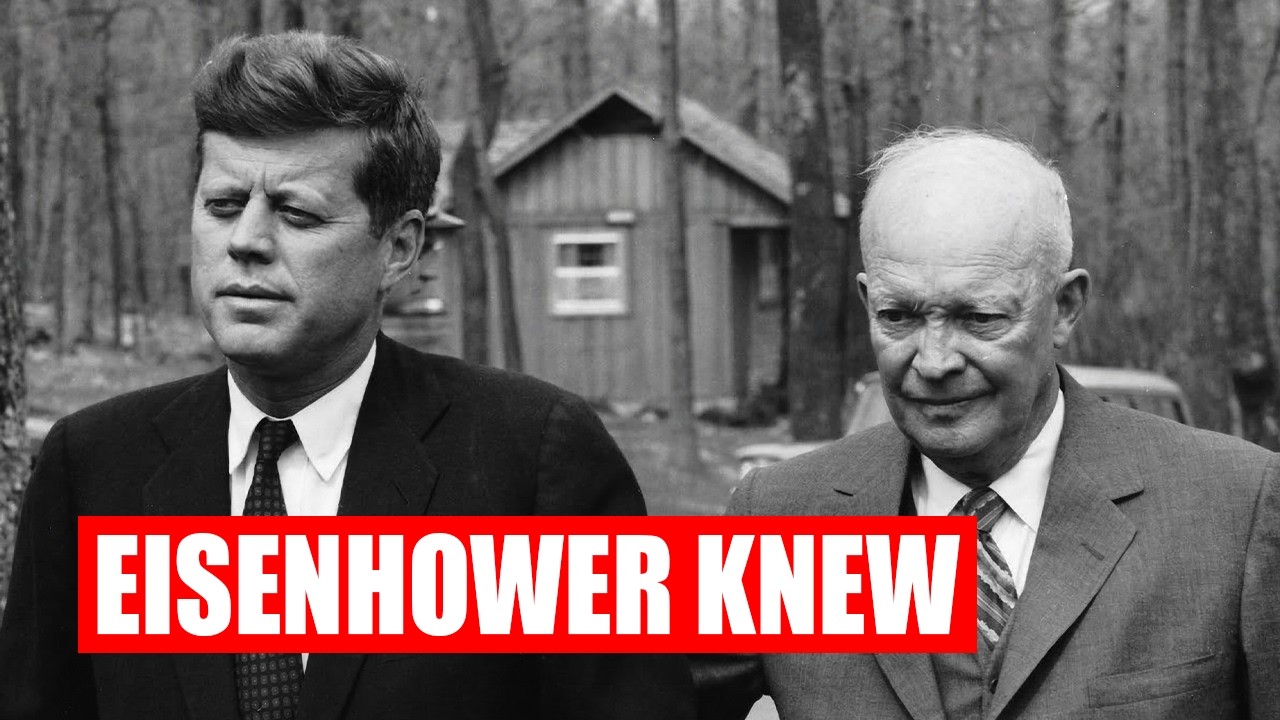
Eisenhower emphasized two things. First, Southeast Asia. Laos was collapsing, and he told Kennedy that military intervention might be necessary. The Joint Chiefs were pushing for it. Second, Cuba. Fidel Castro had taken power, and the CIA had a plan to train Cuban exiles to invade. Eisenhower had approved it but warned Kennedy that the military wanted full US intervention and would use any excuse to get it.
Kennedy listened, took notes, and thanked Eisenhower. Then he made a decision that would define his presidency. He would not give the military what they wanted.
On April 17, 1961, just 87 days into Kennedy's presidency, the CIA's Cuban exile invasion at the Bay of Pigs ended in disaster. The exiles were slaughtered, and Castro's forces crushed them within 72 hours. The CIA and the Joint Chiefs blamed Kennedy. He had refused to provide US air support and refused to send Marines.
Publicly, Kennedy took responsibility. Privately, he was furious. CIA Director Allen Dulles had misled him, promising the invasion would succeed without US troops. The Joint Chiefs had pressured Kennedy to commit combat forces. When he refused, they turned on him.
General Lyman Lemnitzer, Chairman of the Joint Chiefs, was particularly bitter. He viewed Kennedy as weak, indecisive, and soft on communism. Lemnitzer wanted another chance at a real invasion with full military force, and he was willing to do anything to make it happen.
On March 13, 1962, one year after Kennedy took office, Lemnitzer presented a top secret document to Secretary of Defense Robert McNamara. Its title was "Justification for US military intervention in Cuba." Inside was a menu of false flag terror attacks designed to create a pretext for invading Cuba.
The proposals included blowing up a US ship in Guantanamo Bay and blaming Cuba, a modern "remember the Maine" incident. They included developing a communist Cuban terror campaign in Miami, other Florida cities, and even Washington, bombing US cities and killing American civilians to frame Cuba. They included sinking a boatload of Cubans en route to Florida, real or simulated, to use the tragedy to justify war. They included staging fake hijackings and shooting down civilian aircraft to blame Cuba.
The document was signed by every member of the Joint Chiefs of Staff and unanimously approved. It was presented to the Secretary of Defense as official Pentagon policy. This was not a rogue operation. It was America's top military leadership formally proposing to murder American citizens to justify a war.
Kennedy's reaction was blunt and final. We are not going to invade Cuba. Lemnitzer was stunned. This was military strategy and the Pentagon's recommendation. How could Kennedy refuse?

Kennedy did refuse, and six months later Lemnitzer was gone. In December 1962, Kennedy removed him as Chairman of the Joint Chiefs. Officially it was a lateral move, with Lemnitzer becoming Supreme Allied Commander of NATO, a prestigious post. But everyone understood Kennedy had fired him and sent him out of Washington.
Defense Secretary Robert McNamara later reflected that military officers had proposed things that were completely insane. He described Lemnitzer as having lost touch with reality.
Kennedy did not stop there. He began restructuring the military command, reducing the Joint Chiefs' authority and centralizing control in the White House. The generals were furious. They saw Kennedy as undermining military autonomy.
In October 1962, Soviet nuclear missiles were discovered in Cuba. The Joint Chiefs wanted war, immediate air strikes, and an invasion to destroy the missiles before they became operational. General Curtis LeMay, Air Force Chief of Staff, told Kennedy the missiles had to be destroyed and that military action was the only option.
Kennedy asked what would happen if they retaliated. LeMay said they would not. Kennedy pressed further, asking what if Soviet forces in Cuba fired back or Khrushchev responded in Berlin. LeMay replied that it was a risk they had to take.
Kennedy refused and chose a naval blockade instead, along with negotiation and diplomacy. The Joint Chiefs were appalled, viewing it as weakness and appeasement. But Kennedy's approach worked. Khrushchev backed down, the missiles were removed, and nuclear war was averted.
Afterward, LeMay told Kennedy it was the greatest defeat in American history, not a Soviet defeat but an American one, because Kennedy had not gone to war. The rift was total and irreparable. The president and his generals were enemies.
On June 10, 1963, Kennedy announced plans for a nuclear test ban treaty with the Soviet Union. The Joint Chiefs opposed it vehemently, arguing that nuclear testing was essential for military readiness and that banning it would weaken US defenses. Kennedy did not care. He was tired of the arms race, tired of brinkmanship, and tired of generals pushing for war.
He gave a speech at American University that was radical for its time. He asked what kind of peace we seek, saying it was not a Pax Americana enforced on the world by American weapons of war. He spoke of genuine peace, cooperation with the Soviets, and an end to Cold War hostilities. The military establishment saw this as treason.

Privately, Kennedy told aides he planned to withdraw from Vietnam after the 1964 election. No escalation, no ground troops, get out. The Pentagon was planning the opposite, escalation, more troops, and full commitment. Kennedy and the military were on a collision course.
The pattern repeated itself. At the Bay of Pigs in April 1961, Kennedy refused military escalation and the generals were furious. With Operation Northwoods in March 1962, the Joint Chiefs proposed domestic terrorism, and Kennedy refused and fired Lemnitzer. During the Cuban Missile Crisis in October 1962, Kennedy refused air strikes and invasion and chose diplomacy. With the Test Ban Treaty in June 1963, Kennedy pursued peace with the Soviets while the military opposed him.
Every time Kennedy chose against military advice, the rift deepened. Eisenhower had warned him that the military-industrial complex would resist civilian control, push for war, and seek unwarranted influence. Kennedy resisted and paid the price.
On November 22, 1963, at 12:30 p.m. in Dealey Plaza, President Kennedy was shot and killed. Within hours, Lee Harvey Oswald was arrested, described as a lone gunman, with no conspiracy. The case was closed.
But questions remain. Why was Kennedy's limousine washed before forensic examination? Why was his body removed from Dallas in violation of Texas law? Why were witnesses who reported shots from the grassy knoll ignored? And why did the Warren Commission investigating Kennedy's murder include Allen Dulles, the CIA director Kennedy had fired after the Bay of Pigs?
Dulles had misled Kennedy and was connected to the military intelligence establishment Kennedy had battled for three years. His presence on the Warren Commission was a profound conflict of interest.
Did the military-industrial complex kill Kennedy? The evidence is circumstantial and suggestive, not definitive. But what is known is that Kennedy fought the military establishment for 1,036 days, refused their demands, fired their leaders, and pursued policies they opposed.
Operation Northwoods proves the Joint Chiefs were willing to murder American civilians to achieve their goals. That is documented, declassified, and proven. If they would kill random Americans to justify invading Cuba, the question of whether they would kill one American president they despised remains.
Eisenhower warned Kennedy that the military-industrial complex was dangerous, that its power was growing, and that its influence was unchecked. Kennedy believed he could control them and that civilian authority would prevail. On November 22, 1963, in Dallas, Texas, that belief was tested in the most final way.
Eisenhower's warning was not theoretical. It was based on what he had seen, what he knew, and what he feared. Three years after that warning, the president who defied the military was dead.