On January 30, 1933, Adolf Hitler became Chancellor of Germany, effectively ending German democracy. In the months that followed, he used emergency decrees and political pressure to dismantle democratic institutions, eliminate opposition parties, and strip away individual freedoms, including freedom of the press, speech, and assembly. But ideology alone does not build tanks or fire artillery. The Nazi war machine depended on steel, coal, and capital, and on the industrialists who supplied weapons, financed expansion, and profited from human suffering.
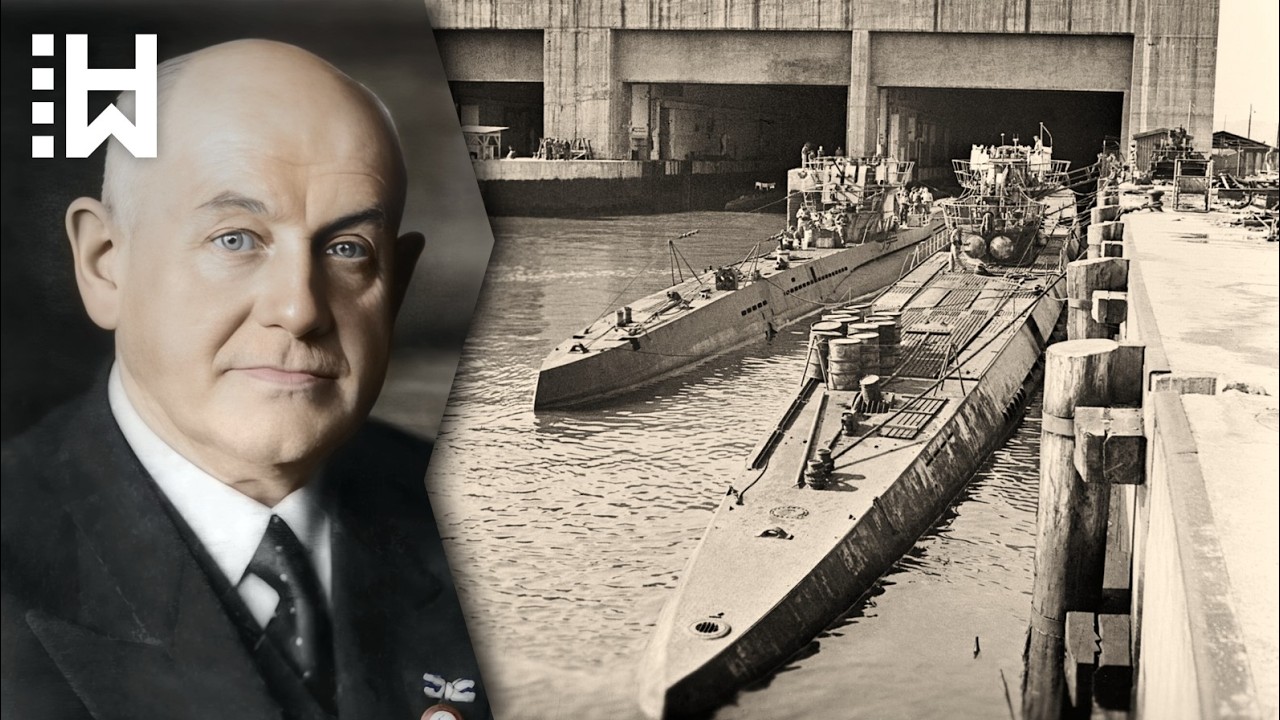
As the war escalated, forced labor became the engine of the German economy. Millions of prisoners, civilians, and concentration camp inmates were forced to work under brutal conditions in factories and mines, where many were worked to death. Among those who benefited most was a man who built one of Germany’s largest industrial empires, supplied ammunition, rifles, artillery, and U-boat batteries to the Nazi war effort, and profited from tens of thousands of slave laborers in his factories. At least three of his plants used concentration camp inmates, where execution areas were set up on the factory grounds.
Thousands of those forced to work for him did not survive. His name was Günther Quandt. Quandt was born on July 28, 1881, in the small town of Pritzwalk, then part of the German Empire. He was the son of cloth manufacturer Emil Quandt.
After attending secondary school in Berlin, Quandt completed several years of training in various branches of the textile industry in Germany and abroad. By 1909, Quandt had become co-owner of the Draeger Brothers Cloth Factory. Two years later, he became co-owner of the Friedrich Paul Cloth Factory in Wittstock. After the outbreak of the First World War in July 1914, Quandt supplied uniforms to the German army, which helped him accumulate a large fortune.
In addition, he was active in the management of war-essential raw materials. In 1915, Quandt became head of Reichswall AG, and his corporate group became the army’s principal supplier. The First World War ended in November 1918, and in the same year, his wife died from the Spanish flu. After the war, Quandt worked as an advisor in the Reich Ministry of Economics of the Weimar Republic, which emerged after the fall of the German Empire.
In January 1921, he married the 19-year-old Magda Ritschel, who was nearly 20 years younger than him, and in November of the same year, their son Harald was born. From 1922 onwards, Quandt became increasingly involved in the potash industry, especially with Wintershall AG. He also worked closely with the influential banker Jakob Goldschmidt, who helped him acquire a controlling interest in Accumulatorenfabrik AG, or AFA, the largest manufacturer of batteries and accumulators in Europe, including battery systems for submarines. In 1928, he gained control of Berlin-Karlsruher Industrie-Werke AG, an armaments company that had been forbidden from producing weapons after the First World War.
Quandt counted on armaments soon having a great future again in Germany. As Quandt expanded his industrial empire, a different kind of transformation was taking place in Germany. The Weimar Republic was plagued by political assassinations, street battles between left-wing paramilitaries, and a deep hatred for the Treaty of Versailles, which held Germany completely responsible for starting the war and imposed heavy reparations. In 1923, hyperinflation made the German currency worthless, wiping out the savings of the middle class and fueling radicalism across the political spectrum.
It was into this atmosphere of crisis that Günther Quandt’s collaboration with the Nazis began. By the late 1920s, Quandt’s marriage to Magda Ritschel was already falling apart, but it was she who would become the family’s key connection to the Nazi movement. By 1929, when the couple divorced, leaving Magda with a generous settlement, she was already deeply involved with the National Socialists. She had read Hitler’s autobiographical and political manifesto Mein Kampf.
She joined the Nazi Party in September 1930 and began working as a secretary at the party headquarters in Berlin. It was there that she met her future husband, Joseph Goebbels, who would become Hitler’s Minister of Propaganda. Quandt, who remained on friendly terms with his ex-wife, was soon introduced to Goebbels. Before long, he was convinced, like many industrialists at that time, that the Treaty of Versailles was a national disgrace and that the communists posed a mortal threat to Germany.
Quandt met Adolf Hitler for the first time in 1931, when the Nazi leader was trying to build relationships with major industrialists. He later described Hitler, recognizable by his trademark brown uniform, as thoroughly average. By mid-1931, Quandt had joined a secret group of industrialists who met with Hitler at Berlin’s Hotel Kaiserhof and pledged 25 million Reichsmarks to the Nazi Party in the event of a left-wing uprising. Later that year, in December, Goebbels recorded in his diary that he had received 2,000 Reichsmarks from Quandt, describing the industrialist as clever, energetic, and a brutal capitalist.
On January 30, 1933, Hitler was appointed Chancellor of Germany by President Paul von Hindenburg. The following month, Quandt participated in another secret meeting between Hitler and industrialists, where campaign aid of 3 million Reichsmarks was approved for the Nazi Party and its coalition partner. On May 1, 1933, Quandt became a member of the Nazi Party. But several days later, he was arrested on false charges.
Nazi officials publicly declared that he had been caught transferring funds abroad and was planning to relocate AFA factories outside Germany. Although Goebbels was not fond of his wife’s ex-husband, he put in a good word for Quandt and told Hitler, “It is a bad idea not to allow the economy to settle down. ”
Quandt was soon released and in the following years became one of the most important German arms producers. In 1937, Hitler appointed him to the position of leader of the armament economy, a title given to industrialists who played a leading role in the Nazi war economy.
The Führer rewarded him with handsome profits. Quandt’s factory supplied Hitler’s military with ammunition, rifles, artillery, and very importantly, batteries. AFA, the core of the Quandt industrial group, was able to produce batteries of sufficiently high quality to make both the submarine war in the Atlantic and the launch of Hitler’s miracle weapon, the V2 rocket, possible. The Second World War started on September 1, 1939, when Nazi Germany invaded Poland.
When German industrialists appropriated factories throughout Europe in the wake of Hitler’s conquests, Quandt was one of the first in line. On two occasions, however, he failed. In Belgium, Quandt tried to take over a chemical company after wrongly assuming its owner was Jewish and would therefore be stripped of his property by the regime. He even filed an official request with the occupation administration.
In Luxembourg, he attempted something just as ruthless. In 1943, a local businessman was arrested by the Gestapo, the Nazi secret police. Quandt appealed directly to Albert Speer, Hitler’s Minister of Armaments, hoping to secure a controlling stake in the man’s company. But Speer saw no reason to step in on Quandt’s behalf.
Yet Quandt’s crimes were not limited to his takeovers of foreign factories. Inside his own factories, the exploitation was already underway. According to historians, Jewish forced laborers were used in at least one of Quandt’s companies as early as 1938. During the Second World War, as German labor was increasingly recruited for military service, the Quandt factories turned to other sources.
Beginning in late summer 1940, the AFA plant in the city of Hagen employed French prisoners of war. As the production of batteries for submarines, torpedoes, and V2 rockets intensified, the number of forced laborers and prisoners of war rose continuously. By 1944, they made up around 40% of the total workforce of up to 5,800 workers. At the DWM plant in the city of Karlsruhe, there were about 4,500 prisoners of war.
From the summer of 1943 onwards, inmates from the Neuengamme concentration camp satellite camp in the northern German city of Hanover were deployed in the AFA branch plant there. Around 1,500 concentration camp prisoners, housed directly on the factory grounds, carried out battery production in lead-poisoned surroundings. Another satellite camp on the factory grounds in Hanover even had an execution site. In Vienna, prisoners from Mauthausen concentration camp were used in 1944.
In Berlin, around 500 female concentration camp prisoners were forced to work with caustic acids at Pertrix, a subsidiary of the AFA battery company. These working conditions caused an average of 80 deaths per month, a rate the company consciously calculated in advance as expected fluctuation. One former forced laborer was Carl Adolf Sørensen, a Danish resistance fighter who was deported in 1943. He was sent to a satellite camp near Hanover and forced to work in the adjacent AFA battery plant.
Sørensen arrived with 40 comrades. He and his fellow slave laborers assembled batteries for German submarines. The men handled toxic heavy metals without any protective gear. Six died in the first three months alone.
SS men told Sørensen that inmates at the camp could not expect to survive more than six months. In the end, most prisoners succumbed to lead poisoning. The Quandt family was aware of these conditions. In fact, Günther Quandt’s son, Herbert, was the director of Pertrix, the Berlin-based subsidiary of AFA that used female slave laborers, including Polish women transferred from Auschwitz concentration camp in German-occupied Poland.
It is estimated that up to 50,000 slave laborers worked in Quandt’s arms factories during the Nazi era. The Second World War in Europe ended on May 8, 1945. In July 1946, Quandt was arrested because of his connections to Goebbels and interned. To the surprise of many, he was classified as a follower, someone who accepted Nazi ideology but did not take an active part in crimes.
In January 1948, Quandt was released without charge. One of the prosecutors at the Nuremberg trials, Benjamin Ferencz, later said that if today’s evidence against Quandt had been presented to the court at the time, Quandt would have been charged with the same offenses as the directors of I. G. Farben.
Those directors served up to eight years in prison. Günther Quandt was 73 years old when he died on December 30, 1954, in Cairo, Egypt. After his death, his son Herbert turned the family fortune toward a new venture. In 1960, he acquired a large package of shares in BMW, protecting the struggling automaker from a takeover by Daimler-Benz.
The story of the Quandt saving BMW became one of the great legends of the German post-war economic miracle. Forgotten was the question of how they had amassed the fortune to make that purchase, and whose lives had paid for it. To this day, the Quandt family remains the controlling shareholder of BMW and is among Germany’s richest and most influential families, with an estimated fortune of nearly 50 billion dollars.