When a kingpin dies, the funeral often says more about how he lived than how he died. These services have historically been less about mourning and more about power—final public statements delivered through custom coffins, massive motorcades, and crowds that filled entire neighborhoods. Some of these funerals drew international attention, while others left city officials scrambling to contain the spectacle. Rich Porter’s funeral in Harlem in 1990 was not the largest or most expensive, but it was among the most painful.
Porter was one of the three prominent figures in Harlem’s crack era, a group later depicted in the film *Paid in Full*. He was 25 years old when he was murdered in January 1990 by his best friend, Alpo Martinez, who shot him and left his body near Orchard Beach Park in the Bronx. Porter had $2,239 in his pockets when he was found. What made the service heartbreaking was what was missing.
Porter’s 12-year-old brother, Donnell, had been kidnapped weeks earlier by Martinez’s crew, who demanded a $500,000 ransom. At the time of the funeral, no one knew if the boy was alive. Porter’s mother sat in the front row mourning one son while uncertain of the other’s fate. Donnell’s body was found months later; he had been killed, wrapped in garbage bags, and left on a bicycle path.
The funeral was packed, but the weight of betrayal and loss hung over the room. Rayful Edmond III, the man who helped make Washington, D. C. the nation’s murder capital, died on December 17, 2024, at age 60.
At his peak, Edmond controlled an estimated 60 percent of D. C. ‘s cocaine supply, employed over 150 people, and was believed to be pulling in around $300 million a year. In 1991, at the height of the epidemic he helped fuel, the city recorded 482 homicides—the highest in its history.
His funeral was held quietly at a local church, presided over by senior pastor Colin Pugh. Family, friends, and those shaped by his complicated legacy attended. There was no motorcade, no luxury cars, and no diamond coffin. The silence of the ending stood in stark contrast to the chaos of his reign.
In 1973, over 7,000 people attended the funeral of Major Benjamin Coxson in Cherry Hill, New Jersey. The motorcade stretched more than 100 cars. The one notable absence was Muhammad Ali, who had given Coxson a silver Rolls-Royce and dedicated a heavyweight championship victory to him on national television. Ali did not attend because there was reportedly a contract on his life.
Coxson had been executed on June 8, 1973, shot three times in the back of the head at his home. His 17-year-old daughter was also killed, and his girlfriend survived by playing dead. The Black Mafia had come to collect a $200,000 debt. Ali, who lived seven minutes away, fled to Chicago that month.
The funeral’s size and the most famous man in the world staying away spoke volumes about the danger surrounding Coxson. Maxine Walter, known as Red Top, was only 16 years old when she was accidentally shot and killed by one of Nicky Barnes’s bodyguards in Harlem in the 1970s. She was reportedly earning $300,000 a month on the same blocks where Barnes ran his operation. She was never arrested.
Her funeral drew Sammy Davis Jr. , one of the biggest entertainers in America. The presence of a man who performed for presidents at the funeral of a teenage girl from Harlem underlined both her power and the tragedy of her death. Frank Lucas, the man portrayed by Denzel Washington in *American Gangster*, died on September 30, 2019, at age 88.
Before his death, Lucas contacted casket designer Fletcher Collins and ordered a custom coffin modeled after a Cadillac CTS-V. The casket featured a sliding rooftop, working headlights and taillights, and a North Carolina license plate on the back, referencing where he grew up. It cost $12,000. Lucas, who was known for smuggling heroin inside the coffins of dead American soldiers, was buried in a coffin shaped like a luxury car.
Willie Fluky Stokes Sr. was shot and killed on November 19, 1986, in Chicago while sitting in a black Cadillac limousine talking on his wireless telephone. He was 48. About 7,000 people filed past his casket at the A.
R. Leak Funeral Home. He was laid out in a mahogany coffin with a powder blue interior, wearing a blue suit and blue python shoes, with tinted sunglasses and a portable telephone placed in his hand. The procession included over 100 cars, led by a restored white 1956 Cadillac.
Flowers spilled from two cars, some with dice and playing cards pinned to them in honor of his reputation as a legendary gambler. He was placed in one of eight crypts he had purchased for $40,000 in cash two years earlier, after his son was murdered. That son, Willie “the Wimp” Stokes Jr. , was 28 when he was killed in 1984.
His father decided he would be buried in a custom coffin built to look like a Cadillac Seville, complete with a real Cadillac grill, flashing headlights, a steering wheel, and side-view mirrors. White velvet lined the interior. Cash was placed between each of his fingers, and diamond rings were on both hands. The funeral made national news and inspired an unexpected tribute.
Texas musician Bill Carter read about it and turned the story into a song. Within two miles of driving to the studio, he and his partner had the lyrics. Jimmy Vaughan was there and called his brother Stevie Ray Vaughan, who recorded the track. *Willie the Wimp* became a blues rock classic, performed by Stevie Ray Vaughan around the world.
The song opens with the line, “Willie the Wimp was buried today. They laid him to rest in a special way. ”
When Bumpy Johnson, the Godfather of Harlem, was laid to rest on July 11, 1968, the NYPD treated the funeral like a military operation. More than 5,000 people attended the service at St.
Martin’s Episcopal Church. Police snipers were positioned on rooftops, uniformed officers lined the blocks, and plainclothes detectives photographed mourners. Johnson’s wife, Mayme, later wrote that police seemed to think Johnson might rise from the casket and start trouble. The crowd included celebrities, politicians, numbers runners, and everyday Harlem residents who had received free turkeys from Johnson every Thanksgiving for decades.
Johnson had run Harlem for 40 years, survived Alcatraz, and outlasted rivals and indictments. He died at 2:00 a. m. eating chicken and grits at his favorite restaurant.
Even in death, the city was not sure he was finished. Felix Mitchell’s funeral in Oakland, California, in 1986 became the standard by which all other kingpin funerals are measured. Mitchell was stabbed to death at Leavenworth Federal Penitentiary on August 21, 1986, two days before his 32nd birthday. He had been serving a life sentence for running a heroin empire that generated about $5 million a year from the 69th Avenue housing projects.
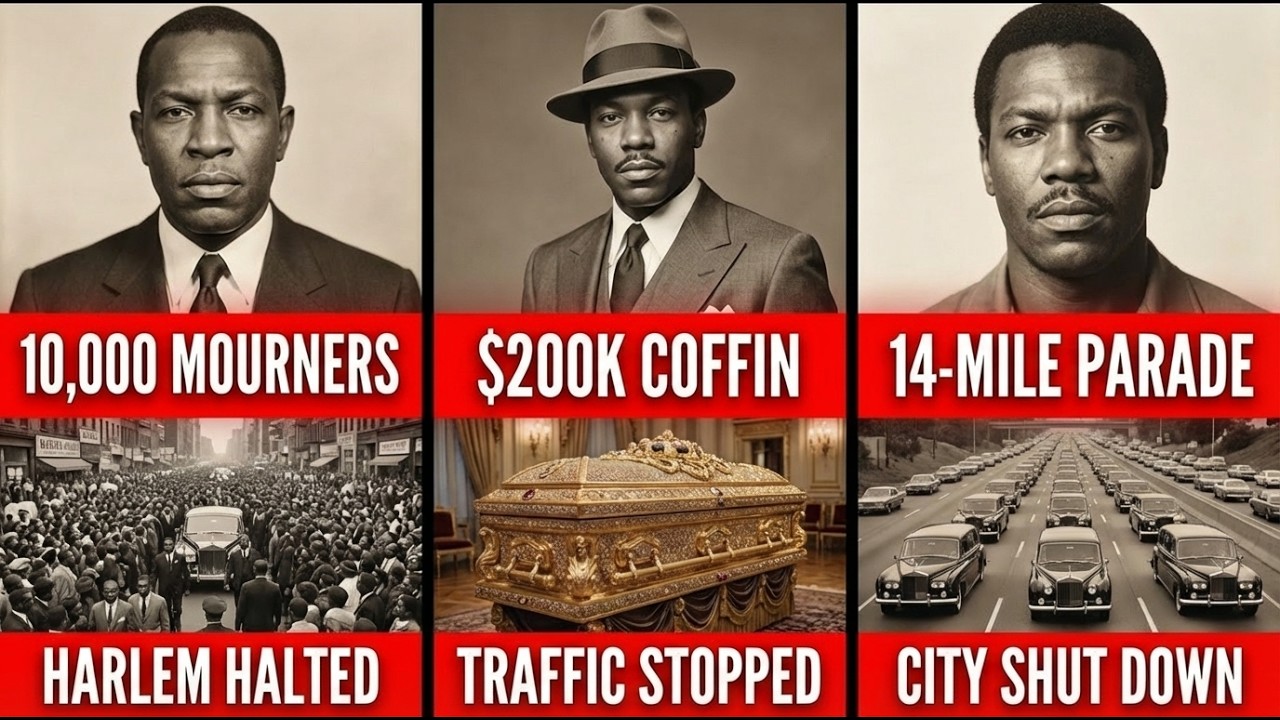
His body was brought home, and Oakland responded. The service was held at Star Bethel Baptist Church, with 1,800 people inside. The casket was placed on a horse-drawn white carriage and followed by 14 Rolls-Royce limousines in a single row. The procession rolled through Mitchell’s old neighborhood as thousands lined the streets.
The Los Angeles Times reported another thousand people gathered just to watch it pass. Black Panther Party co-founder Huey P. Newton attended. International news covered the event, broadcasting images of a royal-style carriage moving through a housing project.
City officials were furious. One council member called it a glorification of the mafia; another called it hero worship of a murdering thug. A police detective said, “They’re trying to martyr him, this scumbag, this murderer, this convicted heroin dealer. ” The streets did not care.
Thousands came out anyway. Mitchell was interred at Rolling Hills Memorial Park in Richmond, California, as the headlights of the 14 Rolls-Royces lit up the cemetery. A local radio personality remembered, “It was like Martin Luther King had died. ”
There is no single funeral that ranks as the greatest of all time because the top spot belongs to the rule that connects them all.
Every kingpin on this list followed one code, even those who broke every other: when one of them dies, they are sent off like royalty. It did not matter if the man in the casket was loved or feared, died in a mansion or a prison cell. The streets came out, and the streets made sure the world saw it. Cadillac coffins with flashing headlights, 14 Rolls-Royces in a line, python shoes, cash between fingers, snipers on rooftops, 7,000 people filing past a casket, and horse-drawn carriages rolling through housing projects.
These funerals were not about mourning. They were about power—the last message that we were here, we mattered, and you will remember us.