During World War II, women served as spies on many sides of the conflict, gathering intelligence and working with resistance networks against occupying German forces. Women were often viewed as less suspicious than men, and resistance groups sometimes used them to track and assassinate targets. If captured, however, these agents frequently faced the worst forms of death and execution imaginable. Some were beaten to death, while others were executed in front of large crowds to send a clear message.
Violette Reine Elizabeth Bushell was born in Paris on June 26, 1921. Her father, Charles Bushell, was English, and her mother was French. This mixed heritage later proved valuable when she became a secret agent, because she was fluent in both French and English. The family eventually moved to London and settled in Stockwell. She grew up in a lively working-class family with four siblings.
By all accounts, she was a vivacious and athletic girl. She loved horse riding, cycling, gymnastics, and swimming, skills that later helped her survive dangerous missions behind enemy lines. As a teenager, she worked in a perfume shop on Oxford Street and later at Woolworths. She was described as sociable, elegant, and full of energy. Those who knew her remembered her as a bold girl with an independent streak.
When war broke out in 1939, Violette was only 18 years old. Britain was under threat, and like many young women of her generation, she wanted to help. She joined the Women's Land Army for a time and later worked in an aircraft factory manufacturing weapons. In July 1940, she met Étienne Szabo, a handsome officer in the French Foreign Legion who had fled France after the German occupation. They fell in love quickly and married in August of that year. She was 19, and he was 31.
They did not spend much time together, as Étienne was soon sent to fight with the Free French forces. In June 1942, Violette gave birth to a daughter named Tania. Tragically, Étienne was killed in battle just a few months later during the Battle of El Alamein in North Africa. Violette was devastated. She had lost her husband and now had to raise her child alone.
Instead of surrendering to grief, she decided to fight in his memory. By 1942, Britain had formed the Special Operations Executive (SOE), a secret organization tasked by Winston Churchill with setting Europe ablaze. Its agents were trained to sabotage German operations, support local resistance groups, and gather intelligence. The mission was extremely dangerous. If agents were captured, they faced torture and execution.
Violette, with her language skills, fitness, and determination, was an ideal recruit. In 1943, they contacted her, and she soon joined the SOE. She trained in weapons use, hand-to-hand combat, parachuting, and wireless communications. She learned how to blow up trains, use disguises, and send coded messages. Her trainers were impressed by her performance. Despite her small stature, around 160 centimeters, she was fierce with a submachine gun and unafraid of danger. She also had a photographic memory, which made her an excellent courier.
In April 1944, Violette was sent on her first mission to occupied France. She parachuted into Normandy a few weeks before the D-Day landings. Her role was to help organize resistance groups and sabotage German communications. She traveled under the false identity of a French woman named Corinne Reine Leroy. Her courage was evident from the start. She cycled long distances to deliver messages, arrange safe houses, and transport vital intelligence. At one point, she helped coordinate attacks on German railway lines, disrupting troop movements to the front. Her mission succeeded, and she returned safely to England after several weeks. But she barely rested before volunteering for another mission.
In June 1944, immediately after D-Day, Violette parachuted into France again, this time near Limoges. Her job was to help local resistance fighters organize sabotage operations against retreating German forces. On June 10, 1944, she and another agent were traveling near Salon-la-Tour when they encountered a German roadblock. A fierce firefight broke out. Violette fought with incredible bravery, holding off the German forces with a machine gun to give her comrade time to escape, but she was eventually captured.
The Germans interrogated her brutally. She was then transferred to Paris and finally to the Ravensbrück concentration camp in Germany. Despite repeated torture, she refused to reveal any information. Fellow prisoners later remembered her as defiant, cheerful, and supportive even in horrific conditions. Ravensbrück was located near Berlin and held 132,000 women throughout the war. The large barbed-wire fences were intended to keep the prisoners inside. Conditions were harsh, and prisoners had to perform hard labor every day. If they failed to meet expectations, they were severely beaten by the guards.
One former prisoner wrote that they did not shoot women. "We were meant to die of misery, hunger, and exhaustion. When we arrived at Ravensbrück, that was the worst. The first thing I saw was a cart loaded with stacked corpses, their arms and legs dangling, their mouths and eyes wide open. They stripped us of everything. We did not even feel we had the value of livestock. You worked and then you died." There was a hut inside the camp that was used and converted into a gas chamber, and thousands of women were pushed into it before the site was liberated.
But in early 1945, as World War II in Europe neared its end, the Nazis began executing many of their most prominent prisoners, including captured SOE agents. On February 5, 1945, Violette Szabo was pulled from her cell and taken to the "execution alley" with two other prisoners, fellow SOE agents Denise Bloch and Lilian Rolfe. These women had been tortured so severely and suffered so much from the conditions that they were actually transported to the execution alley on stretchers and could not walk.
The method of execution was a shot to the neck. A single bullet to the victim's neck, known in German as "Genickschuss." This was a method by which hundreds of thousands died throughout World War II at the hands of German pistols. Violette Szabo was ordered to kneel by SS Rottenführer Schult, while camp commandant Fritz Suhren watched as he read the execution sentence. She knelt slowly on the ground. Witnesses to the executions included deputy commander Johann Schwarzhuber, SS Scharführer Zappe, SS Rottenführer Walter Schenk, camp doctor Richard Trommer, and dentist Dr. Martin Hellinger.
The executioner approached the kneeling Violette, drew his pistol, and fired a single merciless shot into the back of her head or neck, and she fell to the ground a lifeless heap. Her body was then taken to the camp crematorium, where it was burned and turned to ash. When the war ended, the bravery of SOE agents was finally revealed. Violette was posthumously awarded the George Cross, Britain's highest civilian gallantry award, as well as the French Croix de Guerre and the Resistance Medal. The medals were presented to her daughter Tania at Buckingham Palace by King George VI. She was only four years old at the time.
Violette Szabo's story is powerful and moving for many reasons. She was not a professional soldier, nor someone trained from childhood to fight. She was an ordinary young woman, a shop assistant, a wife, and a mother who chose to face extraordinary danger because she believed it was right. Her courage reminds us that heroism is not about age, gender, or background. It is about daring to face fear. She could have stayed safe to raise her daughter, but instead she chose to risk her life to fight tyranny.
Her sacrifice also highlights the often-overlooked role of women in World War II. Agents like Violette were vital to the success of the resistance. They carried weapons, organized sabotage, and endured brutal risks. Their work paved the way for greater recognition of women's contributions in later generations. Today, Violette Szabo is remembered as one of the most famous SOE agents. Her name is engraved on the SOE memorial at Albert Embankment in London alongside her fellow agents. There are even schools in Britain and France named after her. There are also streets bearing her name. In 2009, her image appeared on a series of British postage stamps honoring war heroes. Every year, memorial ceremonies are held in her honor.
A famous French athlete was driving her car on a country road. But she was more than just an athlete. This woman was known as the "Hyena of the Gestapo," infamous as a brutal and cruel collaborator who hunted the resistance against the German occupation. Many of those she helped capture were executed by the Germans, others were sent to camps inside the Reich, and many were tortured. There were even claims that she participated in torture herself.
Violette Morris also ran a garage for the German air force, the Luftwaffe, and the Nazis viewed her as a useful collaborator. Adolf Hitler even invited her to attend the 1936 Berlin Olympics as a guest of honor. But on that fateful day, while driving her car on that road, Violette Morris was killed by a hail of bullets from French Resistance members determined that she would never collaborate and work with their enemy again. Her body was torn apart by bullets and she was later buried in an unmarked grave.
But why did the French Resistance specifically target her? And what made Violette Morris so dangerous? As a young woman, Violette Morris lived in Paris. During World War I, she learned to drive and drove ambulances that helped evacuate wounded soldiers from the battlefield. She also worked as a courier during the deadly Battle of the Somme and the Battle of Verdun. So how did she turn from this into a traitor to her people?
She was extremely athletic and played football for the French women's national team, even winning gold medals. She also participated in many other sports. She was an avid boxer known for defeating men, and she competed in motorcycle and car racing, tennis, shooting, and many other sports including weightlifting and Greco-Roman wrestling. At the 1924 Women's Olympics, she also won gold medals in discus throwing and shot put. But one of her most successful sports was car racing, in which she competed and won many different races.
Violette Morris was a woman completely different from what was expected in the 1920s. She often wore men's clothing, smoked heavily, and swore a lot. This actually led to her being barred from participating in the 1928 Summer Olympics, where it was said she lacked morals. Her racing license was also later revoked. This caused great resentment for Violette, and she said in one trial, quote: "We live in a country corrupted by money and scandals, ruled by conspirators and cowards." "This country full of dwarfs does not deserve its ancestors, nor does it deserve to survive." "One day it will rot." "It will sink to the level of slaves." "But if I am still here, I will not be one of those slaves." "Believe me, that is not my nature."
Perhaps the restrictions imposed on her were what began to change her view of her nation and country. But in 1937, Violette became involved in a high-profile murder case. On Christmas Eve 1937, she was having dinner with friends and met an aggressive, drunk man named Joseph Lemo. The man argued with one of Violette's friends and she managed to calm him down. But the following night, Lemo went to Morris's houseboat and an argument broke out between them. Lemo brandished a knife at Violette, and she pushed him back before he lunged at her with his weapon. Violette fired four bullets at Lemo, who later died in the hospital. She was arrested and charged with murder, but was tried and acquitted when the court accepted her claim of self-defense.
But during World War II, Violette Morris became notorious for betraying France. For some reason, she was invited to attend the 1936 Summer Olympics hosted by the Nazis in Berlin. Hitler himself insisted on Morris's attendance, and she was received as a guest of honor. Now, one reason this was strange is that she was against everything the Nazis believed women should be. Perhaps Hitler invited her to try to annoy the French, because they had completely turned their backs on Violette. She watched many events and stayed in luxury hotels, all at the Nazis' expense.
Years later, following the outbreak of World War II, France found itself under German invasion and soon subjected to occupation. German tanks and military vehicles swept across the territory in a blitzkrieg, causing the country to fall into Nazi hands. The Vichy regime was established under Marshal Philippe Pétain, and this government openly collaborated with the Nazis. The French people faced a difficult choice. Would they join the resistance elements fighting secretly, or would they collaborate and support the occupation? Violette Morris decided to collaborate and work with the Nazis and the Vichy regime.
She was not a casual or one-time collaborator. Her work led to the suffering and destruction of many resistance fighters and networks. One of the largest operations she participated in was an attempt to track down SOE agents. These were British secret agents working undercover to coordinate French resistance operations and ensure they were well-armed. Many of these British agents were parachuted behind enemy lines, and Violette Morris tried to track down many of them. She was also alleged to have spied on high-value targets for the Nazis, and possibly personally participated in brutal Gestapo torture sessions.
Alongside all this, she also worked for the Luftwaffe, the German air force. She ran a garage for them and was involved in securing fuel from the black market for them. Of course, this fuel was later used to bomb British cities and towns and bring death to the Nazis' enemies. It was also said that she did much of this work before the official fall of France. Some historians believe she may have been a scapegoat later, but Violette Morris gained a fearsome reputation for her involvement with the enemy, and was known to enjoy participating in torture. Because of all this, she earned the nickname "Hyena of the Gestapo."
But the resistance was tracking her, and things came to a head on April 26, 1944. Violette Morris was driving her Citroën on a country road near Évreux in Normandy. She was accompanied by another pro-Nazi family, but her car suddenly broke down. The engine coughed and stopped, as resistance fighters had tampered with it beforehand. As soon as she got out of the car, resistance members emerged from hiding and opened fire directly on her and the car. Five people were killed in the attack, including two children. The resistance riddled Violette Morris's body with bullets, then her body was dragged to the morgue, where it remained unclaimed for several months.
It was a brutal end for a woman who had collaborated with the enemy, and it showed the intentions the resistance harbored. But why was she executed or assassinated in such a public place? And why did it happen in the first place? The French Resistance was accustomed to eliminating high-value targets in public places to strike a strong blow and send a message to their enemies that no one was safe. Many high-ranking German officers were killed inside cities like Paris in this way, and most were killed by quick means such as shooting.
Violette Morris was viewed as one of the worst enemies of her country. She had betrayed France and was clearly a traitor. In the eyes of the resistance, this was the worst crime a person could commit. She fell into an ambush during a carefully planned attack, which shows the harsh reality of the war the resistance was waging. She was also a high-value target in the eyes of the resistance. She was not an obscure or unknown figure. Her famous athletic background made her a well-known personality, and her notorious reputation increased the impact of her collaboration.
Killing such a well-known collaborator sent a message to other French people that this would not be tolerated and that prominent figures were not above accountability. But it also sent another message specifically to the Germans, that the resistance possessed intelligence capabilities and was capable of carrying out merciless attacks. The attack also helped the resistance deal with potential security risks. By eliminating her, fewer resistance members were arrested, especially since she held important information about them. Her connections within the Gestapo also made her unpredictable, and resistance groups often eliminated targets considered a future threat to them.
This was for self-defense, especially in 1944 when an Allied invasion was highly anticipated, and secret networks were expanding rapidly for that reason. Many resistance members were also driven by local reports and information they heard on the ground. Civilians knew she was collaborating, and rival networks and informants were also working to bring her down. Occupied France was full of suspicion. Once someone was reported as a collaborator or traitor several times, they became a direct target.
Still, this does not mean the resistance acted randomly. Decisions were often made to eliminate someone based on unconfirmed intelligence. Violette Morris was shot by the resistance because, in their view, she was a dangerous and destructive traitor and collaborator. France suffered for many years under occupation, and she was alleged to have helped the German air force obtain fuel for their aircraft. She was a woman greatly trusted by the Germans to help them, and perhaps felt empowered by them. She was a figure invited as Hitler's personal guest to the Berlin Olympics years before World War II broke out. But on a quiet French country road, her body was riddled with bullets from the weapons of French Resistance fighters.
Anna Ans van Dijk was born on December 24, 1906. She was the daughter of Jewish parents, Aron van Dijk and Kaatje Bin. She is assumed to have had a relatively normal upbringing, and in 1927, at the age of 21, she married Bram Querido. However, they separated within eight years, after which she entered a relationship with another woman and then opened a shop in Amsterdam. Her shop specialized in head coverings or hats.
But dark times were looming for the Netherlands. On May 10, 1940, the Germans invaded neutral Holland, and within five days of the army entering the country, the armed forces surrendered. Rotterdam was heavily bombed during the attack, and the royal family quickly left the country, fleeing to London. The invaders placed the country under direct German occupation, and the swift invasion shocked many, especially given the Netherlands' neutrality.
The armed forces defending the Netherlands collapsed quickly because they had outdated weapons and equipment in small numbers, and they were caught by surprise. Their weapon systems dated back to World War I and had not been modernized. They had very few armored cars and light tanks and could not confront the rapid Wehrmacht attacks. Rotterdam was subjected to intense aerial bombing by Luftwaffe bombers, and about 25,000 homes were destroyed and hundreds were killed. Local residents pressured the commander of the city garrison to surrender. The Dutch high command was shocked by the widespread bombing and ordered the army to surrender.
Life inside occupied Holland became increasingly difficult as the war continued amid severe food shortages. Hitler greatly appreciated the Dutch people and considered them of Aryan race. There were attempts to appease the population and persuade them of National Socialist ideology, and Dutch leaders eased the repression of the civilian population. However, Jews were severely persecuted inside the country. The Nazis began deporting Jews early on to various concentration camps, and the Dutch people witnessed this and began to strike. Mass deportations continued, with Jews sent to transit camps before being transferred to further concentration camps. Jews were forced to wear the Star of David, and the survival rate of Dutch Jews was about 27 percent.
Now, as mentioned, there was a great deal of collaboration with the Nazis. For example, between 20,000 and 25,000 Dutch men joined the German forces, and even entire battalions of Dutch soldiers fought among the Nazi forces. Some even participated in battles on the Eastern Front, and even fought inside the Netherlands itself. But there were very shameful aspects of collaboration. Women who collaborated or had relationships with German soldiers were often forced to endure public humiliation, with their heads shaved and swastikas painted on them.
Anna van Dijk was one of the collaborators who sold her soul to the Nazis. The Nazis closed her hat shop in 1941 as part of their effort to seize all Jewish property in Amsterdam, and Jews throughout the country were banned from owning businesses and working in retail stores. There were other restrictions imposed on them. Because of the closure, van Dijk became unemployed, and as she was Jewish, she must have feared for her life at some point. She is alleged to have begun selling goods wherever she could to make money, and is also said to have helped Jews find places to hide.

However, in January 1943, she was forced into hiding from the Nazis to avoid deportation. On one Passover in 1943, she was arrested by the Security Service (SD) and investigator Pieter Schaap from the Jewish Affairs Office of the Amsterdam police after being caught. During her interrogation, to avoid deportation and ensure her freedom, van Dijk decided to change her stance and collaborate. She agreed to help the Security Service find hidden Jews and accepted working for them as a "Jew hunter" to ensure her own safety.
She began infiltrating various circles, offering help to Jews inside Amsterdam, falsely telling them she could secure safe hiding places for them and provide them with forged papers. She did this several times, and succeeded in entrapping at least 145 people. Estimates suggest this number was much higher. In a horrifying display of how low she sank, she even succeeded in luring her own brother and other family members, who were then handed over to the Nazis. Of these at least 145 people, it is estimated that at least 85 were killed inside concentration camps because of Anna van Dijk's betrayal. However, other estimates raised the toll of her betrayal, saying she was responsible for handing over about 700 Jews to the Nazis.
There were even suggestions that Anna van Dijk may have discovered Anne Frank's secret hiding place, and that she provided the information to the Gestapo to raid the hiding place, leading to the arrest of the Frank family and the others in hiding. She may have been the figure responsible for Anne Frank's death. She continued handing Jews over to the Germans, but after World War II, she was arrested. She moved from Amsterdam to The Hague, and was arrested at her friend's house on June 20, 1945. The Dutch police interrogated her and she faced 23 charges of high treason against her people.
Anna was brought to trial on February 24, 1947, and stood before a judge in the courtroom. During her trial, she claimed she had only agreed to help the Germans to save her life, arguing that if she had not complied with the Nazi Security Service's orders, her fate would have been to be sent to a concentration camp and killed. She said this was the only reason for her actions, denying being a Nazi, but surprisingly she admitted all 23 charges of treason.
The verdict for Anna van Dijk was clear. She was an essential element in the killing of the men, women, and children she handed over. Without her, they would not have been killed. Anna van Dijk was sentenced to death for her actions. She tried to appeal her conviction, arguing that if she had not handed over Jews, she herself would have been killed. However, the matter was escalated to a special appeals court. She even requested a royal pardon from Queen Wilhelmina, but her request was rejected again, confirming the execution of her death sentence.
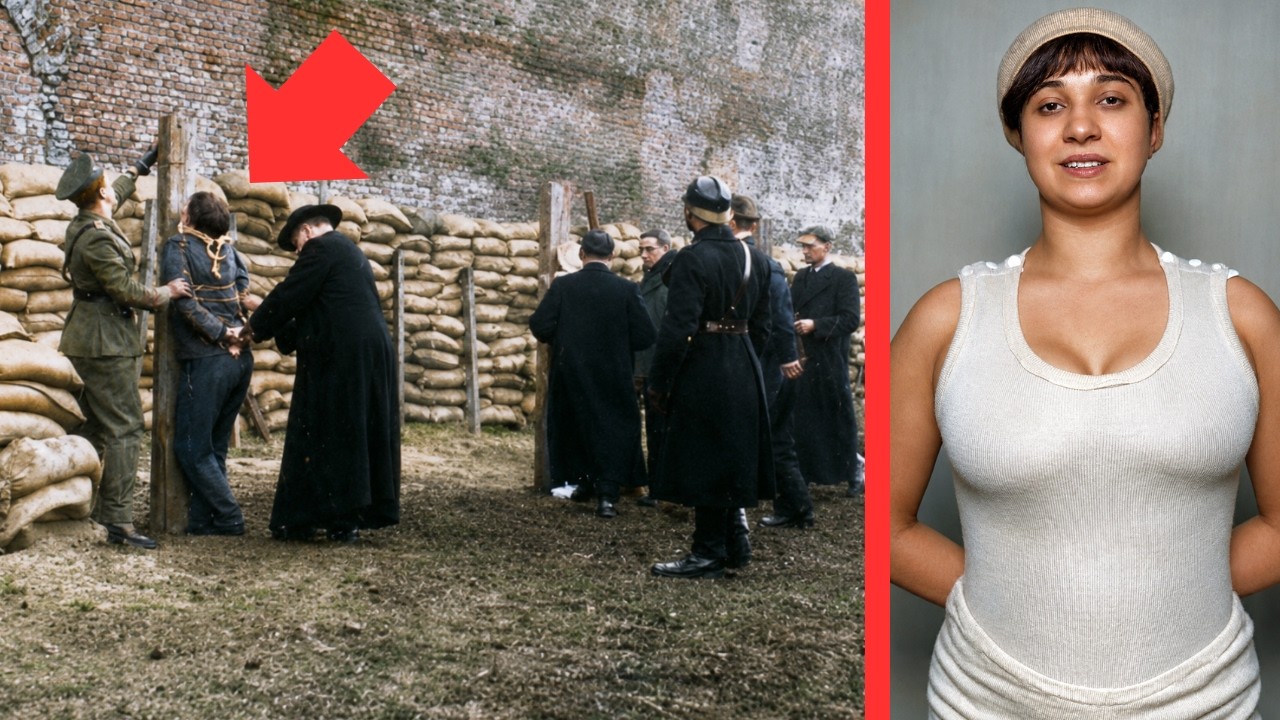
On January 14, 1948, Anna van Dijk was transferred from her prison to Fort Bijlmer. On the night before her execution, she deliberately converted and joined the Roman Catholic Church. She also wrote a number of farewell letters, including one to a person who visited her in prison. In the early morning, she was brought out to what resembled a water trench of the fort or a pit surrounding a wall. Next to the wall, sandbags were placed to ensure bullets would not ricochet. When she was led into the trench, she was tied to a wooden post. She was then bound to the post, and her hands and feet were secured to ensure van Dijk could not escape. A black hood was placed over her head to ensure she would not see her final moments. Opposite her was a firing squad that had just received the ready signal. Once the signal was given, the firing squad fired directly at Anna van Dijk.
Her execution was somewhat controversial, as she was Jewish by origin, and it is clear that without her collaboration she would likely have been killed inside a concentration camp. But what she did not have to do was take her role as an informant for the German Security Service to this level. Because of her actions, dozens were sent to their deaths inside some of the worst and most horrific places the world has seen.
Noor Inayat Khan was born in Moscow on January 1, 1914. Her father was an Indian Muslim, and they belonged to a somewhat noble family. Her father was a pioneer of Sufism in the West, an expression of Islamic faith. She had a wealthy family on her father's side, with many skilled musicians. Her mother was American and met her father during his travels. With the outbreak of World War I in 1914, the family left Russia for London, and she attended a nursery in a wealthy area called Bloomsbury before the family moved to France when she was six years old.
The family was involved in the Sufi movement and the Sufi order, and through that they obtained a house near Paris. Noor was a shy girl, and after her father's death, she took care of her mother and siblings even though she was only 13 at the time. She then studied child psychology and music in Paris and began working as a writer, writing poetry and children's stories in both French and English.
With the outbreak of World War II, Hitler was likely to turn his attention to France as he sought to seize the country very quickly. On September 3, 1939, France declared war on Germany after the Nazi invasion of Poland, and there had been hostilities between the two countries for decades following the end of World War I and the signing of the Treaty of Versailles. The invasion of France began on May 10, 1940, and lasted six weeks, resulting in France falling under German occupation. The famous image of Hitler touring Paris in front of the Eiffel Tower with his inner circle became well known. Shortly before the invasion, Noor and her family had returned to England, fleeing to Bordeaux before entering England from Cornwall on June 22, 1940.
Noor and her family were pacifists. However, she and her brother wanted to fight the Nazis in some way. They wanted to make India proud, and hoped that some Indians would receive military medals during the conflict. They wanted to help the Allies against the Germans, and thereby bring the English and Indians closer together. For this reason, she joined the Women's Auxiliary Air Force and received training as a wireless operator.
However, it was clear she was heading toward a career in a slightly different field. Noor spoke several languages fluently, and because of that she seemed an ideal candidate for the Special Operations Executive (SOE), a group of spies working for the British behind enemy lines. They carried out sabotage operations and worked closely with the resistance to achieve the enemy's defeat. Khan found her work in the air force boring, so she was recruited to join the French section of the SOE and began receiving special training as a wireless operator to work in occupied territory.
She became the first woman to be sent as a wireless operator to occupied territory, where women were only being sent to work as couriers. She began developing her training and received the best instruction on how to operate inside the city and send messages without being detected. She received a training mission designed to simulate a Gestapo interrogation, to show what she might face if captured. Agents underwent harsh tests, and it was noted that Khan seemed so terrified that she nearly lost her voice. Her final report stated that she was not exceptionally intelligent but worked hard, that her personality was unstable and moody, and her suitability was questioned. However, her section head said this was nonsense and supported her.
She was questioned about her ability for covert operations, and her quiet, gentle personality worried SOE trainers. Reports were also submitted about her weak physical fitness, and her fear of weapons was noted. However, she was skilled and proficient as a wireless operator and signaler, and in the end she was selected to participate in the mission.
Her mission would be extremely dangerous. As we said, she became the first female wireless operator sent behind enemy lines. Her job was to link the field with London, receiving and sending messages about sabotage operations and transmitting information about weapons needed by the French Resistance. Vera Atkins, the intelligence officer in the F section, embraced her and supported her, believing she would succeed. During a meeting with Atkins, Noor was upset about the questioning of her suitability, and she had no doubts, but wanted to enter the field. Vera Atkins took a personal approach with her officers, personally bidding farewell to all of them. After receiving assurances about Khan's suitability, she accompanied her to the airport.
Khan was then transported by a Westland Lysander aircraft to France, landing in a field near Angers where she was received by a committee of other SOE agents. After landing, she made her way to Paris to contact members of the French Resistance and other agents of the organization. She was known by the codename "Madeleine," and worked inside France with skill, as her fluency in the language made her an ideal candidate to work inside Nazi-occupied territory. She was flown in on June 16, 1943, and at that point in World War II, the Germans still held the initiative. She belonged to the Prosper network, which had been established at the time.
However, within 10 days of her landing in France, the spy network began to be subjected to arrests and pursuits. A major mistake occurred, but she remained in contact with Britain and was informed that she would be flown home. Noor said she was the only wireless operator in Paris and believed she could continue working in hiding, but it was not long before things worsened. In the end, Noor Inayat Khan was handed over to the Germans. It is believed this was done either by Henri Déricourt, a prominent French SOE agent, or someone else. Suspicion prevailed that Déricourt was in fact a double agent working for Nazi intelligence. Rumors also circulated that another agent received 100,000 francs for information that led to the arrest of the organization's agents.
Khan managed to hold out in France for a few months before being captured on October 13, 1943. More F Section agents were caught and arrested, and many had learned of Noor's capture. They were able to warn Britain about any incoming transmissions from the codename "Madeleine" and ignore them, and this message did arrive. On November 25, 1943, Noor, along with fellow SOE agents and local resistance leaders, succeeded in escaping from the German Security Service headquarters during an air raid. However, after being recaptured, she was transferred to Germany and considered so dangerous that she might escape that she was held in complete solitary confinement. Her hands and feet were chained for 10 consecutive months, as she was viewed as extremely dangerous.
Throughout her imprisonment, she continued to give no information at all, though she found it extremely difficult. Other prisoners noticed how she cried loudly in her cell every evening. Because of her escape attempts and as the tide of World War II turned against the Germans, they kept her detained inside Germany for months. By September 1944, she had been transferred to Dachau concentration camp with other female agents of the organization. Dachau was a camp through whose gates 188,000 people passed, and more than 40,000 prisoners were killed there. When the Allies liberated the camp, tens of thousands were sick at the time.

At Dachau, prisoners lived in constant fear due to the culture of sadistic torture used in the camp. At times, many feared the standing cells and flogging, as well as execution by hanging, where prisoners were suspended for hours. The camp was also a site for medical experiments, but here Noor Inayat Khan was executed. The clearest accounts of what happened during her execution come from Gestapo records, which were recounted by members of the secret police to the United States after the war.
One investigator was told by another Gestapo agent about the execution of Noor Inayat Khan and three of her fellow SOE agents. He said the four prisoners came from the camp barracks where they had spent the night to the square where the execution would take place. Here the camp commandant announced the execution sentence against them. Only the camp commandant and two SS men were present. The English woman who spoke German, the major, informed her companions of the execution sentence. The faces of the four prisoners turned very pale and they cried. The major asked whether they could object to the execution sentence. The commandant announced that no one could object to the sentence. The major then asked to see a priest. The camp commandant refused the major's request on the grounds that there was no priest inside the camp.
After that, the four prisoners were ordered to kneel with their heads facing a small pile of earth before two SS men killed them, one after the other, with a shot to the back of the head. During the shooting, the two English women held each other's hands, and so did the two French women. For three of the prisoners, the first shot caused their deaths. As for the English woman who spoke German, a second shot was required because she was still showing signs of life after the first shot. After the execution of these prisoners, the camp commandant told the two SS men that he was personally interested in the women's jewelry, and ordered that it be taken to his office.
Other accounts from prisoners recalled how Noor was brutally beaten by an SS officer before being taken out and shot from behind. Her alleged last words were "Liberty." In a retaliatory response, the man who beat her was executed after the war for his involvement in the executions. Noor Khan's story is one of a brave woman who wanted to fight with the Allies against the Germans. She was a pioneer in being the first wireless operator working for the SOE behind enemy lines. Her capture remains surrounded by mystery and controversy over who handed her over and betrayed her. But what cannot be denied is what happened inside Dachau, where Khan was executed and shot. She was awarded the George Cross in 1949, and her memory has been honored in many ways over the decades.
During and after the conflict, the Americans executed a number of German teenagers convicted of involvement in espionage. They showed little remorse, and the Germans displayed this cruelty, especially when capturing female spies who worked with the British Special Operations Executive. There were accounts of these women being subjected to severe torture and horrific brutality. A group of spies were even transferred to a concentration camp and burned alive.
One of these women who faced this brutal fate was Vera Leigh, who was thrown alive at the age of 41 into the ovens of Natzweiler-Struthof camp and the crematorium there. It was a horrific end for a woman who dreamed of participating in the liberation of France from the tyranny of Nazi occupation.
Vera Leigh was born in March 1903 and was from Yorkshire in England. As a child, she was abandoned by her family and adopted by an American racehorse trainer who renamed her Vera Leigh. Vera grew up in an environment of horses and stables, and worked near Paris at a training center and racetrack. She aspired to become a jockey, then worked in fashion, entering several fashion houses in Paris, and was known in the social circles of the French capital.
But during World War II, France suffered greatly and Paris fell in 1940. After that, Vera left for Lyon, where she joined her fiancé, who was a director of a Portuguese film company. Vera wanted to return to England and help others escape the tyranny of the Nazis, so she helped secret escape lines and smuggled wanted Allied personnel out of France. She helped them escape across the Pyrenees to Spain, where they returned to England, and eventually she herself took that route to escape the Germans.
Vera reached England in 1942 and wanted to help in the war effort, and as a French speaker she was recruited by the SOE to become a spy. She passed the interviews and was considered a good student, characterized by courage and a willingness to try any work, and she was particularly skilled in handling demolition explosives and wires. She was 40 years old, older than some of the other recruits, but she returned to France and worked with the nursing corps for first aid to help wounded Allied soldiers. She was then assigned by the SOE to a mission to fly and land behind enemy lines near the city of Tours.
She arrived in France to work as a courier of information between the various resistance networks, and she had to work with the Prosper network in Paris, and her role was also to link other resistance groups. Her role was pivotal and dangerous, so she took on a different identity and began filing her reports to her superiors in London before starting work inside Paris and settling in an apartment there. Vera Leigh worked in various cafes and blended into the life of the French capital, but the city was suffering under the weight of German occupation. Many people were living amid an atmosphere of suspicion and mistrust. She nearly had her identity exposed when she met her sister's husband by chance.
But while hiding in the capital and sending reports, Vera continued to help Allied soldiers return to Britain, and some of them stayed in safe houses under her supervision. It was not long before her true identity was exposed. She worked with another SOE agent and managed her husband's business, and Vera was meeting other agents in a nearby cafe in Paris. But the spy network was betrayed, and Vera Leigh was soon arrested and transferred to Fresnes prison outside Paris. She gave a false identity to the Gestapo and revealed no information, but she did not need to, as the German prisoners knew everything about her and her work.
Vera Leigh was tortured, and on May 13, 1944, she was transferred with three other SOE agents to Gestapo headquarters in Paris on Avenue Foch, along with four other women from F Section. The women were taken to the train station chained and under guard, and they set off on a train journey. One of the women who was captured and survived the war said: "We started this journey together in fear, but we all hoped for one thing above all, that we would stay together. We had all already tasted what things could be like. None of us expected much. We all knew they might sentence us to death. I was the only one officially sentenced to death. The others were not. But there is always a tiny glimmer of hope that some miracle might happen."
The women were sent to Germany and held in separate cells in a prison in the city of Karlsruhe, and the agents were treated the same way as other prisoners. They could hear Allied bombers flying over them every night to bomb German targets, and they thought the war was nearing its end. But Vera Leigh did not live to see the end of World War II.
On July 6, 1944, she and three other female spies were taken to the prison reception room and their belongings were returned to them before two Gestapo men took them. They were transferred to Natzweiler-Struthof camp in France and arrived there at about 3:30 in the afternoon. The appearance of the women in the camp shocked the other prisoners, as it was rare for four women to be sent together, and they were led through the main camp to the cells at the bottom of the camp where they were held until evening. One prisoner said that one could see from their appearance that they had not come from a concentration camp. No young women. They were somewhat well-dressed. Their clothes were not shabby, their hair was styled, and each of them carried a bag in her hand.
Vera Leigh was one of these four women who were placed in a cell, and she spoke with the others and with other prisoners, but what followed was completely brutal. The women were transferred to a concentration camp for their execution, and the prisoners of Natzweiler commented on what they saw and heard. That evening, SS guards took the four women one by one, including Vera, to the crematorium at intervals of about three minutes.
Inside the crematorium, the women were ordered to undress for a medical examination. Then a doctor tried to inject the women with what he claimed was a typhus vaccine, but it was actually a lethal injection of phenol, which they believed would end the women's lives. The previous spies lost consciousness, and then they were thrown into the crematorium oven. But according to prisoner accounts, it was clear that the injection did not kill all the women.
One prisoner stated: "The next morning, the German prisoner in charge of the crematorium explained to me that each time the oven door was opened, fire came out of the chimney, and this meant that a body had been placed in the oven." "I saw the fire four times." He would later state regarding the execution of the women, "and that we actually heard faint sounds in the next room and the sound of a body being dragged on the ground, and he whispered to me that he could see people being dragged on the ground under his angle of view through the ventilation window. At the same time this body was being passed in front of us. We heard heavy breathing and faint moaning, and we heard the same sounds again and regular groans as two unconscious women were dragged away. But the fourth resisted in the hallway. I heard her say: 'Poor Kay.'" "When I heard a sound, and recognized the doctor dressed in civilian clothes saying: 'Poor typhus.'" "We then heard the sound of a struggle and the muffled screaming of the woman. I assumed someone had put his hand over her mouth. I heard the woman being dragged away too. She was moaning louder than the others. From the sound of the crematorium oven doors that I heard, I can say with certainty that the women who were moaning were all placed immediately in the crematorium oven."
When the officials left, we went to the crematorium and opened the door and saw four charred bodies inside. The next morning, as part of my duties, I had to remove the ash from the crematorium oven. I found a pink women's garter on the ground near it. Other witnesses came forward to speak about the executions and confirmed that a struggle took place, with at least one of the women being pushed into the oven. A doctor from the SS said that when the last woman was halfway inside the oven, she was inserted feet first. She had regained consciousness and resisted, and because there were enough men there, they were able to push her into the oven, but not before she resisted and scratched the face of Peter Straub. The next day, Schultz noticed that the face of the camp executioner Straub was severely scratched.
There were only a few retaliatory responses to the massacre of these spies. But after the war, Vera and the other spies were awarded the King's Medal for Courageous Conduct, as she was a woman who sacrificed her life to try to save others and liberate France. She was 41 years old when she was brutally killed inside the ovens of the concentration camp, and she had undergone a bloody and brutal ordeal after her capture. Her role in the war was to try to link the various spy networks. Despite her return to life in Paris and her skilled work under secret cover, she was arrested, but her tragic end inside a concentration camp embodied the evil of the Nazis during World War II.