On July 14, 1881, Sheriff Pat Garrett entered a dark bedroom at Fort Sumner, New Mexico, and shot a man through the heart. Garrett claimed the man was Billy the Kid, the most wanted outlaw in the territory. The body was buried the next day in the local cemetery. The story was supposed to end there.
But something strange happened almost immediately. People began whispering that Garrett may have killed the wrong man. Perhaps Billy the Kid had escaped and lived for years under a different name. For more than a century, those rumors never faded.
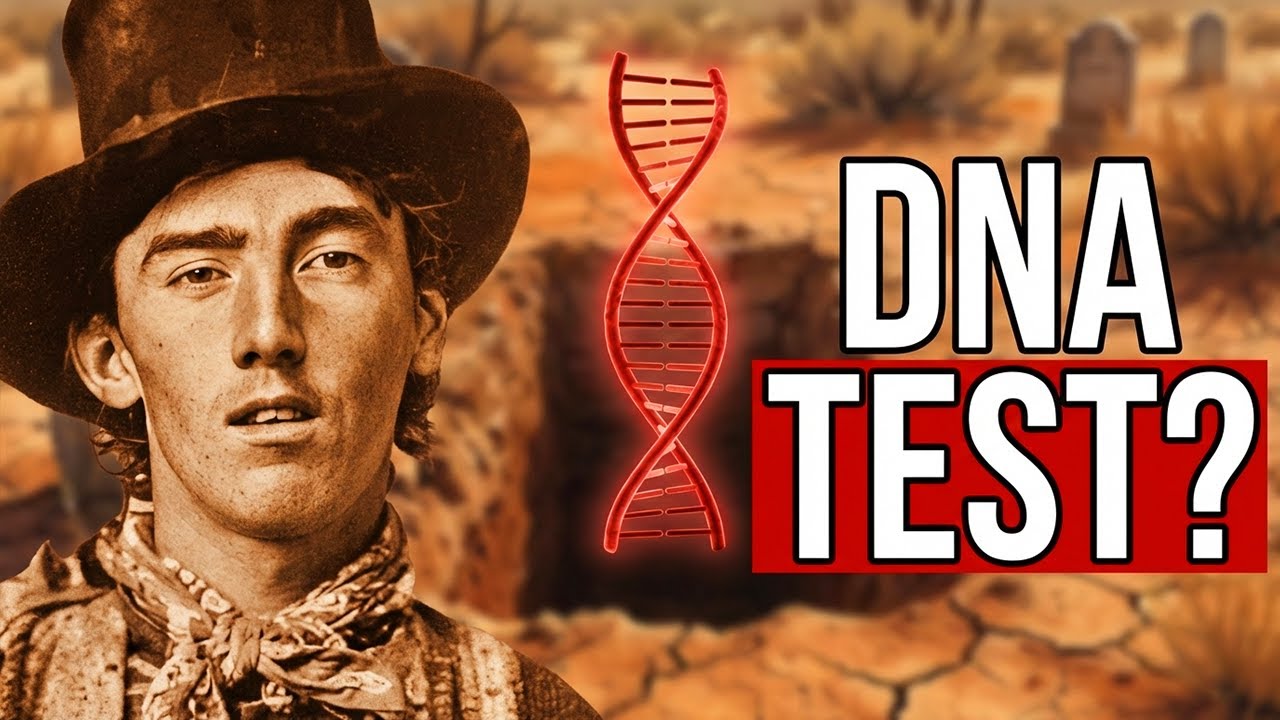
In 2003, the state of New Mexico decided to settle the question. Officials announced plans to exhume the grave, conduct DNA testing, and prove conclusively that the body at Fort Sumner was Billy the Kid. The governor intervened, forensic experts were called in, and media from around the world took notice. Everyone assumed this would solve one of the greatest mysteries of the Old West.
What happened instead shocked everyone. The DNA analysis did not close the case. It opened a new debate that continues to this day. And the reason why may be the most troubling part of the story.
Let us start with what we believe we know. By July 1881, Billy the Kid had been a fugitive for months. He escaped from the Lincoln County jail in April, killing two deputies during his escape. Governor Lew Wallace posted a $500 reward for information leading to his capture, dead or alive.
Pat Garrett, the new sheriff of Lincoln County, pursued Billy relentlessly. At one point, the two men had been friends, playing cards and drinking together. But Garrett had a job to do: bring in Billy the Kid.
Garrett received word that Billy was hiding near Fort Sumner. He arrived on the night of July 14 with two deputies. They went to the home of Pete Maxwell, a wealthy rancher whose sister, Paulita, was rumored to be Billy's girlfriend. Garrett entered Maxwell's bedroom to ask if he knew where Billy was.
While they were talking, someone appeared at the doorway. According to Garrett's account, the man was barefoot and holding a knife. He spoke in Spanish, asking, "Who is this? Who is this?" Garrett recognized the voice. It was Billy the Kid.
Garrett drew his revolver and fired twice in the dark. The first bullet struck the man directly in the chest, through the heart. The second missed. The man fell dead.
Garrett and his deputies lit a candle. On the floor lay a young man of about twenty-one. He was slim, with reddish-brown hair and prominent front teeth. Residents of Fort Sumner identified him as Billy the Kid. They held a wake that night, and hundreds came to see the body. The next morning, July 15, he was buried in the old military cemetery beside his friends Tom O'Folliard and Charlie Bowdre, both of whom Garrett had killed earlier that year. A wooden marker was placed on the grave reading: "Billy the Kid died July 14, 1881."
The story was supposed to end there. But doubts began almost at once, and they came from people who had actually known Billy.
Some residents of Fort Sumner whispered that the man they buried did not look exactly like Billy. The body had been viewed at night by candlelight. Could people have been mistaken?
Paulita, Pete Maxwell's sister and supposedly Billy's girlfriend, gave conflicting answers over the years. Sometimes she said it was Billy. Other times she seemed unsure. Stranger still, Pat Garrett's own account of the shooting began to change. In his first report, he said one thing. In his book, published a year later, he said something else. Details began to blur. Why would Garrett change his story if he was telling the truth?
Then there was the matter of the body itself. Billy the Kid was believed to be left-handed, but the man Garrett shot was holding a knife in his right hand. Today we know Billy was actually right-handed. The belief that he was left-handed came from a photograph that was later found to be reversed. But in 1881, Fort Sumner residents thought Billy was left-handed. So when they saw the body of a man holding a knife in his right hand, some thought: "That is not Billy."
The grave itself became another source of confusion. Floodwaters covered the Fort Sumner cemetery several times over the years. Wooden markers eroded and shifted. By the early twentieth century, no one was sure which grave belonged to Billy. In 1940, the town placed a new marker, but was it in the right spot? Or had the original grave been lost long before?
That was when men claiming to be Billy the Kid began to appear. In 1950, lawyer and amateur historian William Morrison was working in Hico, Texas, when he met an elderly man named Ollie Roberts, known as Brushy Bill Roberts.
Brushy Bill had a strange story. He claimed he was Billy the Kid. According to him, Pat Garrett had not killed him in 1881. Instead, Garrett shot a man named Billy Barlow, a drifter who resembled Billy, and killed him. Billy the Kid escaped, changed his name, and lived quietly in Texas for many years.
Brushy Bill was ninety years old in 1950 when he told this story. He had tales of the Lincoln County War that seemed accurate in their details. He knew things about Billy the Kid's life that were not in any published history book. He could describe people and places that only someone who had been there would know.
William Morrison was convinced. He believed Brushy Bill might really be Billy the Kid. In 1950, Morrison arranged a meeting between Brushy Bill and New Mexico Governor Thomas Mabry. The plan was simple: if Brushy Bill really was Billy the Kid, Governor Mabry would grant him a pardon for his old crimes.
Governor Lew Wallace had promised Billy the Kid a pardon in 1879, but Wallace never kept that promise. Now, seventy years later, Brushy Bill wanted to set things right. He wanted official recognition that he was Billy the Kid, and he wanted that pardon.
The meeting took place in November 1950. Brushy Bill sat with Governor Mabry and told his story. The governor listened, asked questions, and examined the old man closely. Then he made his decision. He did not believe Brushy Bill was Billy the Kid. He refused the pardon and sent Brushy Bill home.
Morrison was devastated. Brushy Bill died just one month later, in December 1950. He went to his grave insisting he was the real Billy the Kid.
But Brushy Bill Roberts was not the only one. In the 1920s and 1930s, several other men claimed to be Billy the Kid. A man named John Miller in Arizona, and another man who used different names in multiple states. Each had his story, and each story had details that made some people believe. All of them died without proving their claims.
By the 1990s, these stories had become part of the folklore of the American West. Most historians dismissed them as the fantasies of old men seeking attention, or perhaps suffering from dementia, confusing stories they had heard with their own memories. But some researchers were more certain. They studied the evidence more carefully.
They noticed contradictions in Pat Garrett's account of the events. They found witness statements that contradicted the official story. They discovered that many people in Fort Sumner had privately expressed doubts at the time. And they began to wonder: what if one of these old men was telling the truth?
That was when they decided the only way to settle the matter was science, specifically DNA testing. If they could get DNA from the body buried in Billy the Kid's grave, they could compare it to DNA from his mother, Catherine McCarty, who died in 1874 and was buried in Silver City, New Mexico. If they could get DNA from both graves, they would know for certain whether the body at Fort Sumner was Billy the Kid.
In 2003, New Mexico Governor Bill Richardson announced a plan to exhume Billy the Kid's body. It was major news, covered by national media. The Discovery Channel wanted to film it. Forensic experts from around the country volunteered to help. The state formed a team, obtained court orders, and prepared to dig.
But before exhuming Billy the Kid, they had to exhume his mother first. Catherine McCarty's grave in Silver City was supposed to provide the baseline DNA, the maternal DNA. That was where the problems began.
The team arrived at the Silver City cemetery in May 2003. They had done their research. They knew approximately where Catherine McCarty was buried. They began digging, but found nothing. No coffin, no remains, nothing. They expanded the search, digging in adjacent plots, but without success. Catherine McCarty's grave had disappeared, or rather, they could not find it.
The cemetery had been in use since the 1870s. Records were incomplete. Graves had been moved. Markers had been lost. After days of searching, the team had to admit defeat. Without Billy's mother's DNA, the entire project stalled.
But Governor Richardson was not ready to give up. He suggested an alternative. What if they exhumed both Billy the Kid's grave and Brushy Bill Roberts's grave? If the two bodies had the same DNA, it would prove Brushy Bill was telling the truth. If they had different DNA, it would prove Brushy Bill was a fraud. And if they could somehow get DNA from other relatives, perhaps they could identify Billy.
The plan moved forward. In July 2003, the team prepared to exhume the body from the grave at Fort Sumner. It was a massive task. The grave was protected by a steel cage. In the 1980s, Billy's tombstone had been stolen twice, so the town built a cage over the grave to prevent further vandalism. The team had to cut through the steel and dig carefully through layers of soil, all while cameras recorded and media watched.
The tension was unbearable. This was the moment of truth. They would finally discover who was really buried there.
But they did not. When the team opened the area where Billy's grave was supposed to be, they found a problem. Floodwaters had catastrophically covered the Fort Sumner cemetery in 1904. A massive flood from the Pecos River swept through the cemetery. Coffins were dislodged, bodies scattered, graves mixed. All the wooden markers that identified individual graves were destroyed.
In 1940, when the town placed new markers for Billy the Kid, Tom O'Folliard, and Charlie Bowdre, they were guessing at the locations. But after the 1904 flood, no one was certain anymore.
The excavation team dug in the area identified as Billy's grave. They found fragments, pieces of wood that might have been from a coffin, and some bone fragments. Nothing substantial, nothing indicating a complete burial. They expanded the search, digging in adjacent areas, and found more fragments, more scattered remains. It became clear that many graves had been disturbed and mixed together over the years. The bones they found might have been Billy the Kid's, or Tom O'Folliard's, or Charlie Bowdre's, or anyone else buried in that section of the cemetery. There was no way to know.

The forensic team collected everything they could find: dozens of bone fragments, teeth, pieces of cloth. They catalogued them carefully, sent them to laboratories for analysis, and waited for results.
Meanwhile, the team also exhumed Brushy Bill Roberts's body from his grave in Hamilton, Texas. This exhumation went more smoothly. They found intact remains, well-preserved bones, teeth that could be analyzed. Things looked promising. If they could get DNA from both sets of remains, they could at least settle the question of Brushy Bill.
That was when things turned upside down. The lab results for the Fort Sumner remains came back, and the news was bad. The bone fragments were too degraded, too contaminated. The Fort Sumner cemetery had been flooded multiple times, not just in 1904 but also in the 1940s and 1950s. The soil was saturated with water. Chemicals from the decomposition of multiple graves had mixed together. The DNA in the bone fragments had degraded to the point of being useless. They could not extract viable DNA samples, not from the bones, not from the teeth, nothing.
The samples from Brushy Bill Roberts were in better condition, and the lab was able to extract some DNA from them. But without DNA from Billy's mother, and without DNA from the Fort Sumner grave, there was nothing to compare it to. The entire project stalled.
Governor Richardson held a press conference, explaining that due to the condition of the remains and the lack of comparison samples, they could not reach any conclusive findings. The investigation was suspended, not cancelled, but put on hold until better technology became available.
That was in 2005, nearly twenty years ago, and we still have no answer. The exhumation that was supposed to settle the Billy the Kid mystery once and for all proved nothing. Except that the grave at Fort Sumner is in chaos, and we may never know for certain who is buried there.
But here the story takes a darker turn. After the failed exhumation, researchers began scrutinizing the physical evidence and historical records, and the details of what happened on the night of July 14, 1881. They found things that raised serious questions about Pat Garrett's account.
First, the matter of the body's description. Witnesses described the man Garrett shot as having reddish-brown hair and medium height. But many who knew Billy the Kid described him as having dark brown hair, almost black. That is a fundamental difference. The dead man was also described as clean-shaven. But Billy the Kid had been a fugitive for months, living a harsh life, hiding. Was he really clean-shaven? Or did he have a beard?
Second, the matter of the shooting itself. Garrett claimed he fired in the dark and could not see the man clearly, recognizing him only by his voice. But if Garrett could not see the man, how did he hit him directly in the heart with his first shot? In a dark room with a moving target? It was an extremely lucky shot. Or perhaps Garrett was lying about the circumstances.
Third, there is Pete Maxwell's behavior. Pete was supposed to be Billy's friend. He was sheltering him, or at least tolerating his presence. Yet when Garrett asked where Billy was, Pete apparently told him. Then he sat calmly in his bedroom while Garrett shot a man at the entrance to his room. That is strange behavior for someone who was Billy's friend. Unless Pete knew the man Garrett was about to shoot was not actually Billy.
Fourth, there is the burial. Why was the body buried so quickly, less than twenty-four hours after the shooting? This was the most dangerous wanted outlaw in New Mexico, yet there was no official investigation, no official photographs, no careful documentation. They just buried him in the ground and that was that. What was the reason for such haste?
And fifth, what happened afterward. Pat Garrett's career was supposed to take off after killing Billy the Kid. He had eliminated the most dangerous criminal in the region. But instead, Garrett struggled. He moved from job to job, made enemies, and died broke and bitter. Some researchers have suggested Garrett was haunted by what he had done, not because he killed a friend, but because he took part in a deception.
According to this theory, Garrett shot someone that night, but it was not Billy the Kid. It was Billy Barlow, just as Brushy Bill claimed. Or perhaps it was another man entirely, someone who resembled Billy enough to pass in the dark. Billy the Kid, the real Billy, escaped. Perhaps with Pete Maxwell's help, perhaps with Garrett's knowledge.
Why would Garrett agree to this? Perhaps money. Perhaps Billy paid him, or perhaps Garrett genuinely wanted to help his old friend. So they staged the shooting, killed a substitute, and let Billy disappear.
It may sound like a conspiracy theory, and perhaps it is. But it explains many things that do not make sense in the official account. It explains why Garrett's story changed over time, because he was trying to keep his lies consistent. It explains why the body was buried so quickly, before anyone could examine it closely. It explains Brushy Bill's detailed knowledge, because he really was Billy the Kid. And it explains why, more than a century later, we are still unable to prove the identity of the man in that grave, because the person buried there is not Billy the Kid.
Now, I am not saying I believe this theory. I am only presenting what some researchers have proposed. The truth is, we do not know. And here is the truly frustrating part: we may never know.
The remains at Fort Sumner are too degraded to recover. Catherine McCarty's grave is lost. There is nothing to compare Brushy Bill Roberts's DNA to. Even with advancing technology, even with better methods for extracting DNA from damaged samples, we face a dead end. Without a baseline for comparison, DNA can tell us very little. Even if we analyzed the genetic sequence of every bone fragment in the Fort Sumner cemetery, we could not determine which one belonged to Billy with certainty.
Some historians have suggested other approaches. What if they could find DNA from Billy's brother? Or his father? But Billy's family history is murky. His father died when Billy was young. His brother's fate is unclear. There are no known living descendants. It is a dead end.

Other researchers have focused on historical evidence. They have examined newspapers from 1881, interviewed descendants of people who were there, and traced old photographs and letters. The picture they paint is complicated. Some evidence supports Garrett's account. Some contradicts it. Nothing is conclusive.
In 2015, a researcher claimed to have found a photograph showing Billy the Kid and Pat Garrett playing croquet together. If the photo were authentic, it would have been taken after Billy's supposed death. That would prove he survived. But the photo's authenticity is disputed. Experts disagree on whether it is genuine. Another dead end.
So where does that leave us? Here is what we know for certain. On July 14, 1881, Pat Garrett shot and killed a man at Fort Sumner, New Mexico. That is documented. The residents of Fort Sumner believed the man was Billy the Kid. They buried him in the local cemetery. That is also documented.
But we do not know for certain whether the man Garrett shot was actually Billy the Kid. We cannot be sure. The evidence is too degraded. The records are incomplete. The witnesses are all dead. And the DNA test that was supposed to settle it failed, not because the science was inadequate, but because the samples were too damaged and there was nothing to compare them to.
We also know that several elderly men, decades after Billy's supposed death, claimed to be him. Most of these claims can be dismissed. But Brushy Bill Roberts's claims are difficult to explain. He had details. He had scars matching Billy's known injuries. He had information that seemed impossible to fake. Was he really Billy the Kid? Or was he just a skilled liar? We cannot be sure of that either.
So the death of Billy the Kid remains one of the great unsolved mysteries of the Old West. Not because we lack the technology, and not because we have not tried to find answers, but because the evidence we need simply no longer exists. It was lost over time, or destroyed by floods, or degraded by chemicals, or perhaps deliberately hidden.
And perhaps that is fitting. Billy the Kid became a legend because of what we do not know. His early life is obscure. His real name may not have been William Bonney. Some researchers believe he was born Henry McCarty, while others doubt it. His motives are unclear. Was he a cold-blooded killer? Or a victim of circumstance in the Lincoln County War? His relationships are disputed. How many men did he actually kill? Was he truly a ruthless outlaw or just a folk hero?
And now, even his death is unknown. In a way, Billy the Kid achieved a kind of immortality. Not because we remember him clearly, but because we remember him dimly. He has become whatever we want him to be: villain, hero, victim, survivor. The fact that we cannot prove his death allows the legend to continue.
If DNA analysis had conclusively proven that the body at Fort Sumner was Billy, the story would be over. Case closed. He died at twenty-one, shot by Pat Garrett. The legend would end. But because we cannot prove it, Billy the Kid remains alive in our imagination. Perhaps he escaped. Perhaps he lived to old age in Texas. Perhaps he is laughing at us all from beyond his grave.
That ambiguity is powerful. It keeps people interested. It keeps researchers searching. It keeps the legend evolving.
Billy the Kid's grave at Fort Sumner still draws visitors. Thousands of people come each year to see the steel cage and the tombstone bearing his name. They take photos. They leave coins and flowers. Some believe Billy is really buried there. Others believe it is just a tourist marker pointing to an empty grave. But they all come because they are fascinated by the mystery.
In Hamilton, Texas, Brushy Bill Roberts's grave also draws visitors. People who believe he was the real Billy the Kid, who believe the old man was telling the truth. That grave has no steel cage, just a simple marker. But for some people, that is where Billy the Kid truly lies.
The truth? Perhaps the truth lies somewhere between those two views. Perhaps the truth is messy and complicated and not as exciting as either version of the legend. Perhaps Pat Garrett did shoot Billy the Kid that night, but perhaps there was more to the story than his official account. Perhaps there was an arrangement. Perhaps there were secrets, things not written in the history books. Or perhaps Garrett did shoot Billy, plain and simple, and everything that followed was just confusion and conspiracy theories. Old men seeking attention, and researchers seeing patterns that were not there.
We want the mystery to remain, because mysteries are more exciting than plain facts. Honestly, I do not know which version is correct. And after considering all the evidence, I am not sure anyone can say for certain.
The DNA tests that were supposed to give us answers ultimately revealed how little we truly know, how much has been lost, and how fragile historical evidence can be.
But here is what I do know. The story of Billy the Kid reminds us that history is not as solid as we think. We read about events that happened 150 years ago and assume we know what happened. We assume the records are accurate, that the witnesses were honest, that the evidence was preserved. But this case shows us that is not always true.
Sometimes the records are incomplete. Sometimes the witnesses have reasons to lie. Sometimes the evidence is destroyed by floods or time or deliberate concealment. And when that happens, the truth slips away. It becomes impossible to recover. We are left with conflicting accounts, plausible theories, and no way to prove which is correct.
That is frustrating for those who want clear answers. But it is also somewhat beautiful, because it means the past is not entirely dead. It is still alive, still debated, still capable of surprising us.
Billy the Kid died or did not die in 1881, but his story is still being written. Every time someone examines the evidence, every time a new theory emerges, every time someone visits that grave at Fort Sumner and wonders what really happened, the legend continues. And in a way stronger than any DNA test. Because legends do not need proof. They only need people who believe in them. Or at least people who want to believe.
If you have made it this far, perhaps you are asking the same question I am. Will we ever know the truth about Billy the Kid? Honestly, probably not. The physical evidence has disappeared, the witnesses are gone, and the DNA has degraded. Unless someone discovers a hidden cache of letters, or finds a photograph that conclusively proves Billy survived, or reveals some piece of evidence that has been locked in someone's attic for a hundred years, we will remain stuck in this mystery.
And perhaps that is the best possible outcome. So here is my question: do you believe Pat Garrett killed Billy the Kid in 1881, or do you believe Billy escaped and lived under another name?