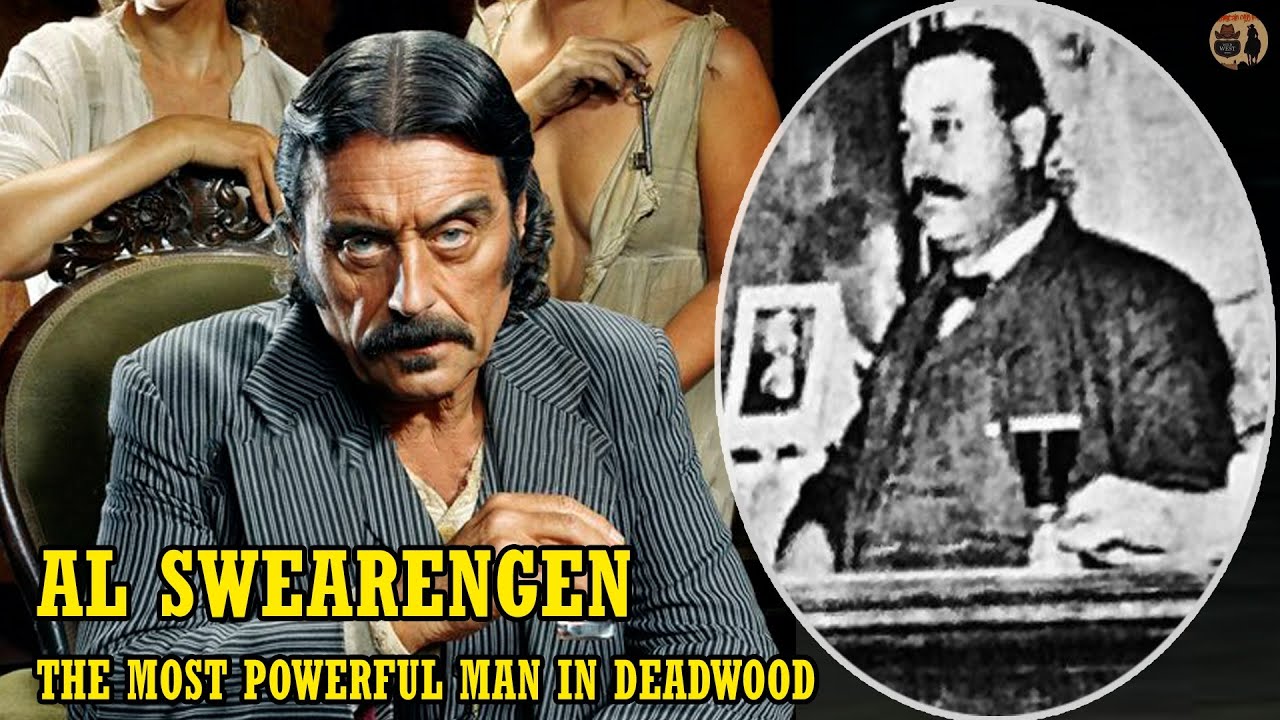
In the lawless frontier town of Deadwood, one name rose above the chaos: Al Swearengen. As the owner of the notorious Gem Theater, he built a fortune on entertainment, vice, and fear, shaping the town's destiny in the late 19th century.
Ellis Alfred Swearengen was born on July 8, 1845, in Oskaloosa, Iowa. His parents were Daniel J. and Keziah Montgomery Swearengen, and he was the eldest of the family's children.
Swearengen had a twin brother named Lemuel. The twins grew up in Iowa alongside eight siblings and remained there until adulthood.
In May 1876, Swearengen arrived in Deadwood, South Dakota. He was one of the earliest non-mining settlers in the area.
Within a week of his arrival, Swearengen had already set up a makeshift dance house. The Black Hills Pioneers 1882 New Year's Edition described it as a 30-by-150-foot structure so crowded that a man had to push and shove to get inside, day and night.
Swearengen's home life in Deadwood soon became turbulent. In September, his wife Nettie decided to leave him and eventually filed for divorce on grounds of abuse.
Nettie would marry twice more while in Deadwood, and both marriages ended in divorce with similar allegations of abuse.
Swearengen replaced his makeshift dance house with a permanent building known as the Cricket Saloon. Despite its small size, the press often referred to it as a hall because of its narrowness, and it became a popular entertainment destination.
There, Swearengen introduced entertaining matches in a limited five-by-five space. The participants were generally ordinary working miners whom Swearengen persuaded to take part, and the matches offered no rewards.
On April 7, 1877, Swearengen successfully opened the Gem Variety Theater. The Black Hills Daily Pioneer described it as a theater of impeccable style and sophistication, surpassing any venue of its kind on the Western frontier.
The theater quickly became a popular entertainment spot, home to beautiful comedians, singers, and dancers. Alongside its diverse repertoire, it continued to stage attractive matches to excite audiences.
Yet the Gem was not simply an entertainment venue. It also served as a brothel, and its notoriety stemmed from the fact that women were forced to serve and entertain wealthy men.
Swearengen used deceptive tactics to recruit women from the eastern states, luring them with promises of luxury hotel jobs and big stage performances at his theater. Upon arrival, these women had to work under the infamous Swearengen or be kicked out into the streets.
Some women were forced into slavery, and some even considered taking their own lives rather than suffer such a fate. Those who remained faced a life of suffering marked by physical bruises and emotional pain.
Despite this, the Gem Theater grew stronger, and its beautiful women quickly became the main attraction of the camp. They drew the attention and patronage of many famous citizens.
Authorities turned a blind eye, allowing the establishment to operate with impunity despite the complicity of so-called citizen leaders. The Gem had a spacious bar area and plenty of seating that served as a prelude to the main event.
Toward the back of the building, discreetly hidden between curtains, were several small rooms where the Gem's painted ladies entertained their guests. Legend holds that the Gem band would sing into the night from their balconies, after which glamorous women would lure potential customers inside.
Once inside, the ladies charged customers $20 for a dance, $10 for a beer, and a substantial $10 for a bottle of wine. The charges for other services remain unknown.

In addition to the many women, Swearengen's staff included Dan Doherty as general manager, Johnny Burns overseeing the women, and a security team. These men, like Swearengen himself, were known for their brutal treatment of the women, with physical abuse a regular occurrence.
Though originally an entertainment venue, the Gem quickly became known as a violent pub where echoing gunshots became an all too familiar sound within its walls. Shots were fired not only during scuffles between drunken men but also in amusements often aimed at the girls themselves.
In one notable case, a prostitute working at the Gem known as Louisa shot a man in the head after he brutally beat her. Incredibly, the man did not die instantly.
A doctor was hastily called and placed a probe on the man's head, shocked to learn that he had miraculously survived the bullet. About 30 minutes later, the man died.
Amid the chaotic events at the infamous theater, the whereabouts of field marshal Seth Bullock remained a subject of curiosity. It is said that Bullock and Swearengen reached an agreement drawing an imaginary line along Main Street.
This boundary, known as the bad lands, effectively divided the town. Swearengen took control of the lower part of Main Street, while Sheriff Bullock maintained control of its upper part.
The division separated their spheres of influence and set them apart in financial interests. Bullock emphasized the general well-being of the community, while Swearengen focused on his lucrative projects along the lower section of the street.
In the early summer of 1879, the Gem Theater was engulfed in flames, causing considerable damage. Swearengen wasted no time repairing and rebuilding the facility.
Just three months later, in September 1879, tragedy struck the entire town of Deadwood when a catastrophic fire ravaged the area, consuming about 200 buildings, including the Gem Theater.

Undeterred, Swearengen embarked on another ambitious endeavor, rebuilding the Gem from scratch. The newly emerged theater was more majestic and magnificent than before.
Its opening in December 1879 was met with great anticipation, with the Daily Times enthusiastically calling it the most splendid theater ever to appear. The Gem continued to thrive, raking in substantial profits nightly.
On average, the theater grossed $5,000, with nights even surpassing $10,000, equivalent to $300,000 in 2023. But it did not last.
In 1899, the Gem faced its final demise: a devastating fire that left it in ruins. Swearengen's reign in Deadwood came to an end as the Gem was permanently closed, severing his ties to the town for good.
On October 2, 1904, an unfortunate incident befell Lemuel, Al Swearengen's twin brother. While leaving the local butcher market, Lemuel was assaulted and received a severe blow to the head.
The attacker tried to rob him. Lemuel was discovered the next day unconscious, and despite receiving medical attention, he passed away eight days later.
Al Swearengen then left Iowa, embarking on a new journey. Less than two months later, on November 15, 1904, his life came to an abrupt and tragic end.
Swearengen's body was discovered on the street near his residence. Similar to his brother, Al had been brutally struck on the head with a heavy, blunt object.
The circumstances surrounding his death baffled Denver police, who were unable to determine for certain whether it was an accidental incident or an intentional act of violence. Subsequent reports suggested that Swearengen died penniless while trying to hop on a freight train.
For a deeper look into the fascinating history of the Gem Theater and the town of Deadwood, the Adams Museum at 54 Sherman Street in Deadwood, South Dakota, holds a wealth of information and photographs. There, the stories of the famous characters around the Gem come to life.