In the spring of 1930, a group of relatives bound a woman in her mid-forties inside a house on the outskirts of Paris, injected her with morphine and scopolamine, and put her on a train to a Swiss sanatorium. She had committed no crime. Born a princess by birth and marriage, and a granddaughter of Queen Victoria, she had also raised a small boy who would one day become the husband of the Queen of England.
What could drive a devoted family to sedate their daughter and confine her behind sanatorium walls for more than two years? How could a deaf princess, condemned as insane by some of Europe's most respected doctors, spend her final decades wearing the gray habit of a nun? The state of Israel would honor her for sheltering a Jewish family from the Gestapo. Her story begins in a nursery at Windsor Castle and ends in a crypt on the Mount of Olives.
She was born on February 25, 1885, in the Tapestry Room at Windsor Castle, with her elderly grandmother Queen Victoria present at the birth. At baptism she was named Victoria Alice Elizabeth Julia Marie of Battenberg, the eldest daughter of Prince Louis of Battenberg and Princess Victoria of Hesse. By birth, through her mother, she belonged to the vast clan Queen Victoria had planted on the thrones of Europe, a network of children and grandchildren soon to be scattered by the century's wars.
Alice arrived at the top of that world from the moment she was born. No one in that room suspected the child would grow up unable to hear a single word spoken to her. Her deafness emerged gradually. Nothing appeared at birth, and for a time no one around the infant noticed anything unusual. By the age of eight months, her mother and her paternal grandmother, Princess Julia of Battenberg, observed that the child was slow to speak, was not startled by sudden sounds, and responded to speech only when watching the speaker's face.
A specialist in ear, nose, and throat examined her and delivered his verdict plainly: congenital deafness caused by blockage of the Eustachian tubes. The diagnosis carried obvious weight for a child of her rank. Throughout the nineteenth century, noble families treated deafness in a child as a disgrace, something to be handled quietly and out of sight. The customary court response was to isolate the deaf and expect little of them.
Princess Victoria refused that thinking. Instead of surrendering her daughter to the low expectations of the age, she taught her herself and rejected isolation entirely. Her chosen method demanded enormous effort. Rather than sign language, she trained Alice in lip-reading and phonetics, teaching her to watch the movement of mouths and to shape sounds herself, syllable by syllable. It was slow, unrelenting work, requiring immense discipline from a small child who could not hear her own pronunciation in order to correct it.
It worked to a degree few had predicted. By early childhood, Alice could read lips and speak clearly in English and German, the two languages that filled her home. She learned French in her youth by the same method, watching movements and repeating sounds until they came naturally. Greek came later. She taught herself to lip-read and speak it fluently after her marriage and move south, mastering a language that shared nothing with the German and English of her childhood. Four languages, and she never heard a word of any of them.
Prince Andrew of Greece and Denmark married Alice in the autumn of 1903, with a two-day wedding celebration in Darmstadt, the German city tied to her mother's Hessian family on the Rhine. The civil ceremony took place first, on October 6. The next day brought religious services, one Lutheran and one Greek Orthodox, a mix reflecting the two families' different faiths. At eighteen, the deaf granddaughter of Queen Victoria became a princess of Greece.
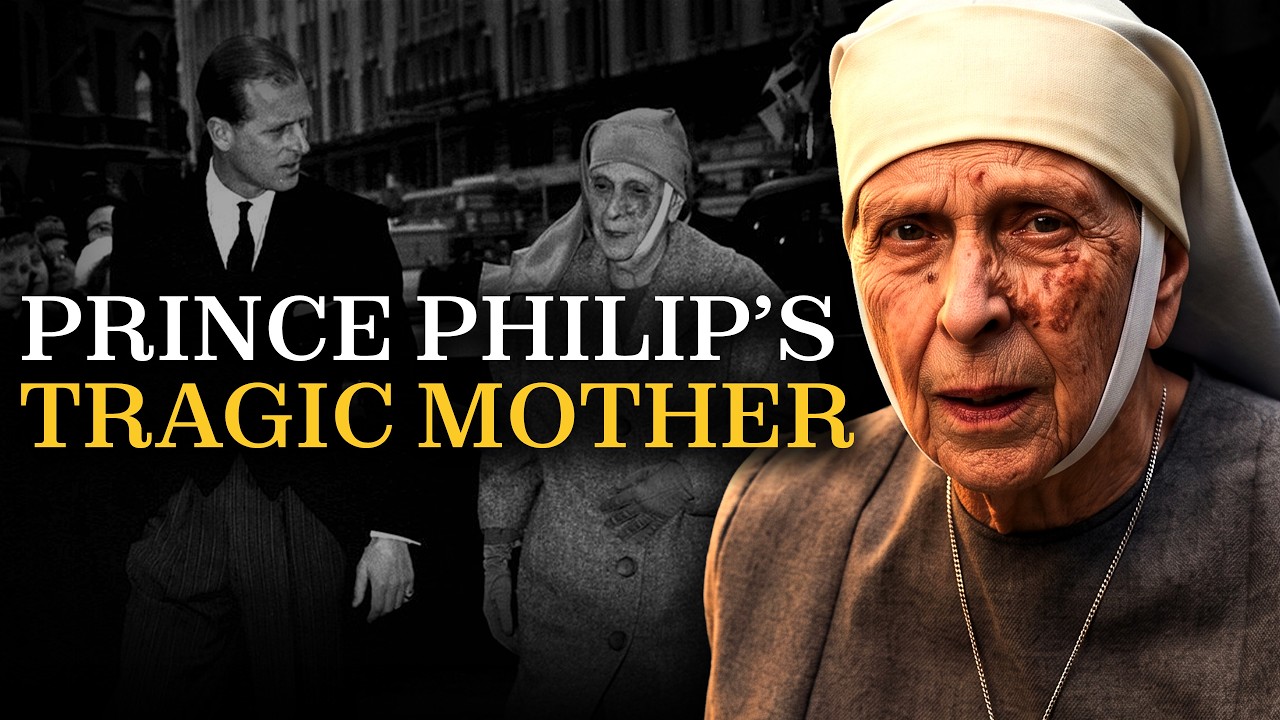
Over the years that followed, Alice gave birth to five children. Her daughters came first, and then, on June 10, 1921, she bore a son, Philip, the boy who would stand beside the British throne decades later as the husband of Queen Elizabeth II. Motherhood placed Alice at the center of a large, scattered family whose fortunes depended on the unstable politics of Greece. Those politics soon turned violent.
The Greek throne rested on shaky ground throughout the early years of her marriage, and in 1922 it collapsed. Defeat in the Greco-Turkish War brought down King Constantine I, who abdicated after a revolutionary military council seized power. In the aftermath, the new rulers arrested Prince Andrew, brought him before a military tribunal, and he narrowly escaped execution before the council settled on exile. The family fled Greece.
They settled outside Paris in the suburb of Saint-Cloud, in a house lent to them by Princess Marie Bonaparte. The Greek throne had taken their old life with it. Once the wife of a prince in a ruling house, Alice now ran a household in rented rooms in a foreign country, raising her children on the goodwill of relatives. The bitterness of exile pressed on her in ways no one around her fully grasped at the time.
A bitter irony crept quietly through those years. The deaf girl Victorian doctors expected to withdraw from the world had become, thanks to her mother's teaching, the linguistic and practical anchor of a family living in upheaval. She ran a household in a fourth language, managed children, servants, and finances, and held the family together while her husband's country closed its doors to them. That competence was real, which makes what happened next harder to explain.
Something changed in Alice during the exile years. In October 1928, that change took a religious form. She converted to the Greek Orthodox Church, the faith of her husband's country, and what began as ordinary devotion escalated over the following months into something far stronger. Through the winter of 1929 and into 1930, her family watched her slide from piety into a fervor they could not match.
Her claims grew stranger by the week. She told those around her that she was receiving direct messages from God, that her hands held the power to heal the sick, and that she had entered into a marriage, physical and spiritual, with Jesus Christ. To a family already unsettled by exile, these words landed as a warning of danger rather than divine inspiration. In the ordinary routines of daily life, Alice remained an intelligent, capable woman running a household in four languages. That steadiness made the change in her harder to explain.
Alarmed, her relatives turned to the medical establishment. In early January 1930, while Alice was in London, two prominent physicians examined her. Dr. Thomas Ross, a psychiatrist who had built his reputation treating soldiers traumatized in World War I, and Sir Maurice Craig, the physician responsible for the mental health of the British royal family, reached the same conclusion. They diagnosed her with paranoid schizophrenia in what they called a pre-psychotic state, a condition they believed was heading toward deterioration.
The diagnosis pointed the family toward Germany. In early February 1930, Alice entered Kurhaus Schloss Tegel, a psychoanalytic clinic in the suburbs of Berlin founded and run by Dr. Ernst Simmel. Simmel examined her and confirmed the London doctors' findings, describing her condition as paranoid schizophrenia linked to religious delusions. She remained under his care in Berlin through March and April, with the weeks passing without the improvement her family had hoped for.
One name stands out above this chapter of Alice's life more than any other, and much of what is said about it is untrue. Sigmund Freud, the founder of psychoanalysis, did play a role in her case. While Alice was at Schloss Tegel, Simmel wrote to Freud for advice on her condition, and Freud replied with a theory rooted in the biological psychiatry of the era. He suggested that her religious delusions stemmed from sexual frustration and hormonal imbalance, an excess of sexual desire with no outlet.
Freud's recommendation, which looks barbaric from the standpoint of the present, was to push Alice toward early menopause by exposing her ovaries to X-rays in order to curb that supposed desire. A Berlin gynecologist named Dr. von Schubert carried out the procedure literally while Alice was at the clinic, irradiating her ovaries without her knowledge or consent. The men who believed they were treating her were, in the most literal sense, experimenting on her.
But the popular version of these events, repeated in biographies and dramatized on screen, distorts the record badly. In that telling, Freud himself sat Alice on his couch, examined her personally, and performed the irradiation with his own hands. None of that is true. By 1930, Freud was seventy-three, gravely ill with the jaw cancer that would eventually kill him, and largely confined to his home in Vienna. He never met Alice, never examined her, and never treated her directly. His involvement began and ended with letters to Simmel.
A second myth deserves the same correction. The story often told claims the radiation destroyed Alice's body forever and turned her into a permanently broken woman. Medical historians dispute that. Though the treatment was brutal and violated her dignity, it did not destroy her health. She lived into her eighties, active and physically demanding of herself to the end. Her recovery, when it finally came, arrived gradually and over years, long after these physical interventions stopped, suggesting they were not what cured her, whatever her doctors believed.

When Schloss Tegel produced no change, her family decided to move her somewhere more secure. Her mother and Prince Andrew arranged the transfer together. The destination lay behind locked doors in Switzerland, and the method of getting her there returns to the scene that opened this story. On May 2, 1930, her relatives restrained her, injected her with morphine and scopolamine, and carried her drugged across the border against her will.
The Bellevue sanatorium in Kreuzlingen, on the Swiss shore of Lake Constance, was run by Dr. Ludwig Binswanger, a psychiatrist known for integrating philosophy into his clinical work. Binswanger also judged her to be suffering from paranoid schizophrenia. Alice, for her part, agreed with none of it. She insisted on her sanity, protested her confinement without pause, and tried more than once to escape.
The confinement lasted two years and four months. That is a long time for anyone held against their will, and longer for a woman convinced she had done nothing to deserve it. The walls cut her off from her children in years when they badly needed a mother, and by the end she had distanced herself from the family that had signed the order committing her. When Bellevue finally released her in September 1932, no home awaited her return.
The years immediately after her release from Bellevue remain the least documented of Alice's life. That silence in the records tells its own story. After her release in September 1932, she spent a short period at a clinic in Moran, in the town now called Morerano in northern Italy, before disappearing into a quiet, wandering life that left few traces. She moved among modest lodgings across central Europe, living simply and often under an assumed name, keeping her distance from the royal relatives who had signed the order committing her.
Here, slowly and without ceremony, she regained her health. No single treatment or dramatic breakthrough explains the turn. Her recovery came in its own time during the mid-1930s, as she rebuilt what the clinics had failed to restore. Six years separated her release from her return to Greece. When she went back to Athens in 1938, she returned alone, a woman in her early fifties who had survived something few in her class ever spoke of openly.
Greece did not bring Alice lasting peace in 1938. She immersed herself in charitable work among the poor of Athens for several years. That work gave her days a shape they had lacked since the sanatorium. Then war broke out in 1941. Axis forces overran Greece, and the occupation that followed brought a famine so severe that people starved in the streets of the capital.
Alice stayed through the worst of the occupation. She remained in Athens and worked without pause. She ran soup kitchens for the starving under her supervision alongside the Swiss and Swedish Red Cross, and set up shelters for children orphaned by the war, using what remained of her name to bring supplies into a city stripped bare. The deaf princess who had once been carried away in restraints now moved through occupied territory on her own authority.
The act that would define Alice's memory came in the autumn of 1943, after Italy's surrender and the German forces' direct takeover of Athens. The city's Jews faced deportation by the Gestapo. The danger reached the family of Haki Cohen, a Greek Jewish member of parliament from Trikala who in 1913 had sheltered and helped King George I of Greece. Cohen had died, but his widow Rachel and their children now faced deportation directly.
Alice remembered the debt. She took Rachel Cohen and two of her children, Tilde and Michel, into her home, hiding them in her third-floor apartment inside the Athens palace of Prince George of Greece. She kept them there in a city swarming with occupation troops for more than a year, from September 1943 until October 1944. Discovery would have meant death for the family and most likely for Alice as well.
The danger was never merely theoretical. When special forces officers came to search her residence, they nearly found what they were looking for, and Alice's position was precarious, since several of her daughters had married high-ranking German officers, a fact that cut both ways under the occupation. Facing Gestapo questions, she resorted to the one defense no one could disprove. She pretended to be deaf, staring blankly and showing complete incomprehension of everything the officers asked until they gave up the interrogation and left.

The condition Victorian doctors had once treated as a defect became a protective shield, and because of it three lives survived. The war ended, but Alice's turn toward religion did not. In January 1949, she founded the Greek Orthodox nursing order known as the Christian Sisterhood of Martha and Mary, dedicated to serving the poor and the sick. The idea drew on her family history.
Alice modeled her order on a convent founded years earlier in Russia by her aunt, Grand Duchess Elizabeth Feodorovna, the woman she regarded as her spiritual guide and who was killed by the Bolsheviks in 1918. The bond between the two women went deeper than a shared calling. Both had married into royal houses and then turned away from that world toward religious service, and both knew upheaval and loss, though Elizabeth's life ended in murder. By founding the sisterhood, Alice completed the work her aunt had begun and lost.
The sisterhood opened on the island of Tinos before moving to a permanent home in a poor neighborhood on the northern edge of Athens. Alice took the title Mother Superior Alice Elizabeth and wore the simple gray habit and white veil that stayed with her for the rest of her life. The contrast with the world of her birth could hardly have been sharper. It produced one of the strangest images of her later years.
In June 1953, she took her place at the coronation of her daughter-in-law, Queen Elizabeth II, in Westminster Abbey, wearing not her coarse working habit but a specially designed gown of two shades of gray silk with a matching veil, made to imitate a nun's habit while conforming to strict royal ceremonial rules. A nun in a nun's habit, dressed by the royal court.
The sisterhood itself was not long for the world. It never attracted enough young women to sustain it, and it lacked the endowment such an order needs to survive. So, over time, it faded. But Alice never abandoned the vows she had taken. She kept them until her death, a nun without a convent, bound to a mission that outlived the institution she built around it.
Politics uprooted Alice one last time. In April 1967, a group of army colonels seized power in Greece, and the coup made the country unsafe for the aging princess. Queen Elizabeth II and Prince Philip arranged to bring her out. At eighty-two, she left Athens for the last time, bound for Buckingham Palace. The girl born in a room at Windsor under Queen Victoria's gaze would end her days inside another royal palace, as a guest of her daughter-in-law.
She lived quietly in private rooms at the palace for the rest of her life. On December 5, 1969, Princess Alice died there at the age of eighty-four. For a woman who had been sedated, confined, exiled, estranged, and hunted through an occupied city, she had reached an age that exceeded every prediction once made about her fragile constitution.
Her body was first laid in the royal vault at St. George's Chapel in Windsor, the same castle where her life had begun. Alice had left instructions about her final resting place, and they did not point anywhere near Windsor. She wished to lie beside her aunt, Grand Duchess Elizabeth Feodorovna, whose remains were in Jerusalem. Nearly two decades after her death, that wish was fulfilled.
On August 3, 1988, her remains were transferred from Windsor to the crypt of the Church of St. Mary Magdalene, a Russian Orthodox church on the Mount of Olives, where the two women who had traded royal life for religious service finally rested near each other. Another kind of recognition followed. In the decades after the war, the story of the Cohen family reached a wider audience.
In 1993, Israel's Holocaust authority, Yad Vashem, named Princess Alice Righteous Among the Nations, an honor reserved for non-Jews who risked their lives to save Jews from the Holocaust. The award came on April 11, 1993, long after she could have known of it. The following year, on October 31, 1994, her son Prince Philip and her daughter Sophie, Princess George of Hanover, traveled to Jerusalem and planted a tree in her name, a living marker for a woman most of the world had never heard of.
Alice's life resists easy summary. Deaf in an age with little patience for disability, declared insane by the brightest minds of her time, and subjected to treatment no ethics committee today would permit, she was cast out by her family and erased from the history of the family she had joined by marriage. Yet she survived it all on the other side.
For most of the twentieth century, she was present in public memory only as a footnote to her famous son, the eccentric mother in a gray dress who appeared at the edges of royal photographs. The full picture took decades to come into focus. This was the woman who read lips in four languages, deceived the Gestapo, and buried herself on a hill in Jerusalem beside the aunt she loved. She was neither saint nor victim, but a person shaped at every turn by forces far larger than herself.