Henry VIII is remembered as one of England’s most transformative monarchs, a king who married six times, ordered two of his wives executed, and broke with Rome to establish the Church of England after Pope Clement VII refused to annul his first marriage to Catherine of Aragon. Yet despite the enormity of his reign, Henry was never supposed to rule. That destiny belonged to his older brother, Arthur, whose status as heir to the English throne seemed secure from the moment of his birth. The fates of Henry’s siblings, however, were just as intertwined with the great political struggles of early modern Europe, from the battlefields of Scotland to the royal courts of France and Spain.
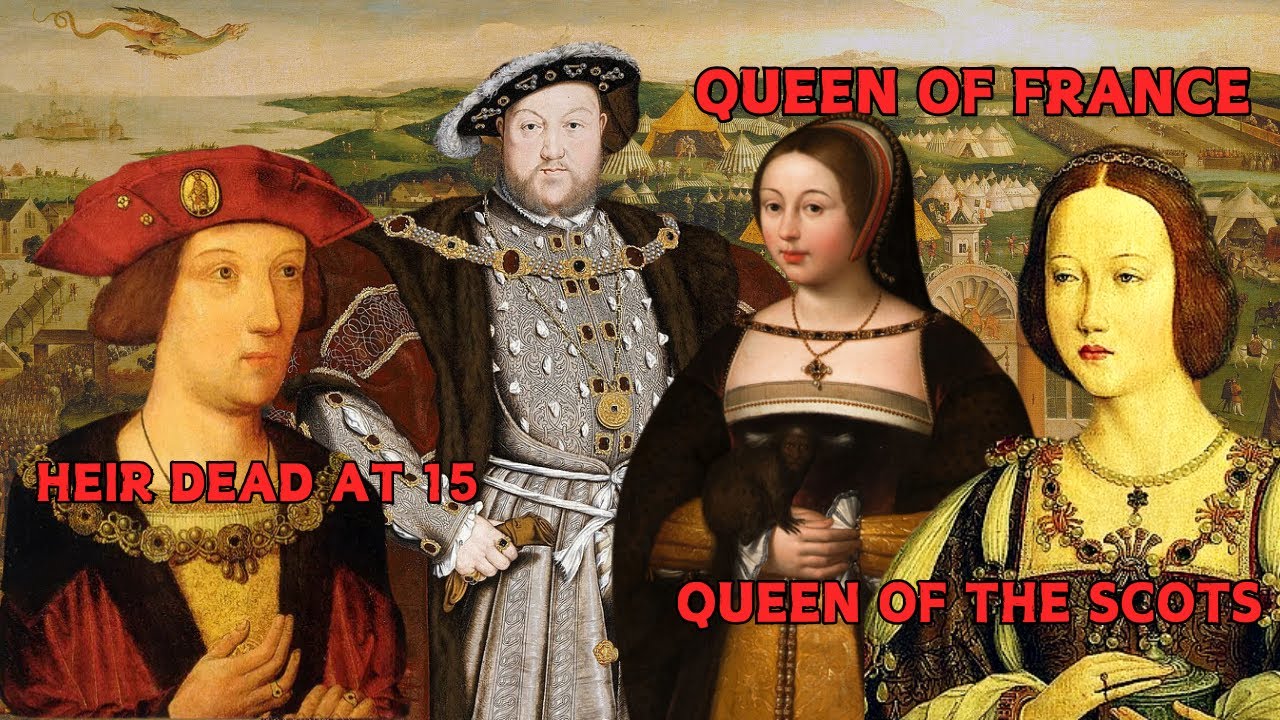
Arthur was born on September 19, 1486, the first son of Henry VII and Elizabeth of York. He was named after the legendary King Arthur of post-Roman Britain, the mythic figure said to have led battles against the Anglo-Saxons. His birth came just a year after his father’s victory at the Battle of Bosworth Field, where Henry VII had slain the disputed Yorkist king Richard III, ending decades of conflict between the Lancastrian and Yorkist factions in the Wars of the Roses. The marriage of Henry VII and Elizabeth of York had been a crucial settlement between those rival houses, and Arthur, as the heir to the newly established Tudor dynasty, was viewed as its great hope.
He became Duke of Cornwall at birth and was created Prince of Wales and Earl of Chester at the age of three. His education concentrated on grammar, poetry, history, rhetoric, and ethics, and he earned a reputation as a star student under the blind French poet and Augustinian friar Bernard André, who said the young prince had read and memorized large portions of Homer, Virgil, and Cicero. Arthur was unusually tall for his age, and his ginger hair and high-bridged nose made him particularly handsome in the eyes of the royal courts across Europe. By 1501, he was considered an unrivaled archer and a skilled dancer.
His father had recently sent him to Ludlow Castle in the Welsh Marches, where he set up his own household and council. Seeking an alliance with the recently unified Spain, Henry VII planned to marry his heir to Catherine of Aragon, the youngest daughter of the Spanish monarchs Isabella I and Ferdinand II. The two were officially betrothed in 1497 through a papal dispensation, since Arthur was below the age of consent. They were married by proxy in 1499 and then formally married in November 1501, after Catherine made the tempestuous voyage from Spain to England at just fifteen years old.
In a letter to Catherine from 1499, Henry wrote: “I cannot tell you what an earnest desire I feel to see your highness, let be hastened the love conceived between us, and the wished-for joys may reap their proper fruit. ”
On the night of the wedding, a bedding ceremony was arranged by Arthur’s grandmother, Lady Margaret Beaufort, who had been instrumental in Henry VII’s rise to power. The couple’s bed was sprinkled with holy water and blessed by the Bishop of London. Catherine was undressed, veiled, and laid in the bed, and Arthur was escorted by his gentlemen into the bedchamber.
The two were left alone. Soon the English court was confidently awaiting news that Catherine, now Princess of Wales, had fallen pregnant. By the spring of the next year, a messenger did arrive from Ludlow, but the news blindsided the king. On April 4, 1502, Henry VII was told that his son and heir, Arthur, was dead.
The marriage between Arthur and Catherine had lasted just five months before the fifteen-year-old prince died of what was thought to be the mysterious English sweating sickness. Arthur was buried on April 25. Soon after, Spain and England agreed that Catherine would be betrothed to the new heir: the future Henry VIII. On the night of November 28, 1489, Elizabeth of York was preparing to give birth to her second child.
Her mother-in-law, Margaret Beaufort, attended her during confinement and was there to witness the birth of her first granddaughter, who was named Margaret in the matriarch’s honor. Margaret shared a close relationship with her grandmother. When the Spanish ambassador was sent by Isabella at the turn of the sixteenth century to broker a peace deal between England and Scotland, with the main task of securing a marriage between the nine-year-old Margaret and the twenty-five-year-old Scottish King James IV, Lady Margaret Beaufort vehemently refused. She insisted that the two wait, possibly recalling her own traumatic experience of childbearing at a young age.
Henry VII had been Margaret Beaufort’s only son, and she had fallen pregnant at twelve and given birth at just thirteen, three months after her husband Edmund Tudor died from the plague. Heeding the refusal, the Spanish ambassador wrote to Isabella that “the daughter of Henry is in fact very young, and very small for her years. ”
Having obtained a papal dispensation for the marriage of his eldest daughter and the Scottish king, since they were distant cousins, the marriage treaty between Margaret and James was officially signed in 1501. The following January, the Treaty of Peace was signed between England and Scotland, the first peace agreement between the two kingdoms in over 170 years.
It was said that once Henry VIII realized that his sister Margaret would take precedence over him when she became Queen of Scotland, he wept with rage. Months before Margaret was set to leave England for Scotland, her mother, Elizabeth of York, died of a postpartum infection on the day of her thirty-seventh birthday. In just over two years, Henry VII had lost his eldest son, his wife, and his newborn daughter. Now his eldest daughter would be moving to Scotland.
They would never see each other again. From 1507 until 1514, Margaret and James had six children, but only one, the future James V, survived infancy. When Henry VII died of tuberculosis in April 1509 and Margaret’s younger brother Henry VIII ascended the English throne, the peace treaty between England and Scotland quickly deteriorated. As Henry VIII headed towards war with France, Scotland honored its historic alliance with the French by invading England.
The subsequent Battle of Flodden on September 9, 1513, became the largest battle ever fought between the two kingdoms. James IV was killed in the disastrous battle, becoming the last British monarch to die while fighting. Margaret, at just twenty-three, was confirmed by Parliament as the Regent of Scotland during the future James V’s minority. Margaret would regularly switch her allegiances between the pro-French and pro-English factions in Scotland, and in the summer of 1514 she secretly married the sixth Earl of Angus, Archibald Douglas.
By remarrying after James’s death, Margaret sacrificed her position as Regent, and soon she was replaced by the pro-French Duke of Albany, John Stewart. The marriage soured quickly. After Margaret returned to Scotland following a year-long stay in England for her own safety and the safety of her newborn daughter, Lady Margaret Douglas, she discovered that the Earl of Angus had been living with his former lover, Lady Jane Stewart. Margaret managed to obtain an annulment from Angus in 1527, and soon she married her third and final husband, Henry Stewart.
Margaret’s only living son, James, was pronounced King in his own right at just twelve, but their relationship was turbulent, and she spent the rest of her life drifting in and out of his favor. Margaret eventually died on October 18, 1541, at fifty-one, most likely from complications following a stroke. The third child of Henry VII and Elizabeth of York was the future Henry VIII, born on June 28, 1491. Henry and Elizabeth’s fourth child and second daughter, Elizabeth, was born on July 2, 1492, but she died just three years later and was buried in Westminster Abbey in September 1495.
A year after Elizabeth’s death, Elizabeth of York gave birth to another daughter, Mary, on March 18, 1496, at Sheen Palace. At just six years old, the same year that her mother would die, Mary was given her own household with staff, a physician, and a schoolmaster. She was taught French, Latin, music, and dance. Mary and her brother Henry were close as children.
In 1516, when Henry’s first daughter was born, she was named Mary in honor of the king’s sister. Mary was said to be a great beauty in her youth, even catching the eye of Philip of Castile when the ten-year-old was tasked with entertaining the court’s guests. When Philip died in December 1507, Mary was betrothed to his son Charles, later the powerful Holy Roman Emperor Charles V, but the union was called off in 1514. As marriages continued to act as some of the most effective peace treaties between hostile states, the English statesman and Cardinal Thomas Wolsey was tasked with arranging a marriage between France and England.
In the end, it was agreed that the eighteen-year-old Mary Tudor would marry the fifty-two-year-old Louis XII. Louis had been King of France since 1498, succeeding his second cousin once removed Charles VIII, who had died without heirs. Naturally reluctant to accept the proposed marriage, Princess Mary convinced her brother that if she agreed to the French marriage, she would be allowed to independently choose her next husband. That agreement would play out sooner than anyone expected.
Less than three months after his marriage to Mary, Louis XII died from a severe episode of gout with no legitimate sons. As Francis I ascended the French throne, he began plotting another marriage for the widowed Mary. But the English princess told her brother that if he did not abide by her wishes that she would choose her next marriage, she threatened to join a nunnery. Eventually agreeing to Mary’s demands, Henry sent the Duke of Suffolk, Charles Brandon, whom Mary already harbored romantic feelings for, to negotiate the princess’s return.
Although Brandon was forced to promise Henry and his privy council that he would not propose to the Tudor princess, Mary was adamant that the two marry. The couple was secretly wed in a Paris ceremony on March 3, 1515, with just ten guests in attendance, one of whom was King Francis himself. Without Henry’s approval, Brandon’s decision to marry the king’s sister was tantamount to treason. It was only thanks to Henry’s love for his sister Mary that Brandon was spared execution, though he was forced to pay a heavy fine.
Mary and Brandon soon retired to country life in Suffolk, where she gave birth to four children, who she raised alongside Brandon’s daughters from his second marriage. Mary and Brandon’s first daughter, Frances Grey, born in July 1517, would later give birth to Lady Jane Grey, who was chosen by Henry VIII’s son Edward VI to be his successor. Jane’s contested reign lasted just nine days before she was deposed by Mary I and executed the following year. Despite the close relationship between Mary and her brother Henry, the king’s choice to pursue Anne Boleyn and attempt to annul his marriage to Catherine of Aragon marred the siblings’ relationship.
The same year that Anne Boleyn became Queen of England, Mary was on her deathbed. She had been sick on and off for the past few years, having never fully recovered from a bout of the sweating sickness she caught in 1528. On June 25, 1533, Mary died at thirty-seven years old. After the birth of Mary back in 1496, Henry VII and Elizabeth of York would have two more children: Edmund in 1499 and Katherine in 1503.
Neither would live long. Henry VIII outlived all of his siblings, dying in 1547 at the age of fifty-five. While Henry is by far the most well-known of the Tudor siblings, the fates of his brother and two sisters were just as instrumental to European politics and diplomacy, from Spain to Scotland to France.
The second generation of the Tudor dynasty carved out their respective places in early modern Europe.