The Icelandic sagas preserve the story of Egill Skallagrímsson, a man who embodied the contradictions of the Viking Age: a child killer who became a celebrated poet, a ruthless berserker who composed elegant verse, and a bitter enemy of kings who nonetheless served one of England’s greatest rulers. Born in Iceland around 910, Egill was the son of Skallagrím, a farmer and blacksmith who had fled Norway after a bloody feud with King Harald Fairhair. That feud had begun with the death of Egill’s uncle, Þórólfur, who was slain by the king after his growing power threatened the crown. His grandfather, Kveldúlfr, died of illness during the family’s flight, but not before the family had killed two of the king’s cousins in vengeance.
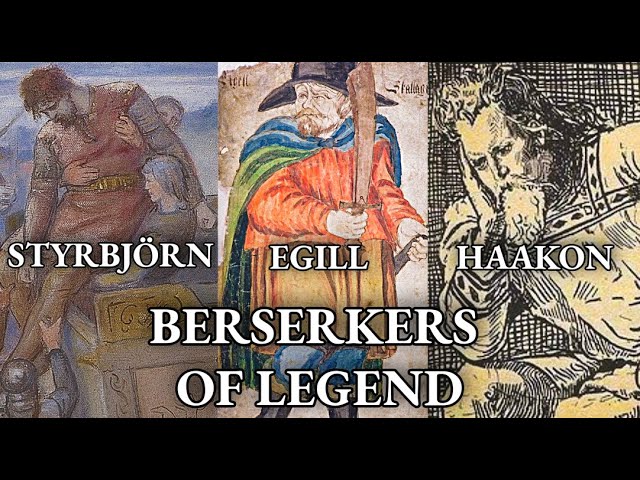
Egill showed his violent nature early. At age seven, after losing a ball game to an older boy, he fetched an axe and killed the boy with a blow to the head. By twelve, he towered over most men. When he and a companion challenged his father to a strength contest, Skallagrím killed the companion in a fit of rage; only the intervention of Egill’s mother saved his life.
Egill responded by killing one of his father’s prized slaves, and the two did not speak for a full winter. His older brother, Þórólfur, eventually took Egill abroad. During their travels, Egill stayed at a farm belonging to King Eirik Bloodaxe, son of Harald Fairhair, the very man who had driven Egill’s family from Norway. When the king and his queen, Gunnhild, arrived for a banquet, Egill used the occasion to mock the farm’s steward, Bárðr, for lying about having no ale.
The queen, angered by Egill’s behavior, offered him a poisoned drink. Egill, suspecting treachery, pricked his palm and carved runes into the drinking horn, which shattered in his hands. He then drew his sword and killed Bárðr before fleeing. Eirik demanded Egill’s death, but Egill fought his way free, killing three guards and commandeering a longboat.
His brother negotiated a settlement: Egill would pay a fine and leave Eirik’s kingdom. The exile only sharpened Egill’s edge. He raided in Courland, where he and his men were captured but escaped, freeing his companions and stealing treasure. He plundered in Denmark, where Harald Bluetooth had recently taken the throne, building a reputation for ferocity.
Around 937, Egill and his men heard that King Æthelstan of England was seeking mercenaries. Æthelstan had united much of Britain, provoking a coalition of Scots, Dublin Norse, and Northumbrian rebels. Egill joined the English king with 300 warriors. At the Battle of Brunanburh, his brother Þórólfur was killed fighting through a Scottish shield wall.
Enraged, Egill fought to the front, killed a warrior named Aldulf, and drove the enemy divisions into flight. Æthelstan won the battle, and Egill was hailed as a hero. At the victory feast, Æthelstan presented Egill with a gold ring and two chests of silver in compensation for his brother’s death. Egill stayed in Wessex for the winter, composing praise poems for the king.
But honor required him to return to Norway to care for his brother’s widow, Ásgurðr. He eventually married her. His troubles with Eirik Bloodaxe resumed when Ásgurðr was denied her inheritance after her father died. The claim went to her half-sister, who had married a man allied with the king.
At a legal assembly, Queen Gunnhild sent men to disrupt the proceedings. Egill threatened anyone who tried to take the disputed land and fled by ship, managing to kill one of the king’s kinsmen in a skirmish before leaving Norway as an outlaw once more. Furious, Egill composed a curse against Eirik:
“Requite him, righteous gods, for robbery of my wealth. Hunt him away, be wroth, high Odin, heavenly powers, foe of his folk, base king.
May Freyr and Njörðr make him flee, hate him, land-guardians, who holy ground hath scorned. ”
Later, after returning to Norway by chance and killing Eirik’s son Rögnvald in a raid, Egill erected a nithing pole, a wooden pole topped with a horse’s head, and cursed the king and queen:
“Here set I up a curse pole, and this curse I turn on King Eirik and Queen Gunnhild. This curse I turn also on the guardian spirits who dwell in this land that they may all wander astray nor reach or find their home till they have driven out of the land King Eirik and Gunnhild. ”
The curse proved prophetic.
Eirik was eventually ousted from Norway by his brother Hákon the Good and fled to Northumbria, where Æthelstan had appointed him king to defend against Scottish and Irish attacks. By ill luck, Egill was shipwrecked in Northumbria while sailing to England. Egill’s old friend Arinbjörn had risen to serve Eirik. When Egill appeared before the king, Eirik condemned him to death.
Arinbjörn argued that Egill should be allowed to atone with a poem of praise that would endure forever. Eirik, after a long silence, relented, granting Egill one night to compose a poem in his honor. Egill worked through the night. The next morning, he recited his poem before the court.
It praised Eirik’s deeds in battle, his generosity, and his prowess. When Egill finished, Eirik declared the poem well sung and allowed him to leave, with the condition that he never appear before the king again. Egill gave Arinbjörn two gold rings Æthelstan had given him, then sailed to Wessex. In England, Egill was persuaded to stay and command Æthelstan’s armies, but he first returned to Iceland to see his family.
He later joined Arinbjörn in raiding Saxony and Frisia, and fought alongside King Hákon’s champions. In his later years, he returned to Iceland, becoming a force in local politics. Egill lived to about 91. In his final years, he went blind.
His last wish was to throw the two chests of silver from Æthelstan into a crowd and let people fight over it. Denied this, he had two slaves help him hide the treasure, then killed them to keep the secret. The location of Egill’s silver remains unknown, and legend holds that it may still be buried in Iceland. The saga presents Egill as a man of extremes: a poet of rare skill, a master of runes, a devoted friend, and a ruthless enemy.
He is credited with introducing end rhyme into Old Norse verse, and his saga, written around the mid-13th century, remains one of the most detailed portrayals of a Viking warrior’s life. Modern scholars have speculated that Egill may have suffered from conditions affecting his skull and mood, which could explain his unusual appearance and violent temperament. But the saga itself offers no diagnosis, only the portrait of a man defined by the values of his age: honor, loyalty, and the certainty that broken promises merited destruction, whether through force, poetry, or sorcery.