In 1956, a young man in Buenos Aires began dating a girl named Sylvia. He did not know her father was a half-Jewish German lawyer who had survived the Dachau concentration camp. The young man, Klaus Eichmann, boasted openly about his father’s role in the Nazi regime. Four years later, that boasting helped Israeli agents track down and capture one of the most wanted war criminals in history: Adolf Eichmann, Klaus’s father.
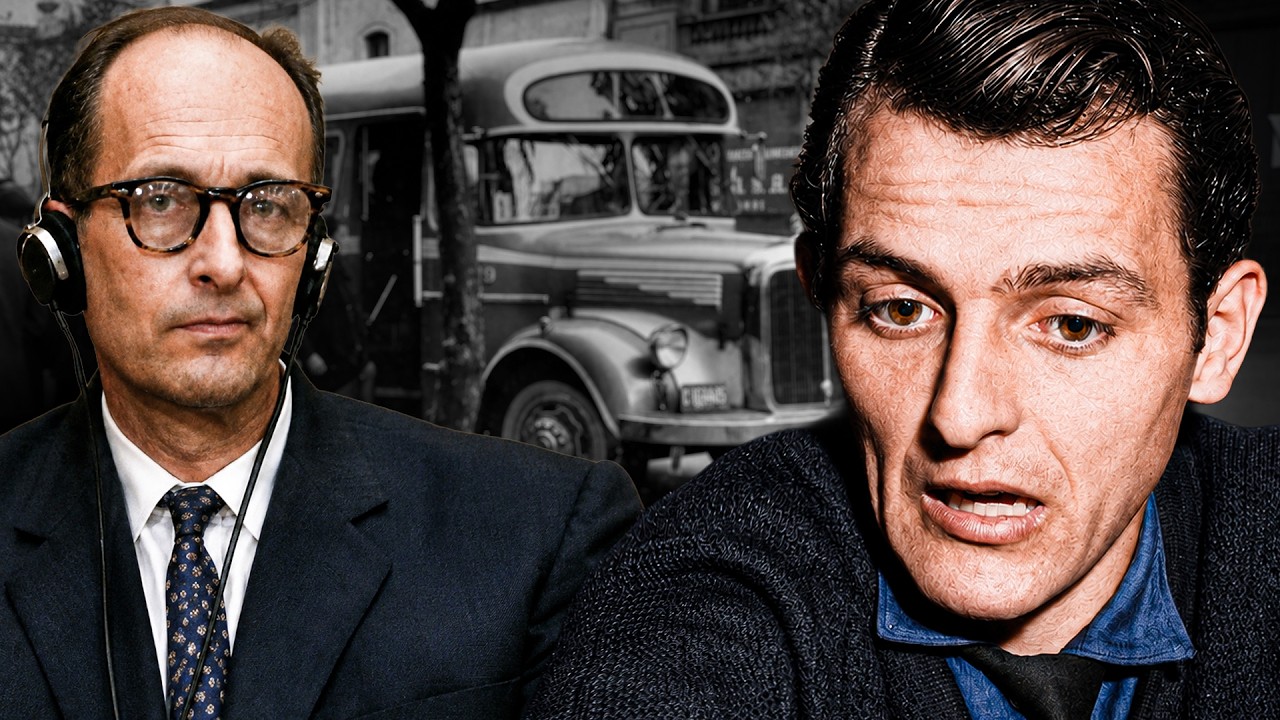
Adolf Eichmann had four sons. Klaus was born in Berlin in 1936, Horst Adolf in Vienna in 1940, Dieter Helmut in Prague in 1942, and the youngest, Ricardo Francisco, was born in Buenos Aires in 1955. By the end of World War II, their father was a fugitive. He escaped American custody, worked under a false identity as a forester for five years, and in 1950 used Red Cross papers obtained through a bishop’s network to sail from Genoa to Argentina.
His wife and first three sons followed two years later. In Argentina, Adolf and his wife registered under false names, but their sons kept the family name at school and on the street. That decision became a significant security failure. In 1956, Klaus began dating Sylvia Hermann.
Her father, Lothar Hermann, had emigrated to Argentina after surviving Dachau. Klaus, unaware of Sylvia’s background, spoke freely about his father’s wartime work. Lothar Hermann became convinced his daughter was dating the son of a wanted war criminal. In 1957, Hermann wrote to Fritz Bauer, a German attorney general who was himself a Jewish survivor.
Bauer bypassed German authorities and passed the information directly to Israeli officials. Mossad began investigating. Sylvia was sent back to the Eichmann house on a fact-finding mission and was met at the door by a man who claimed to be Klaus’s uncle. Klaus arrived moments later and addressed him as father.
That confirmation helped Israeli agents build their case. On May 11, 1960, Mossad operatives captured Adolf Eichmann near a bus stop in San Fernando, Argentina. He was flown to Israel nine days later disguised as an airline crew member. His trial in Jerusalem ran from April to December 1961.
He was convicted and hanged at Ramla prison on June 1, 1962. His four sons received the news in two countries, and each took a dramatically different path afterward. Klaus Eichmann was 25 when his father stood trial. In 1961, he traveled to the United States and gave an interview to Parade magazine, defending his father, calling the charges propaganda, and suggesting Jewish figures had engineered wartime deaths.
American authorities deported him back to Argentina. After his father’s death sentence, Klaus held a press conference in Buenos Aires protesting the verdict. He later moved to West Germany, abandoned his first wife and two children, started a second family, and never publicly renounced his views. He died in Germany in 2015 at age 79, having outlived his father by 53 years.
Horst Adolf Eichmann was the most committed of the four sons. According to his long-time partner, he genuinely believed his father had done nothing wrong and treated the Holocaust as an invention. In 1962, following his father’s execution, Argentine police raided a Nazi cell that the brothers had reportedly formed, recovering propaganda, firearms, and Molotov cocktails. Horst was jailed for possessing weapons and extremist material.
In 1964, he appeared at a press conference wearing a Nazi armband. He was later arrested in a sweep of hundreds of extremists but released for lack of evidence. He spent the rest of his life in Buenos Aires, working construction and furniture removal. He died of bowel cancer in December 2015.
Dieter Helmut Eichmann took the quietest path. Born in Prague in 1942, he gave no interviews and stayed out of politics and police records. He built a career in construction and property management, splitting his time between Argentina and Germany. He privately believed his father was innocent but never said so publicly.
Photographed in Buenos Aires in 2018 at age 76, he was living a short drive from where his father had been captured and declined to comment. Ricardo Francisco Eichmann was different in almost every way. He was five years old when his father was taken and later said his clearest memories were of being walked to the bus stop by the hand and being bought chocolate nearby. After the execution, his mother hid newspaper cuttings under a sofa; he read them in pieces as a child.
The family moved back to Germany, where Ricardo studied prehistoric and classical archaeology. He earned a doctorate in 1984 and later served as director of the Orient Department of the German Archaeological Institute, leading excavations in Saudi Arabia, Jordan, and Qatar. He has said his father deserved to be brought to justice and that the defense of following orders excused nothing.
Asked whether he had considered changing his surname, he replied that it would have made no difference because nobody escapes their own past.