On November 25, 1963, at Arlington National Cemetery, three-year-old John Kennedy Jr. saluted his father's casket. The image became iconic. The nation mourned. Jackie Kennedy stood in black, veiled, and unflinching. She had just buried her husband.
What she did in the week that followed revealed a side of her that few expected.
The funeral ended at 3:34 p.m. World leaders departed. The crowds dispersed. Jackie Kennedy returned to the White House still wearing black. She was 34 years old. She had been First Lady for two years and ten months. She had been a widow for three days.
Now she had to leave the only home her children had ever known, and she had to do it fast.
That evening, Jackie sat at her desk in the family quarters. She began planning, not her future, but her exit. She knew protocol. When a president dies, the new president needs the house.
Lyndon Johnson had been gracious. He told Jackie to take as much time as she needed. He even offered to let her stay through his entire term if she wanted. But Jackie knew better. She would not impose. She would not linger.
She set a deadline: two weeks. December 6. She would be gone.
But first, something private, something painful, something almost nobody knew about yet.
In the days following the funeral, Jackie made arrangements that few outside the family understood. The Kennedy plane, named Caroline after her daughter, was positioned at a remote corner of Quonset Naval Air Station in Rhode Island, deliberately out of sight. No advance announcement had been made. The press did not know. This was intentional. Jackie had moved the date up by one day after learning reporters might discover what she was doing.
Two small white coffins were prepared for transport. One contained Patrick Bouvier Kennedy, the infant son Jackie and Jack lost just three months earlier in August. He died at 39 hours old from respiratory distress. He had been buried in Brookline, Massachusetts, near the Kennedy family plot.
The other coffin contained an even more tragic loss: a daughter stillborn in August 1956. The Kennedys had planned to name her Arabella, but she never received an official name. She was buried in Newport, Rhode Island.
Jackie had made a decision. Her babies would not be separated from their father. They belonged with Jack at Arlington.
Boston's Richard Cardinal Cushing, a family friend, accompanied Patrick's body from Brookline. A Catholic priest brought the stillborn child from Newport. Senator Ted Kennedy, Jack's youngest brother, boarded the Caroline for the two-hour flight to Washington.
The plane landed quietly. No ceremony, no cameras, just family.
Then, on the evening of December 4, 1963, at 8:40 p.m., a small group gathered at Arlington National Cemetery. Fewer than a dozen people, close family and friends only. Jackie stood in the flickering light of the eternal flame she had lit 11 days earlier.
A 20-minute burial service was conducted. The two small white coffins were lowered into the ground on either side of President Kennedy's grave. Jackie watched, silent, composed, devastated.
The public only learned about it later. Time magazine would report it. The nation would discover that Jackie Kennedy, in the depths of her grief, in the chaos of packing and moving, took time to reunite her family, all of them, together, forever.
It was an act of profound love and unbearable sadness, and it was just the beginning of a remarkable week.
Back at the White House, the packing continued. Jackie had started immediately. On November 23, the day after the assassination, when most widows would be frozen in grief, Jackie woke up and told her staff to begin packing. She wanted it done quickly, efficiently, no delay.
By the afternoon of November 23, JFK's Oval Office was already empty, everything removed except his desk, two telephones, and the rug. Jackie herself sat at her writing desk sketching diagrams. She was calculating bedroom space for funeral guests. How many could stay on the third floor? Five singles, two doubles. She wrote it all down on White House stationery. Even in crisis, she was planning.
Her long-time personal assistant, Providencia Paredes, who had packed Jackie's pink suit for the Dallas trip, busied herself in Jackie's dressing room. She organized clothes and accessories, trying to stay close in case Jackie needed anything. But Jackie accepted almost nothing, just tea. That was all she would take.
For four consecutive days, starting November 26, two moving vans and a crew of six workers arrived at the White House early each morning. They loaded boxes, furniture, and personal belongings. Some items went to storage until Jackie could decide on a permanent home. Others went to a temporary residence, a red-brick Georgetown house at 3038 N Street, lent to Jackie by Under Secretary of State W. Averell Harriman.
The scene at the Harriman house was surreal. Deliveries arrived constantly. A two-wheeled bicycle, a box marked John's toys N Street, pink and blue-covered parakeet cages, hat boxes, a generous supply of French wines, a bulging briefcase bearing the initials JFK. A maid carried an armload of White House guidebooks. A Washington florist delivered yellow chrysanthemums.
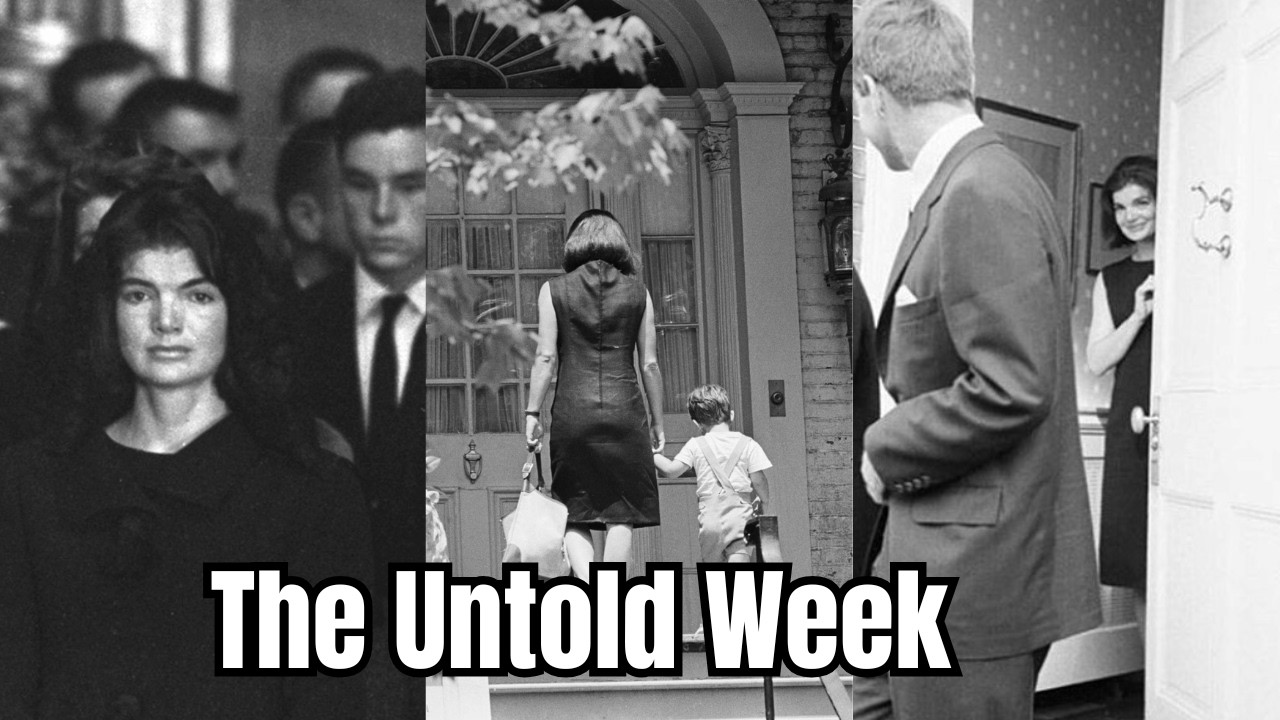
On Friday, December 6, just after 1:00 p.m., it happened. A black White House limousine pulled up to the Georgetown house. Out stepped Jackie Kennedy, Caroline, and John Jr. Accompanying them were Bobby and Ethel Kennedy. They chatted for half an hour, then Bobby and Ethel left.
Jackie stood at the front door, smiling, actually smiling. It surprised onlookers. How could she smile? Her husband had been dead for two weeks. But those who knew Jackie understood. She was not happy. She was relieved. The ordeal of leaving was over. She had her children in a new home. They were safe, private, away from the crushing weight of the White House and all its memories.
Meanwhile, back at the White House, letters piled up six feet high in the East Wing. Over 300,000 sympathy notes, prayers, and condolences from around the world. Jackie would eventually send acknowledgement cards to thousands of people, small printed cards with her thanks. Some she personalized with handwritten notes. Years later, those cards would sell at auction for hundreds of dollars each.
But there was something else Jackie did that week that truly left a lasting impression, something that revealed her grace, her strength, and her awareness of history.
On November 26, the day after the funeral, Jackie wrote a letter. Not to family, not to close friends, but to Lyndon Johnson, the man who was now president, the man who had taken her husband's job, the man some Kennedy loyalists already resented.

The letter was seven pages long, handwritten, intimate, extraordinary. In it, Jackie thanked Johnson for his kindness. She praised his strength. She reflected on continuing her husband's work and offered thoughts on governing the nation during this difficult transition.
Johnson was deeply moved. He called Jackie on December 2. The phone call was recorded. Johnson's voice is tender, almost paternal. "I just wanted you to know you are loved by so many and so much. I'm one of them."
Jackie replied, "Oh, Mr. President, I tried. I didn't dare bother you again, but I got Kenny O'Donnell over here to give you a message if he ever saw you."
Johnson spoke warmly and reassuringly. "The first thing you've got to learn is that you don't bother me. You give me strength."
They talked about her letter. Johnson was amazed she took time to write it. Jackie told him she had more letters in his handwriting than she did of Jack's now. Johnson had been writing to her constantly, checking on her, offering help, being present.
The relationship between Jackie and the Johnsons during this period was not what most people imagine. Lady Bird Johnson visited Jackie the day after the funeral. Jackie gave her a tour of the White House living quarters. She offered household advice.
She told Lady Bird, "Don't be frightened of this house. Some of the happiest years of my marriage have been spent here." Think about that. Jackie Kennedy, who had just buried her husband after watching him die in her arms, was comforting the new first lady, helping her transition, making her feel welcome. It was an act of profound grace.
On December 21, Johnson called Jackie again. It was Christmas time. She had left Washington without saying goodbye. Johnson teased her about it. "You left town without saying goodbye," he said on the recorded call.
They exchanged Christmas wishes. Johnson told her gifts were being delivered by his daughter Lucy. Jackie thanked him. They chatted about upcoming visits, about foreign leaders, about White House business. It was warm, friendly, almost familial.
This surprised Kennedy loyalists. Many of them despised Johnson. They blamed him for policy disagreements, for perceived slights during the vice presidency, for taking power after Jack's death, even though that was literally how succession worked. But Jackie refused to participate in that bitterness. She treated Johnson and Lady Bird with dignity and respect.
But Jackie also did something else that week that showed her steel beneath the grace. She took control of Jack's legacy.
During those two weeks at the White House, Jackie made critical decisions about how JFK would be remembered. She strongly insisted on the eternal flame at Arlington. Cemetery officials opposed it, too risky, too unconventional. Jackie played a decisive role in ensuring it was established.
She insisted on modeling the funeral after Abraham Lincoln's state funeral from 1865. Every detail researched, every protocol followed. She wanted Jack remembered as Lincoln was, as a martyr, as a great leader cut down in his prime.
She insisted on the horse-drawn caisson, the riderless horse with boots reversed in the stirrups, the walk from the White House to St. Matthew's Cathedral, eight blocks on foot, heads of state from around the world walking behind the casket. It was unprecedented, dangerous in the era after an assassination. Security officials protested. Jackie insisted. She got her way.

She also made sure JFK's presidential papers were carefully packed and crated. His personal files would go with her. His official papers would be warehoused until completion of the Kennedy Memorial Library in Boston. She was already planning the library, already thinking about how history would judge her husband.
And she did one more thing that left an impression. She attended an award ceremony.
On December 4, the same day her children were reburied at Arlington, Jackie went to the Treasury Department building, expressionless, controlled. She watched Treasury Secretary Douglas Dillon award a citation for exceptional bravery to Secret Service Agent Clinton J. Hill.
Hill was the agent assigned to protect Jackie. He was the man who ran to the rear of the presidential limousine in Dallas after Kennedy had been shot. He climbed onto the back bumper. Jackie had reached out and pulled him aboard as the car sped away. He threw himself over Jackie to shield her. He thought he had failed. He thought he should have saved the president.
Jackie wanted Hill to receive recognition. She wanted the nation to know he had done everything possible. She attended the ceremony to honor him just days after burying her husband.
By December 6, Jackie was gone from the White House. She moved into the Harriman House in Georgetown, built in 1805, seven bedrooms, dining room seating for 18, a block-long terraced garden with magnolia trees and a swimming pool. It would be temporary, just until Jackie figured out what came next.
Congress voted unanimously to pay the expenses of President Kennedy's funeral. They also voted to give Jackie free office space for 6 to 12 months, continued Secret Service protection, $50,000 to help pay her personal staff, a $10,000 a year widow's pension, and free use of the mail for life.
But money was not what Jackie cared about. Legacy was. History was. Her children were.
She had lost a husband. She had buried two babies beside him. She had moved out of the White House in two weeks. And through it all, she had shown the world what grace under pressure looked like.
People were struck by how quickly she moved, how composed she remained, how generous she was to the Johnsons, how focused she stayed on her children and her husband's memory. Many expected her to collapse, to retreat, to disappear into grief. Instead, Jackie Kennedy showed them strength.
She buried her children with their father in a private nighttime ceremony. She packed up the White House with disciplined urgency. She wrote a seven-page letter to the new president offering support. She attended an award ceremony for her Secret Service agent. She moved her family to a new home and smiled at the door. And she did it all in two weeks.
The week after JFK's funeral was not about what Jackie Kennedy said. It was about what she did. She reunited her family in death. She honored her husband's legacy. She supported the peaceful transfer of power. She protected her children. She maintained her dignity. And she showed America that even in the darkest moment, grace and strength were possible.
That is what left such a lasting impression. Not that she grieved, but how she grieved. With purpose, with control, with an awareness that the world was watching and history was being written.
Jackie Kennedy understood that her actions in those days would define how people remembered not just her husband's death, but her own character. She chose strength, grace, and focus. And in doing so, she created a legend that endures to this day.
Not just as the woman in the pink suit, not just as the widow at the funeral, but as the woman who buried her children in private, moved out of the White House with dignity, and supported her husband's successor with generosity.
That is the story of what Jackie Kennedy did the week after JFK's funeral. And that is why it left such a powerful impression on history.