The German invasion of the Netherlands on May 10, 1940, brought World War II to a country that had hoped to remain neutral. The Dutch army surrendered after just five days of fighting, and Queen Wilhelmina and the government fled to London.
Over the following months, the Nazi occupiers imposed increasingly harsh anti-Jewish measures. Jewish businesses were seized, civil rights were stripped away, and from July 1942 tens of thousands of Dutch Jews were deported to concentration and extermination camps.
Across the country, many ordinary citizens risked their lives to hide Jewish families, forge identity documents, and organize escape routes. But not everyone chose resistance.
Some exploited the persecution for personal gain, pretending to help people fleeing Nazi terror while secretly working with the occupiers. Among the most notorious was a Dutch brothel owner and prostitute named Adriana Valkenburg.
Adriana Schon Valkenburg was born on June 10, 1894, in the city of Schiedam, the fourth of fourteen children of butcher Jacob Valkenburg and his wife, Adriana Cornelia de Leest. Her childhood was marked by constant conflict; her father was strict and often violent, while her mother neglected the children. Hatred, jealousy, and frequent fights became part of daily life.
Valkenburg attended primary school until the age of thirteen, then spent a year at a domestic science school. She later helped her mother run the household, but she also began attracting the attention of police. In 1911 she was reported for public indecency, and the following year she was accused of stealing a gold ring. Around the same time, her parents separated, adding to the instability of an already troubled childhood.
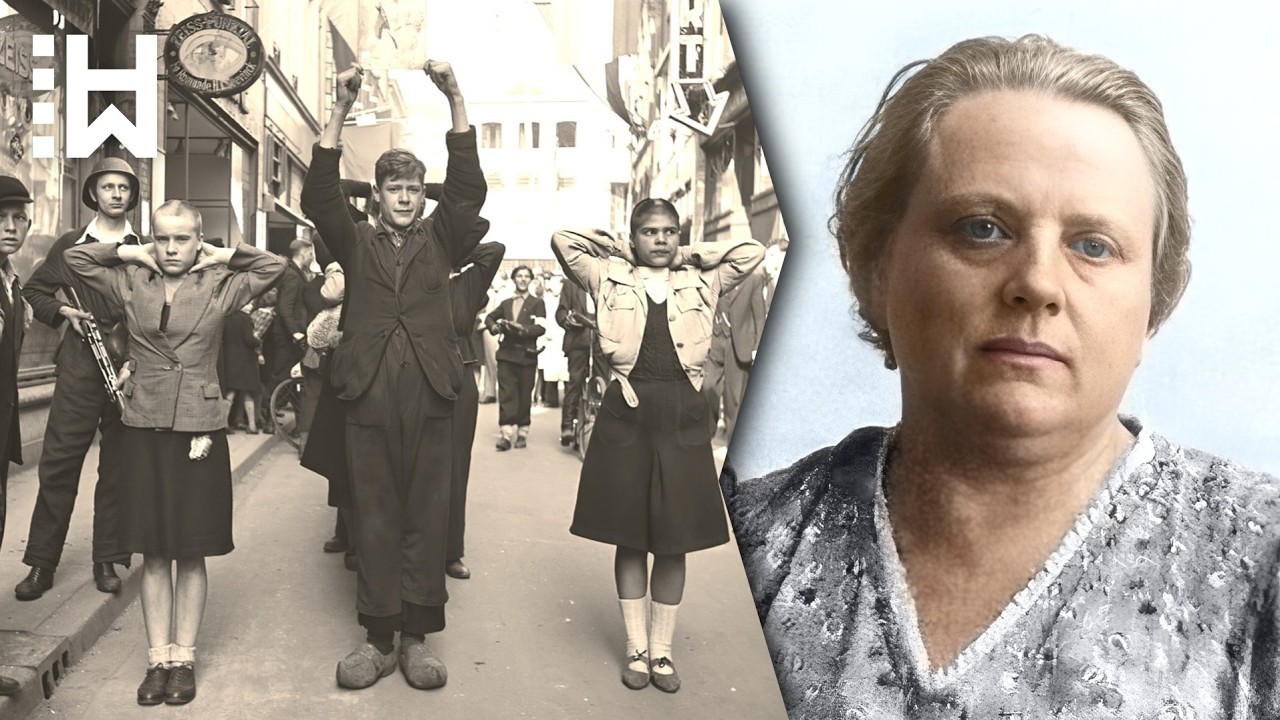
At eighteen, Valkenburg found work as a fashion seamstress at the Gerzon fashion store in Rotterdam. In 1916 she began a relationship with Jan Bort, a wealthy shipbuilding businessman who provided her with financial support and housing. Later that same year, she unexpectedly married Jewish businessman Jacob Stieber, whom she had met only shortly before. The marriage lasted just a few weeks before Stieber disappeared without a trace.
After spending several months with one of her sisters, she settled in Amsterdam in 1918, where she resumed her relationship with Jan Bort. By the early 1920s, Valkenburg had established a second source of income alongside that relationship. She worked as a prostitute and later became the owner of several brothels in Amsterdam and The Hague.
During this period, she became involved with a waiter named Arnoldus Noo van Leersum, who soon began living off her earnings. Valkenburg repeatedly tried to prosecute him for pimping, but her efforts failed. After years of legal disputes, she finally ended the relationship in 1933, though the long court battles drained much of her fortune.
Despite these setbacks, Valkenburg became a prominent figure in Amsterdam's criminal underworld. Former police commissioner Hendrik Voort de Vient later described her as charmingly beautiful, tall, blonde, with a very beautiful face and a regal bearing. Both police and the criminal world knew her by the nickname "Zwarte Jo the Liar," reflecting her reputation for manipulation, deception, and intrigue.
Over the years, twenty-one reports accumulated against her with police, on charges of prostitution, drunkenness, fighting, and other offenses. By the mid-1930s, Valkenburg had also begun performing illegal abortions alongside running her brothels. In December 1938 she was sentenced to nine months in prison for these activities.
When she was released in June 1939, her circumstances had changed drastically. Jan Bort withdrew his financial support, the brothels she ran were closed, and Valkenburg was left nearly destitute. She was forced to seek help from social services and returned to working as a street prostitute to survive.

For Adriana Valkenburg, World War II marked a turning point in 1942. At the time, she was living on Van Woestraat in Amsterdam with Jacob Arko Hen, a Jewish market trader she had first met in 1931. Their relationship had begun as one between a client and a prostitute, but over the years it developed into something emotional.
Valkenburg planned to marry Arko Hen on April 2, 1942, hoping a mixed marriage would protect him from deportation. But before the marriage could take place, the German authorities arrested him and deported him to Mauthausen concentration camp, where he later died.
After his arrest, Valkenburg began presenting herself as someone willing to help persecuted Jews. She arranged hiding places, helped organize escape routes, and soon gained the trust of many desperate people seeking to avoid deportation. Yet she demanded large sums for her help, exploiting those who had no other options.
By the spring of 1943, these activities had drawn the attention of the Sicherheitsdienst, or SD, the intelligence service of the Nazi SS. Facing the risk of arrest, Valkenburg agreed to work with the Jewish Affairs Bureau, a German-controlled organization responsible for identifying and arresting Jews in the occupied Netherlands.
From that moment, the woman who had presented herself as a savior became something like Nazi poison inside Amsterdam's Jewish community. Exploiting the trust she had built among Jewish families, she directed many of them to hiding places or false addresses under her control. These "Jewish traps" allowed the German authorities to arrest victims who believed they were being rescued.
In return, Valkenburg received financial rewards, as well as payments tied to property seized from those she betrayed. As her cooperation with the German occupation authorities grew, she established close ties with some of the most famous Jewish hunters in the Netherlands, including Pieter Schaap, one of the most feared collaborators.

Valkenburg had a brief relationship with Otto Kempin, the German officer who headed the Jewish Affairs Bureau in Amsterdam. Through payments made for each successful arrest and rewards tied to confiscated Jewish property, Valkenburg amassed enormous sums from her activities.
In the summer of 1943, after another Dutch collaborator was assassinated by the resistance, Valkenburg moved to a new address on Zuider Amstel Street in Amsterdam. During the move, she met manual worker Joop Boom. The two soon became partners, both personally and professionally, and continued running so-called "Jewish traps" together.
On November 16, 1943, Valkenburg married Boom. As Allied forces advanced across Western Europe during 1944, the German occupation of the Netherlands began to collapse. On September 5, 1944, a day known in the Netherlands as "Dolle Dinsdag," or "Mad Tuesday," false reports spread that Allied forces had already crossed the Dutch border.
Panic spread among many Dutch collaborators who feared immediate revenge. Valkenburg and Boom fled south and temporarily took refuge with one of them in the city of Bergen op Zoom. But their escape did not last long.
Acting on information provided by Valkenburg's own sister, Dutch authorities arrested the couple on March 31, 1945, and transferred them to the Middorn detention camp in Bergen op Zoom. World War II in Europe ended on May 8, 1945.
By that time, Valkenburg is estimated to have betrayed around fifty Jews, including relatives of one of her former lovers. At least thirty-three of those she betrayed died during the Holocaust.
On July 3, 1947, the Special Court of Justice in Amsterdam sentenced Valkenburg to death for her crimes during the war. Two years later, in 1949, the Special Court of Cassation upheld the ruling. Later that same year, however, she received a presidential pardon, and her death sentence was commuted to life imprisonment.
In 1959 her sentence was reduced to twenty-two years, and in January 1960 she was released after serving nearly fifteen years in prison. After her release, Valkenburg lived a largely isolated life in Amsterdam, and later in the border village of Putte. Apart from intermittent contact with her half-brother Jules de Leest, her contact with her family was very limited.
During the 1960s, severe obesity forced her to use a wheelchair. When Adriana Valkenburg died in Bergen op Zoom on February 19, 1968, she was seventy-three years old.