In October 1944, the Third Army was pushing east through France. The fighting was brutal, and casualties were mounting by the day.
In field hospitals behind the front lines, doctors and nurses worked through the night by lantern light, saving men who should have died. But they were running out of morphine.
The problem was not broken supply lines. The morphine was arriving. It was leaving again just as fast.
A military doctor named Captain Harold Green first noticed the shortage in late September. His unit was short on morphine, so he filed a requisition. It came back partially filled.
He filed another, with the same result. When he asked the supply sergeant directly, the sergeant said shipments were coming in short.
Green did not believe him. He started keeping records of every shipment arriving at the depot and every amount distributed to medical units. The numbers did not match.
Hundreds of morphine vials were disappearing between arrival and distribution. Green took his records up the chain of command.
The investigation that followed revealed something that made every officer who read the report go very quiet. Three quartermaster sergeants had been systematically skimming morphine from medical supply shipments for six weeks.
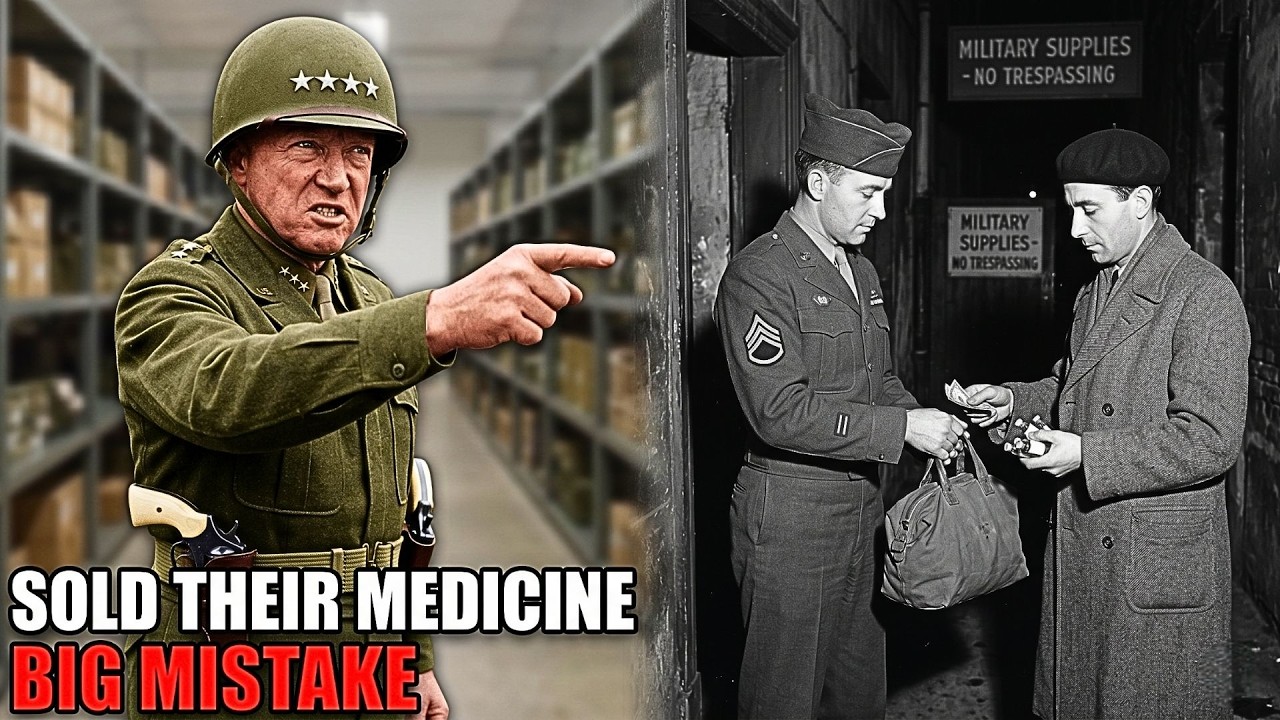
They pulled vials before they were logged and sold them to French black market dealers in nearby towns for cash, while their own soldiers lay in field hospitals asking for something to manage the pain.
The report reached Patton on a Tuesday morning. He read it once. Then he drove to the supply depot himself.
Patton arrived unannounced. There was no advance warning, no staff cars sent ahead, no aide calling to say the general was coming. Just Patton's jeep pulling up to the depot gate.
The sergeant on duty came to attention and started to announce the arrival. Patton was already through the gate.
He walked into the depot without waiting for an escort. He knew where the medical supply section was because he had made it his business to know the layout of every major depot in his sector.
He went straight there and looked at the shelves and the manifest logs hanging on the wall beside the storage racks. He pulled the logs off the hooks himself and compared them against the incoming shipment records that Green's investigation had assembled.
Green had spent two weeks building his case the way a doctor builds a diagnosis, ruling out alternative explanations one by one. Supply confusion was ruled out because the pattern was too consistent and directional. Clerical error was ruled out because the changes were too deliberate.
Someone was skimming, not making mistakes. When military investigators arrived at the French towns with documentation and the right questions, two black market dealers confirmed everything in exchange for consideration.
Three sergeants, hundreds of vials, six weeks, cash. The discrepancies in the depot logs were not subtle once you knew what to look for. Someone had gone back into the logs after the fact and made changes, crossing out numbers and writing in different ones.
They added notations that did not correspond to any actual transaction. It was the work of men covering their tracks without enough skill to do it cleanly.
Patton set the logs down on a crate. He stood there for a moment, very still, looking at the evidence of what had been happening in this depot while his soldiers were lying in pain 60 miles east.
Then he called for the three sergeants. They were brought to him one by one and then stood together in front of him: Sergeants First Class Thomas Briggs, Walter Cobb, and Raymond Haas.
All three had been with the Quartermaster Corps for over a year. All three had access to the medical supply section. All three had signatures on manifests during every shipment that showed discrepancies.
They were not desperate men. They were not starving or acting under duress. They were quartermaster sergeants in a functioning depot receiving regular pay, eating regular meals, and sleeping in relative safety behind the front lines.
They had simply seen an opportunity and taken it week after week until Green's careful records made the pattern impossible to explain away. They stood at attention now and said nothing.
Patton looked at each one of them in turn, taking his time. He asked if they knew how many men were in field hospitals right now without adequate pain management because of what they did. None of them answered.
He told them it was hundreds. Men who came in from combat with wounds that should be manageable. Men lying awake at night because the morphine that should have been there was not, because they took it and sold it.
He paused, letting that settle, then added two words: for cash. He let that sit in the air.
He said he wanted to make sure he understood it correctly. Their fellow soldiers were lying in hospitals in real pain, the kind that comes from shrapnel and burns and broken bones, and they were selling their medicine to French dealers for personal profit.
Still nothing from the three men. Patton told them they would be tried for theft, black market trading, and conduct unbecoming. They would be stripped of their rank, and he would personally ensure every detail of what they did went into their service records.
He dismissed them without waiting for a response. Then he turned to the depot commander, Lieutenant Colonel Frank Aldrich, who had been standing to one side watching with the expression of a man watching something fall on someone else while knowing he might be next.
Patton asked how this had gone on for nearly two months without him knowing. Aldrich began to explain: the volume of supplies moving through the depot, hundreds of different items, thousands of individual transactions every week.
He cited the reliance on experienced NCOs for day-to-day management of specific sections, and the difficulty of auditing every line item when the operational tempo of the campaign demanded all available attention.
Patton waited until Aldrich finished. He said he understood the depot was busy, and that every depot was busy. That was not a defense.
These men were under Aldrich's command. These supplies were his responsibility. They were being stolen for weeks and he did not notice. Aldrich said nothing.
Patton asked what Aldrich was going to do to make sure it never happened again. Aldrich had been thinking about this since the investigation began, preparing for exactly this question.
He laid out his plan clearly and specifically. There would be mandatory dual sign-off on all medical supply transactions, meaning no single person could log a receipt without a second signature witnessing it.
There would be weekly spot audits conducted by officers not assigned to the depot, with no prior notice. And there would be direct reporting lines from the medical units receiving supplies back to the depot, so any shortfall would trigger an immediate inquiry rather than accumulating unnoticed over weeks.
Patton listened to all of it without interrupting. He told Aldrich to implement it today. If he heard of another shortage in any medical unit in his sector that traced back to this depot, he would hold Aldrich personally accountable.
Patton walked out of the depot and got back in his jeep. His aide, who had been waiting outside and had heard most of what happened through the open door, fell in beside the vehicle.
Patton told him to find out exactly how many men in field hospitals were being undertreated for pain because of the shortage. He wanted a specific number on his desk that night, and he wanted to know what emergency resupply required and how fast it could happen.
The aide made notes. Patton also told him to find Captain Green, the doctor who found this, and to find out what he needed to do his job properly. If he was short anything, it was to be fixed.
The aide made more notes. Patton looked at him and said one word: today. The aide understood.
The court-martial proceedings began within the week. The evidence was organized and clear: the logs with their clumsy alterations, the shipment records, and the testimony of the French dealers who had confirmed everything when military investigators arrived with documentation.
The defense made the arguments available to them, citing wartime pressure, record-keeping ambiguity, and the suggestion that discrepancies like this were not unusual and these men had simply been identified when others had not.
The tribunal rejected every argument without extended deliberation. The evidence was specific. The intent was clear. The consequence, hundreds of soldiers in pain who should not have been, was documented.
All three were found guilty and received dishonorable discharges and imprisonment. The sentences were carried out.
The morphine shortage was addressed within days of Patton's visit. Emergency resupply was arranged and prioritized. The field hospitals that had been running short received what they needed.
The doctors could treat their patients properly. The wounded soldiers in those wards got what they had been asking for and not receiving for weeks.
Captain Green received a formal commendation for his investigation. He returned to treating wounded soldiers, which was what he had been trying to do since the shortage first appeared and he could not get a straight answer about why.
Patton made one more decision in the aftermath. He issued a general order to all quartermaster units in the Third Army. It was not long, and it did not need to be.
The order stated that any soldier found diverting medical supplies from military use for personal profit would be prosecuted to the fullest extent of military law. It did not use abstract language.
It described specifically what had happened: morphine intended for wounded soldiers taken from supply shipments and sold for personal gain. It described the consequence for the men who were caught, and the consequence for anyone who did the same thing.
Patton made sure every quartermaster NCO in the Third Army read it. Every depot commander confirmed receipt in writing.
The black market trade in military medical supplies in the Third Army sector dropped sharply in the weeks that followed. It was not because the market disappeared, but because the people who might have participated understood clearly what the cost would be.
The order made it real in a way that abstract prohibitions never could. It used names. It used numbers. It used the specific image of a wounded soldier lying awake in pain because someone had sold his morphine for cash.
That image, over Patton's signature, was worth more than a hundred warnings. Patton never spoke publicly about the incident. It was not the kind of story his headquarters wanted circulating.
The image being projected was of an unstoppable advance, a brilliant commander, and an army grinding through German resistance toward final victory. This was a story about three men who had stolen medicine from wounded soldiers and sold it for cash.
It was ugly. It was necessary to address, but it was not the kind of story that went into press releases or dispatches back home. It went into service records instead, permanent ones, the kind that follow men for the rest of their lives.
Green finished the war and came home to Ohio in late 1945. He built a practice in a small city, the kind of practice where you know your patients by name, delivered babies, managed chronic illnesses, and treated the ordinary complaints of ordinary people.
There were no plaques about France on the walls. No mention of morphine or quartermasters or records kept at a field desk by lantern light. He never talked about the months he spent keeping careful records because morphine was disappearing and he could not accept what the records were telling him.
He went back to work every morning and made sure his patients received what they needed when they needed it. That was what he had been trying to do all along.
The three sergeants served their sentences. They came out of the war with dishonorable discharges and carried that distinction for the rest of their lives.
What they made from selling morphine to French dealers did not survive the court-martial. What it cost them did. Every job application and every question about military service carried the discharge status requiring explanation for the rest of their lives.
The men in the field hospitals got their morphine, all of them. That was the part that mattered. That was the part Green had been working toward since the first requisition came back short.
That was the part Patton had driven to the depot himself to address on a Tuesday morning when he could have sent someone else. Not the arrests, not the court-martial, not the general order distributed to every quartermaster NCO in the Third Army, not the deterrence effect that made the black market in military medical supplies drop sharply in the weeks that followed.
Just the men in the hospitals getting what they needed when they needed it, because that is what the system was supposed to deliver. Everything else was consequence.