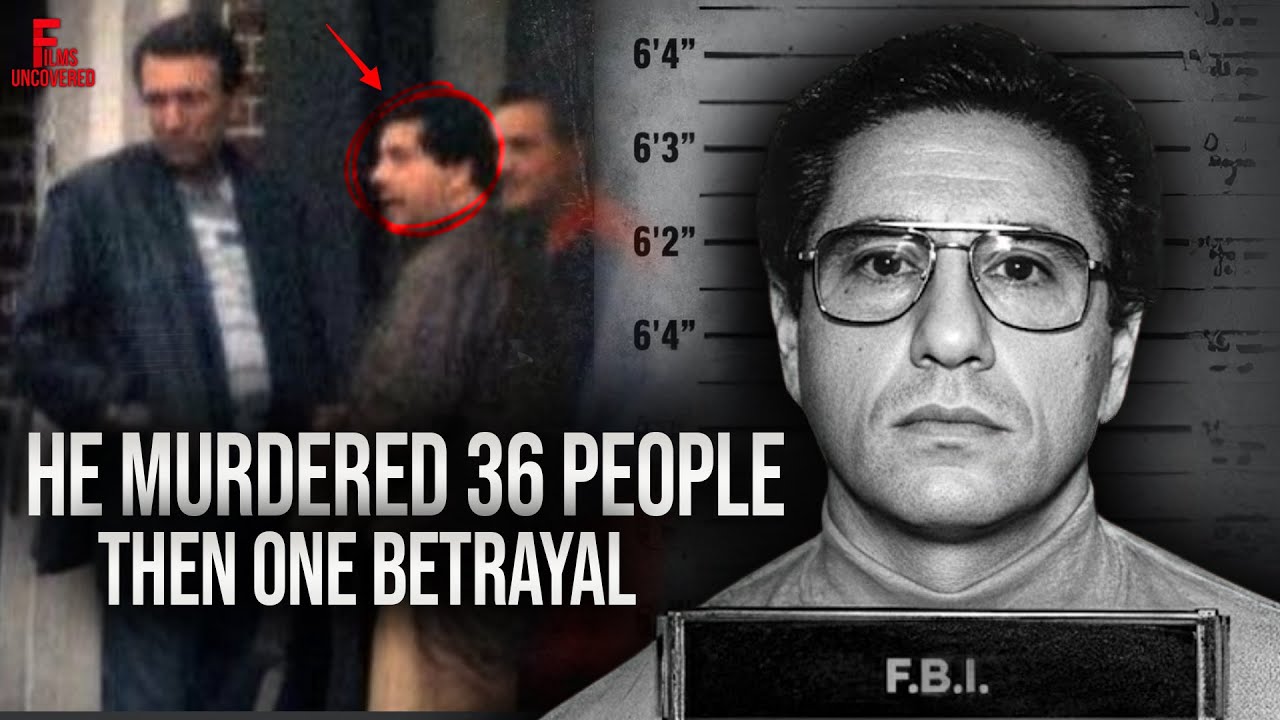
Anthony Salvatore Casso was one of the most feared and violent figures in the history of the American Mafia. A member of the Lucchese crime family from his initiation in 1974 until his arrest in 1993, Casso is believed to have participated in as many as 36 murders, and those are only the ones he confessed to.
Nicknamed Gaspipe by his associates, Casso was described as a man who actively desired to carry out his murderous actions. Other mobsters referred to him simply as a homicidal maniac. After the law finally caught up with him, he became one of the highest-ranking Mafia members ever to become an FBI informant, taking a plea agreement in the hope of reducing his potential sentence.
Anthony Salvatore Casso was born on May 21, 1942, to Michael and Margaret Casso, a family of Italian descent in South Brooklyn, New York City. His grandparents had emigrated from Italy in the 1890s in search of a new life. From the very beginning, his life seemed tied to organized crime: as a baby, Salvatore Callinbrano, a capo in the Genovese crime family who controlled Brooklyn's docks, was assigned as his godfather.
Despite this connection, the record suggests his parents did not want Anthony to enter a life of crime. His father in particular tried to dissuade him while he was still young, but those efforts ultimately failed.
Growing up, Casso was described as a violent individual who showed an interest in guns from an early age. While still in school, he became handy with a pistol, building a makeshift shooting range with friends on a Brooklyn rooftop. By the age of 16, he was able to hit most targets.
After dropping out of school at 16, Casso found work shooting birds of prey for local pigeon keepers and was able to live on his earnings for a while. In the late 1950s, he became affiliated with organized crime on a small scale, perhaps to supplement his income as a gunman.
He became a fully initiated member of the South Brooklyn Boys, a street gang that specialized in drug trafficking and extortion across a broad territory. His first brush with the law came in 1958, when he was arrested following a public street brawl with a rival gang. His father visited him at the police station and reportedly tried to scare him into quitting crime while he was still young, but to no avail.
Casso continued to run with the South Brooklyn Boys until the early 1960s, when his criminal activities caught the eye of Christopher "Christy Tick" Furnari, leader of the 19th Hole Crew, a division of the Lucchese crime family. Throughout the early 1960s, Casso became a keen associate of the family, working primarily in loan sharking, illegal gambling, and drug dealing, with Furnari as his mentor.
Casso's violent nature and affinity for weaponry led him to be used as muscle in many of Furnari's dealings and rackets. There is evidence to suggest that around this time his casual violence turned bloodthirsty. In 1961, he was arrested for a second time as an attempted murder suspect, but the unnamed victim refused to identify him, potentially out of fear, and he was acquitted.
By all accounts, Casso had a way with women, though he was not a particularly pleasant partner. As a young adult, he entered a relationship with Rosemary Botti, whom he met while working with the South Brooklyn Boys. The relationship was serious in its early years, and Botti's parents hoped the two would wed.
The relationship eventually broke down, and in 1968 Casso married Lillian Delnova, another South Brooklyn resident. The couple had two children together. Yet without Delnova's knowledge, Casso was still seeing Botti. Over several decades, he set Botti up with a house in New Jersey and frequently met with her as part of an affair that lasted nearly 30 years.
When Casso's career ended with his arrest, the truth became clear to Delnova, who was understandably furious. The two remained married and she visited him often, but the betrayal hung over her, and she never viewed him the same way again.
Anthony Casso was formally integrated into the Lucchese crime family as a made man in 1974, undertaking the initiation ceremony in Manhattan. He joined the crew of Vincent Furnari, who controlled Manhattan's 116th Street and 14th Avenue in Brooklyn. Over the following year, Casso spent much of his time engaging in the common Mafia rackets of extortion, drug trafficking, and illegal gambling.
His true calling was just around the corner. Mere months after he joined the family formally, Victor Amuso, the future boss and at the time a rising mobster, took notice of Casso's efforts. The two became close friends and entered a partnership spanning several decades, embarking on increasingly violent endeavors. Burglary, assault, murder, and the elimination of police informants were all in a day's work for the duo.
Still working under Furnari's 19th Hole Crew, Casso and Amuso sought out people who could help them in their exploits. Security experts, lockpickers, and master thieves were brought into their newly formed Bypass Gang, a division of Furnari's crew that specialized in burglary. In just a few months, they went from hitting homes and local businesses to jewelry stores and even banks, stealing more than $100 million across the 1970s and 1980s.
Multiple unsolved bank robberies from this period are thought to have been the work of the Bypass Gang, and its remnants are believed to still carry out jobs today. Casso was so prolific and successful that when Furnari was promoted to consigliere of the Lucchese family shortly afterward, he opted to make Casso a capo in his place. Casso respectfully declined and suggested that Amuso should hold the power instead.
Amuso accepted, and Casso worked as his right-hand man in almost all of his dealings. For years the two worked closely together and became extremely wealthy.
In 1985, they were presented with an intriguing offer. Frank DeCicco, a capo in the Gambino crime family, approached Casso asking for help with a coup brewing within their ranks. DeCicco and the infamous John Gotti planned to oust and kill Paul Castellano on the basis that he was too weak to lead the Gambinos. They could not go to the Commission, so they sought support from notoriously skilled members of the other four families to keep things under wraps.
Casso agreed to help but was cautious. This would be a massive violation of the Commission's rules, and they themselves could be killed if they were caught. The assassination of Castellano went ahead, but Casso and Amuso would later turn on Gotti and DeCicco, siding with the bosses of the four families as they sought revenge for Castellano's murder.
Casso and Amuso were themselves tasked with eliminating Gotti and DeCicco, and were surprisingly instructed to use a car bomb, a banned method of killing Mafia members due to the high risk of collateral damage. They set to work and planted a bomb in DeCicco's car in April 1986, on a day when he and Gotti were known to be stopping at a local social club. The bomb detonated as planned when the car started, and DeCicco was killed, but Gotti was nowhere to be seen.
Gotti had evaded the butcher of Brooklyn, but the same cannot be said for many others. The heads of the Mafia's five families were struck by the culmination of the Mafia Commission Trial, a lengthy court case that saw each family's leaders indicted on serious charges of extortion, labor racketeering, and murder. Eight key Mafia leaders were convicted, and most were told they would die in prison, receiving sentences of 100 years.
The Commission had received a massive blow, and to ensure the continuation of the Mafia in New York City, decisions had to be made about who would replace those convicted. Among those imprisoned was Anthony Corallo, then the leader of the Lucchese crime family. Feeling the trial would not go his way, he preemptively transferred power to Casso and Amuso. Once again, Casso recommended Amuso as boss while he took the position of underboss.
After a couple of years acting as consigliere with two of the most ruthless Mafia members at the helm, the Lucchese crime family continued to grow and prosper. At the height of their power, they were estimated to bring in over $100,000 per month from combined racketeering, extortion, and unlicensed video game machine setups, with an additional half a million dollars per year from a large concrete supplier business and a protection racket in New York City's garment district.
They also each took a cut from every crime committed by lower-ranking mobsters across the family. Casso was known for bringing in great wealth through his relationships with Russian mobsters operating in the United States. He was particularly close with Marat Balagula, a Soviet Jewish refugee from Odessa who had set up an extremely successful multi-billion-dollar gasoline bootlegging scam in New York.
Balagula entered an agreement with Casso and Amuso in which he would receive support from Lucchese family members in exchange for a cut of the illegal operation. The two organizations also mutually protected one another and announced their alliance to other gangs in the region, strengthening both groups. At the height of this partnership, the gasoline bootlegging scam became the largest source of income across all five families.
The agreement would culminate in a brutal display of Casso's violent streak. Balagula became involved in a rivalry with fellow Russian immigrant Vladimir Reznikov, who caught wind of Balagula's successful schemes and wanted in. Instead of offering to work with him, Reznikov threatened him, demanding $600,000 and a percentage of all his earnings in exchange for Balagula's life.
Balagula paid up but soon suffered a huge heart attack. He survived, but Reznikov was still demanding money. At that stage, Balagula called upon Casso for support, and Casso was furious that someone would extort his ally in this manner. He planned to put an end to it once and for all and told Balagula to arrange a meeting with Reznikov the following evening, where he would supposedly receive his money.
Reznikov headed to the meeting point but stormed out furious with empty pockets. In the car park outside, Joseph Testa and Anthony Senter, two veteran Lucchese mobsters, were waiting. Reznikov was shot dead, and Balagula's problems with Eastern European gangsters ended that night.

Over the remainder of the 1980s, Anthony Casso became known as quite literally a homicidal maniac, using brute force and meticulous executions to solidify his power. One of his most notable murders came in the form of Gambino crime family associate James Hydell. Hydell was ambushed by Casso himself in 1986, after Casso had become underboss of the Lucchese family.
Hydell had participated in a botched assassination attempt on Casso, who in turn used crooked lawmen to his advantage. Louis Eppolito and Steven Caracappa, corrupt New York police officers, kidnapped Hydell on Casso's behalf and brought him to the underboss. Casso took great pleasure in torturing the young mobster, shooting him several times in non-fatal areas before finally delivering a killing shot.
While that was a vicious act of revenge, other murders carried out by Casso were little more than business. At the turn of the 1990s, Casso was as prolific as ever, tending to target members of the Lucchese family whom he deemed a flight risk, soldiers and associates liable to become FBI informants under pressure.
The first of these victims was Bruno Facciolo, a Lucchese soldier suspected of cooperating with law enforcement. The last thing Casso and Amuso wanted was to end up like their former boss, Anthony Corallo, so they opted to stamp out any potential traitors before they could act. Casso worked with Caracappa and Eppolito once more to lure Facciolo to a Bensonhurst garage, where he was shot and stabbed multiple times. His body was stuffed into the trunk of a car, and a dead canary was placed in his mouth as a warning to other would-be informants.
After Facciolo's death, it became apparent that he was not an informant and had no prior interactions with law enforcement. Facciolo was not the only unnecessary victim of Casso's hasty, murderous tendencies. Casso's corrupt police officers, acting on his orders, also killed a man named Nicholas Guido, believing him to be a mobster accused of turning informant. Guido was in fact a civilian with no ties to the mob, murdered on Christmas Day.
Also falling victim to Casso's brutality were John Morrissey, a construction union leader allied with the Lucchese family who was suspected of working with law enforcement, and Anthony Fava, Casso's personal architect, who had done little more than complain about late payments for his work on Casso's mansion.
Casso would use a newly promoted mobster, Alphonse "Little Al" D'Arco, to carry out much of his dirty work when it came to killing. D'Arco was initially under the impression that he would be working for the Lucchese Construction Panel, a committee that oversaw unions and construction businesses in Brooklyn, but it soon became apparent that this was not the case. Years after cutting ties with the mob, D'Arco came clean about his relationship with Casso and Amuso, who used him in any way they could.
In his own words, D'Arco said: "When a job needed to be done, whenever they needed to do something unpleasant to someone, I was chosen by them." In one notable incident, Amuso and Casso ordered D'Arco to murder the entire Jersey crew, the New Jersey faction of the Lucchese family, after its capo, Anthony Accetturo, refused to increase the family's share of their profits. Accetturo managed to escape and later cut ties with the mob. He has spoken out against Amuso and Casso, claiming they did not uphold traditional Cosa Nostra values. Of Casso, he said all he wanted to do was kill, and get what he could even if he didn't earn it.
By 1991, Casso was in hot water. He had received a tip that he was about to be indicted for his crimes, but summoned D'Arco once more for another big hit. They had marked Peter Chiodo, a Lucchese capo, for death after he pleaded guilty to his Mafia-related crimes without their permission.
D'Arco was tasked with bringing Chiodo down, and was surprised at the identity of his target given Chiodo's otherwise good standing with Casso and Amuso. D'Arco assigned two of his men to ambush Chiodo while he was working on his car at a Staten Island gas station on May 8, 1991. Despite receiving 12 bullet wounds to his limbs and body, Chiodo survived, with doctors remarking that his obesity likely saved his life.
Casso continued to threaten Chiodo after the botched assassination, saying that if he continued to testify against the Lucchese family he would be murdered. When that did not deter Chiodo, Casso threatened to murder his wife instead. To protect his family, Chiodo became a government witness, and an increasingly paranoid Casso turned his attention to D'Arco, cutting ties with him altogether.
On July 29, 1991, Amuso was arrested after an unidentified Lucchese gangster tipped off law enforcement about his whereabouts and wrongdoings. Casso was made de facto boss in his absence. Some even suspect that Casso may have been the leak, though he reportedly had no desire to lead the family and attempted to arrange an escape for Amuso. For this reason, many believe he did not leak information about Amuso to the feds. Amuso, on the other hand, refused to leave prison, believing his life would be at risk if he did.
Casso was reluctantly placed in charge of the entire family, where his fragmented domain would be racked by suspicions about those formerly close to him. At the forefront were D'Arco and Chiodo. Upon hearing that Casso had been placed in charge, D'Arco followed in Chiodo's footsteps and defected, which brought a series of murder indictments on Casso's doorstep from across his criminal career. Casso had arranged a series of unsuccessful hits on Chiodo's family, and D'Arco believed he would be the butcher of Brooklyn's next victim any day.
FBI agents were soon hot on the trail of Casso's mobile phone calls, which were traced using informants and tapped phones. He was arrested while showering at Rosemary Botti's home in Mount Olive, New Jersey. In January 1993, the FBI searched the property and found $340,000 in cash, a rifle that linked Casso to his murders, and paperwork detailing the structure and plans of the Lucchese crime family.

While awaiting trial, Casso was imprisoned at New York's Metropolitan Correctional Center, facing enough murder charges to ensure he would spend the rest of his life behind bars. He continued to administer the Lucchese family's movements from prison but knew that given his impending fate, an escape attempt might be his best bet. He began organizing a series of escape plans, and one nearly worked after he bribed a security guard at the jail's entrance. At the last minute, another guard stopped him, and he was thrown back in.
He subsequently planned to assassinate his judge, Eugene Nickerson, and started tasking Lucchese gangsters with ambushing prison buses. None of these plans came to fruition, however, as Amuso stripped Casso of his underboss title as a result of his recent failures, formally recognizing him as the man who had betrayed him and using him as a scapegoat.
Casso was getting desperate. Facing life in prison, with multiple gangsters lined up to testify against him and following multiple failed escape attempts, he saw his only option as becoming the very thing he had tried to stamp out throughout his career: an informant.
Casso's decision to side with the law led him to agent Richard Rudolph. He met regularly with Rudolph and at first found it difficult to recount just how many criminals and groups of criminals he had been involved with. He reportedly told him around this time: "Every time I stepped out of the house, I committed a crime. You expect me to remember all of them?"
Casso's first act as an informant was to tell Rudolph about his relationship with corrupt NYPD officers Caracappa and Eppolito. They had committed an estimated eight murders by his command and had also provided the Mafia with the names of many informants, which in turn caused a host of other murders.
Casso began to reel off a long list of his co-conspirators throughout his Mafia career and admitted to several murders he had planned but did not go ahead with. Of the murders he carried out himself, he initially confessed to 12 but indicated he was complicit in another 24, bringing the total to a possible 36. There is every chance that many details were left out, and the actual count could be much higher.
Casso's meetings with Rudolph continued until the beginning of 1994, and the FBI found it difficult to accept his role as an informant given his brutal history. Federal prosecutor Gregory O'Connell, who spent a lot of time with Casso discussing his crimes, is known to have said that it gets to a point where somebody is just too evil to put on the stand, believing that many of his most violent actions would not look good in front of a jury or the public.
Despite his cooperation, Casso's credibility as a witness was constantly in question. He was caught lying on multiple occasions, exaggerating his role in certain crimes and even fabricating stories to make himself appear more valuable to prosecutors. In 1998, after years of cooperation, the government withdrew from its agreement with Casso, citing his pattern of lying and manipulation. Any hopes he had of a reduced sentence evaporated. Instead, he was sentenced to life imprisonment plus 455 years.
Casso spent his remaining years at ADX Florence Supermax Prison in Colorado, one of the most secure facilities in the United States. He was isolated from other inmates, spending 23 hours a day in his cell. Even from behind bars, Casso remained bitter and defiant. He wrote letters claiming he was innocent of many charges, blamed others for his downfall, and showed little remorse for his actions. He never fully acknowledged the devastation he caused to countless families and communities.
Anthony Casso died on December 15, 2020, at the age of 78, from complications related to COVID-19 and various health issues. His death marked the end of one of the most violent chapters in modern organized crime history.
As Anthony Accetturo said, all he wanted to do was kill. That statement captures the essence of Anthony Casso's criminal career. Unlike other mobsters who saw violence as a necessary tool of the trade, Casso seemed to relish it, seeking out opportunities to inflict harm.
His partnership with corrupt law enforcement officials was particularly disturbing. By turning police officers into his personal hit squad, Casso corrupted the very institutions meant to protect society. The Eppolito and Caracappa case remains one of the most shocking examples of police corruption in New York history.
Casso's willingness to kill innocent people like Nicholas Guido, murdered simply because he shared a name with a suspected informant, demonstrates the recklessness of his violence. He showed no regard for collateral damage and no concern for basic human decency. His betrayal of his closest associates, including D'Arco and Chiodo, revealed a man driven purely by self-preservation. Even his partnership with Victor Amuso, which had lasted decades, dissolved into mutual suspicion and recrimination.
When Casso became an informant, he did so not out of any moral awakening but out of desperation. He continued to lie and manipulate even in his cooperation, ultimately sabotaging his own plea deal through his inability to tell the truth. The butcher of Brooklyn left behind a trail of bodies, broken families, and shattered lives. His 36 admitted murders represent only a fraction of the damage he inflicted on society. Each victim had families, friends, and futures that were stolen by Casso's brutality.