For 11 years, Hollywood cameras captured every moment of Rusty Hamer’s childhood. For the rest of his life, the industry only reached out for brief flashes of nostalgia. That silence ended in 1990 with a single self-inflicted gunshot, killing the exhausted 42-year-old laborer who had once been one of television’s biggest child stars. The man the entertainment industry erased was Rusty Hamer, the child powerhouse who helped carry the 1950s sitcom “Make Room for Daddy” to massive ratings.
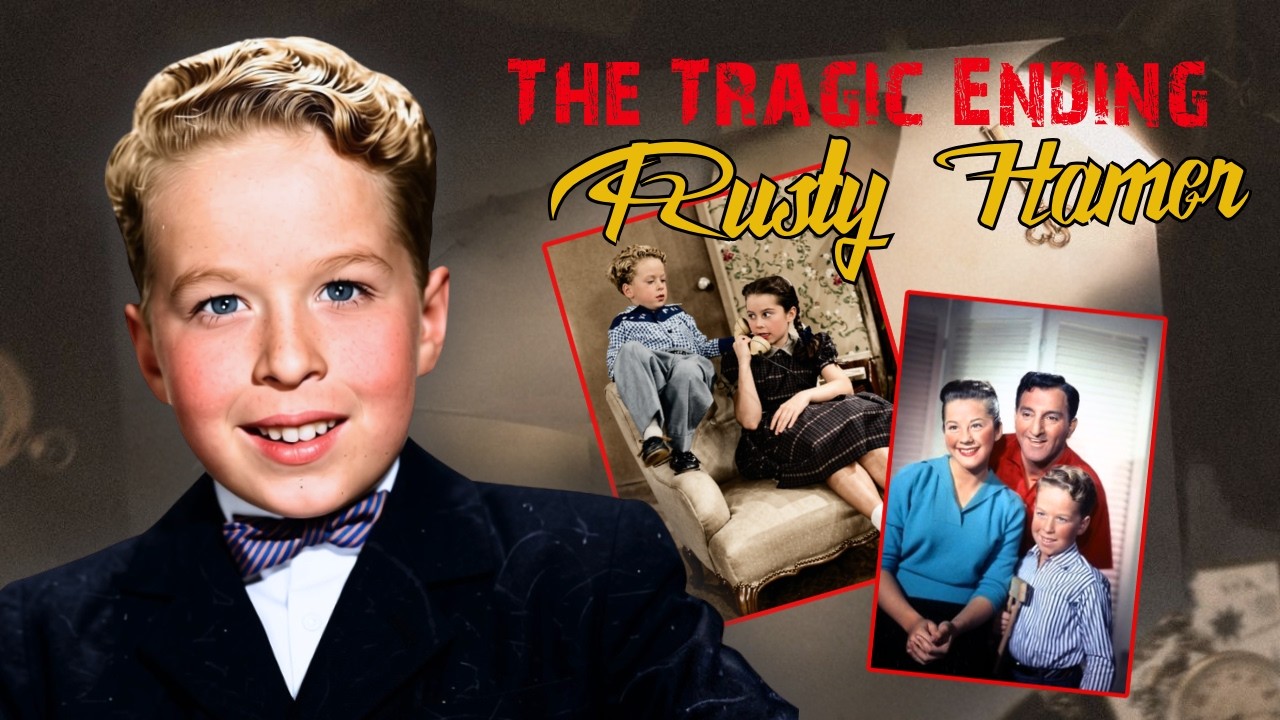
Audiences loved his character so deeply that they refused to accept the actor behind him had the right to grow up. Russell Craig Hamer was born on February 15, 1947, in Tenafly, New Jersey. He was the youngest of three boys born to Arthur and Dorothy Hamer, a working-class family with no connections to the entertainment world. Arthur worked as a traveling salesman of men’s sport shirts, while Dorothy managed the household.
Both parents shared a passion for community theater, spending evenings and weekends performing in local amateur productions across New Jersey. It was a casual hobby, not a career ambition. But that hobby would quietly shape the path their youngest son would eventually take. In 1951, the family moved across the country to Los Angeles, California, seeking better economic prospects and a warmer climate.
The decision placed them in the shadow of the entertainment industry’s fastest-growing power center. Two years later, Arthur Hamer suffered a fatal heart attack, plunging the family into financial crisis. In 1950s America, the sudden death of the father was a catastrophic economic event. Dorothy was left a single mother with three boys, no income, no advanced skills, and rapidly depleting savings.
Facing the mathematical certainty of poverty, she made a cold, pragmatic decision: she began taking her sons to open casting calls for child extras. Her decision was not driven by vicarious ambition or a hunger for fame. It was a matter of survival. Rusty was sent to the studios because his family needed him to work.
At age six, Rusty was thrown into the industrialized grind of commercial film sets. He performed uncredited extra work in the 1953 Western “Fort Ti” and in Abbott and Costello comedy features. He learned to follow barked directions immediately, to sit in silence for hours while technicians adjusted equipment, and to suppress any childish behavior that could cost the family its day rate. He was stripped of a normal childhood and integrated into an adult workforce that treated him as moving set dressing.
The lesson he absorbed was brutal: his value to the adult world rested entirely on his ability to perform on command. At the same time, American television was exploding. The three major networks were locked in a fierce battle for audiences, and the family sitcom emerged as the most lucrative production formula. Producers needed child actors who were physically appealing, capable of memorizing weekly scripts, and able to deliver punchlines with expert comic timing.
In 1953, comedian Danny Thomas was developing a new sitcom based loosely on his own life. The show, “Make Room for Daddy,” centered on a nightclub entertainer trying to reconnect with his family. The script demanded a young son capable of sparring verbally with Thomas’ overpowering persona. Hundreds of boys auditioned.
Most defaulted to timid, polite behavior under the pressure. Rusty Hamer walked in and shifted the dynamic instantly. He had curly red hair and a freckled face, but more importantly, he had a loud, clear, slightly defiant voice. He had already survived the dehumanizing world of extra work, and he was not intimidated by the room.
He responded to Thomas’ push with equal comedic force. The casting search ended immediately. Rusty was cast as Rusty Williams. The show debuted in 1953 and became an immediate critical and commercial triumph.
Unlike other family sitcoms of the era, the writers placed Rusty directly at the center of the narrative conflict, building entire episodes around his character. The veteran crew on the Desilu lot spoke with genuine astonishment at his professionalism. While other six-year-olds were learning to read, Rusty operated on the soundstage with the precision of a seasoned stage actor. He instinctively understood camera placement, hit his marks without breaking character, and mastered the difficult technique of holding for laughs in front of a live studio audience.
Adult actors spend years perfecting that skill. Rusty executed it flawlessly at age seven. The scale of his fame was enormous. In the pre-cable, pre-streaming era, three networks dominated American broadcasting.
When a hit show aired, tens of millions of viewers watched the same broadcast simultaneously. Rusty was beamed directly into American living rooms every week, and viewers developed a profound sense of ownership over him. Before his tenth birthday, he was the universal symbol of the ideal American son. What made his case unique was the duration of his contract.
“The Danny Thomas Show” ran for 11 consecutive seasons, from 1953 to 1964, producing over 300 episodes. For more than a decade, Rusty was locked into a relentless schedule of script readings, rehearsals, and live tapings. His entire biological development, from a six-year-old missing his baby teeth to a 17-year-old navigating puberty, was broadcast in inescapable detail to a national audience. The studio viewed his natural maturation as a logistical liability.
Writers were forced to keep recalibrating the stories to justify his aging presence, shifting from innocent childhood mischief to teenage milestones like driver’s licenses and first dates. Rusty had to reinvent his acting style while retaining the core recognizable essence of the character. It was an impossible psychological tightrope. The erosion of the boundary between the real person and the fictional asset was made worse by a creative decision made at the show’s inception.
The producers named the character Rusty Williams, using the child’s actual real-life nickname. There was no protective barrier between the actor and the performance. Directors called him Rusty. His mother called him Rusty.
Millions of strangers called him Rusty. Viewers wrote letters to him about his fictional schoolwork. Adults stopped him on the street, ruffled his hair, and expected him to fire back with a scripted, sassy punchline. He was not permitted to have a private mood or a sovereign emotional state.
He was a permanent interactive exhibit of American television. His world was compressed within the insulated walls of a Hollywood soundstage. His daily interactions were almost exclusively with stressed adult professionals. His education was delivered by a studio-appointed teacher in a small trailer on the production lot, often in 15-minute intervals squeezed between camera takes.
He was deprived of the standard socialization process that prepares a human being for adulthood. Danny Thomas functioned as a surrogate father figure and artistic mentor. Their on-screen chemistry was rooted in genuine affection. But the relationship was fundamentally tied to a lucrative commercial contract.
Thomas was the star, the creator, and the executive producer. He had total control over the creative direction and the shooting schedule. Rusty, despite his massive fame, was child labor with zero structural power on the set. His entire identity was programmed around being Rusty Williams.
When the machine shut down, it would leave a catastrophic void in his psychological foundation. In 1964, Danny Thomas made the unilateral decision to end production. The show was still generating solid ratings, but Thomas wanted to pursue other ventures, including producing “The Dick Van Dyke Show” and “The Andy Griffith Show. ”
Rusty had no leverage.
He was not a producer and held no ownership stake. One day he reported to the soundstage with the routine that had defined his life since age six. The next day the sets were struck, the contract was nullified, and he was unemployed at exactly 17 years old. He had bypassed the standard developmental path of a working actor.
He had never taken acting classes, never auditioned, never faced rejection, and never tested his skills in other environments. His repertoire was perfectly calibrated for one specific task: executing a multi-camera sitcom format. At 17, he had lost the soft, endearing traits of childhood but lacked the rugged maturity for adult leading roles. He was no longer competing against children, but against thousands of classically trained actors in their twenties with unknown faces and no baggage.
His childhood fame became a concrete wall blocking his adult future. Casting directors in the late 1960s recognized his talent but were terrified of the cognitive dissonance. If they placed America’s favorite wholesome sitcom son into a gritty crime drama, the audience would only wonder why Danny Thomas’s son was holding a gun. He was professionally penalized simply for growing older.
Rusty did not immediately quit the industry. He secured sporadic minor guest appearances, including a brief supporting role on “Green Acres” in 1966. But these were favors called in, not career-building moves. The resistance from network casting departments remained insurmountable.
The most telling event came in 1970. ABC launched a sequel series titled “Make Room for Granddaddy,” centered on Danny Williams as a grandfather. Producers contacted the now 23-year-old Hamer and invited him back to reprise his role as a married medical student. He accepted, desperately needing the income and hoping to reignite his career.
The project proved two harsh facts. First, the network valued the intellectual property of his past, not the potential of his future. They were only willing to pay him if he regressed into the same familiar box built for him in 1953. Second, the industry is merciless when nostalgia fails to generate revenue.
The cultural landscape of 1970 America had moved far beyond the sanitized domestic comedy of the 1950s. The sequel suffered terrible ratings and was canceled after just one season, 1970 to 1971. The failure definitively closed the door on Rusty Hamer’s mainstream acting career. By the early 1970s, with all viable acting opportunities exhausted, remaining in Los Angeles became both financially untenable and psychologically damaging.
Hamer packed his belongings and fled California, relocating to Deridder, a small town in southwestern Louisiana. He was seeking anonymity. But in Louisiana, he faced the brutal reality of adult survival. He had no university degree, no corporate skills, and no technical training outside the logistics of a soundstage.
He secured employment with Exxon, working as a laborer on offshore oil rigs in the Gulf of Mexico. It was notoriously dangerous, physically punishing work. He endured long shifts, heavy machinery, and hostile maritime weather. It was a staggering drop in status and comfort for a man who had spent his childhood in air-conditioned studios.
He eventually left the rigs in the early 1980s and took odd jobs as a freelance mechanic. Eventually, he settled into working as a short-order cook at a small diner operated by his brother, John Hamer, just outside Deridder. The pressing question is how the co-star of a top-rated national show for 11 seasons ended up destitute. The answer lies not in personal financial mismanagement, but in the predatory economic structure of mid-century television contracts.
The modern system of residual payments and syndication royalties did not exist for him. Today, the core cast of a hit sitcom can earn tens of millions annually from rebroadcasts. In the 1950s and 1960s, actors were paid a fixed salary for the initial filming and a minimal fee for one or two reruns. After that, the network or production company sold syndication rights and kept the profits.
Child actors like Rusty saw absolutely nothing from those infinite rebroadcasts. His image was generating massive revenue for network executives every single day while he was working on an oil rig. California’s Coogan Law, enacted in 1939, mandated that 15% of a child actor’s gross earnings be placed in a blocked trust account. But the remaining 85% was legally accessible to his guardians.
That money was depleted by taxes, agent commissions, management fees, and the daily living expenses of the entire Hamer family. Following his father’s death, Rusty’s acting income became the family’s primary financial engine in the expensive Los Angeles market. His childhood labor paid the mortgage and bought the groceries. By the time his career ended, there was no accumulated fortune waiting for him.
The money had been spent to survive. As Hamer labored in obscurity, “The Danny Thomas Show” remained in heavy daily syndication. Every afternoon, the character of Rusty Williams lived on. On those broadcast tapes, biological time was suspended forever.
Rusty Williams never aged, never suffered, and never stayed in trouble for longer than 25 minutes. The real Rusty Hamer was being systematically broken down by time and manual labor. He was trapped in a trailer, watching his glowing fictionalized youth on a continuous loop while his actual physical life disintegrated in poverty. Years of industrial labor extracted a severe biological toll.
Hamer developed chronic back pain, his joints degraded, and the physical agility that had once defined his comedy was erased. For a manual laborer, physical health is the only viable asset. As his body failed, his earning potential collapsed. Working publicly as a diner cook created a new layer of agony.
When locals or travelers recognized him, they approached with joyful memories of the television boy, projecting the image of a wealthy, carefree star onto a hardened, exhausted middle-aged man. He could not shed his recognizable face to live anonymously. He could not leverage his fame to secure a better life. He became an alienated spectator to his own existence, forced to serve customers who only saw the ghost of a 1950s sitcom star.
By the late 1980s, Hamer lived a quiet, reclusive life in a small trailer, close to his brother. The lifelong friction between his early success and his current destitution deepened into clinical depression. According to his brother’s later accounts, Rusty grew increasingly withdrawn, isolated, and bitter. Psychiatric professionals noted that his anger was not a delusion.
It was a rational response to systemic exploitation. He had been put to work at age six, before he had the legal or cognitive capacity to consent. When his biological demographic value expired, he was discarded with no transition mechanisms. There were no therapists to help him separate his identity from his character.
No career counselors to enter the civilian workforce. No financial advisers to manage what little remained. He was simply pushed out of the studio gates. On January 18, 1990, the cumulative weight of chronic physical pain, absolute poverty, and profound psychological isolation reached its limit.
Inside his cramped Deridder trailer, 42-year-old Rusty Hamer ended his own life with a single gunshot wound to the head from a . 357 Magnum revolver. His body was discovered by his brother John. There was no Hollywood glamour, no sensationalized scandal.
Just a quiet, desperate act in a small southern town far from the soundstages where his life had been defined. Danny Thomas issued a public statement expressing shock and grief, praising Hamer’s comedic talent. The stark contrast between Thomas’s sustained wealth and Hamer’s destitution served as a catalyst for change. Angered by his peer’s death and recognizing it as the direct result of a predatory labor system, fellow former child actor Paul Peterson founded the nonprofit organization A Minor Consideration in 1991.
The foundation was established to provide legal advocacy, financial guidance, and psychological intervention for young actors, ensuring the systemic abandonment experienced by Rusty Hamer would not be repeated.