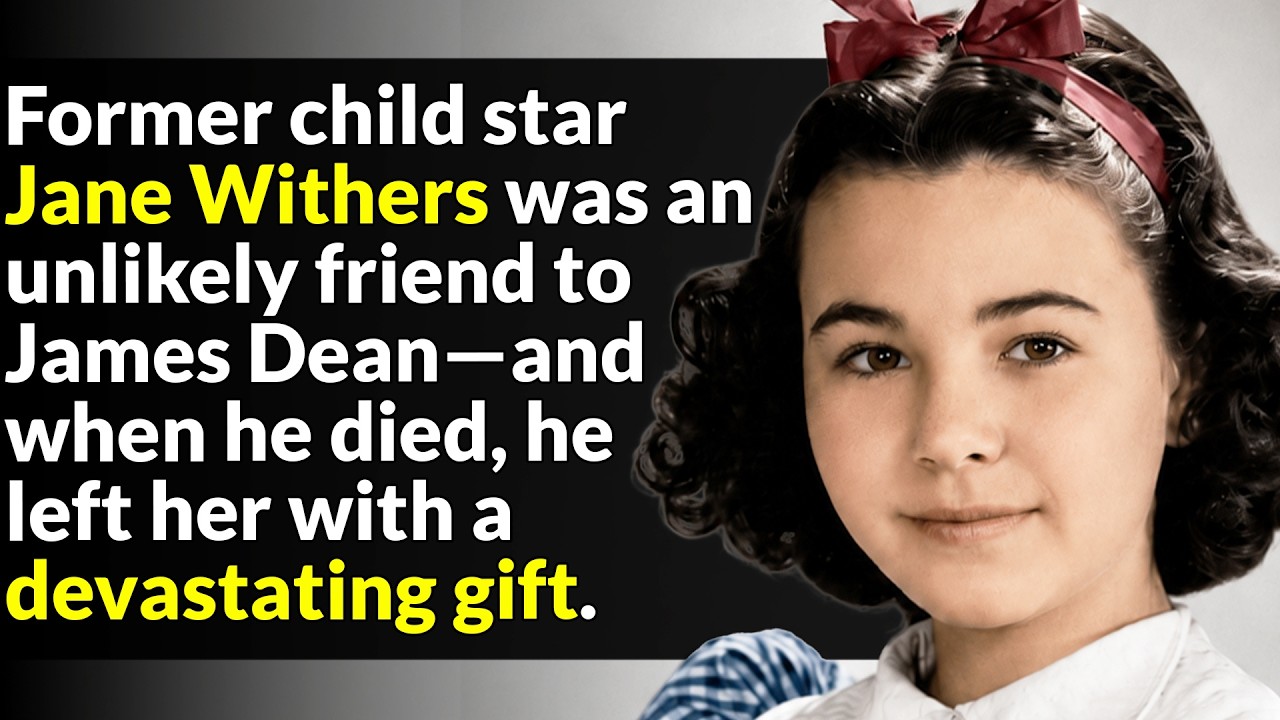
Former child star Jane Withers became an unlikely friend to James Dean near the end of his life. When he died, he left her a deeply personal memento that she kept for decades. Withers was one of the most successful child actors of Hollywood’s Golden Age, and remarkably, she avoided the troubled fate that befell so many of her peers. That wasn’t because her life was easy.
She faced her own share of drama and tragedy. Born in 1925, Withers was pushed into show business by her mother, Ruth, who had dreamed of becoming an actress but was forbidden by her own parents. Ruth’s backup plan was to marry the right man, “have a daughter and make her a star. ” She even chose the name Jane because she thought it would look good on movie marquees.
Withers trained in every performance skill from an early age. In her hometown of Atlanta, she was a radio star interviewing celebrities at just three years old. Ruth couldn’t resist the pull of Hollywood, so mother and daughter headed west to chase their dreams while Walter, Jane’s father, stayed home and sent them $100 a month. In Hollywood, Withers was just one of countless girls trying to make it.
She landed only minor roles, and if she was lucky, a few lines of dialogue. Ruth, a devout Christian, reassured her daughter that God would take care of them. At age eight, Withers got her breakthrough part in “Bright Eyes,” though not the lead. That honor went to Shirley Temple, already a beloved child star.
The two girls had much in common, including pushy stage mothers, yet they never spoke during filming. Temple’s mother, a failed ballerina living through her daughter’s success, didn’t even allow the girls to say hello to one another. Withers described her character, Joyce, as the meanest, most horrible little girl imaginable, and she was sure audiences would hate her. Instead, Joyce became the character audiences loved to hate.
Some critics insisted Withers stole the spotlight from Shirley Temple herself. Fox Studios signed Withers to a seven-year contract, but Temple already had a deal with the same studio, making Withers the clear underdog in that informal competition. Throughout the 1930s, she made several films a year and outperformed her budget. In 1936 and 1937, theater owners ranked her among the most profitable movie stars.
Instead of resting after securing her contract, Withers kept working on skills like ice skating, voice training, horseback riding, foreign languages, and swimming. She and Ruth treated acting as an art, not just a job. The training cost thousands, but it paid off. Withers became the family breadwinner, earning a fortune from her studio salary, endorsements, personal appearances, and licensing deals.
Her name appeared on dresses, bags, books, dolls, and jewelry. Fame had its darker side. At just ten years old, Withers received anonymous letters threatening to kidnap her and kill her mother unless a $50,000 ransom was paid. She had round-the-clock bodyguards following her everywhere.
While her most famous characters were sassy, Withers was known off-screen as one of the kindest, best-behaved child stars. That was part of her parents’ plan. They knew Hollywood could ruin even the sweetest girls and refused to let that happen under their watch. They made her perform at orphanages and hospitals, and she bought extra dolls for her collection just to donate them.
Even as a teenager, Withers struggled with being typecast. Fox kept her in comedic and family roles, so much so that people couldn’t imagine her in more mature dramatic parts. She played the lead in “Small Town Deb” in 1941, a story about a teenage girl whose mother blocks her ambitions. The screenplay was written by Jerry Walters, who was actually Jane Withers herself, using a pseudonym at age 16.
Withers signed with Republic Pictures at 16, but the child-star film genre was already declining. She knew her career had an expiration date and had made peace with it. She never had a normal childhood, but she always dreamed of a normal ending. At 19, she met Bill Moss, a 25-year-old wealthy film producer and businessman.
She retired, lived on a farm, and had three children. Unlike many child stars, Withers’ earnings didn’t evaporate. Her parents had been strict about saving her profits, and when she turned 21, they handed her several million dollars. A year later, her father died.
The dream man turned out to be the wrong man. After six unhappy years of marriage, Withers and Moss divorced. He turned out to be an alcoholic and gambler. The stress of the divorce caused her to collapse emotionally and physically in 1953.
At 27, she developed severe rheumatoid arthritis and complete paralysis and ended up in the hospital for five months. She recovered without long-term damage. In the divorce settlement, Withers got full custody of the children, child support, trust funds, a $1 million property settlement, monthly alimony, and even a share of Moss’s oil fields. In 1955, she began studying film at the University of Southern California, hoping to move into directing.
She was surprised when director George Stevens asked her to play a supporting role in his 1956 film “Giant. ” That role put her directly in the path of tragedy. Living in Texas during the shoot, Withers hosted parties almost every night. The cast included legends like Elizabeth Taylor, Rock Hudson, and James Dean.
During filming, Dean confronted her with a question: “You don’t like me, do you? ” She did like him, but she thought he needed to adjust his behavior. An odd, close friendship developed between them. One night, as one of her parties was winding down, Withers entered her room to find James Dean there.
When she asked why he didn’t come through the front door, he said he didn’t want to see anyone but her. She grabbed her toolbox and nailed the window shut in front of him, telling him to use the front door next time. He did. During one visit, she noticed he always wore the same shirt in the Texas heat.
She offered to wash it, starting a tradition where Dean would drop off his dirty clothes and pick them up the next day. The studio had banned him from car racing during the production of “Giant. ” When filming wrapped, Dean gave Withers his favorite pink shirt and hurried off to a race. On the way there, he died in a car accident.
Hollywood lost a legend, and Withers lost a friend. She kept the pink shirt for the rest of her life. “Giant” revived her career. Word spread that Jane Withers was back, and she received dozens of offers for television and theater work.
Unlike many whose fame faded, she turned almost everything down. Thanks to her childhood stardom and divorce settlement, she didn’t need the money and could pick her roles. Withers found love again with Kenneth Errair, a singer with The Four Freshmen. They married in 1955 and had two children.
From 1963 to 1974, she played “Josephine the Plumber” in a series of Comet cleanser commercials. It was one of the few roles she accepted because it allowed her to stay home. In 1968, her husband Kenneth was killed in a plane crash. Withers was devastated but comforted herself with the belief that it was God’s will.
In 1983, her mother Ruth died. When an interviewer asked the 48-year-old Withers why she, as one of the few child stars who turned out well-adjusted, credited her parents, she credited God instead. “I have always taken my troubles to the Lord, and I have never failed to get an answer,” she revealed. While many former child stars felt exploited or resentful over lost childhoods, Withers insisted she was truly blessed and had no regrets.
In her 80s, she still loved meeting fans and reading their letters. She held no grudge against Shirley Temple either, despite spending much of her career in her shadow. She described Temple as a dear friend and called her every year on her birthday. Withers had one of the largest doll collections in the world and thousands of pieces of Hollywood memorabilia.
In her later years, she donated them to museums. In 2004, she sold hundreds of her dolls at public auction. Her Shirley Temple doll sold for $3,100, but a Jane Withers doll sold for $5,600. In 1990, she was diagnosed with lupus, suffering for over a decade before entering remission.
In 2007, she began experiencing dizziness. At 85, she admitted she was falling frequently and ending up in the hospital. In August 2021, Jane Withers died surrounded by her family at age 95. In an industry where child stars still face exploitation and breakdowns, her story stands out as exceptional.
She may not have been the greatest star of her generation, but she was something rarer: she was kind and she was grateful.