AVERA, Italy — The man who ordered the cold-blooded execution of fifteen unarmed American commandos was strapped to a wooden post in a muddy courtyard at dawn on December 1, 1945, and shot dead by a twelve-man firing squad, becoming the first German general executed for war crimes after a plea for mercy that reached the desk of Supreme Allied Commander Dwight D. Eisenhower — and was rejected without hesitation.
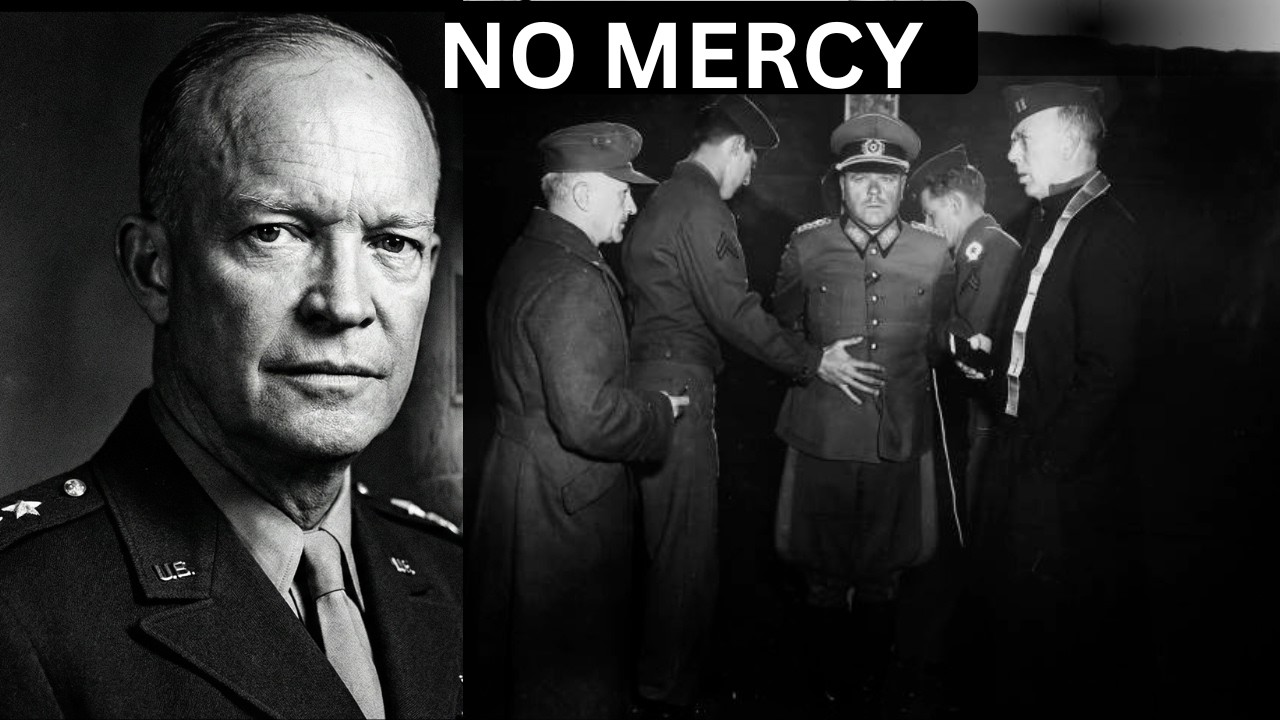
General Anton Dostler, commander of the German 75th Army Corps in Italy, died at 8:11 a. m. local time, his gray uniform stripped of insignia, his hands bound behind his back, a black hood pulled over his head in the final seconds before twelve American rifles cracked through the frigid winter air.
The execution marked the end of a case that military historians now regard as one of the most consequential legal decisions of the postwar era — a moment when the United States drew a line that no rank, no uniform, and no claim of obedience to orders could cross.
Dostler’s crime dated back to March 1944, when fifteen American soldiers — regular Army commandos, not spies, wearing standard uniforms — were captured behind German lines during a failed sabotage mission known as Operation Ginny II. Their objective had been to destroy a railway tunnel vital to German supply routes. When the mission collapsed, they were seized by Italian Fascist forces and handed over to Dostler’s corps.
Under the Geneva Convention, the fifteen men were prisoners of war. They had surrendered. They wore military uniforms.
They were entitled to food, shelter, and protection until the end of hostilities. Dostler ignored every one of those protections.
A wireless message from his superiors cited Hitler’s secret “Commando Order,” which demanded the immediate slaughter of any Allied commando captured behind German lines — even those in uniform. Dostler’s own subordinates balked. One officer reportedly telephoned him directly and warned: “General, these are American soldiers.
Killing them is a war crime.”
Dostler did not waver. He slammed his fist on the desk and ordered the executions carried out at once. The fifteen Americans were lined up on a rocky cliff near the sea.
They were given no trial. They were forbidden from writing final letters to their families. They were shot in cold blood, their bodies dumped into a shallow grave and concealed in the hope the world would never learn what had happened.
Dostler returned to his dinner. He believed the matter was closed. He believed he would never answer for those fifteen lives.
He was wrong. History has its own way of hunting men like Anton Dostler.
By 1945, the war had transformed — and so had Eisenhower. In the early years of the conflict, the Supreme Allied Commander had viewed German generals as chess opponents, moving armies across maps with strategic detachment. But in the spring of 1945, as Allied forces pushed deep into Germany, they began liberating the concentration camps: Ohrdruf, Buchenwald, Dachau.
 When Eisenhower visited Ohrdruf, he walked among huts piled with starved corpses. He saw the gas chambers. He saw the ashes of thousands of innocents.
Witnesses said his face went pale, his jaw clenched tight, and he could not speak for a long time. Before that moment, he had been fighting to defeat an enemy army. After it, he understood he was fighting absolute evil.
The excuse “I was only following orders” no longer meant anything to him. Eisenhower understood that the entire Nazi system was built on men like Anton Dostler — men who shut off their consciences, who killed defenseless prisoners and innocent civilians, then shrugged and said the Führer had commanded it.
Eisenhower made a vow to himself and to the world. “We are told that the American soldier does not know what he is fighting for,” he said. “Now, at least, he will know what he is fighting against.”
The heart of the Supreme Commander had hardened. The era of chivalrous war was over. The time for justice — harsh, strict justice — had arrived.
When the war in Europe ended in May 1945, Dostler was captured by the U. S. Army.
At first, he was comfortable. He was held in a clean cell. He ate American rations.
Like many other German generals, he expected to be interrogated for information and eventually released. He had no idea that American investigators had already found the mass grave of the fifteen American commandos in Italy.
When investigators entered his cell and accused him of war crimes, Dostler was stunned. He was offended. “I am a general,” he protested.
“I hold the rank of infantry general. I cannot be tried as a common criminal.”
During his trial in Rome, Dostler sat with his arms crossed, radiating arrogance. His defense rested entirely on a moral void. His lawyer argued: “General Dostler had no choice.
Had he disobeyed Hitler’s order to shoot the commandos, he would have been arrested. He was a soldier obeying his commander. A man cannot be executed merely for obedience.”
It was a dangerous argument. Had the Americans accepted it, no German officer could ever have been punished. They could all have blamed Hitler.
But the American court was not persuaded.
The judges looked at Dostler and delivered their ruling: “A soldier is only required to obey lawful orders. The order to 𝓀𝒾𝓁𝓁 unarmed prisoners of war is unlawful. It is a crime against humanity.
You had a choice, and you chose murder.”
The verdict came swiftly: guilty. The sentence: death by firing squad.

His arrogance finally collapsed. When Dostler heard the word “death,” his face went pale. He realized the grim reality of his situation.
He was not going to a retirement home. He was going to his grave.
His legal team rushed to file frantic appeals. They sent telegrams to the highest levels of Allied command, arguing that executing a German general would set a dangerous precedent. They begged for clemency.
They pleaded for life imprisonment instead of death.
The appeal reached the desk of General Dwight D. Eisenhower. It was a moment of truth.
Victorious generals typically show mercy to defeated commanders to help rebuild relations. It would have been easy for Eisenhower to commute the sentence to twenty years in prison. That would have been the diplomatic move.
But Eisenhower was not thinking about diplomacy.
He was thinking about those fifteen American boys lined up on a cliff in Italy. He was thinking about their mothers receiving telegrams. He was thinking about the piles of corpses he had seen at Ohrdruf.
He understood that if he pardoned Dostler, he would send a message that following orders was an acceptable excuse for murder. He would be insulting every soldier who died fighting the Nazis.
Eisenhower picked up his pen. He did not call a meeting. He did not agonize over the decision.
He wrote a single devastating sentence confirming the execution. Allowing a general to escape the death penalty after ordering the shooting of prisoners would be a mockery of justice.
Eisenhower denied the appeal. The execution was carried out.
December 1, 1945. Avera, Italy. The morning air was bitterly cold.
A thick fog covered the courtyard. At 8:00 a. m.
, General Anton Dostler was led from his cell. He still wore his distinctive gray military uniform, stripped of its insignia. His hands were bound behind his back.
He walked past a row of American military police. He looked tired and defeated. The arrogance of the master race had evaporated.
Now he was just a frightened old man about to die.
 He was led to a wooden stake driven into the muddy ground. Twelve American soldiers stood in a line twenty paces away. They carried M1 Garand rifles.
They were the executioners. A chaplain murmured a short prayer. Dostler mumbled a response.
An American officer wearing a black hood approached him. Dostler flinched as the darkness descended over his head.
For a moment, a dead silence fell over the courtyard. Only the sound of the wind and the distant breathing of witnesses could be heard. In those final seconds beneath the hood, one wonders whether General Dostler thought about the fifteen Americans he had ordered shot.
Did he remember their faces? Or was he still convincing himself that he was innocent?
The officer in charge raised his hand. Ready. The twelve rifles fired.
Aim. Twelve muzzles focused on the white target pinned over Dostler’s heart. Fire.
A loud volley echoed through the air. General Dostler’s body jerked violently against the ropes. He fell forward.
It was over in an instant.
The first German general executed for war crimes was dead.
The execution of Anton Dostler sent shockwaves through the German military hierarchy. Until that moment, many of them believed they would escape punishment. They thought the Americans were soft.
They thought they could hide behind their ranks and their orders. Eisenhower proved them wrong.
By refusing to pardon Dostler, Eisenhower sent a message that echoes through history to this day. A military uniform does not give you the right to be a killer. Rank does not protect you from justice.
When you cross the boundaries of humanity, when you slaughter the defenseless, no excuse can save you.
Eisenhower was a man of peace, but he understood that true peace requires justice — and sometimes justice requires a firing squad.
The case remains a landmark in international military law, cited in subsequent war crimes tribunals including Nuremberg, where the principle was firmly established that “following orders” is not a defense for crimes against humanity. Legal scholars note that Dostler’s execution established the precedent that military commanders bear personal criminal responsibility for orders they issue, regardless of their source.
Historians have observed that the Dostler case represented a turning point in how the Allied powers approached the prosecution of German officers. In the months that followed, dozens of similar cases moved through military tribunals across Europe, each one reinforcing the same principle: the uniform is not a shield, and the chain of command is not an alibi.
What do you think of Eisenhower’s decision? Should he have shown mercy to the German general, or was the death penalty the only correct choice? Share your thoughts in the comments below.
If you believe in the importance of remembering the harsh facts of history, don’t forget to like and subscribe.