Newly resurfaced testimony from one of Easy Company’s most decorated officers has cast a stark and unflattering light on Captain Lewis Nixon, the celebrated intelligence officer of the 506th Parachute Infantry Regiment, revealing a bitter personal animosity that has long been hidden beneath the polished portrayal of the HBO miniseries Band of Brothers.
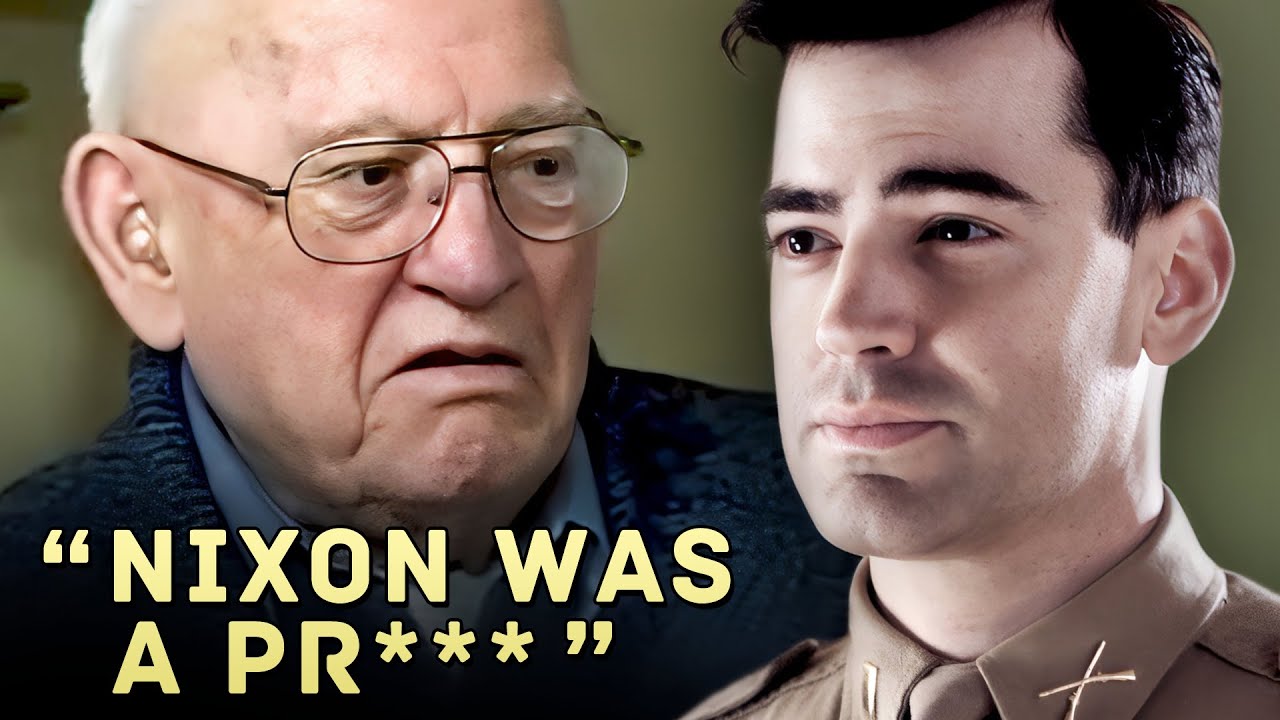
In a recorded interview conducted on May 2, 2007, Lieutenant Lynn “Buck” Compton, a Silver Star recipient and former platoon leader in Easy Company, described Nixon in blunt and unforgiving terms, calling him “just a prick” and recounting a wartime confrontation in which Nixon singled him out for humiliation because of his athletic background.
The remarks, preserved in video testimony and circulated anew among veterans’ communities and military history audiences, contradict the affable, wisecracking image of Nixon popularized by actor Ron Livingston in the acclaimed 2001 miniseries, which was based on historian Stephen Ambrose’s bestselling book.
Compton, who died in 2012, was an All-American catcher at UCLA who played alongside Jackie Robinson and a two-way guard on the Bruins football team that appeared in the 1943 Rose Bowl. He volunteered for the paratroopers and joined Easy Company as a replacement second lieutenant in December 1943 while the unit was stationed in Aldbourne, England.
According to Compton, Nixon, then the battalion intelligence officer known as S2, took an immediate and unexplained dislike to him. The resentment, Compton said, stemmed from Nixon’s contempt for athletes and his privileged upbringing as the heir to a New Jersey chemical fortune.
“He said, ‘I’ve got no damn use for you jocks,'” Compton recalled in the interview. “He said, ‘You’re a bunch of jerks. When I was in college I had girlfriends and we used to party a lot, and you’re out sweating and practicing.'”
Compton said he responded mildly, telling Nixon that everyone pursues his own path. But the exchange did not end there. Nixon, who had no direct command authority over Compton, vowed to use his staff position to make the young lieutenant’s life difficult.
“He said, ‘I’m going to make you the battalion physical fitness officer,'” Compton recounted. “He said, ‘Every morning I want you to have this whole battalion out on the road. I want an hour’s run.'”
 The order soon arrived over the battalion commander’s signature, appointing Compton to lead physical training for the entire unit. A petty detail buried in the directive made the assignment deliberately miserable: enlisted men were to wear T-shirts, jump pants and boots, while officers were required to wear a wool shirt and necktie.
“So I’m out there with a wool shirt and a necktie on, sweating, with these guys in T-shirts,” Compton said. “Now that’s Nixon. It’s just chicken stuff like that.
That’s why I say I just never liked the guy.”
The animosity appears to have been mutual and enduring. According to Easy Company veteran Don Malarkey, Nixon badmouthed Compton at a postwar reunion in Dallas, calling him a coward for having been pulled off the line at Bastogne during the brutal winter fighting of December 1944.
Compton was officially evacuated for a severe case of trench foot, a debilitating condition caused by prolonged exposure to cold and moisture that afflicted thousands of American soldiers during the Battle of the Bulge. Ambrose’s book suggests Compton had been unnerved after witnessing close friends Bill Guarnere and Joe Toye lose their legs to German artillery outside Foy, Belgium.
Compton rejected that characterization in his own autobiography, writing that while he was deeply affected by the horrors of Bastogne, “I do not believe I was clinically shell shocked as the series portrays me.”
Malarkey, who died in 2017, reportedly confronted Nixon at the reunion after the coward remark, asking him how many Silver Stars he had earned. The question silenced Nixon, according to Malarkey’s account. Compton was awarded the Purple Heart, the Silver Star and the Bronze Star for his wartime service.
The friction between the two men reflected a deeper cultural divide within the officer corps of the 101st Airborne. Nixon was a Yale-educated engineer’s son who had traveled Europe before the war, drank heavily and cultivated an air of detached sophistication. Compton was a working-class athlete from Los Angeles who had earned his standing through physical prowess and combat leadership.
Ambrose wrote that the flamboyant Nixon resented jocks, describing him as a wealthy, well-educated, alcohol-addicted party boy who did not understand the need to prove oneself through sports. In Nixon’s world, the historian noted, status and intelligence mattered more than physical ability.

That resentment, according to Ambrose, may have inadvertently shaped Compton into one of the most beloved officers in Easy Company. Because Nixon assigned him to lead daily battalion runs, Compton spent hours alongside enlisted men, forging bonds that other officers never developed.
Edward “Babe” Heffron later said Compton was not only one of the nicest and most humble men he had ever known, but also the officer closest to the enlisted ranks. Compton grew especially close to Toye and Guarnere, gambling and joking with the men in a manner that alarmed Richard Winters and other senior officers.
Winters, Nixon’s closest friend and the central figure of Band of Brothers, argued that such familiarity could undermine an officer’s authority and leave him reluctant to order a friend on a dangerous mission. He and Compton clashed heatedly over the issue, a dispute that Compton believed reached Nixon’s ears and deepened the intelligence officer’s disdain for him.
Malarkey described Nixon in his memoirs as the resident lush at battalion headquarters and said nobody could figure out why he and the abstinent Winters were such close friends. The two had met at Officer Candidate School at Fort Benning, Georgia, in the spring of 1942 and remained lifelong companions.
Winters repeatedly defended Nixon, once persuading Colonel Robert Sink to spare him from removal from the 506th after the commander had grown weary of his drinking and demoted him. In his memoir, Winters acknowledged that despite their opposite lifestyles, he and Nixon looked at life in similar ways.
Nixon’s wartime record was nonetheless distinguished. He made three combat jumps, into Normandy, Holland and Germany, earning three combat jump stars on his jump wings. He received the Bronze Star for carrying a map of German artillery positions three miles to Utah Beach so it could be forwarded up the chain of command.
He never fired a shot in combat, a fact that has fueled criticism from veterans who questioned his preference for staff assignments. Compton himself suggested that Nixon remained in headquarters roles because “you didn’t need a leading man in war.”
Winters, however, regarded Nixon as the finest combat officer he ever served with under fire. “He never showed fear, and during the toughest times he could always think clearly and quickly,” Winters wrote. Whether Nixon’s composure reflected courage or the numbing effects of alcohol remains a matter of debate among historians.

Private David Kenyon Webster described Nixon as a blasé young man who slouched, never raised his voice and made a point of being a Yale man. The nickname Blackbeard, earned for his refusal to shave, became a small emblem of his disregard for military convention.
What has emerged from the veterans’ recollections is a portrait far more complicated than the charming rogue of television. Apart from Winters’ favorable memoir, Nixon is barely mentioned in the published accounts of his Easy Company comrades, and when he does appear, the references are often unflattering.
Historians note that had Winters not been Ambrose’s primary source for the book, Nixon might scarcely have figured in the narrative at all, let alone become one of its most prominent characters. His friendship with Winters, and Winters’ willingness to vouch for him, secured his place in the story.
The 2007 Compton interview adds a raw, personal dimension to that history. It captures a decorated officer, decades removed from the war, still bristling at a humiliation engineered by a staff officer he considered a bully and a drunk.
Compton’s words also underscore a broader truth about the men of Easy Company: they were not the saints of popular memory, nor the villains of revisionist critique, but ordinary Americans thrown into extraordinary circumstances, carrying grudges, rivalries and resentments alongside their courage.
Nixon died in 1995 at the age of 77. Compton died in 2012 at 90. Both men are buried with the honors due to soldiers who jumped into occupied Europe and fought through some of the bloodiest campaigns of the Second World War.
Their personal conflict, preserved in interviews and memoirs, serves as a reminder that heroism and human frailty often occupy the same foxhole. Whatever Nixon’s failings, he served his country in its hour of greatest peril, and whatever Compton’s grievances, he earned the admiration of the men who fought beside him.
The veterans’ testimony continues to draw attention as new generations discover Band of Brothers and seek the truth behind its dramatized characters. For historians, the lesson is clear: the men who won the war were not characters in a screenplay, but flawed and complicated human beings whose stories deserve to be told in full.