In August 1715, Louis XIV of France endured a death that stripped away every illusion of divine power. For 22 days, the Sun King remained conscious while gangrene consumed his legs, turning flesh black, liquefying tissue, and eventually reaching the bone. He could smell his own rot. Surgeons later reported that he stayed lucid until very near the end.
This was not a battlefield casualty or a plague victim. It was the monarch who had ruled for 72 years, built Versailles, and commanded armies that reshaped Europe. He believed he ruled by God's will. Then a black spot appeared on his leg after a hunting trip, and none of that mattered.
His surgeons knew the danger and the only chance: immediate amputation. Instead, they argued for two weeks about gout and sciatica while their patient rotted from the feet up. By the time they faced the truth, the corruption had spread through the leg and into the bone. One finally told him, "Sire, we can remove your legs, but we cannot save your life."
What followed in his bedchamber at Versailles between August 10 and September 1, 1715, was so grotesque that even the embalmers balked. His coffin would later be displayed in the Mercury room. The Sun King did not simply die. He remained conscious as necrosis advanced day after day.
On the morning of August 10, 1715, Louis XIV was still the Sun King in all his glory. The 76-year-old king maintained the same rigid routine he had followed for decades. He rose at 8:30 sharp for the Grand Lever, the theatrical ceremony where chosen nobles watched him dress, each button and buckle a sacred ritual. Then came chapel, meetings with ministers, and dinner eaten in public view.
That morning, Louis had been hunting at Marly, his favorite escape from the suffocating etiquette of Versailles. He had ridden for hours through the same forests where he had hunted since he was a boy. At 76, he could still spend six hours in the saddle without complaint. The courtiers who rode with him remembered nothing unusual. The king seemed in good spirits, even jovial.
It was on the ride back that he felt it: a sharp, stabbing pain in his left leg just above the knee. Nothing dramatic, just enough to make him shift in his saddle. By the time his carriage rolled through the gates of Versailles that evening, he was limping.
His chief physician, Guy-Crescent Fagon, took one look and declared it sciatica. A bit of rest, some poultices, and His Majesty would be dancing again within the week. Except Louis XIV did not rest. He could not, or rather, he would not. The Sun King had an image to maintain.
For 72 years, he had been the fixed point around which all of France and all of Europe revolved. To show weakness was unthinkable. So the next morning, August 11, he got up for the lever as usual. He stood through mass despite the pain shooting through his leg. He presided over the Council of State, his face a marble mask hiding his agony.
But those closest to him noticed things. The way he gripped the arm of his chair until his knuckles went white. The beads of sweat on his forehead during dinner, even though the August evening was cool. Madame de Maintenon, his secret wife, saw how he barely touched his food. This from a man who usually devoured twelve courses without blinking.
By August 13, the pain had become a burning sensation, as if someone was holding a torch to his flesh from the inside. Fagon prescribed laudanum, basically opium mixed with wine, but it barely took the edge off. The king's valet noticed something else that morning: a small black spot on his leg about the size of a coin. When they pointed it out to Fagon, he waved them away. Just bruising from the pressure, he said. Apply more poultices.
What Fagon did not know, or chose to ignore, was that the black spot was necrosis. Tissue death. The beginning of senile gangrene, where the blood supply to the extremities fails and the flesh literally starts to die while you are still using it. It is more common in elderly diabetics. And Louis, after a lifetime of consuming massive quantities of meat and sweets at his legendary banquets, almost certainly had diabetes. But eighteenth-century medicine did not know what diabetes was. They did not understand circulation. They thought the body was governed by four humors that needed to be balanced.
By August 15, the Feast of the Assumption, Louis XIV gave his last public performance. He had to be practically carried to the chapel, but once there, he stood through the entire mass. Witnesses described his face as gray, his lips blue-tinged. The smell had already started. That sweet, cloying stench of rotting flesh that anyone who has worked in a hospital knows. It clung to his clothes and filled the chapel. Some courtiers discreetly held perfumed handkerchiefs to their noses.
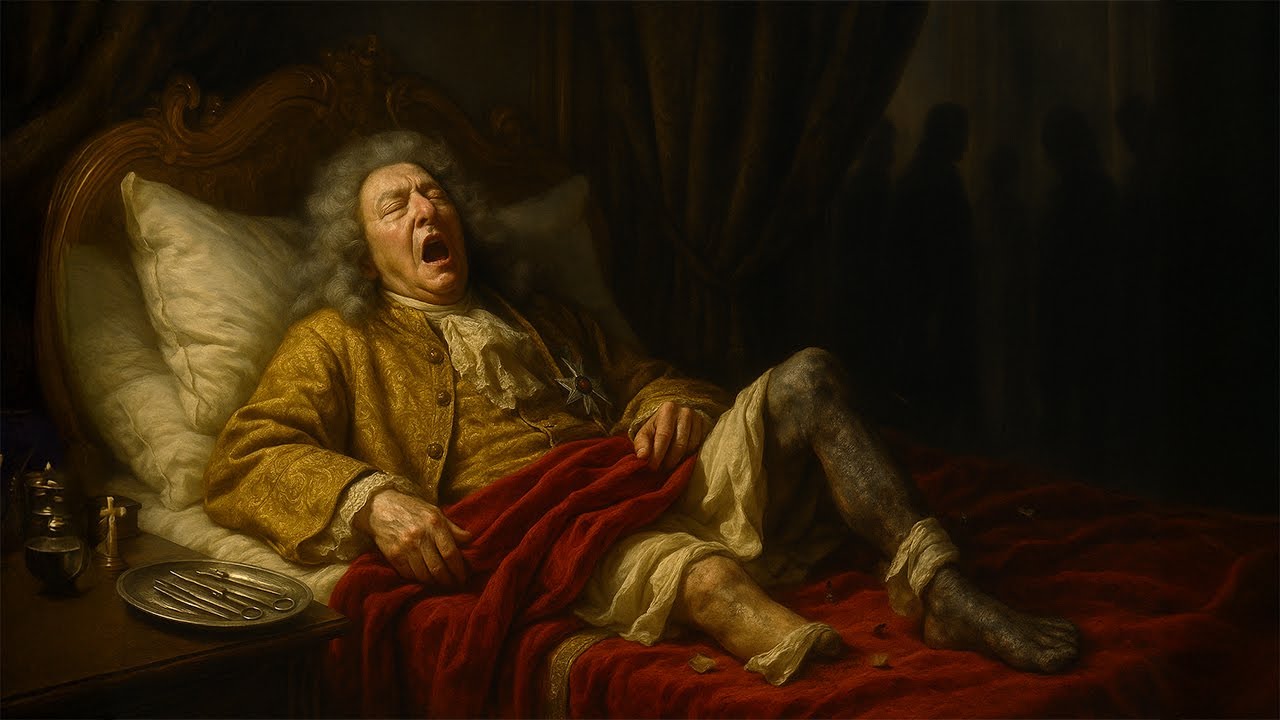
That night, Louis XIV's leg swelled to twice its normal size. The black spot had spread, creating what looked like an ink stain creeping up from his foot toward his knee. The skin was tight, shiny, starting to crack and weep foul-smelling fluid.
Fagon finally called in other physicians, not because he admitted he was wrong, but to spread the blame for what was clearly becoming a disaster. They arrived on August 17: four of the most celebrated doctors in France. They examined the leg, now mottled purple and black, swollen like a grotesque sausage. They conferred in hushed Latin, throwing around terms like mortification and putrefaction. Then they prescribed their remedy: donkey milk baths and camphorated spirit dressings. They also decided to bleed him, because clearly a 76-year-old man whose leg was rotting needed less blood, not more. Louis, weakened from pain and lack of food, fainted three times during the procedure.
When he came to, he asked them plainly, "Am I dying?" They lied to his face. "Your Majesty's constitution is remarkably strong," they said. "With rest and treatment, recovery is assured."
Meanwhile, in the corridors of Versailles, the death watch had begun. Not the noble vigil you might imagine, but something far uglier. Philippe d'Orléans, the king's nephew, had already sent riders to Paris to alert his supporters. The Duke of Maine, Louis's illegitimate son whom he had legitimized and named in his will, was gathering his own faction. They were like vultures circling a dying animal. Except the animal was still conscious, still giving orders, still trying to rule France from his bed of agony.
August 25 was the day Louis XIV finally broke. It was St. Louis's Day, the feast day of his ancestor and namesake, Louis IX, the crusader king who had been canonized as a saint. Louis had always marked this day with special ceremony. He was determined to at least show himself to the court, to prove he was still alive, still king.
His valet tried to dress him, but when they attempted to pull stockings over his legs, he screamed. Actually screamed, for the first time in his life in public. The silk stocking came away bloody, with pieces of blackened skin stuck to it. The smell that filled the room was indescribable. One courtier later wrote that it was as if all the graves of Saint-Denis had been opened at once.
They carried him to his bedchamber, and Louis XIV never stood again.
What happened over the next seven days defies belief. The gangrene had now consumed his entire left leg from foot to thigh. The flesh was black, green in places, literally liquefying. Surgeons who examined him reported that you could push your finger through his leg like it was soft cheese. The smell was so overwhelming that servants had to burn perfume constantly, creating a bizarre mixture of incense and decay that made people wretch.
Yet Louis's mind remained clear. Horrifyingly, agonizingly clear. He conducted state business from his bed, signing documents with a shaking hand.
On August 26, he summoned his five-year-old great-grandson, little Louis, Duke of Anjou, the future Louis XV. Picture this: a dying king, his leg rotting off his body, the room thick with the stench of death, and in walks this tiny boy in his silk court dress, probably terrified out of his mind. Louis XIV pulled the child close, close enough that the boy must have been overwhelmed by the smell, and spoke words that would echo through history.
"My child, you are about to become a great king. Do not imitate me in my love of warfare. Try to relieve your people's burdens, which I have failed to do. I have loved war too much. Do not imitate me in that, nor in my excessive spending."
This farewell advice is attested in court memoirs. Think about that for a moment. The Sun King, who had waged war for 54 of his 72 years of rule, who had built Versailles at a cost that would be billions in today's money, who had styled himself as a god-king, was confessing his failures to a five-year-old. He knew what he had done to France. He knew the treasury was empty, the people exhausted, the nation bled dry by his ambitions. And he was begging a child not to repeat his mistakes. The boy was led away in tears. He would never see his great-grandfather again.
On August 27, the surgeons made a horrifying discovery. They judged that the gangrene had reached the bone. Louis looked at it and said, with that dark humor that emerges in the face of death, "Gentlemen, I appear to be falling apart ahead of schedule."

One surgeon, a man named Maréchal, finally had the courage to tell the truth. He took the king's hand and said, "Sire, we could amputate the leg, but it would only buy you days, perhaps hours. The corruption has spread too far. Your Majesty should make preparations."
Louis refused amputation. "If I must die anyway, I prefer to keep all my limbs." He nodded. He had known, of course. How could he not? He could see his own leg rotting away. He could smell his own decay. But hearing it confirmed seemed to bring him a strange peace. He turned to his confessor and said, "I have lived as a king. At least let me die as a Christian."
August 28 and 29 were days of farewell. Louis called in his courtiers in small groups, thanking them for their service, asking their forgiveness for any wrongs. Many wept openly, not just for the dying king, but for the end of an era. These people had known no other monarch. Some of them had been born at Versailles, lived their entire lives in Louis's shadow. What would happen when the sun finally set?
To his illegitimate children, he gave his blessing and wept, knowing that his brother and nephew would strip them of their rank the moment he died. To Madame de Maintenon, his secret wife, he said, "I thought dying would be harder." She held his hand as the fever consumed him, as his body temperature spiked so high that his physicians could not understand how he was still conscious.
The political vultures, meanwhile, were getting bolder. Philippe d'Orléans was already acting as if he were regent, giving orders to ministers, promising positions to supporters. The Duke of Maine was frantically trying to secure military backing. Letters flew between Versailles and Paris, Versailles and Madrid, Versailles and Rome. Everyone wanted to know how much longer.
On August 30, something bizarre happened. A man named Brun, who claimed to be a healer from Marseille, talked his way into the royal bedchamber. He said he had an elixir that could cure gangrene. The regular physicians protested, but Louis, perhaps desperate for any hope, or maybe just curious, allowed it. Brun gave him several drops of a red liquid.
Within an hour, Louis felt better. The fever dropped. He asked for food, the first time in days. The courtiers in the antechamber began to celebrate. A miracle. The king would live. Plans for the succession were hastily shelved. Philippe d'Orléans allegedly went pale when he heard the news.
But it was a false dawn. By that evening, the fever had returned worse than ever. The pain in his leg, which had been numbed by the advancing necrosis, came roaring back as if his nerves were on fire. Louis spent the night of August 30 to 31 in absolute agony, crying out despite himself, begging God to take him.
His last coherent day was August 31. He confessed to his Jesuit confessor, Père Le Tellier. The last rites were administered by Cardinal de Rohan. Then he did something extraordinary. He ordered his courtiers to open the curtains of his bed fully so everyone could see him. See what the Sun King had become. This rotting, dying thing that had once been the most powerful man in Europe.
"Look well," he said. "This is what becomes of the glory of kings."
As midnight approached on August 31, Louis began to drift. His breathing became shallow, rattling. He muttered prayers in Latin, fragments of Psalms he had learned as a child. At one point, he clearly said, "I thought dying would be harder than I thought. Now I know it is."
September 1, 1715, 8:15 in the morning. The dawn light was just beginning to filter through the tall windows of the royal bedchamber. Madame de Maintenon held his hand. His confessor whispered prayers. The physicians stood uselessly by, their remedies exhausted, their patient beyond all help.
Louis XIV's breathing slowed. Stopped. Started again. Stopped. A courtier approached the bed and held a mirror to the king's lips. No breath fogged the glass. He turned to the crowd of nobles pressed into the room and spoke the words that would end an epic life. "The king is dead. Long live the king."

The silence lasted perhaps three seconds. Then chaos. Philippe d'Orléans immediately left the room to secure his regency. The Duke of Maine tried to follow but found his path blocked by Orléans's guards. The coup was already in motion. Courtiers scattered like roaches when a light comes on. Some raced to align themselves with the new regime. Others fled to their estates to wait and see which way the wind would blow.
And Louis XIV's body lay abandoned in the Mercury room, attended only by servants and the physicians who had failed him. The smell was so overwhelming that they had to evacuate the room within an hour. When the embalmers arrived, they nearly refused the job. The king's legs had putrefied so completely that they fell apart when moved. They had to essentially pour what remained of Louis XIV into his coffin.
His coffin was displayed there from September 2 to 10. Transport to Saint-Denis occurred on September 9. Royal tradition demanded that the king's body be divided into three parts. The corpse would go to Saint-Denis, the heart to the Jesuits' Church of Saint-Louis, today St. Paul-Saint-Louis, and the entrails to Notre-Dame.
The funeral procession, when it finally happened on September 9, was a shadow of what it should have been. Yes, there were torches and prayers and all the pomp, but contemporary summaries note that some along the route jeered. After 72 years, France was sick of the Sun King.
The most telling moment came during the funeral oration. Bishop Massillon stood before the assembled nobility in Saint-Denis, looked at Louis XIV's coffin, and began his sermon with these words: "God alone is great." Not "Louis the Great is dead." Not "We mourn the Sun King." Just "God alone is great."
It was a repudiation of everything Louis XIV had stood for. All his glory, all his power, all his pretensions to divinity, reduced to a rotting corpse that fell apart so badly they could barely get it into the ground.
On September 2, Philippe d'Orléans had the king's will annulled by the Parlement de Paris and made himself sole regent. Within a week, the court left Versailles for Paris. The regent governed from Paris. It was as if the Sun King had never existed. The great palace Louis had built as a monument to his glory stood empty, a 700-room tomb for a dead dream.
The physicians who had attended Louis, especially Fagon, who had misdiagnosed the gangrene until it was far too late, fled court in disgrace. Fagon died in 1718. In his final delirium, witnesses said he kept crying out, "The black spot? I should have seen the black spot."
But perhaps the most poignant aftermath came from little Louis XV, that five-year-old boy who had inherited an empty treasury and an exhausted nation. Years later, as an adult, he would tell people about his last meeting with his great-grandfather, how the smell had made him sick, how the rotting king had pulled him close and whispered about not repeating his mistakes.
He did not listen. Louis XV would rule for 59 years and leave France even more bankrupt, even more broken. The Bourbon monarchy would limp on for two more generations before the French Revolution finally put it out of its misery.
In 1793, when the revolutionaries broke into the royal tombs at Saint-Denis, they found Louis XIV's lead coffin. The lead was melted down for bullets. The remains were thrown into common pits and covered with quicklime. The Sun King, who had long been apocryphally credited with proclaiming "L'état, c'est moi," I am the state, ended up as a few handfuls of bone fragments dissolved in lime.
The man who thought he was a god died rotting from the feet up, conscious and in agony until almost the very end, abandoned by his courtiers before his body was even cold. In those last days of August 1715, as gangrene ate through his body, Louis XIV experienced something that all his power, all his wealth, all his glory could not prevent: the basic, brutal biology of death.
No amount of gold could stop the bacteria multiplying in his flesh. No divine right could halt the necrosis creeping up his legs. No army could fight the infection destroying him from within. His surgeon Maréchal left us one final chilling observation in his notes: "His Majesty died as any peasant might die of the same affliction. Slowly, painfully, and with full knowledge of what was happening to his body."
In death, the king discovered he was merely a man. The horror of Louis XIV's death was not just the physical agony, though that was terrible enough. It was the complete destruction of an illusion that had held France in thrall for seven decades. The Sun King could not die like ordinary men. Except he did, and worse than most. He died over 22 days of increasing putrefaction, each day stripping away another layer of the mystique that had made him seem immortal.
Today, when you visit Versailles, they show you the grandeur, the Hall of Mirrors, the vast gardens, the gold and marble and crystal. They do not show you the Mercury room where his coffin lay in state. They do not tell you about the servants who had to burn pounds of incense to cover the smell of royal decomposition. They do not mention that the Sun King's last words were not some profound statement about glory or France, but a simple, exhausted, "Now I know it is."
Because that is the truth about absolute power, about men who think they are gods. In the end, they discover what Louis XIV discovered in those horrible August days of 1715: flesh rots the same whether it is wrapped in silk or sackcloth. Death does not care about your divine right. And when the gangrene comes, whether it is in your leg or in your kingdom, all the glory in the world cannot stop the rot.