Jacqueline Kennedy Onassis presented herself to the world as a woman shaped by European refinement. Her dark hair, her quiet composure, and her fluent French made people see Paris, old money, and centuries of aristocratic polish.
But that image was a painting, and most Americans never saw the painter behind it. Jackie was not the daughter of counts and dukes. She was the descendant of a cabinet maker who fled a revolution and the granddaughter of Irish immigrants who survived a famine.
Her family did not simply lie about its past. The truth it hid was, in many ways, more impressive than the fairy tale it invented.
To understand Jackie, one has to begin with the man who gave her the famous Bouvier name. Her grandfather, John Vernou Bouvier Jr., known as the Major, was obsessed with image.
In New York City, money was common, but lineage was power. So the Major set out to fix his family tree.
He wrote a book about the Bouviers. He claimed they descended from the ancient house of Fontaine near Grenoble. He invented coats of arms and spoke of illustrious families and noble bloodlines.
His story made the Bouviers look like French royalty who merely happened to be in America. It was a beautiful lie, and it served as social armor. It told the world the Bouviers belonged at the top because they had started at the top.
The records tell a different story about the man who actually began the American line. His name was Michel Bouvier, and he was not a nobleman. He was a survivor.
Michel was born in France in 1792 and grew up in the chaos of the Napoleonic Wars. He was a foot soldier. When Napoleon fell in 1815, France became a dangerous place for men who had served him.
Royalists hunted down the old guard during the White Terror. Michel faced a life-or-death choice. If he stayed, he risked prison or execution. So he fled, crossing the Atlantic and arriving in Philadelphia around 1817.
He did not land with a fortune. He landed with a skill. Michel was a cabinet maker, and he knew how to work with wood. In a new country, that was his only currency.
He opened a small shop on 9th Street. He had no coat of arms, but he had hands that could make beautiful things. He built furniture for the wealthy.
He became so skilled that he gained a client named Joseph Bonaparte, Napoleon's own brother, who was also an exile. He even crafted desks that ended up in the White House. Long before Jackie redecorated the White House, her great-great-grandfather's work was already sitting in it.
Michel did not stop at furniture. He saw that the city needed fuel and started selling firewood. That simple trade led him to the land. He bought 800,000 acres of forest in Pennsylvania.
Then came luck, or perhaps just smart judgment. The land sat on top of anthracite coal. By 1840, his coal royalties were paying him $50,000 a year, roughly $1.4 million in today's money, every single year.
Michel Bouvier did not need a fake title. He built a real empire. He moved from a shop to a mansion on Broad Street. By the time he died, he was worth millions. He took a family that was running for its life and planted it firmly in the American elite.
His grandson, the Major, should have been proud of that. Instead, he was embarrassed. He did not want a carpenter for an ancestor. He wanted a count. So he erased the sawdust and painted in a crest.
Jackie inherited the crest. She grew up with the myth. She learned that being French meant being refined and that being Bouvier meant being noble. She wore that identity like a shield.
But there was another side to her family, one that was even harder to hide. Jackie's father was John Vernou Bouvier III, but nobody called him John. The world called him Black Jack.
He lived for the mirror. He was incredibly handsome, with a thick mustache and slicked-back hair. He looked like a movie star, specifically Clark Gable. But the thing people noticed most was his skin. He was dark, very dark.
Rumors began to swirl. People whispered that the Bouviers had exotic blood. They said Black Jack must have African ancestry, or perhaps he was Cherokee. In a time when racial lines were drawn in concrete, being swarthy was enough to start a scandal.
The truth was less mysterious and more vain. Black Jack was obsessed with his tan. He used sun lamps and spent hours outside. He cultivated that dark, bronzed look on purpose because he thought it made him look dangerous and dashing.
He earned the nickname Blackjack partly because of his face, but mostly because of his life. He was a gambler. He drank too much. He chased women. He lived like a man trying to burn through his inheritance as fast as possible.
Jackie adored him, but she also learned a hard lesson from him. Appearance is everything. Her father's dark looks and wild reputation taught her that if you do not control your image, strangers will invent one for you.
People looked at him and made up stories about secret bloodlines. Jackie saw how easily a rumor could turn into a label. She would need that lesson later, when she faced a trap that could have damaged her husband's presidency.
In the 1960s, the civil rights movement was shaking America. Tensions were high. The one-drop rule, the racist idea that any amount of African ancestry made a person black, was a weapon used to segregate and shame.

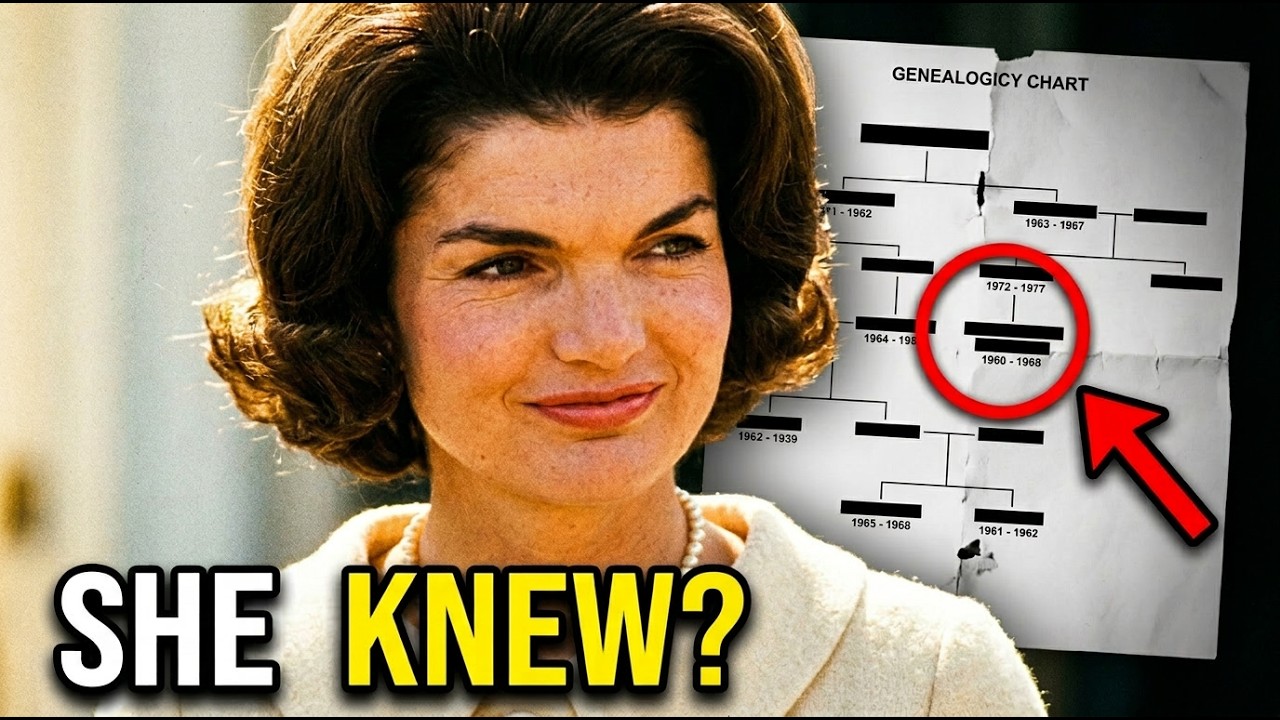
Suddenly, a genealogical society contacted Jackie. They had found something interesting in her family tree. They were looking at the Van Salee line.
Anthony and Abraham Van Salee were early settlers in New Amsterdam. Their father, Jan Janszoon, was a Dutch pirate. And the rumor that had followed the family for centuries was that their mother had been a mixed-race woman from North Africa.
The society wanted to publicize this. They thought it would be a good story. The first lady has mixed heritage. They thought it might help JFK with race relations.
Jackie saw the trap instantly. If she admitted to mixed blood, the press would not treat it as a nice story about diversity. In 1960s America, it would become a political grenade. Her husband's enemies would use it. The gossip columns would run wild.
So Jackie made a choice. She did not ignore them. She redefined the story. She told them the Van Salles were Jewish. She knew that some members of that family had used Jewish identity in the past to avoid persecution.
She grabbed that label and pinned it to herself. Jewish was safe. It was European. It stopped the questions about African blood without causing a scandal. She shut the door. The conversation ended. She protected the White House by editing her ancestors one more time.
But the biggest edit in Jackie's life did not happen in a history book or a press release. It happened in her own house, with her own mother.
Janet Lee Auchincloss was a woman who had mastered the art of social climbing. She married Black Jack Bouvier, then divorced him, then married into the wealthy Auchincloss family. She moved through the highest circles of society.
She told everyone she was a Lee of Virginia. That name meant something. It meant Robert E. Lee. It meant the old Southern aristocracy. It meant you were a Protestant, Anglo-Saxon, blue-blooded American.
Janet played the part perfectly. She even served on the board of Stratford Hall, the ancestral home of the Virginia Lees. She let people assume she was related to the general.
But Janet Lee was lying. She was not a Lee of Virginia. She was not a Protestant aristocrat. She was the daughter of Irish Catholics.
Her parents, James Lee and Margaret Merritt, were the children of famine immigrants. They came from County Cork and County Clare. They had not arrived on the Mayflower. They had arrived on coffin ships fleeing starvation.
Janet's grandfather, Thomas Merritt, came from a village called Shandrum. He was not a general. He was a man trying not to starve.

Janet knew that in the elite world she wanted to join, Irish Catholic was a stain. It meant you were new money. It meant you were loud. It meant you did not belong. So she hid it. She buried her history deep.
The most painful part of this secret was not the lie itself. It was what she did to her own mother.
Janet's grandmother was still alive. She had a thick Irish brogue. She sounded like the places she came from. When wealthy guests came to the house, Janet did not introduce her grandmother. She sent her upstairs.
She told people the old woman with the accent was a housemaid. She turned her own flesh and blood into a servant to keep her story straight.
Jackie grew up watching this. She saw the Virginia Lee performance. She heard the stories about the glorious past. But unlike her mother, Jackie eventually went looking for the truth.
In 1967, after JFK was gone, Jackie took her children, Caroline and John Junior, to Ireland. She did not just go for a photo op. She visited the places where the Kennedys came from. She felt the pull of the land.
She realized that half of her own blood, the Lee side, was just as Irish as the Kennedy side. The research showed that Jackie was roughly 50 percent Irish. Her mother's family was almost entirely Irish. The French Bouvier blood was actually quite thin, only about 12 percent by the time it got to Jackie.
She came home and confronted Janet. The daughter who had been the most famous woman in the world stood in front of the mother who had spent a lifetime building a disguise. Jackie asked about the Merritts. She asked about County Clare. She asked about the famine.
Janet denied it. She got angry. She heatedly insisted that the Virginia story was real. She refused to let the mask slip, even for her own daughter.
It was Jackie's stepfather, Hugh Auchincloss, who finally broke the tension. He laughed and said he had always thought Janet was a Lee of Shanghai. He made it a joke, but the point landed. The Lee of Virginia story was over.
Jackie did not expose her mother to the press. She did not humiliate her. But she stopped playing along.
She realized that her strength did not come from the fake French counts or the fake Virginia generals. It came from the people who had actually lived.
It came from Michel Bouvier, who stood on a dock in Philadelphia with nothing but his tools and built a fortune from sawdust and coal. It came from the Merritts and the Lees who survived the hunger that killed a million people in Ireland, crossed an ocean, and raised a generation that could dream of the White House.
Jackie Kennedy spent her life being looked at. She was a symbol of perfection. But under the polish, she was the daughter of fighters and survivors.
Her family tried to hide the struggle. They wanted to look like they had always been there, sitting on velvet chairs. But the truth is that Jackie's elegance was not a gift from the aristocracy. It was the armor she forged from a family history of reinventing themselves to survive.
She was the granddaughter of a housemaid and the descendant of a carpenter, and she became the queen of America. That is the story they should have told. It was the only one that was real.