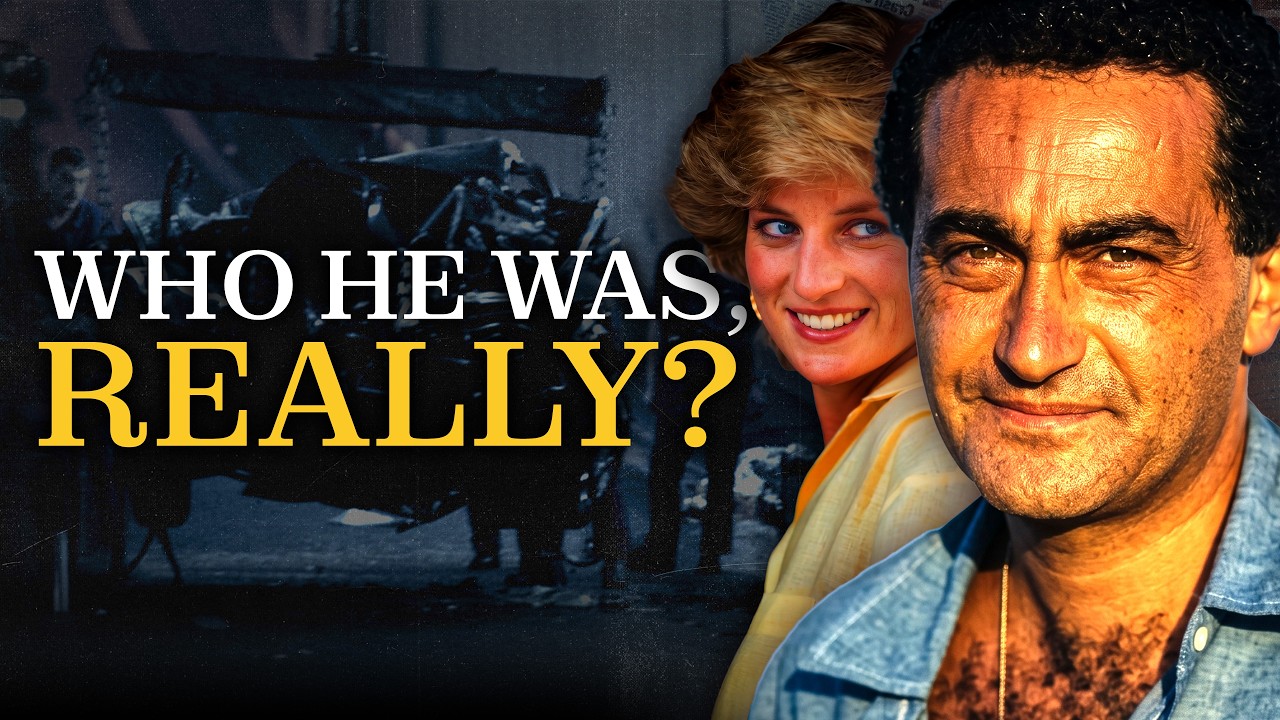
For nearly thirty years, Dodi Fayed has existed in the British tabloid imagination as a kind of ghost. He is remembered less as a man than as a single photograph and a single adjective: Egyptian playboy, party boy, the boyfriend in the car.
That version erases almost everything. It leaves out his childhood, his mother, and any career beyond the gossip columns. His entire existence collapses into one function: the man sitting beside the Princess of Wales when a Mercedes struck the thirteenth pillar in the Alma Bridge tunnel at 23 minutes past midnight.
A second ghost emerged from a different direction. Built by his father's lawsuits, funded biographies, and bronze memorial statues displayed for years inside Harrods, this version cast Dodi as the martyred prince of a future royal dynasty. Fiancé of the most photographed woman on earth. Future stepfather to the heir to the British throne. A man, the story went, whom Prince Philip personally ordered MI6 to assassinate because he was an Egyptian Muslim who dared to love a princess.
Both ghosts are nonsense. The first is lazy tabloid shorthand from journalists who never bothered to research a man whose backstory sat in public court filings. The second is the fever dream of a grieving father who could not accept that his son died because the driver was drunk and nobody had buckled a seatbelt.
The real Emad El-Din Mohamed Abdel Moneim Fayed lived for 42 years before that tunnel in Paris. Almost none of what most people think they know about him is correct.
Emad El-Din was born on the 15th of April, 1955, in Alexandria, the cosmopolitan Mediterranean port that had hosted wealthy Egyptian, Greek, Italian, and Levantine families for generations. The Alexandria of 1955 stood on the edge of disappearance. Gamal Abdel Nasser had taken the presidency the year before, the Suez crisis loomed a year ahead, and an old multicultural elite had begun its long bleed into European exile.
He was the first of Mohamed Fayed's children, born to Mohamed's first wife, Samira Khashoggi. That sentence sounds simple, but it is not. Tucked inside those names sits the genetic material of three decades of geopolitical scandal that would echo through Dodi's life.
Samira's brother, Adnan Khashoggi, would become the most famous arms dealer of the 20th century. He brokered weapons deals between Western governments and Middle Eastern royalty, took his cut, and spent it on yachts and parties that became their own kind of geopolitical signaling. Through Samira's family connections, Mohamed Fayed gained access to the money and the rooms that turn a clever Egyptian businessman into a player on the global stage, particularly in Dubai during the early 1960s oil boom.
The marriage did not survive even two years. Mohamed and Samira divorced in 1956, when their only child could barely walk. From that moment, Emad El-Din existed in a strange custody pattern. His mother lived but stayed mostly absent. His father appeared only between flights. The actual work of raising him fell to staff, schools, and a rotating cast of relatives across at least three countries.
Samira died in 1986, felled by a heart attack without warning, when Dodi was 31. She had been mostly a phantom in his childhood. Her death made the phantom permanent. This is the first thing the tabloids erased. Dodi Fayed had a mother, and losing her broke something in him that never went back together properly. His behavior in the eleven years that followed bears the imprint of that absence.
The family surname carried no prefix in any document predating the 1970s. No nobility, no ancient lineage hidden in the consonants. Just Fayed. The whole costume came later, applied by Mohamed himself for reasons of marketing rather than ancestry.
Mohamed Fayed added the "Al" sometime in the 1970s. He did not inherit the prefix, nor discover it in a forgotten branch of his family tree. He glued it on because it sounded better to Western ears, because it suggested a patrician Arab lineage the Fayed family did not actually possess. A UK Department of Trade and Industry investigation into his takeover of Harrods documented this in detail.
The British press mocked it relentlessly for decades, and the mockery is part of why Mohamed Fayed never received the British citizenship he spent his life chasing. The "Al" worked as a costume that Mohamed wore the way other men wear hairpieces, and the wearing of it shaped every public-facing decision he made for the next 40 years, including, eventually, the way he managed his own dead son's reputation.
Dodi grew up inside a family whose own surname was being rewritten in real time by a father obsessed with how he appeared to the British establishment. Identity in the Fayed household worked like a marketing decision. Heritage came as something you could purchase and renovate, the same way Mohamed would eventually purchase and renovate Harrods, the Paris Ritz, and Fulham Football Club.
If your father can change your last name to chase status, what else can he change? Almost everything. The answer ran from his schooling to his professional title to the way history would eventually remember him.
Dodi's childhood resembled a passport stamp collection that ran from Alexandria to Dubai to Geneva to Paris to London, none of which ever quite became home. That is what happens to children of the global wealthy. You become a citizen of hotels, a passport with too many stamps and no particular country willing to claim you as one of its own.
His formal schooling came at the Institut Le Rosey in Switzerland, the kind of place where the children of shahs, dictators, oil shaikhs, and minor European royalty learn to ski and to nod politely in four languages. Le Rosey provides an introduction service for the international ruling class dressed up as a boarding school. The real curriculum is the contact list you leave with.
After Le Rosey, the official biography says he attended the Royal Military Academy Sandhurst. This is technically true and entirely misleading, in the way that almost everything about the Fayed family's public-facing record turns out to be technically true and entirely misleading.
Sandhurst commissions British Army officers through a brutal 44-week training program that ends with the Sovereign's Parade. Dodi did not do this, nor did he come anywhere near doing this. He attended instead a short special course Sandhurst occasionally ran for the sons of wealthy foreign dignitaries, a finishing school version of military life with the brutality filed off.
His father's geopolitical connections arranged the placement. As documented in biographer Brian Brown's 2007 research from the period, the course produced no commission, no rank, only a line on a CV. So when British tabloids in the 1990s described Dodi as Sandhurst-trained, implying he had survived the same crucible as British officers, they were participating in his father's preferred fiction. He had been there, but he had not done that.
In 1979, Mohamed Fayed founded a production company called Allied Stars and installed his son in it. No film school education backed him, no apprenticeship in any below-the-line craft, no track record of any kind in the film business. His father, however, kept writing very large checks.
The company's first major credit came with Breaking Glass in 1980, a British rock and roll drama that did fine without being remembered. Then came Chariots of Fire. That production would define Dodi Fayed's professional reputation for the rest of his life and afterward more than anything else he ever attached his name to.
Chariots of Fire won Best Picture at the 1982 Academy Awards. Dodi Fayed received an executive producer credit. Walk into any IMDb page or any obituary and you will see those two facts placed next to each other, and you will be invited to draw the obvious conclusion. He was an Oscar-winning producer, but not in any meaningful sense of those words.
The actual creative engine behind Chariots of Fire was David Puttnam, who had spent years developing the project and putting the elements together. When the production ran out of money mid-shoot, Mohamed Fayed wrote a rescue check of approximately 1.5 million pounds, and in exchange, the family received producer credits.
David Puttnam himself, after Dodi's death, took pains to publicly distance himself from the Fayed family and clarify the historical record. Dodi, in Puttnam's account, had virtually no creative involvement and was frequently absent from set. He carried a name on a contract. The check had purchased the appearance of authorship, much as the "Al" prefix had purchased the appearance of aristocracy a decade earlier.
The filmography that followed kept up the pretense. F/X in 1986, F/X 2 in 1991, Hook the same year, where his credit came largely from early rights acquisition rather than any hands-on producing. The Scarlet Letter with Demi Moore in 1995, a critical disaster of historic proportions. In each case, Dodi's name appears in the financier and packager position rather than the line producing trenches. He brought money and introductions, but in the boring daily sense, never produced any of the films his name appeared on.
Yet people who worked with him in this period mostly liked him. He came across as soft-spoken, polite, and generous in person, not a screamer or a tantrum thrower in a town where screaming and tantrum throwing was the regional sport. The Hollywood crowd is full of obnoxious money guys with worse manners. Dodi made easy company, simply not a filmmaker.
When his father got cold feet on a project or decided to tighten the spigot, the checks would stop. Bills would go unpaid. Hotel accounts would lapse. So we have a man in his 30s and 40s producing films he did not really produce, supported by an allowance that biographers placed at roughly $100,000 a month.
The allowance deserves a closer look. It explains things that nothing else explains about Dodi Fayed's behavior in his 30s and 40s, particularly his inability to commit to any project, person, or location without his father's continued financial backing.
$100,000 a month in 1990s money comes to $1.2 million a year for a single bachelor who already had his housing, his cars, his security, and most of his social life subsidized through the larger Fayed business empire. By any normal measure, the number is unspendable. Most people in their 40s would simply accumulate a fortune and quietly grow rich. Dodi managed to spend it all.
Sometimes he burned through it faster than it arrived, requiring his father's accountants in London to wire emergency top-ups across the Atlantic on short notice. The cocaine drew no secrecy. Tom Bower's biography and the Vanity Fair investigation from 1997 both documented his cocaine use as a routine feature of his Hollywood years, not as a tabloid rumor but as something his actual circle confirmed on the record.
He never reached chaotic addict territory, by all accounts. He functioned as a high-functioning user in a town and an era where high-functioning use formed the wallpaper of the industry he had bought his way into. The bounced checks drew no secrecy either. He paid late or partially or occasionally not at all, waiting for someone in London to clean it up before any embarrassment could leak into the press.

In the most precise and literal sense, he had never faced the consequences of his own spending. Every time he hit the bottom of the account, his father refilled the account. Around him, his peers in their late 30s and 40s had children, mortgages, divorces, businesses they had built or destroyed on their own credit. Dodi had none of that. Instead, he kept an allowance and a permanent adolescence, lived in Malibu and Mayfair and the South of France, photographed at premieres for films he had paid to be associated with.
Then came the summer of 1997. For a brief stretch of weeks, it looked, against all prior evidence and against all the patterns of his previous four decades, like Dodi Fayed might be about to become an adult.
In that summer, Dodi Fayed had become engaged to a 29-year-old American model named Kelly Fisher. The engagement was real, not the staged tabloid romance the British press had retroactively assigned to his earlier years with figures like Brooke Shields, all of which the supposed partners had denied as purely public relations fictions invented to keep Dodi's name in the gossip columns.
Kelly Fisher was different. Dodi had purchased a house in Malibu. Specific financial promises sat in legal filings. Dodi had told her he wanted her to scale back her modeling career so they could build a life together. According to the lawsuit she eventually filed in Los Angeles County Superior Court, he had offered her $500,000 to do exactly that. The dollar figure appears in the original complaint filed by Fisher's attorney, Gloria Allred, in August 1997.
In July of 1997, Mohamed Fayed invited Princess Diana and her two sons to holiday at his villa in Saint-Tropez. He summoned Dodi to join them. Dodi flew in from where he had been spending time with Kelly Fisher on a yacht moored nearby in the south of France. Fisher remained on the yacht while Dodi headed up to his father's villa one harbor over to entertain a princess.
For most of August, Fisher did not know what was happening. She thought she was waiting for her fiancé, but in actual fact she was waiting for a man who, in real time, had transferred his attention to the most photographed woman on earth and was not coming back to her boat. When the story broke and Dodi did not return, Fisher hired the attorney Gloria Allred and filed a breach of contract suit. The suit landed in mid-August 1997. Roughly two weeks later, Dodi Fayed lay dead in a Paris tunnel, and Fisher dropped the lawsuit out of respect for his family.
A grown man engaged to one woman abandoned her on a yacht in the South of France while he sailed off with another. A real person on a real yacht in a real harbor ended up hurt by his choices, and her hurt is part of his historical record. It also tells you something about the speed at which the Diana relationship unfolded.
The relationship between Dodi Fayed and Diana, Princess of Wales, lasted less than two months. People who have absorbed the conspiracy literature talk about Dodi and Diana the way they talk about Charles and Camilla, as if it had been a long-running affair of state. It amounted to a holiday romance. A spectacular, paparazzi-saturated, internationally watched holiday romance, sure, but a holiday romance.
It began at Mohamed Fayed's villa in Saint-Tropez in July 1997 and played out almost entirely at sea on the Fayed family yacht called the Jonikal, which would become the principal setting for what remained of their lives. Diana and Dodi cruised the Mediterranean through August. Photographers shot them constantly, and those pictures sold for prices that would, in retrospect, become part of the murder weapon that killed them both.
What actually happened between them stays harder to know. The people who knew Diana best disagree with the people who knew Mohamed best in ways that are not coincidental and that map almost perfectly onto each side's incentives after the crash.
Diana's closest confidantes, including her friend Rosa Monckton and Lady Annabel Goldsmith, provided detailed testimony to the Operation Paget investigation in the years that followed. Their account stays consistent. According to that account, Diana enjoyed herself and found Dodi affectionate and kind, a generous man who treated her with care during a period of her life when most of the attention coming her way did the opposite. She harbored no intention of marrying him, no pregnancy existed, and conversion to anything had never appeared on her schedule. By all credible accounts, she remained a recently divorced 36-year-old woman taking a sun-soaked summer with a wealthy man who treated her well and kept her laughing.
Mohamed Fayed, after his son's death, would build an entire mythology on the opposite premise: that his son and Diana were secretly engaged, that she carried his grandchild, and that the British state had murdered them both to prevent a Muslim stepfather for the future king. He repeated the accusation in interview after interview for the rest of his life.
The forensic evidence in Operation Paget would eventually demolish all of this. Diana was definitively not pregnant. The blood from the Mercedes footwell and an examination of her remains confirmed her condition with the kind of clinical certainty that conspiracy theories cannot survive. The plot did not exist. No MI6 hit team operated, no royal command came down, and no Muslim stepfather panic gripped the British establishment. A man fell in love with a princess over six weeks, and then a tunnel arrived.
One other detail belongs in this story. On the afternoon of the 30th of August, 1997, the last day either Diana or Dodi would live to see the sunrise, Dodi Fayed walked into the Alberto Repossi jewelry store in Paris and purchased a ring from a collection called "Dis-moi oui." The name translates, with no subtlety whatsoever, as "Tell me yes." Surveillance footage from the store recorded the visit, and the receipt sits in the public record.
What the ring meant has been argued about ever since. Operation Paget interviewed everyone who knew Diana well enough to know what actually occupied her mind during those weeks. The conclusion came out straightforward and unanimous. Diana viewed the ring, if she viewed it at all before the crash, as a friendship gift or at most a pre-engagement token of affection from a wealthy man who liked dramatic gestures. On the night of the crash, she was not about to accept a marriage proposal. The people closest to her have maintained this repeatedly and consistently for more than two decades.
A man can buy a ring with one set of intentions while the woman receiving it carries a different set. Dodi may genuinely have hoped Diana would say yes. That does not retroactively turn her engagement to him into a fact, and it certainly does not turn his death into a murder. But the ring, in the hands of a grieving father with infinite money and infinite media access, became the centerpiece of a conspiracy industry that ran for almost 20 years. Mohamed put the ring on display, sent it out for photographs, and mentioned it in every interview and press release. The object became the most exhausting prop in modern royal mythology. But the ring stayed just a ring.
On the evening of the 30th of August, 1997, Dodi and Diana dined at the Hotel Ritz in Paris, the hotel his father owned. The paparazzi stood at the front entrance in numbers that made any normal departure impossible. So someone improvised. Hasty decisions sent them through the rear of the hotel with a decoy vehicle strategy that nobody had rehearsed and nobody had properly staffed.
At approximately 20 minutes past midnight on the 31st, a Mercedes-Benz S280 pulled out from the back of the Ritz. Behind the wheel sat Henri Paul, the acting head of security at the hotel. Trevor Rees-Jones, a former British paratrooper employed by the Fayed organization, rode shotgun. Dodi and Diana sat in the back. Nobody had buckled a seatbelt, a detail investigators would note repeatedly in the years that followed, and one the coroner's jury would eventually count as contributing to two of the four deaths.
At 23 minutes past midnight, the Mercedes entered the Alma Bridge tunnel at high speed and struck the thirteenth pillar. The impact destroyed the car. Emergency responders would later describe the wreckage as one of the worst single-car collisions they had ever attended in the center of Paris, a city not short on bad accidents.
Henri Paul died at the scene. Dodi Fayed died at the scene. Diana, Princess of Wales, emerged from the wreckage alive and rode by ambulance to the Pitié-Salpêtrière Hospital, where she died hours later from internal injuries that, with a seatbelt, she might have survived. Trevor Rees-Jones, the only seatbelted occupant in the car, survived with severe injuries to his face and skull.
The French judicial investigation and, later, the Operation Paget review and the 2008 British coroner's inquest established the technical cause of the crash with a level of detail rare in any traffic fatality. Henri Paul's blood alcohol registered more than three times the French legal limit. His system also contained therapeutic doses of fluoxetine, marketed in the United States as Prozac, and tiapride, a medication used in alcohol withdrawal treatment. Both of these drugs interact dangerously with alcohol.
By every clinical measure available, he was not fit to drive a vehicle that night, let alone a luxury sedan at high speed evading a paparazzi pursuit. He should never have sat in that driver's seat. The people who put him there bear part of the weight of what followed.
The paparazzi were also pursuing the car at speeds that French and British investigators considered reckless and contributory. They were chasing money. A clear shot of the Princess of Wales that night ran into six figures per image, depending on the buyer and the angle.
The 2008 British coroner's inquest jury delivered its verdict on the 7th of April. Unlawful killing, grossly negligent driving of the following paparazzi vehicles, and grossly negligent driving of the Mercedes by Henri Paul. The jury identified the failure of the victims to wear seat belts as a contributing factor in the deaths of Dodi Fayed and Diana, Princess of Wales.
That is the verdict, and that is the documented historical record. No version of events contradicts this verdict without contradicting forensic toxicology, surveillance footage, witness testimony, and the basic laws of physics that govern what happens when a luxury sedan strikes a concrete pillar at high speed.
Dodi Fayed received an initial burial at Brookwood Cemetery in Surrey in an Islamic funeral attended by close family. Then he was moved. In October 1997, his remains were reinterred on the grounds of the Fayed family estate at Barrow Green Court in Oxted, where his father could visit him daily and where his father would, over the next quarter century, talk to him.
In 2005, Mohamed Fayed unveiled a bronze statue inside Harrods called Innocent Victims. The piece depicted his son and Diana dancing beneath the wings of an albatross. In case the symbolism risked being too restrained, the albatross referred to the seabird associated with grief and the souls of the dead.
The statue stood near the Egyptian escalator alongside a smaller memorial Mohamed had installed in 1998 that held photographs of the couple, a wine glass from their last dinner, and a ring he claimed was the Repossi engagement ring used the night before the Paris crash. It was not the Repossi ring. The actual Repossi ring had been recovered separately and entered into the inquest's evidentiary record years earlier.
The memorials were not subtle, nor were they designed to be. They amounted to a department store cathedral honoring the Fayed family's preferred version of events, and tourists filed past them every day for years, treating them as if they constituted public history.
In 2010, Mohamed sold Harrods to Qatar Holdings. The new owners tolerated the memorials for almost a decade out of respect for the family. In 2018, they finally removed them and returned them to Mohamed personally. The Innocent Victims statue ended up at Fulham Football Club, the other major Fayed possession at that time, before eventually being sent into private storage and out of public view entirely. This had been the last public-facing infrastructure of the Fayed conspiracy theory, and its removal in 2018 ended the era quietly.
By 2023, when Mohamed Fayed himself died, almost no serious commentator outside the conspiracy fringe still entertained the murder narrative. The narrative had been killed three times over. Once by the Operation Paget report, again by the coroner's inquest, and finally by time and the steady accumulation of evidence that pointed always in the same direction.
The conspiracy industry built around Dodi Fayed's death did not honor his memory. It buried him under his own father's obsessions. For almost 20 years, you could not say his name in public without triggering an argument about MI6 and Prince Philip and pregnancy and engagement and royal cover-ups. The actual man, the actual life, the actual person who had lived for 42 years in five different countries and produced bad films and dated models and used cocaine and lost his mother and loved a princess for six weeks, vanished entirely from his own story.
His father killed him a second time. With the best of intentions and the worst possible outcome, Mohamed Fayed spent 20 years erasing his own son to turn him into a martyr.