In May 1913, Adolf Hitler was a 24-year-old failed artist living in Vienna. He had inherited the last of his father's estate, money earned during Alois Hitler's 30 years in the Austrian customs service.
Hitler used that small sum to move from Vienna to Munich, in Bavaria. In Vienna he had lived in men's shelters for years, scraping together a precarious living by selling paintings and postcards and working as a day labourer. He was underweight and sickly looking, and he had managed to avoid national service in the Austro-Hungarian army.
On 5 August 1914, Hitler reported to a medical board in Salzburg for an army medical examination. Unsurprisingly, given his years as a homeless vagrant in Vienna, he was classified as unfit for military service and returned to Munich.
In later years Hitler explained that he had been against serving in the multi-racial army of Austria-Hungary, though this may have been a statement made in retrospect. When war broke out in August 1914, he did not return to Austria to join up. Because he identified strongly as a German, he wanted to join the German army.
The problem was that Hitler did not hold German citizenship. He certainly sounded German, having picked up a Bavarian accent when his family lived at Passau, on the border with Austria, during one of his father's postings.
Swept up in the wave of German nationalism that accompanied the outbreak of war, Hitler took the unusual step of writing to King Ludwig III of Bavaria asking for permission, as an Austrian, to serve in the Bavarian army. Permission was granted, apparently in error. The Bavarians should have arrested Hitler and deported him to Austria. In 1924 they admitted that a clerical error had allowed Hitler to join the German army.
Hitler enlisted into the 1st Company, 1st Battalion, 16th Bavarian Reserve Infantry Regiment, known as the List Regiment after its commanding officer. He completed a short basic military training course in Munich.
Hans Mend, a fellow recruit, recalled how Hitler seemed enamoured of his new rifle. He regarded it, Mend said, with the delight of a woman with her jewellery, while Mend secretly laughed to himself. Another recruit, Ernst Schmidt, noted that Hitler was a voracious eater, evidently making up for the lean years when he was a vagrant in Vienna.
On 8 September 1914, the regiment's commanding officer, Colonel Julius von List, addressed the recruits with a rousing speech. On 8 October, Hitler and his fellow soldiers swore oaths of allegiance to Emperor Wilhelm II and King Ludwig III.
Following field training at Lechfeld on the Danube, the List Regiment joined the new three-regiment 6th Bavarian Reserve Division. On 20 October the regiment boarded a train for the Western Front, and Hitler was about to enter battle for the first time.
The regiment detrained at Liège, Hitler's first experience of a non-German-speaking country. Spending four days in the city, he saw the first effects of war: the city was badly damaged, and he could hear far-off artillery fire.
The regiment would go into action against the British in a clash known to the British as the First Battle of Ypres and to the Germans as the Battle of Langemarck. From Ledegem in Belgium, the regiment marched to the front.
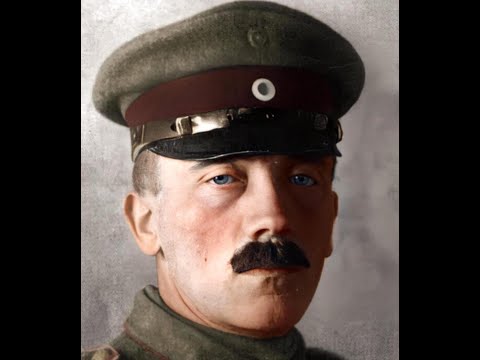
On 29 October 1914, the List Regiment was sent forward to relieve a unit of Württembergers and suffered extremely heavy losses, particularly from artillery fire. Hitler and 1st Company advanced and withdrew four times until finally capturing the village of Gheluvelt. The fighting was at times hand to hand.
First Company captured a trench before Gheluvelt Castle, fighting elements of the Worcestershire Regiment and also a unit of the Black Watch, an ancient Scottish regiment. Hitler's company charged forward under artillery fire, fighting the British troops in beet fields and meadows.
List Regiment casualties were crippling. Some 3,600 men entered combat, and in 20 days they were reduced to only 611 fit men. First Company began the fight with 250 men and was reduced to 42, including Hitler.
On 9 November 1914, after 11 days in action at the front, Hitler was appointed a regimental dispatch runner. He joined what was termed the battle ordnance. He had somehow come through several attacks unscathed, though he was deeply affected by the death and destruction all around him.
In his letters Hitler noted his pride in the List Regiment, described comrades and officers killed or horribly maimed, British troops being shot down, and the terrible artillery fire as his company cleared trenches. At one point a bullet tore off one of his sleeves, yet he was untouched.
Hans Mend later said of his friend that with unbelievable toughness he endured the greatest strains and never showed any weakness. The battle ordnance to which Hitler belonged was far more exposed to enemy fire than the companies themselves. While the latter could always find cover in the trenches, the ordnance staff were constantly on the move with messages.
The regiment, partially rebuilt with conscripts, next broke through the British line north of Messines and turned the left flank of trenches held by the London Scottish. A series of seesaw battles developed, but by now Hitler was acting as a regimental runner and was not involved in direct attacks on the enemy.
In late 1914 the new regimental commander, Lieutenant Colonel Engelhardt, placed Hitler's name on the list recommending him for the Iron Cross Second Class, along with four other soldiers. On 2 December Hitler received the medal, awarded for gallantry and an excellent performance of his duties as a runner. Of eight regimental runners including Hitler, three were killed and one badly wounded.
From the Battle of Wytschaete, in 1932 Colonel Engelhardt gave more details of the award of the Iron Cross Second Class to Hitler in 1914. He recalled that once, as he emerged from the wood at Wytschaete during a fierce attack to make some observations, Hitler and an orderly from the regimental staff planted themselves in front of him to shield him with their own bodies from machine gun fire.
Hitler was also promoted to Gefreiter, equivalent today to a lance corporal in the British army or a private first class in the U.S. army. By early 1915, stalemate had caused both sides to dig in, and trench warfare with all its attendant horrors became the norm.
Hitler was described by a contemporary as a trench runner. His job was to keep up communications between regimental headquarters and the companies deployed on the front line, and his unit numbered eight to ten men. The men would transit backwards and forwards between the relative safety of regimental headquarters behind the lines and the company command posts on the front line. Such journeys exposed them to artillery fire and sometimes enemy machine gun and rifle fire.
In March 1915 the List Regiment occupied positions to defend the town of Neuve Chapelle, where a vicious battle developed following a British offensive. The lines were confused during heavy fighting. Hitler recalled taking orders and reports to and from the front by moving from shell hole to shell hole under fire.

Demonstrating that the regimental runners' duties were dangerous, the regimental commanding officer commented that he could not understand how his runners kept getting through under such heavy fire. Hitler and the other runners were under shell and sniper fire.
Hitler the soldier was portrayed by his comrades as a reserved and very prudish man, but one full of strong opinions about the war and Germany. He made clear that the army was his whole life. His comrades noted that Hitler never received any parcels from home and had no interest in home leave.
All of his contemporaries said that Hitler was completely dedicated to his duties and volunteered even for the toughest assignments. Even Alexander Moritz Frey, a medic who disliked Hitler and later became a science fiction writer and fled Germany after Hitler came to power, nonetheless wrote of Hitler that when people claimed he had been a coward, that was not true. Frey nonetheless thought Gefreiter Hitler to be a backstabber and a selfish individual who impressed only the youngest, most impressionable soldiers with his nationalistic rhetoric.
During a long period of trench warfare, Hitler continued to operate as a runner. Normally runners were dispatched in pairs in case anything happened to one of them. They carried leather dispatch cases and were armed normally with holstered pistols, leaving their rifles behind as they were heavy and an encumbrance when moving around quickly. The sealed dispatches were marked with one, two or three crosses indicating how urgently they must be delivered.
It was noted in records and memoirs that Hitler was sent out under machine gun and artillery fire on numerous occasions, particularly during a British offensive in late September 1915.
The List Regiment next transferred to the Somme, where the British offensive that opened on 1 July 1916 raged on inconclusively for three and a half months. The List Regiment spent 10 days in the front line near Bapaume, losing 120 men on average per day killed and wounded.
A British shell landed in the runners' dugout, killing four of the runners and badly wounding seven others. Hitler was struck in the face by a shell splinter, though not badly injured.
On 12 October 1916 Hitler was wounded more seriously. During heavy fighting he had volunteered with one other man to get a message through. A shell splinter buried itself in Hitler's left thigh, and he was later rescued by stretcher from the battlefield.
He ended up in a military hospital for two months at Beelitz, near Brandenburg. After convalescence he was sent to the regimental depot in Munich. Hitler wrote to regimental adjutant Captain Wiedemann asking to be allowed to return to the regiment at the front, writing that he could not tolerate being in Munich when his friends were at the front. Wiedemann arranged for Hitler to return to the regiment and to his old position of regimental runner, arriving on 5 March 1917.
The List Regiment next saw action on the Aisne through the winter into 1918, before being withdrawn in January for rest. Hitler was noted to have been very interested in the bigger strategic picture, particularly the Russian Revolution that released hundreds of thousands of German troops from the Eastern Front for a last great offensive in the west planned for March 1918.
In more horrendous trench warfare, Hitler was noted as a food scavenger who would go out with comrades to slice meat off the carcasses of dead horses, so hungry were German troops becoming in the last months of the war as the Allied naval blockade of Germany bit deeply.
One of Hitler's comrades, Ignatz Westenkirchner, noted of this period that they were nothing but a handful of tramps, mud from top to toe, not a whole tunic amongst them, and that they came out of the line over 1,200 men fewer than when they went in.

By late April 1918 the List Regiment was being subjected to terrific British artillery barrages, which added to the hunger and mud. When the regiment was eventually relieved on 15 May 1918, it amounted in size to just a single company's worth of fit men.
Refitted and with fresh men, the regiment advanced within 50 miles of Paris during the last great German offensive, but took heavy casualties. On 26 May 1918, while delivering a message, Hitler encountered and single-handedly captured a group of eight French soldiers, marching them a couple of miles at pistol point to the nearest German lines.
Soon afterwards Hitler was awarded the Iron Cross First Class, an award rarely given to rank-and-file soldiers. He was recommended for this prestigious award by Lieutenant Hugo Gutmann, to whom Hitler and the other runners reported.
Gutmann, a Jewish officer who had been awarded the Iron Cross First Class himself in 1915, wrote in a citation of Hitler that as a runner his coolness and dash in both trench and open warfare had been exemplary, and that he had invariably shown himself ready to volunteer for tasks in the most difficult situations and at great danger to himself. Whenever communications had been totally disrupted at a critical moment in a battle, it was thanks to Hitler's unflagging and devoted efforts that important messages had continued to get through despite every difficulty. Hitler had received the Iron Cross Second Class for gallant conduct during the fighting at Wytschaete on 1 December 1914, and fully deserved to be awarded the Iron Cross First Class.
Hitler was also awarded a Bavarian medal for bravery, the Cross of Military Merit Third Class with Swords. The grade of his medal was determined more by his military rank of lance corporal than by the act of gallantry itself.
Hitler was wounded again on 15 October 1918, at the end of World War One, temporarily blinded along with several other comrades during a British mustard gas attack. From a field hospital he was evacuated to a base hospital at Pasewalk in Germany, where on 11 November 1918 he learned that Germany had surrendered.
At Pasewalk he received the new German Wound Badge, the only other military decoration he would wear as leader of Germany in later years alongside his Iron Cross First Class. The symbolism of the badge and the Iron Cross was obvious to the World War One veterans of the Nazi Party and the new army he created.
Hitler was also given a service medal for World War One, the Bavarian Medal of Military Service Third Class with Swords. Following his discharge from Pasewalk hospital, Hitler went to Munich, arriving on 21 November 1918.
He was placed in 7th Company, 1st Replacement Battalion, 2nd Infantry Regiment. He was then used as a guard at a prisoner of war camp at Traunstein until January 1919.
Returning to Munich, he sat in barracks for two months awaiting a new posting while Munich dissolved into lawlessness as a revolution broke out in Bavaria. He was twice elected by his battalion soldiers to represent them, but he urged the troops to stay out of the conflict.
On 6 May 1919 the Bavarian Socialist Republic was destroyed by army troops sent from Berlin. Hitler was a noted anti-communist and so was allowed to remain in the army after his battalion was disbanded. His next job was at the administrative office of the 2nd Infantry Regiment.
In June 1919 Hitler was recruited as an undercover intelligence agent to spy on political activities in Munich. In this capacity he would join an insignificant little political party that met in the back of beer halls, the German Workers' Party.
Hitler started giving speeches and joined the party on 12 September 1919. That party would eventually become the National Socialist German Workers' Party, or Nazi Party. Hitler was discharged from the Reichswehr in 1920, ending his formal military career.