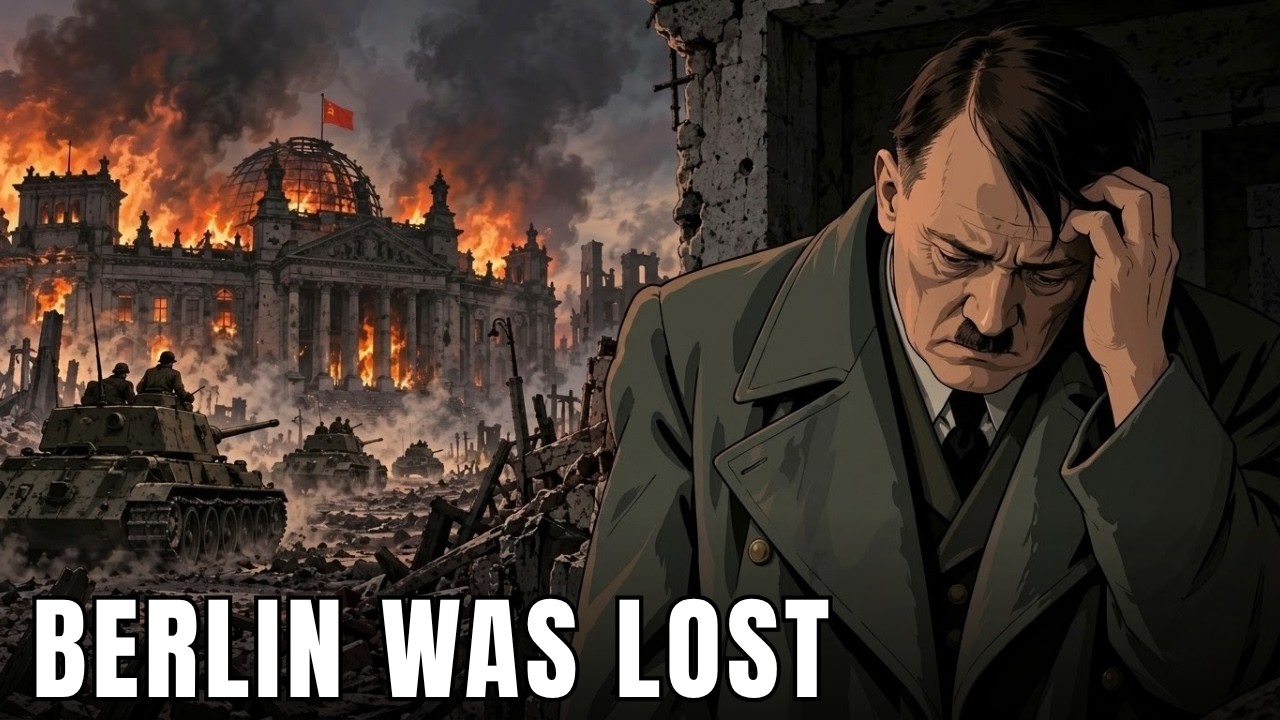
On April 30, 1945, Berlin was no longer the capital of an empire. It was a city being crushed from above and below, and in every street in between.
Soviet artillery shook the ground. Tank shells tore through ruined streets. And beneath the city, inside the leader's bunker, Adolf Hitler listened as the world he had built collapsed over his head.
The Third Reich had been promised a thousand years. It lasted twelve.
Now the man who once spoke of destiny, conquest, and final victory sat underground, surrounded by concrete walls, stale air, and the muffled thunder of the Red Army closing in. His dream of "final victory" had become such a broken illusion that even his closest followers could no longer pretend to believe it.
Hitler blamed the German people. In his view, the collapse was not the result of his invasions, his crimes, his strategic disasters, or his refusal to face reality. The cause was that the people had failed him. They had not fought hard enough. They had not been worthy enough. They were, in his words, cowards.
Nearby stood Lieutenant Hans Baur, Hitler's personal pilot and one of the men who remained close enough to speak with him in those final hours. Baur tried to persuade him to escape, offering to fly him out of Berlin — perhaps to Japan, Argentina, or the Middle East, where he could disappear far from the ruins.
It was a desperate proposal, but by then everything around Hitler was desperate. Hitler had already made his decision.
The voice that had once filled stadiums with rage and certainty faded into something quieter, almost emptied of content by defeat. Above him, Soviet forces were advancing through the capital of Nazi Germany. Around him, his regime was coming apart. Within hours, the dictator who had dragged Europe into catastrophe would choose death in a bunker while Berlin burned above his grave.
By early 1945, Berlin still stood, but only in the literal sense. The city had endured years of British and American air raids. Its neighborhoods were torn apart, its streets darkened, and its residents forced into a life of sirens, shelters, dust, and waiting.
Before the war, Berlin had been home to more than four million people. By the final months, that number had fallen sharply, and those who remained lived inside the ruins of a capital that no longer felt protected by its own government.
Morale had been collapsing since at least the winter of 1944. Christmas did not arrive with victory speeches that anyone believed. It arrived with hunger, exhaustion, and the realization that Germany was surrounded from the east and the west.
The most fanatical supporters of the regime clung to promises of wonder weapons and final victories. But ordinary Berliners read the truth in the sky every night. The Reich was no longer expanding. It was shrinking toward them.
The Western Allies were feared, but they were not the deepest terror in Berlin. The Americans and British came from the air and, eventually, from the west. The Soviets were coming by land from the east, and everyone knew what that meant.
German propaganda had spent years portraying the Soviet Union as an existential enemy, while German armies had devastated Soviet territory with a brutality that made revenge seem not only possible but inevitable. In the shelters, people whispered about what would happen when the Red Army arrived.
Some scratched bitter warnings on walls, urging others to learn Russian quickly, as if language might become a tool for survival amid the ruins. The fear was not abstract. It came from the realization that Germany's war in the east had been a war of annihilation. Now the survivors of that war were crawling toward the capital that had ordered it.
Joseph Goebbels, the Reich's propaganda minister, tried to sustain morale with speeches, rumors, and carefully manufactured hope. The temporary delay caused by the Ardennes offensive gave him something to work with — a final illusion that Germany might force a political miracle.
But beneath the slogans, Berlin was waiting for the east. With each day, the sound of that approaching reckoning grew louder.
For a brief moment, Goebbels had something he could market as hope. In December 1944, Germany launched the Ardennes offensive, known as the Battle of the Bulge, throwing what remained of its strength into a final desperate attack in the west.
The offensive delayed the Allied advance for several weeks, and Nazi propaganda presented that delay as proof that Germany could still strike back. But inside the German high command, the more perceptive officers understood the truth.
The Ardennes did not change the outcome of the war. It consumed fuel, aircraft, men, and armored formations that Germany could barely replace. The Reich did not regain the initiative. It simply spent more of its remaining strength to buy time it did not know how to use.
General Heinz Guderian, chief of the general staff, and General Reinhard Gehlen, who oversaw military intelligence on the Eastern Front, knew where the greater danger lay. The Soviet buildup along the Vistula River was impossible to ignore.
Intelligence not only indicated the timing of the attack but also its direction. The Red Army would break through the Vistula line, sweep across Poland, and drive toward the heart of Germany.
Guderian argued that troops had to be moved east before it was too late. But Hitler refused to accept that the Soviet threat could be as overwhelming as his officers warned. In his mind, German superiority was still some vague law, even as tanks, fuel, aircraft, and manpower pointed elsewhere.
Heinrich Himmler reinforced this illusion, dismissing the idea of a massive Soviet offensive as nothing more than a bluff. And so Germany entered the final months of the war with a leadership divided between those who read maps and those who preferred myths.
The Red Army was assembling force on a scale Germany could no longer match. Yet Hitler treated warnings as defeatism and reality as betrayal. Berlin was not doomed because no one saw the danger coming. It was doomed because those in power refused to believe the danger was real.
Instead of seriously preparing for the Soviet storm, Hitler made one of the most revealing decisions of the war's final phase. He diverted armored forces away from the eastern defensive line — not to stop the Red Army's advance toward Germany, but to launch a counterattack in Hungary.
The target was the oil fields and the besieged city of Budapest, as if fuel and prestige could still reverse the collapse of an entire empire. Budapest had already been encircled by Soviet forces since Christmas 1944.
German and Hungarian defenders were trapped inside a city being slowly strangled, while Hitler imagined that a relief attempt could break through and restore control. It was a plan that looked offensive on paper but in reality exposed how disconnected Nazi strategy had become from the state of its army.
The attempt failed. Budapest fell to the Soviets on February 13, 1945, and the German effort to save it only wasted more strength at the moment it was needed elsewhere. Tanks, fuel, and veteran formations that might have helped slow the Soviet crawl toward Berlin burned in a battle that could not change the course of the war.
In the west, Germany launched Operation North Wind, another desperate attack aimed at disrupting the Allied advance. It prolonged the fighting but did not restore German power. Worse, it exhausted the already depleted Luftwaffe, which became too weak to compete in the skies in any meaningful way.
Germany could still launch operations, but it could no longer make decisions of consequence. By early 1945, Nazi Germany had lost the ability to act strategically. It was reacting, lashing out, improvising, and bleeding in places that would not save Berlin.
Hitler still spoke the language of will, destiny, and counterattack, but the machinery beneath those words was falling apart. The road to Berlin was opening, not because the Red Army met no resistance, but because Germany's last reserves had been spent chasing illusions.
By the time the road to Berlin was open, the Red Army was no longer the desperate force that had fought for survival in 1941. It had been forged by years of catastrophic war, rebuilt through brutal experience, and sharpened by victories from Stalingrad to Kursk to Operation Bagration.
The Soviet Union had paid for that transformation with millions of lives, but by 1945 it possessed an army not merely for resistance but for destruction on a continental scale. Across the Eastern Front, Soviet forces numbered in the millions, stretching from the Baltic down toward the Adriatic.
Against Berlin alone, the invading force was immense. Nearly 2.5 million men, more than 40,000 guns and mortars, over 6,000 tanks and assault guns, and thousands of aircraft.
Germany still had men and weapons on paper, but paper strength did not equal usable strength when fuel was scarce, command was fractured, and the skies belonged to the enemy. The imbalance in the air was especially severe.
The Soviet army could deploy thousands of aircraft, while the Luftwaffe — once among the most feared air forces in the world — had been worn down by years of attrition, fuel shortages, lost pilots, and failed attacks. Hermann Göring, the man who had promised that German skies would remain safe, dismissed Soviet air power with almost theatrical denial.
But by then, denial was one of the few resources Nazi leaders had in abundance. Yet it would be wrong to say the Soviets were winning only because they had more men. That was the comfortable explanation many German officers preferred, because it allowed them to treat defeat as a matter of numbers rather than adaptation.
In reality, the Red Army had learned. It had become better at planning attacks, coordinating artillery, using tanks in mass, exploiting breakthroughs, and maintaining pressure after the first defensive line broke. By 1945, Soviet morale was also at its highest point of the war.
The soldiers moving west were not merely advancing toward another city on a map. They were closing in on the capital of the regime that had invaded their homeland, burned their villages, starved their civilians, and turned the Eastern Front into a war of annihilation. For the Red Army, Berlin was not just a target. It was an ending. And for many, it was a moment of reckoning.
As the Red Army massed outside Germany, Berlin prepared to defend itself with a force that revealed how far the Reich had fallen. Joseph Goebbels helped organize tens of thousands of emergency fighters, but many of them were not soldiers in any meaningful sense.
They were elderly men, wounded veterans, boys from the Hitler Youth, and civilians forced into uniforms because the state had run out of real options. Some received only a few rounds of ammunition. Others carried weapons they barely knew how to use.
In another era, Nazi propaganda had promised modern war, armored breakthroughs, and the invincible power of German arms. Now it was asking children and grandfathers to stand in front of Soviet tanks in the streets of the capital.
Among them were hardened veterans, remnants of the SS, fanatics, and soldiers who had survived the war long enough to understand exactly how hopeless the situation was. Some fought out of ideological conviction, some out of fear, and some because surrender to the Soviets seemed worse than death.
The defense of Berlin was not one thing. It was a mixture of fanaticism, coercion, desperation, and terror, all packed into the same ruined city. Hitler continued to speak as if willpower could replace everything Germany lacked.
He imagined the enemy bleeding to death in front of the capital, as if new units could simply appear, as if artillery and slogans could fill the gaps in the defensive lines. But Berlin was not being defended by an army with capability. It was being defended by the remnants of a regime that had consumed its people and now demanded the last of them die for its myths.

This was the Nazi regime's final cruelty toward Germany itself. After years of promises of glory, it offered civilians nothing but ruins. After years of demanding obedience, it handed boys and old men anti-tank weapons and called it courage. The city was being turned into a fortress, not because victory was possible. Berlin was being prepared as a sacrifice.
On January 12, 1945, under a snowy sky, the Soviet offensive began. Red Army engineers had cleared minefields, prepared crossing points, and positioned artillery. The massive force assembled along the Vistula finally moved.
What followed was not a slow advance but a rupture — the kind of breakthrough that tells an army the line in front of it is no longer bending but collapsing. German tank reserves were moved forward on Hitler's orders, placing them dangerously close to Soviet artillery. Instead of becoming the steel fist that stopped the offensive, many of these formations were struck before they could be used effectively.
The Red Army swept through defensive positions, and the Vistula line, which was supposed to protect the road to Germany itself, began to crumble. The Soviet advance moved with terrifying speed.
In the days that followed, Red Army formations surged into Silesia and East Prussia, breaking through German resistance and seizing territory faster than Berlin could respond. Towns, roads, rail lines, and defensive points fell in rapid succession, as Soviet commanders exploited their advantage instead of pausing after early successes.
Within about two weeks, much of Poland had been torn from German control, and Soviet forces had reached a point only 69 kilometers, or 43 miles, from Berlin. For a regime that had once imagined itself ruling from the Atlantic to the Urals, the distance was almost humiliating. The enemy Hitler had tried to destroy was now closer to his capital than many German officials were to their own offices.
Yet even at that moment, the final assault on Berlin did not begin immediately. Marshal Georgy Zhukov, commander of the 1st Belorussian Front, paused because German forces in Pomerania still threatened the Soviet flank. Berlin was close, but closeness was not enough.
Before taking the capital, the Red Army had to make sure the road to it could not be cut from behind. The storm had reached the gates, but the final blow was still being prepared.
By April 1945, the final offensive was no longer just a military operation. It had become a race. The Red Army was preparing to encircle Berlin with three massive formations.
The 1st Belorussian Front under Georgy Zhukov, the 2nd Belorussian Front under Konstantin Rokossovsky, and the 1st Ukrainian Front under Ivan Konev. Together, they formed a steel arc closing around the last great symbol of Nazi power.
Stalin understood Berlin's importance as a battlefield and as a prize. The Western Allies were advancing from the west, and although they were still some distance away, the Soviet command had no intention of letting Britain or America seize the Nazi capital first.
Berlin was not just a city. It was a wager. Whoever raised their flag over it could tell the world that they had delivered the final blow to Hitler's empire. This created pressure among Soviet commanders.
Zhukov wanted the honor of taking Berlin, but Konev's forces were also positioning to move toward the capital from the south. Stalin encouraged the competition, drawing operational boundaries in a way that allowed both men to believe they had a chance. It was a dangerous kind of motivation, because ambition could move armies quickly, but it could also make commanders accept casualties that might have been avoided.
The Soviet plan was massive and direct. Berlin would be struck from several directions, isolated from supply, and crushed before the Germans could reorganize. The Red Army did not want a long siege that allowed the Western Allies to approach, or gave Nazi leaders time to improvise another desperate escape, counterattack, or propaganda miracle.
The city had to be isolated, entered, and finished. For the German defenders, this meant the battle was no longer about stopping the Soviets in open areas. That chance was already gone. Now the most they could hope for was delay.
To obstruct the advance, exhaust the attackers, and perhaps buy time for a rescue that existed only in Hitler's mind, not on any real map. The race for Berlin had begun, but only one side still had the power to continue.
On April 16, 1945, the Battle of the Seelow Heights began. This was one of the last major defensive barriers before Berlin, a series of hills east of the capital where German forces tried to turn geography into a means of survival.
Behind them stood the city. In front of them came the central weight of the 1st Belorussian Front. Zhukov began with an intense artillery bombardment, hoping to shatter German defenses before his infantry and armor advanced.
But the attack did not go as smoothly as planned. Smoke, darkness, confusion, and stubborn German positions slowed the Soviet advance, and the defenders used the heights to inflict damage on the advancing forces. The Red Army had enormous power, but even enormous power can bleed.
The battle lasted only a few days, but those days were brutal. Soviet forces suffered heavy losses as they pushed through minefields, anti-tank fire, trenches, and desperate resistance. Zhukov was under pressure to break through quickly, partly because Berlin was waiting and partly because Konev's forces in the south were moving fast as well.
In this final race, delay itself seemed like defeat. By April 19, the German defenses at the Seelow Heights had cracked. The road to Berlin was open, and on April 20, Hitler's birthday, Soviet artillery began hitting the capital itself.
It was a birthday gift from history, delivered as shells. The city that had once celebrated him with banners and military parades now trembled under the guns of the army he had sworn to destroy.
Over the following days, Berlin was fully encircled. German armies outside the capital were ordered to link up and rescue the city, but those orders were closer to fantasy than reality. By April 25, Soviet forces had entered Berlin itself.

The battle was no longer approaching the capital. The capital had become the battlefield. Once Soviet troops entered Berlin, the shape of the fighting changed.
It was no longer a sweeping advance across open ground, but combat in streets, apartment blocks, basements, bridges, squares, and shattered public buildings. Every intersection could become a trap, every window a sniper position, every broken wall a place where someone waited with a rifle, machine gun, or anti-tank weapon.
German defenders used the city itself as a weapon. Machine guns and snipers were placed on upper floors and rooftops, where Soviet tanks struggled to raise their guns enough to hit them. Anti-tank weapons were hidden in alleys and building entrances, allowing small groups of defenders to attack armored vehicles at close range.
The ruins of Berlin gave the weak a temporary advantage. They could disappear among the rubble and force a stronger army to pay for every street. The Soviets adapted quickly.
Tanks moved close to the sides of roads to protect themselves from certain attack angles, while machine guns were set up to cover windows and rooftops. Anti-aircraft guns, designed to fire at the sky, were turned toward buildings to destroy German positions on upper floors. Flamethrowers, grenades, and self-propelled artillery were used to clear strongpoints that could not easily be taken.
The fighting drew comparisons to Stalingrad, but Berlin had its own particular horror. In Stalingrad, the city swallowed the Germans who tried to capture it. In Berlin, the Nazis were being crushed inside the capital they had made the center of their empire.
There was house-to-house fighting, but there was also something more brutal, as buildings were leveled by artillery fire instead of being taken room by room, because time, politics, and revenge pushed the Red Army forward. Civilians were trapped inside this collapsing battlefield, moving through basements, shelters, and ruins while armies fought above their heads.
The city's landmarks, ministries, and apartment complexes all became parts of the same violent maze. Berlin did not fall in a single dramatic moment. It came apart street by street until the Red Army reached the last symbols of Nazi power.
By the end of April, the battle had narrowed toward the center of Berlin, where the Reichstag stood as a wounded symbol waiting for whoever would control it. The building had not been the real seat of Nazi power for years, but symbolism does not always care about administrative reality.
For the Soviets, the Reichstag represented the German state, the regime that had invaded their homeland, and the final prize of the battle. The approaches were heavily fortified.
Trenches, tunnels, barricades, guns, and improvised strongpoints surrounded the area, turning every advance into a killing ground. Soviet troops moving toward the building came under intense fire, and many fell in the open spaces around it. Even as German defenses collapsed across the city, the last symbols of the Reich remained protected by men willing or forced to fight to the end.
The fighting around the Reichstag building was chaotic and savage. Soviet units rushed through smoke, rubble, and machine-gun fire, while German defenders tried to hold out from broken positions inside and around the building. The Red Army had the power, but power did not make the final meters easy.
Every destroyed floor, staircase, corridor, and room could become a miniature battle within the larger death surrounding the city. At the same time, Soviet commanders were still competing for the honor of victory. The flag over Berlin mattered, and everyone knew it.
Raising the Soviet banner over the Reichstag building did not simply mean capturing a structure. It would create an image of Nazi Germany's defeat, an image history would remember more easily than the suffering that produced it.
On May 2, Soviet forces finally secured the Reichstag and raised the red flag over it. That image became one of the defining symbols of the end of World War II in Europe. Berlin had not recovered, and the consequences of the war would continue for generations, but in that moment, the meaning was unmistakable.
The regime that had promised dominance over Europe now saw the enemy's flag flying over the ruins of its capital. While the fighting continued above ground around the Reichstag, the final chapters of Nazi Germany's drama were unfolding beneath it.
Inside the Führerbunker, Hitler's world had shrunk to concrete corridors, exhausted aides, military maps that no longer described reality, and orders that could no longer be carried out. The armies he imagined would save Berlin were either not effectively present or were encircled, shattered, and moving in the wrong direction.
On April 30, 1945, Hitler committed suicide. The man who had demanded sacrifice from millions chose death before capture, leaving behind a capital in ruins and a country he claimed to represent. It was not a heroic last stand. It was an escape from the consequences of a war he had started.
A war that had consumed Europe had now come back to destroy the city from which so many of its orders had been issued. The defense of Berlin was collapsing around the bunker. Of the forces gathered to defend the city, only a small portion remained capable of organized resistance.
General Helmuth Weidling, the last commander of the Berlin defense area, realized that continuing to fight would only produce more bodies in a defeat that was already complete. He preferred surrender because there was no longer any military purpose in pretending Berlin could be saved.
Joseph Goebbels briefly tried to continue the myth of resistance. As Hitler's loyal propaganda mouthpiece, he had spent years turning defeat into hope, catastrophe into destiny, and lies into state policy. But propaganda could not stop Soviet troops in the streets.
On May 1, Goebbels and his wife killed their children and then themselves, leaving behind one of the darkest final chapters of a regime already steeped in brutality. On May 2, Berlin surrendered.
The guns did not fall silent everywhere in Europe that day, but the fall of the Nazi capital made the end unmistakable. Within days, Germany signed its unconditional surrender, and the war in Europe was over. The Third Reich, which had promised a thousand years of dominance, ended after twelve years amid ruins, suicide, and occupation.
The Battle of Berlin was not just the last major battle against Nazi Germany. It was the collapse of a great illusion. The myth of racial empire, the dream of conquest, and the promise of final victory were all buried beneath a city that the regime claiming to defend it had turned into a battlefield.
Berlin did not simply fall. It revealed what the Nazi project had always been moving toward: ruin, denial, and a final silence beneath columns of smoke.