High above the Lungau valley floor, the tower of Mauterndorf Castle rises 44 meters into the Alpine air. From the watch platform, visitors can see the Radstädter Tauern pass to the north and the first slopes of the Hohe Tauern to the south. On a clear midday, the panorama stretches across roughly 60 kilometers of Alpine terrain.
That view is precisely why the archbishops of Salzburg chose this hill for a toll station in the 13th century. Today the castle is a museum. The government of the province of Salzburg acquired it in 1968, renovated the interior between 1979 and 1982, and installed an exhibition titled "Passion for the Middle Ages."
Life-size figures of merchants, bishops, and armored knights stand throughout the rooms. In the dungeon, children can handle replica bows and crossbows. A restaurant occupies the former grain store. The chapel holds tall Gothic wall paintings dating to the 14th century. All signage is in German and English.
There is no mention of Hermann Göring on any panel. Yet he owned this castle for six years, from 1939 until the end of World War II. He never registered the ownership in the land records. He never lived here as an adult for any extended period, but he called it "my youth castle." When the Reich collapsed in April 1945, he drove south through the mountains to reach it. He was arrested 35 kilometers away.
The story of how Göring got Mauterndorf is not a tale of military conquest or political seizure. It is a story of family arrangement.
His godfather bought the castle in 1894. That godfather was the lover of his mother for more than a decade, and when the godfather and his widow died, the castle passed to the boy who had once played in its courtyard wearing a cardboard helmet. This is the history of a building whose ownership changed hands through intimate relationships, inheritance, and silence.
The oldest structure on the Mauterndorf hill was certainly Roman. Archaeological surveys during the 1979 renovation revealed parts of 4th-century fortifications, possibly a small garrison post guarding the narrow mountain road connecting the Enns valley to the Salzburg basin. The same route followed the Tauern pass at an elevation of about 1,738 meters.
In winter, the pass closed under heavy snow for months at a time. In summer, it carried salt, iron, and cattle, and occasionally church delegations between the northern Alpine foothills and the Mediterranean trade networks that ended at Aquileia on the Adriatic coast.
The toll function arrived early and endured. In 1002, Emperor Henry II issued a decree confirming a customs station at the site. The word "Maut" in the castle's name is the Middle High German term for toll or tariff.
Over the following two and a half centuries, the site collected revenue for the Salzburg cathedral chapter, which administered the Lungau region as a temporal fief of the archbishopric. Every salt cart crossing the pass paid a fee. Every cattle herd paid a head tax per animal. The toll collectors kept their records in a wooden building that predated the stone castle.
The castle itself was first documented in 1253. The cathedral chapter ordered its construction, needing a fortified complex to protect the toll collectors and store the administrative records of the surrounding market town. The main tower, the outer wall, and the residential complex date to the mid-13th-century building phase, though each was modified repeatedly over the next 300 years.
The tower walls are about 3 meters thick at the base, tapering to just under 2 meters at the balcony level. The stonework is local limestone, quarried from outcrops less than a kilometer from the construction site.
The most ambitious modifications came in the 15th century. Cathedral dean Burkhard von Weißpriach expanded the residential quarters and added a second defensive tower on the eastern side. Archbishop Leonhard von Keutschach, who held office from 1495 to 1519, went further. He treated Mauterndorf as a personal summer residence, spending weeks in the upper rooms while his secretaries processed toll receipts below.
Keutschach ordered new windows cut into the south wall to admit more light, had the chapel interior repainted with scenes from the Passion of Christ, and installed a ceramic stove in his private quarters weighing more than 600 kilograms. His coat of arms, a turnip on a golden field, is still carved into the lintel above the chapel door.
After the secularization of the archbishopric's temporal holdings in 1803, Mauterndorf passed to the Bavarian state, then after the Congress of Vienna in 1815 to the Austrian imperial administration. Neither government invested in the structure.
The toll road was rerouted to a lower crossing in the 1830s, ending the castle's economic purpose entirely. By the mid-19th century, the roof had partially collapsed, the courtyard was used for hay storage, and the upper floors of the tower were exposed to the weather.
A regional architectural survey conducted in 1880 classified the building as structurally compromised and of no current administrative value. The assessor recommended against demolition because the cost of removing the stonework would exceed the value of the cleared land.
The castle remained in that condition for another 14 years. Rain fell through the broken roof, and the courtyard filled with weeds and farm equipment. Herders used the lower rooms for shelter during summer storms.
Then in 1894, a wealthy Prussian doctor arrived in the Lungau valley with a surveyor, a checkbook, and a passion for medieval stonework that bordered on obsession.
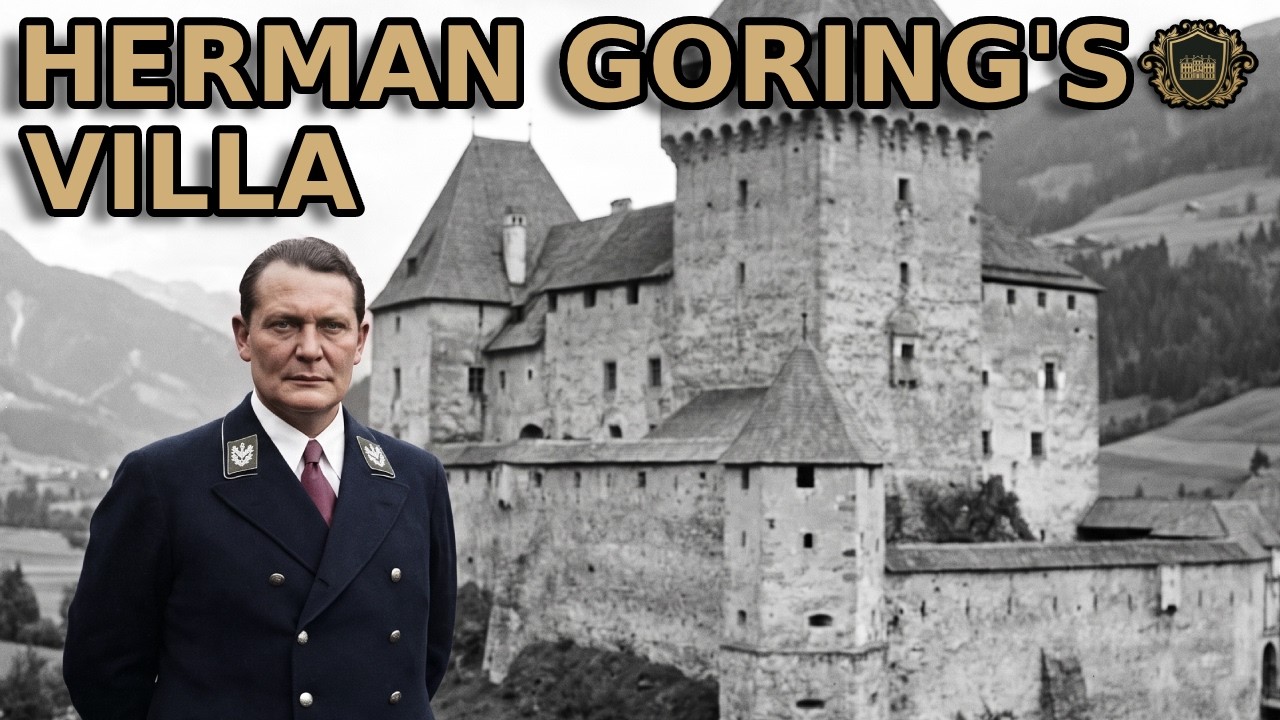
Hermann von Epenstein was born in 1850 in Berlin. His father was a doctor who converted from Judaism to Catholicism in order to marry, a common social arrangement in mid-19th-century Prussia that granted the convert respectability without entirely erasing his origins. Under the racial classification system that the regime his godson later helped build would impose, he would have been classified as a "Mischling" of the first degree — someone with two Jewish grandparents who did not practice the Jewish religion.
Epenstein studied medicine, practiced it for a period the available records do not precisely define, and then moved into business and real estate. No single archive fully documents the sources of his fortune, but by the early 1890s he had accumulated enough capital to pursue a singular obsession: buying and restoring ruined castles.
He purchased Mauterndorf Castle in 1894 from the Austrian state for a sum that Salzburg archive records describe as modest, given that the building was entirely abandoned and generated no income. Three years later, in 1897, he bought Veldenstein Castle, a second ruin near the village of Neuhaus an der Pegnitz in Franconia, about 40 kilometers east of Nuremberg.
Between the two properties, he spent more than a million marks on restoration over the following decade, an enormous sum at a time when senior Prussian civil servants earned about 4,000 marks a year.
The restorations were thorough and deliberate. At Mauterndorf, he rebuilt the roof entirely, repaired every joint in the exterior walls, laid new oak floors in the residential wing, replaced the fortified tower staircase, and commissioned a set of Neo-Gothic furniture to complement the surviving medieval elements. He brought in builders from Tyrol and carpenters from Bavaria. The chapel murals, hidden for centuries under layers of soot and lime, were cleaned and stabilized by a specialist from Munich.
At Veldenstein, he rebuilt the collapsed castle gate, added a carriage road wide enough for four horses, and planted a row of lime trees along the approach that took more than a decade to mature.
He furnished both properties with hunting trophies, armor collections, antlers, boar tusks, and heavy oak furniture that he brought from estate auctions across Central Europe. He hosted frequent receptions at both properties. Weekend guests arrived by carriage and later by automobile. The household staff was permanent and included cooks, gardeners, and a gamekeeper at each property, with domestic servants living in the outbuildings year-round.
In recognition of this work and his charitable donations to churches and civic institutions in the Landau region, the Austrian authorities granted him a minor title of nobility. He became known as Hermann Ritter von Epenstein, later styled Ritter von Mauthenberg after the castle itself. The title carried no land rights, no parliamentary seat, and no hereditary privileges. It was essentially a decorative title and an acknowledgment of civic contribution. But it allowed him to sign correspondence and present himself at social gatherings as a landed aristocrat, which appears to have been the primary objective.
The relationship with the Göring family began abroad. Heinrich Ernst Göring, a seasoned jurist from a Prussian legal family, had served as the first Reich commissioner in German South West Africa from 1885 to 1890. His assignment was to establish a civil administration in the territory now known as Namibia, which Berlin had claimed in 1884 as part of Bismarck's colonial expansion.
After Africa, Heinrich joined the diplomatic corps and served as Germany's resident minister in Haiti and the Dominican Republic from 1892 to 1895, a posting that kept him and his wife thousands of kilometers from their children for extended periods. It was in this colonial and diplomatic world that Epenstein met the Göring family.
The exact date and place of the first meeting is disputed. Some biographies place it in Africa, while others place it in Berlin after Heinrich's return. One account holds that Epenstein assisted Franziska Tiefenbrunn, Heinrich's wife, during a difficult childbirth.
What is not disputed is the outcome. Epenstein became Franziska's close companion. The relationship was open, sustained, and visible to neighbors and relatives alike, and it had financial consequences. Epenstein became the godfather to all five Göring children and the primary financial supporter of the entire family, covering school fees, clothing, medical care, and household expenses that Heinrich's modest diplomatic salary could not meet.
Hermann Wilhelm Göring was born on January 12, 1893, at the Marienbad sanatorium in Rosenheim, Bavaria. His father was stationed in Haiti at the time. His mother returned to Germany to give birth, then sent the infant to live with a family friend in the town of Fürth while she rejoined Heinrich in the Caribbean. That arrangement lasted three years. The young Hermann grew up among strangers during the first years of his life.
When Franziska returned to Germany permanently in 1896, she did not move into a house rented by Heinrich. She moved to Veldenstein Castle, where Epenstein had already settled as master of the household.
The Göring children grew up between two castles. Summers were spent at Mauterndorf in the Austrian Alps. The rest of the year they spent at Veldenstein in Franconia. At both sites, Epenstein was the one who ran the family. He paid the children's tutors, chose their reading material, organized their meals, and supervised the servants who cared for them.
Heinrich, when present at all, occupied a secondary role. A retired diplomat on a small pension, living in another man's castle, eating at another man's table, watching another man exercise daily influence over his children. This family arrangement was visible to anyone who visited either property. Epenstein and Franziska shared rooms on the upper floor. Heinrich occupied a separate suite on a lower level. The children moved between the adults without a fixed schedule.
Biographers later noted that this unstable structure of authority, with the biological father in one corridor and the financial patron in another, shaped Hermann Göring's orientation toward power as a personal rather than institutional phenomenon throughout his life. He learned early that whoever owned the building owned the family. He learned that money determined sleeping arrangements, seating order, and who was permitted to speak at the dinner table. He learned that titles, whether earned or purchased, dictated social reality.
The question of Albert Göring's paternity added another layer to the family dynamic. Albert, born on March 9, 1895, resembled Epenstein in his physical features, a fact noted by family acquaintances and neighbors in Neuhaus, and later by historians who placed photographs of the two men side by side. Albert's face was rounder, his build fuller, his complexion darker than his siblings'. It was never established through any medical or legal inquiry whether Epenstein was his biological father, but the resemblance fueled a persistent rumor that followed Albert throughout his life and produced one of the bitterest paradoxes of the war. The brother who may have been half-Jewish spent the entire conflict saving Jewish lives, while the brother who certainly was not spent the war building the bureaucratic and military machinery to destroy them.
Hermann's boyhood years at the castles left specific and lasting marks on his personality and tastes. He wore a Boer War uniform his father sent from South Africa and organized mock sieges in the Veldenstein courtyard with the children of local farmers. At Mauterndorf, he handled the hunting rifles stored in Epenstein's gun room, tried on pieces of the displayed armor, and climbed the keep to the watch platform to study the valley below.

The Middle Ages were not an abstract or literary concept to him. He touched them, wore them, climbed their walls. They entered his constitution as a physical, tangible experience. When he later built Carinhall, his grand country estate northeast of Berlin, he filled it with flags, antlers, mounted boar heads, and full suits of armor arranged in the hallways, an arrangement that replicated the designs of his godfather's castles in every significant detail.
Hermann Ernst Göring died in Munich on December 7, 1913. He was 75 years old. His pension was small, his final years were quiet, and his influence over his children had ceased to matter for more than a decade. Epenstein continued to support the family financially for another 20 years after Heinrich's death, but the father's departure removed the last structural pretense that the Göring household was organized around a conventional marriage. From 1913 onward, Epenstein was explicitly and unambiguously the sole patron of the family.
Franziska Tiefenbrunn Göring died in 1923. By then, Hermann Göring was a decorated war hero, a holder of the Pour le Mérite, and a rising figure in the National Socialist movement. The relationship between Hermann and Epenstein cooled after Franziska's death. The two men no longer had much in common with her gone as the connecting thread.
Epenstein lived in his castles for another 14 years after Heinrich's death, increasingly reclusive, tending his collections and gardens until his death in 1934. Epenstein died on October 18, 1934. He was 84 years old.
His estate, including both Mauterndorf and Veldenstein castles, passed to his widow Elisabeth, known to the family as Lili. She was not Franziska. Epenstein had married a younger woman after Franziska's death, and the marriage produced no children. Lili inherited the properties, the furnishings, the armor collections, and the accumulated maintenance obligations of two large medieval buildings.
By 1934, Hermann Göring was among the most powerful men in Germany. He held the rank of Reich Marshal, the highest military rank in the German armed forces. He commanded the Luftwaffe, which he had built from a secret planning office into a force of thousands of aircraft in less than three years. He served as commissioner of the Four-Year Plan, giving him direct authority over the German war economy, including steel production, synthetic fuel manufacturing, and raw material allocation. He had also founded the Gestapo, the state secret police, in 1933, though he later handed its day-to-day administration to Heinrich Himmler.
He was also the chief architect of the Anschluss, the annexation of Austria in March 1938. In the days before the German invasion, Göring issued a series of ultimatums to the Austrian government by telephone and telegram. He forced Chancellor Kurt von Schuschnigg to resign, demanded the cancellation of a planned independence referendum, and arranged for the appointment of the Nazi official Arthur Seyss-Inquart as replacement chancellor. When Seyss-Inquart hesitated to send the telegram inviting German troops into Austria, Göring had a German agent send the message instead. At the Nuremberg trials eight years later, Göring boasted that he bore 100 percent of the responsibility for the annexation.
The Anschluss had a direct and practical effect on Mauterndorf Castle. Before March 1938, the castle stood in a foreign country. Its legal status was governed by Austrian property law, Austrian inheritance law, and Austrian courts. After March 1938, the castle was inside the German Reich. Austrian law was subordinated to German law. Austrian courts became answerable to German courts. Göring's role in erasing the border was, among many other things, an act that greatly simplified his personal property arrangements.
Lili Epenstein died in 1939. In her will, she left Mauterndorf to Hermann Göring and sold Veldenstein to him for a sum that records indicate was far below market value. The Mauterndorf bequest was consistent with the long-standing family understanding that Epenstein's properties would eventually go to his baptized children, but the transfer was never formally recorded in the Austrian land register.
No surviving document establishes whether this omission was an administrative oversight caused by the chaos of the Anschluss, a legal complication arising from the merger of two property law systems, or a deliberate choice by Göring to avoid creating an official paper trail linking his name to a Jewish benefactor. The result was a castle that Göring treated as his own property, referred to in his correspondence as his property, but never legally owned in any sense a court would have recognized.
Meanwhile, Göring was assembling one of the largest private art collections in 20th-century Europe. Working through a network of dealers, agents, and direct confiscation orders issued under his authority as head of the Four-Year Plan, he gathered approximately 1,375 paintings along with hundreds of sculptures, bronzes, ivories, and decorative objects. The bulk of the collection was kept at Carinhall, his country estate near Schorfheide, northeast of Berlin.
A large and well-documented portion of the collection was looted from Jewish art collectors and galleries across occupied France, the Netherlands, Belgium, and Poland. The irony was precise and inescapable. A man whose childhood was financed by a family of Jewish origin, whose surrogate father was a Jewish doctor, and whose brother may have been that doctor's biological son, was now seizing Jewish property on an industrial scale and displaying it in a country house that deliberately imitated the interiors of the Jewish man's castles.
The castle of his boyhood was furnished with Jewish money. Carinhall was furnished with Jewish art.
Mauterndorf itself was not a major art storage site. When it became clear after the Allied advance that Carinhall had to be evacuated, Göring's agents moved the collection south to tunnels near Berchtesgaden and to Fischhorn Castle near Zell am See. But Mauterndorf remained a fixed point of emotional attachment in his personal geography, referred to in letters and private conversations throughout the 1930s and 1940s. He called it my youth castle. He repeated the phrase often without any apparent awareness of its full historical weight.
The final chapter began on April 20, 1945. It was Hitler's 56th birthday. Göring attended the reception in the bunker complex beneath the Reich Chancellery in Berlin, offered his congratulations, and then left the city for Berchtesgaden in the Bavarian Alps. He never returned to Berlin. He was among the last senior Nazi officials to leave the capital before the Soviet encirclement closed all road and rail exits.
Three days later, on April 23, Göring sent a telegram to Hitler from Berchtesgaden. The message proposed that Göring assume leadership of the Reich, citing a 1941 decree that named him Hitler's successor should the Führer become incapacitated or unable to exercise power. The telegram was carefully worded. It included a deadline. If Hitler did not respond by 10 that evening, Göring would treat silence as confirmation and begin issuing orders in his name.
Hitler's response was immediate and furious. Martin Bormann, the head of the Party Chancellery and Göring's old rival, presented the telegram to Hitler as evidence of an attempted coup. Hitler issued a cascade of orders. He stripped Göring of all his offices, including command of the Luftwaffe and the rank of Reich Marshal. He expelled him from the Nazi Party. He revoked the 1941 succession decree and ordered the SS to arrest Göring at his Obersalzberg compound and to execute him if the military situation made continued detention impractical.
The SS arrested Göring, his wife Emmy, his daughter Edda, and several members of his personal staff. For the next twelve days, from April 23 to May 5, he was held under armed guard at his home, watched by men with explicit orders to shoot him rather than allow him to fall into Allied hands.
The situation did not require his execution. On May 5, a unit of the Luftwaffe, composed of officers and soldiers still personally loyal to the former Reich Marshal, arrived at the Obersalzberg compound and overpowered the SS guards. Details of the confrontation are sparse. No shots were fired. The SS men surrendered their weapons and left.
Göring gathered his family, a small entourage of staff and aides, and a convoy of vehicles loaded with personal belongings. He drove south through the mountains along roads increasingly crowded with retreating Wehrmacht units, displaced civilians, and the wreckage of abandoned military equipment. His destination was Mauterndorf.
He reached the castle on the evening of May 5 or the early morning of May 6. The exact timing is uncertain because the collapse of German military and civil communications in the final week of the war produced conflicting dates in surviving records. What is clear is that he spent no more than a day or two inside the building before deciding to surrender.
Göring wanted to surrender to the Americans. He feared the Soviets, whose advance units were moving west through eastern Austria, and he believed the Americans would treat him as a high-ranking prisoner of war rather than as a criminal.
On May 6 or 7, his personal adjutant, Colonel Bernd von Brauchitsch, drove north from Mauterndorf to the command post of the 36th Infantry Division and opened communications. Brigadier General Robert I. Stack, the division's assistant commander, agreed to accept the surrender personally.
Stack intercepted Göring's convoy on a road near the town of Radstadt, about 35 kilometers north of Mauterndorf. The encounter was tense. SS units in the surrounding hills had not yet surrendered and could have fired on either party.
Stack escorted Göring to the 36th Division command post, set up in the Grand Hotel in Kitzbühel. There, Göring was photographed smiling alongside American officers, apparently believing he would be treated as a diplomatic figure rather than a war crimes suspect. He was interrogated, placed under formal arrest, and moved south to Fischhorn Castle near Zell am See. From there he was eventually transferred to the Allied detention facility at Mondorf-les-Bains in Luxembourg, where senior war criminals were gathered before the Nuremberg trials began.
Albert Göring's war ended with less fanfare and no photographs. He spent the conflict years working at the Skoda armaments factory in occupied Czechoslovakia. From that position, he used his access to travel documents, factory letterhead, and the weight of his family name to forge transit papers for persecuted families, secure the release of individual prisoners from concentration camps, and smuggle political dissidents across borders.
When the war ended, he surrendered to American intelligence officers and was asked to explain why a man named Göring had spent the war helping Jews. Thirty-four people provided sworn affidavits testifying to his rescue efforts. He was released, then rearrested by Czechoslovak authorities, interrogated again, and released again, spending the last 21 years of his life in deep poverty in Munich. He died on December 20, 1966, two years before the province of Salzburg bought the castle where he had spent childhood summers.
The International Military Tribunal at Nuremberg opened on November 20, 1945. Göring was the number one defendant, the highest-ranking surviving member of the Nazi leadership. He had lost more than 30 kilograms during months of detention and had been weaned off the paracodine addiction that had gripped him for years. The man who sat in the dock was physically diminished but intellectually sharp.
Throughout the trial sessions, Göring was alert, combative, and theatrical in his performance. He challenged prosecutors on points of international law, disputed the admissibility of documentary evidence, and defended the actions of the Third Reich with a rhetorical fluency that unsettled several Allied judges. His examination by U.S. prosecutor Robert H. Jackson became one of the trial's most notorious episodes, with Jackson struggling at several points to maintain control of the proceedings. Göring treated the courtroom as a final stage, an opportunity to present himself as a patriot who had served his country rather than as a criminal complicit in mass murder.
He was convicted on all four counts against him: conspiracy to wage aggressive war, crimes against peace, war crimes, and crimes against humanity. He was sentenced to death by hanging. He requested execution by firing squad, as a military rather than criminal death. His request was denied.
On the night of October 15, 1946, about two hours before his scheduled execution, Göring bit down on a brass cartridge containing a potassium cyanide capsule that he had concealed somewhere inside his cell. He died within minutes. How he obtained the poison under strict security conditions was never conclusively determined. An American guard named Herbert Lee Stivers later said in interviews that he had been persuaded by a German woman to smuggle a small object to the prisoner hidden inside a fountain pen, without knowing its contents. Other theories suggested the capsule had been concealed among his personal effects since his initial arrest, or that it was passed to him by another prisoner. No official conclusion was ever issued.
Göring left a note to the Allied commander. In it, he stated that he would not submit to execution by his enemies. The Reich Marshal of the Greater German Reich could not be hanged like a common criminal. He had chosen to determine his own death. The note was dramatic, arrogant, and entirely consistent with the persona he had displayed throughout the trial.
The castle he had considered his own entered a long legal twilight. Epenstein's heirs argued that Lili's will leaving Mauterndorf to Göring was invalid because the transfer had never been registered in the land records. The West German federal government, which confiscated the assets of convicted war criminals, asserted a competing claim. The Austrian government, on whose sovereign territory the castle actually stood, watched the dispute without intervening for more than two decades until 1968, when the province of Salzburg bought the property outright and ended the litigation.
The restoration work that followed between 1979 and 1982 focused exclusively on the building's medieval structure. Workers restored the tower's wooden floors, replaced rotted beams in the residential complex, repaired mortar joints in the defensive walls, and cleaned the 14th-century chapel murals for the second time in the castle's modern history.
Afterward, the provincial museum authority installed two permanent exhibitions. The first, titled "The Desire for the Middle Ages," uses multilingual audio guides and life-size costumed figures to reenact the daily routine of a medieval toll station. Merchants arrive at the gate, the archbishop inspects the accounts, the knight watches from the tower. The second, the Lungau Landscape Museum, documents the geology, mineral deposits, traditional crafts, and seasonal customs of the surrounding valley.
Today, a knight's playground occupies the inner courtyard. A restaurant called Burgschenke serves regional Austrian cuisine in the former grain store. Visitors can climb the full 44 meters of the tower and stand on the same platform where a boy in a Boer War uniform once scanned the valley with borrowed field glasses.
There is no memorial plaque anywhere on the property. There is not a single interpretive panel. No room bears the name "Göring period" or "Epenstein restoration." The castle's promotional website traces its history from the Roman garrison through the medieval archbishops, mentions Epenstein's acquisition briefly, and then moves directly to the provincial purchase of 1968, as if the intervening decades were a gap in the historical record rather than a chapter the institution has chosen not to write.
That decision is deliberate. Austria's relationship with its wartime past has long been managed through a specific set of architectural choices. What to restore, what to demolish, what to label, and what to leave unlabeled. Mauterndorf was left unlabeled. The building communicates its medieval identity through every sign, audio guide, and costumed figure. It communicates its 20th-century identity through their absence.
The tower still stands at 44 meters. The toll road still cuts through the mountain pass. The murals still cover the chapel ceiling. And the name that occupied the building for six years has been removed as thoroughly as if it had been chiseled out of the limestone.
In the courtyard on a summer midday, children climb a wooden siege tower and fire foam-tipped arrows at a painted target. The target is shaped like a shield. The shield bears no coat of arms. It is blank, deliberately, precisely, and permanently.