Ozzy Osbourne’s death brought the world of heavy metal to a standstill, but his private farewell revealed something even more unexpected. As thousands gathered publicly to mourn the man once known as the Prince of Darkness, a much smaller group gathered behind closed doors to say goodbye. Among them were familiar faces, old friends, estranged family members, and people whose relationships with Ozzy had taken very different turns. But there were also guests whose presence raised questions about old wounds, broken alliances, and whether some grudges had finally been buried with him.
Long before Ozzy Osbourne became the Prince of Darkness, before the sold-out arenas and outrageous headlines, he was simply John Michael Osbourne, a working-class boy from Birmingham. Born on December 3rd, 1948, in Aston, he grew up in a tiny two-bedroom home shared by his parents, three older sisters, and two younger brothers. The family had very little money, and nothing about his childhood suggested he would one day become one of the most recognizable figures in rock music history. School was particularly difficult for Ozzy.
He struggled with dyslexia and attention-related difficulties, and the experience left him feeling isolated and humiliated. He was bullied by other children and recalled harsh treatment from teachers, experiences that convinced him traditional education was not built for him. By age 15, he had left school and entered the world of manual labor, working in construction, spending time in a car factory, and eventually taking a job at a slaughterhouse, an experience he later described as particularly unpleasant. Music would eventually provide his escape, but before it did, his desperation briefly pushed him toward crime.
Ozzy was arrested after breaking into a clothing shop and stealing property. Because his father refused to pay the fine, hoping the experience would teach his son a lesson, Ozzy spent six weeks inside Winson Green prison before turning 18. Prison gave him unexpected time to think about what he actually wanted from his life. Then came the Beatles.
Hearing “She Loves You” helped convince Ozzy there was another possibility beyond factories and construction sites. He wanted to become a musician. In 1968, he joined forces with Tony Iommi, Geezer Butler, and Bill Ward in a Birmingham group originally known as Earth. The band soon changed its name to Black Sabbath, borrowing the name from a 1963 horror film starring Boris Karloff.
Ozzy’s journey into heavy music had begun. Their breakthrough arrived with the release of Black Sabbath in 1970, followed later that same year by Paranoid. The latter produced songs that became permanent fixtures of rock history, including “War Pigs,” “Iron Man,” and the title track. Over the course of Black Sabbath’s original run, Ozzy recorded eight studio albums with the group, helping create a catalog that would influence generations of heavy metal musicians.
Success eventually came with its own price. Ozzy’s substance abuse became increasingly severe, his behavior unpredictable, and his relationship with the other members deteriorated. In 1979, Black Sabbath fired him. For most musicians, dismissal from the band that made them famous might have been the end.
For Ozzy, it became the beginning of another chapter. With the support of Sharon Arden, who would eventually become his wife and manager, he rebuilt his career as a solo artist. In 1980, Blizzard of Ozz arrived, producing “Crazy Train,” one of the most recognizable songs in heavy metal history, while Diary of a Madman followed in 1981. Ozzy ultimately sold more than 100 million records across his combined work with Black Sabbath and as a solo artist.
He accumulated Grammy awards, received a Hollywood Walk of Fame star, and entered the Rock and Roll Hall of Fame twice, first with Black Sabbath and later as a solo artist in 2024. But the accolades only told one part of the story. The same man who helped invent heavy metal would spend decades battling addiction, surviving serious accidents, enduring devastating health problems, and repeatedly finding himself at the center of controversies. Some of those episodes were so outrageous they became part of his mythology.
But behind the mythology was a man whose private life was far more complicated than the character the world saw on stage. During the worst periods of his substance abuse, Ozzy consumed enormous quantities of alcohol and illicit substances. His first marriage to Thelma Riley had begun in 1971 during the early years of his Black Sabbath fame. Ozzy adopted Thelma’s son, Elliot, and the couple later had two children of their own, Jessica and Lewis.
But touring, infidelity, and substance abuse gradually turned the marriage into something deeply unstable. The marriage eventually collapsed, and Ozzy would later acknowledge that his addiction and lifestyle had made him a terrible husband and father during that period. Then came one of the incidents that helped transform Ozzy’s real-life behavior into rock mythology. In 1981, while performing in Des Moines, Iowa, Ozzy encountered an object thrown onto the stage by an audience member.
He believed it was a rubber toy. It was actually a dead bat that turned out to be real. Ozzy picked it up and bit its head off. He subsequently had to receive medical treatment, including rabies vaccinations, because of the possibility the animal had been infected.
Earlier that year, while meeting with executives at CBS Records, Ozzy reportedly brought two live doves into the room. In an intoxicated state, he killed one of them. And then there was San Antonio. In 1982, while heavily intoxicated, Ozzy urinated on what he believed was a wall or structure near the Alamo.
He was arrested for public intoxication and subsequently banned from San Antonio for years. What made the episode even more bizarre was the claim that he had been wearing one of Sharon’s dresses at the time. Ozzy and Sharon married in 1982, and their relationship became one of the defining partnerships in rock history. Sharon was not simply his wife.
She became his manager, business strategist, and in many ways, the person responsible for keeping his career alive. Together, they had three children, Amy, Kelly, and Jack. One of the most disturbing episodes occurred in 1989 when Ozzy, during a period of severe substance-induced psychological instability, physically confronted Sharon inside their home. Ozzy was arrested and spent months in a court-ordered treatment facility.
The incident could have ended the marriage permanently, but Sharon eventually chose to remain with him. Ozzy’s reputation was already far larger than his music. That became especially obvious when The Osbournes premiered on MTV in 2002. The reality series transformed the family into a television phenomenon.
Millions of viewers watched Ozzy at home rather than on stage. Addiction was no longer an abstract part of his biography. It became something viewers could see affecting the people closest to him. Then, in 2016, Sharon revealed that Ozzy had been unfaithful with celebrity hair colorist Michelle Pugh.
The revelation led Sharon to temporarily separate from him, and Ozzy entered treatment for what was described as an addiction to intimacy. They eventually reconciled. By that point, however, Ozzy’s body was beginning to impose limits that even fame could not overcome. In 2019, Ozzy was diagnosed with Parkinson’s disease, a condition he publicly disclosed in 2020.
The diagnosis came when he was already dealing with serious physical problems stemming from an earlier accident. In 2003, Ozzy had suffered a devastating accident at his Buckinghamshire estate. The crash caused significant spinal injuries and left him with long-term nerve damage. Another fall at home in 2019 aggravated those injuries and caused further damage to the metal rods implanted in his spine.
Ozzy underwent multiple spinal surgeries and eventually found himself struggling to walk. The man who had spent decades jumping across enormous stages was now often dependent on a wheelchair. Yet Ozzy refused to let his final chapter be defined entirely by illness. In 2025, plans were made for one of the most emotionally significant performances of his career.
Back to the Beginning, a massive homecoming event at Villa Park in Birmingham. On July 5th, 2025, Ozzy returned there for the final performance of his career. He could no longer stand for an entire concert, so he performed seated on a specially designed throne. He sang “I Don’t Know,” “Mr.
Crowley,” “Mama, I’m Coming Home,” and “Crazy Train” during his solo set before joining Tony Iommi, Geezer Butler, and Bill Ward for the final Black Sabbath performance. It was the first time the original four members had performed together since 2005. Then, just 17 days later, the world lost him. Ozzy Osbourne died on July 22nd, 2025, at the age of 76.
His death certificate later identified an out-of-hospital cardiac arrest and acute myocardial infarction with coronary artery disease, with Parkinson’s disease and autonomic dysfunction listed as contributing factors. On July 30th, thousands of people gathered along Broad Street as Ozzy’s funeral cortege moved through his hometown. Fans chanted his name while music accompanied the procession, including brass band versions of Black Sabbath classics. The hearse stopped at the famous Black Sabbath Bridge where Sharon and the family saw the mountain of flowers and messages fans had left behind.
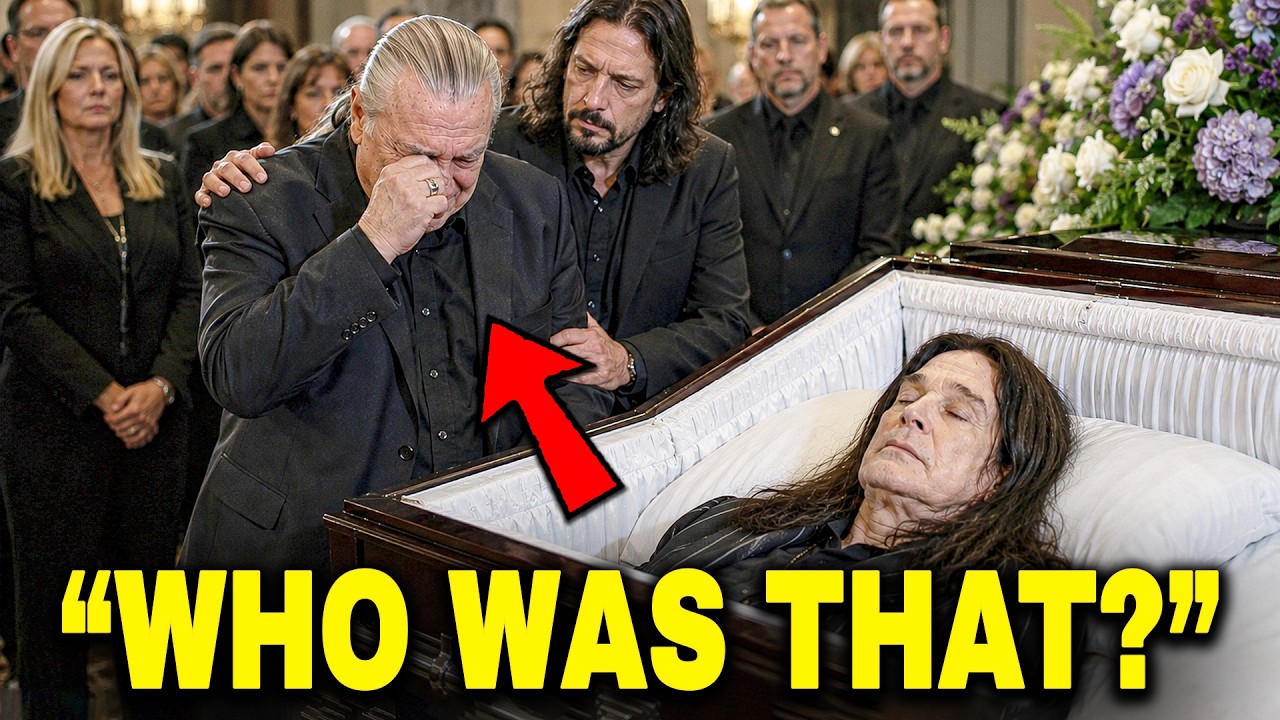
The following day, the public farewell gave way to something much more private. On July 31st, Ozzy was laid to rest at the Osbourne family’s Buckinghamshire estate, Welders House. His burial took place near a lake on the property, honoring his wish to have his final resting place at home. Approximately 110 family members, friends, and carefully selected guests attended.
And when the guest list began to emerge, it became clear that Ozzy’s final farewell was not simply a gathering of his closest family members. Tony Iommi and Geezer Butler were almost impossible to imagine missing. Zakk Wylde had spent years performing beside Ozzy and regarded him as something closer to an older brother than a former employer. Metallica’s James Hetfield and Robert Trujillo represented another generation of musicians who had inherited the world Ozzy helped build.
Corey Taylor and Rob Zombie represented yet another generation. Yungblud represented the newest. And then there was Bill Ward. Ward’s presence was particularly meaningful because the relationship between the original Black Sabbath members had never been completely straightforward.
When Black Sabbath attempted to reunite in the 2010s, Ward became embroiled in a public dispute over contractual terms. He ultimately did not participate in the band’s later reunion performances. Ozzy was openly critical of Ward during that period. Yet Ward attended the funeral, standing alongside Iommi and Butler as the surviving original members of Black Sabbath gathered to say goodbye.
Marilyn Manson’s attendance was particularly striking because Manson had become one of the most controversial figures in modern rock, facing multiple allegations and civil lawsuits, all of which he has denied or contested. Ozzy had maintained a connection with him. Manson had publicly paid tribute to Ozzy after his death, describing him as a beloved friend. Rob Zombie attended as well.
Elton John was also among the mourners, providing a bridge between two very different worlds of British popular music. Yungblud, at 27, belonged to a generation that had grown up with Ozzy as an established cultural figure. Ozzy and Sharon had appeared in Yungblud’s 2022 music video for “The Funeral,” a title that became almost haunting in retrospect. Amy Osbourne’s presence was especially significant because she had spent much of her life deliberately avoiding the family’s public identity.
When The Osbournes became a television phenomenon in 2002, Amy refused to participate. She eventually left home as a teenager rather than become part of the reality show machine. When she appeared during her father’s final farewell, it carried emotional weight precisely because she had spent so much of her life refusing the spotlight. She stood with her siblings, Jack and Kelly, and with Lewis, Ozzy’s son from his first marriage.
Reports from the service described a stage on the estate where guests could share memories and performances, turning what might have been an overwhelmingly mournful occasion into something closer to a celebration of Ozzy’s life. Robert Trujillo later described the private funeral as beautiful and deeply emotional, recalling the atmosphere as both sad and, in places, surprisingly funny. Ozzy was buried near the lake on the family’s Buckinghamshire estate. There was no enormous stadium ceremony.
Instead, there was a small gathering, a private farewell, and a group of people whose presence quietly told the story of a career that stretched from a poor Birmingham childhood to the summit of global rock music. The Prince of Darkness had spent his career building an image around rebellion, danger, and excess. Yet when the time came to say goodbye, the people who surrounded him were not there because of the mythology.
They were there because somewhere beneath the headlines and decades of chaos, there was a man whose music had changed their lives.