Queen Victoria’s private journal, kept daily for 69 years and running to an estimated 60 million words, survives today in 111 handwritten volumes at Windsor Castle’s Royal Archives. Every word in those volumes is in the handwriting of her youngest daughter, Princess Beatrice. The originals are gone. Beginning in 1902, the year after her mother died, Beatrice read each journal volume, transcribed the passages she judged fit to survive, and then destroyed the original book.
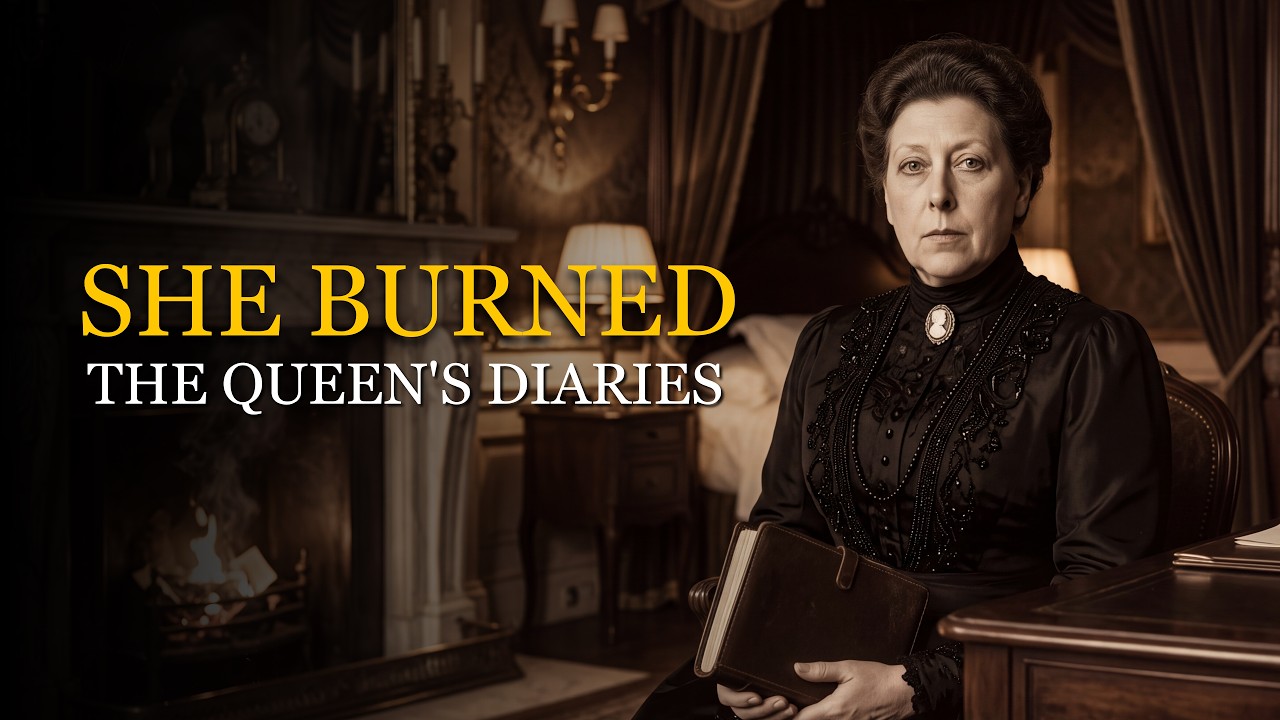
She finished in 1931. Roughly two-thirds of the Queen’s written record had been reduced to ash, and the only person who ever saw Victoria’s written instructions authorizing the work was Beatrice herself. Beatrice was born on April 14, 1857, the ninth and last child of Victoria and Prince Albert. Her birth was unusual for the era: Victoria took chloroform, administered by Dr.
John Snow, a decision that drew disapproval from the Church and much of the medical profession. The Queen later called it “that blessed chloroform. ”
When Albert died on December 14, 1861, Victoria carried her sleeping four-year-old into her own bed and held her through the night. That night effectively decided the rest of Beatrice’s life.
Over the following decades, as her sisters married and left, Beatrice became her mother’s constant companion and, in practice, her private secretary—writing letters on the Queen’s behalf before she turned 16. Victoria made no secret of her dependence. She called Beatrice her “constant companion” and expressed hope she would never leave. Beatrice had announced at age six that she did not like weddings, would never marry, and would stay with her mother.
The family treated that childhood remark as a binding contract. When suitors appeared, Victoria removed them. Louis Napoleon, the Prince Imperial, was linked to Beatrice in the press but died in the Anglo-Zulu War in 1879. A proposal to marry Beatrice to the widowed Grand Duke of Hesse was blocked by British law forbidding a man from marrying his deceased wife’s sister.
When Prince Louis of Battenberg took an interest, Victoria seated herself between the pair at dinner and instructed her daughter to ignore him. In April 1884, at a family wedding in Darmstadt, Beatrice met Prince Henry of Battenberg, the younger brother of the man she had been told to ignore. She told her mother she wished to marry him. Victoria did not argue.
She simply stopped speaking to her daughter for roughly seven months, communicating only in writing while they shared the same houses and meals. Beatrice continued her secretarial work throughout the silence. The rest of the family eventually persuaded Victoria to relent. Consent was granted in January 1885, but the terms were severe: Henry had to resign his Prussian commission, give up his country, and live permanently with the Queen in her houses.
Beatrice was required to continue as her mother’s unofficial secretary exactly as before. The wedding took place on July 23, 1885, at St. Mildred’s Church near Osborne on the Isle of Wight. Beatrice wore her mother’s wedding veil.
The honeymoon lasted two days. Four children followed between 1886 and 1891. Henry of Battenberg had nothing to do. His career had been surrendered as a condition of marriage, and his life in the Queen’s household offered no real function.
In late 1895, he asked permission to join a military expedition to West Africa. Victoria reluctantly agreed. He contracted malaria, was carried aboard a cruiser, and died off Sierra Leone on January 20, 1896. He was 37.
Beatrice was waiting for him at Madeira when the telegram arrived telling her he had been dead for two days. Victoria died at Osborne on January 22, 1901—five years and two days after the telegram reached Madeira. In her coffin, at her own instruction, she was buried with a photograph of John Brown, a lock of his hair, and his mother’s wedding ring, hidden under flowers so her family would not see them. Victoria had left separate written instructions for Beatrice: she was to take charge of the journals and remove anything liable to affect any of the family painfully.
The instruction was a private paper, never published, never shown to any other person. Beatrice described her authority in those words herself. She was not named literary executor in the will; the only authority was that unseen document. The method Beatrice used was methodical.
Volumes arrived one at a time from the Royal Library. She read each one, made a working draft of what she intended to keep, copied that draft in her own hand into blue-bound notebooks, destroyed her working draft, and then burned the original volume. She repeated the process for 29 years. Only one direct trace of the work in progress survives.
In 1904, Beatrice wrote to Lord Esher, keeper of the Royal Archives, asking him to collect the key to the box so he could bring her the next volumes of the journals, having finished the last notebook she had for writing into. Lord Esher inadvertently preserved the evidence of what the editing removed. For a book about Victoria’s early life, he had typescript copies made of the original journals covering 1832 to February 16, 1840—six days after Victoria’s wedding—before those originals were destroyed. For roughly eight years, the unedited words and Beatrice’s edited version of the same days both existed.
The comparison shows the method in a single morning. On February 13, 1840, Victoria recorded that her new husband put on her stockings, that she watched him shave, that this was “a great delight” to her, that they breakfasted together, and that she sang to him. Beatrice’s surviving version removes the entire morning: the stockings, the shaving, the breakfast, the singing. It begins with a walk to see Mama and records the weather and the hunt.
Historians cite this passage as the standard exhibit for what the editing did. The scholarly consensus is that Beatrice removed material on physical intimacy with Albert, family quarrels, blunt opinions of her children, references to John Brown, and political indiscretion. Those conclusions are inferences drawn from this one surviving window; no one has read a single destroyed page. While Beatrice copied in her cottage, her brother, now Edward VII, was destroying material too.
He had Victoria’s memorials to John Brown pulled down and destroyed more than 300 letters from his mother to her Balmoral factor that concerned Brown. He sent men to the home of Abdul Karim, his mother’s Indian teacher, demanded every letter and paper, and burned them on the spot. There is no evidence that Victoria and John Brown were lovers. The claims of a secret marriage or child rest on hearsay and are unsupported by any document.
The surviving record shows a queen who grieved for a friend publicly and ferociously, to her family’s humiliation. Beatrice worked through the journals during the years her own world was collapsing. In October 1914, her favorite son, Maurice, was killed at Ypres at age 23. In 1917, the family renounced its German titles and became Mountbatten.
In 1922, her son Leopold, who had inherited hemophilia, died after surgery, one month before his 33rd birthday. Her daughter Ena had married the king of Spain; when their heir proved hemophiliac, her husband blamed Beatrice personally. George V and Queen Mary are documented as deploring the destruction of the journals, but no record shows either of them stopping it. Beatrice continued anyway, into her 70s, long after most of the people who might have been wounded by the contents were dead.
She finished in 1931. She died on October 26, 1944, aged 87, one day short of the 30th anniversary of Maurice’s death. She was the last surviving child of Queen Victoria and Prince Albert. She was buried beside her husband in the Battenberg Chapel on the Isle of Wight.
What survives today is a fragment: 13 original volumes in Victoria’s hand covering 1832 to 1837, Esher’s 13 typescript copies covering 1832 to 1840, four volumes of Victoria’s own drafts, and 111 volumes in Beatrice’s handwriting at a third the length of what they replaced. In 2012, the Royal Archives digitized 141 volumes and 43,765 pages and placed them online. Free access was restricted to users within the United Kingdom in 2013. Historians have called the destruction one of the greatest acts of historical censorship of the century.
Others argue the explanation need not be scandal; Victoria wrote so forcefully and so freely that the sheer volume and rawness may have been reason enough for her daughter to prune it. Beatrice was following written orders she had received from her mother, and she obeyed as she had obeyed that woman for 43 years. Both things are true. She was following instructions, and the instructions destroyed the record.
The one person who could have explained the full contents of those burned pages was the shy, obedient daughter who never kept a journal of her own.