In 2010, when Corey Haim died at 38, the media instantly declared his death a drug overdose. The coroner’s report told a different story: zero illegal drugs in his system, prescription medications at therapeutic levels, and an official cause of death of pneumonia, respiratory failure, and an enlarged heart—the physical toll of a body that had spent years processing toxic substances. He died broke, in a rented Burbank apartment, with his cancer-stricken mother nearby. The path to that moment began in Toronto, where Haim was born in 1971 into an unremarkable middle-class household.
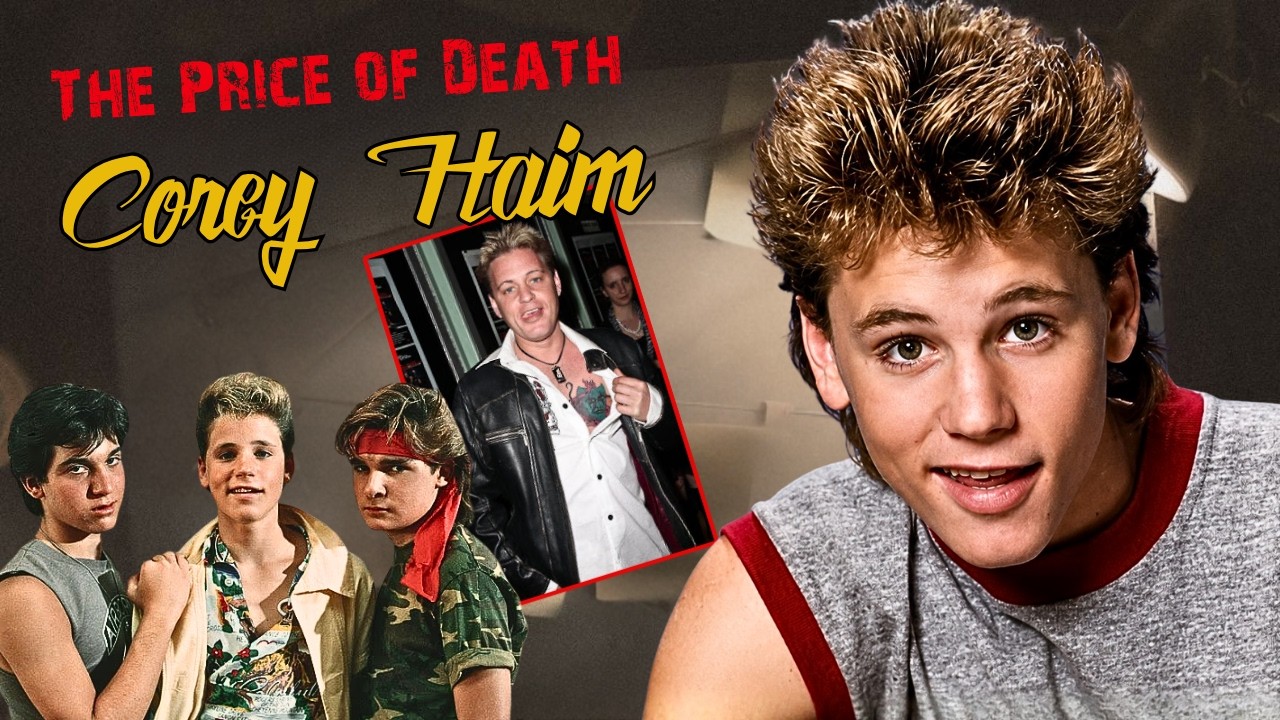
His father sold goods; his mother worked in data entry. There were no showbiz ambitions in the family. Haim was a shy, sensitive boy who loved hockey and dreamed of playing professionally, ideally alongside his idol, Wayne Gretzky. His mother enrolled him in drama and mime classes to help with his crippling social anxiety.
The goal was therapeutic, not professional. But when Haim tagged along to his sister’s audition, casting directors spotted something marketable. By age 10, he was modeling for Sears catalogs, where he was directed to mimic adult male models—an early lesson that his authentic self was not enough to earn approval. His first television role came on the Canadian series *The Edison Twins*.
The steady work on a soundstage gave him a surrogate family, but it was transactional: praise was contingent on performance. That false security primed him for what waited in Hollywood. On his first day filming the 1984 movie *Firstborn*, Haim, then 13, greeted his adult co-star Peter Weller. According to Haim’s own accounts, Weller—deep in an aggressive method-acting approach to his role as an abusive boyfriend—grabbed the boy by the collar, slammed him against a wall, and threatened him, demanding silence between takes.
No crew member intervened. The lesson was immediate: a child’s safety was subordinate to the adults’ artistic process. Despite the trauma, Haim’s talent was undeniable. He took supporting roles in *Secret Admirer* and *Murphy’s Romance* opposite Sally Field, then landed his first leading role in the Stephen King adaptation *Silver Bullet*.
His portrayal of a dying child in the TV film *A Time to Live* earned him a Young Artist Award. By 14, he had proven he could carry a film. Then his father made a calculated decision: Bernie Haim quit his sales job, became his son’s manager, and moved the family to Los Angeles. The line between family and business dissolved.
The household’s income depended entirely on the teenager’s labor. The critical peak came in 1986 with *Lucas*. Roger Ebert, notoriously harsh on child actors, praised Haim’s performance as one of the most three-dimensional of the year and predicted he would become a great adult actor. But the authenticity on screen was not technique.
Haim, secretly in love with his older co-star Kerri Green, channeled his real insecurities into the role. It was also on this set that he drank his first beer at 13—not rebellion, but an attempt to manage stress. His management made a crucial misstep. Haim auditioned for *Stand by Me* and *The Mosquito Coast*, but after losing those roles, his father steered him toward purely commercial projects with higher immediate payouts.
The long-term strategy of building a serious dramatic portfolio was abandoned. In 1987, *The Lost Boys* turned him into a global phenomenon. Overnight, he and co-star Corey Feldman became the highest-paid child stars of the decade. The “Two Coreys” brand was a corporate merger of personas: Haim the sweet, vulnerable romantic; Feldman the edgy rebel.
Their faces were plastered on lunchboxes, posters, and magazine covers. At 15, Haim was earning up to $500,000 per film, traveling on private jets, and living in a $1. 35 million Hancock Park mansion. The wealth was mismanaged.
A manager named Michael Bass was later accused of siphoning the family’s income. Beneath the surface, Haim was being severed from normal development. He was denied a real education, receiving fragmented three-hour tutoring sessions between shoots. His mother became his schedule manager.
His health and mental state were sidelined in favor of production demands. During *License to Drive*, the 16-year-old, holding only a learner’s permit, was forced to actually drive a Cadillac through active streets, with a stunt coordinator hidden on the floorboards. During *Dream a Little Dream*, Haim broke his leg days before filming; the studio refused to delay, so he performed the entire film in severe pain while a fake cast was built into the script. The exploitation extended to his physical safety because the legal protections of the era governed only visible spaces.
Private trailers, dressing rooms, and industry parties ran without oversight. Within those shadows, organized predators operated. They targeted children who were the primary breadwinners of their families—children like Haim, shy, insecure, and desperate for validation. In his 2013 memoir *Coreography*, Corey Feldman confirmed that Haim was deliberately groomed and abused during the production of *Lucas*.
Feldman said the abuser was a powerful man connected to his own circles. Media speculation pointed to Charlie Sheen, who was 19 during filming; Sheen denied the claims, and Haim’s sister publicly dismissed them. Haim’s mother instead named a different industry figure. The specific identity remains disputed, but the fact of the abuse is not in question.
Haim was threatened with an industry blacklist if he spoke; he stayed silent to protect his family’s income. Haim’s eventual drug use was not recreational. It was survival. He suffered from untreated PTSD.
At 15, on the set of *The Lost Boys*, he smoked marijuana as a neurological stabilizer. Within 18 months, the pressure of *License to Drive* drove him to hard narcotics. Cocaine provided the artificial stamina for 14-hour shoots while blacking out his cognitive functions. By 1989, he entered his first rehab.
The treatment was catastrophic. Doctors treated his substance abuse as misbehavior and missed the PTSD entirely. To manage his anxiety, they prescribed massive doses of benzodiazepines, muscle relaxants, and opioids. Haim traded a crack addiction for a pharmaceutical dependency that was far more physically destructive.
At his worst, he was consuming 85 Valium pills a day alongside Soma and Vicodin, procured through a network of cash-only payments and fake aliases to avoid detection. The chemical load ravaged his body. His weight ballooned from 150 to 302 pounds. He developed tremors, slurred speech, and chronic short-term memory loss.
In 2001, he slipped into a drug-induced coma, hovering near brain death. Meanwhile, Hollywood had moved on. Studios abandoned him once his cherubic features matured. More decisively, he was classified as uninsurable.
Without a completion bond—insurance guaranteeing a film will finish on time—no studio could legally cast him. The financial mathematics of Wall Street barred him from mainstream productions. He spent the 1990s in the direct-to-video market, churning out films like *Fast Getaway* and *Demolition High* on brutal 15-day schedules that required punishing 18-hour days. He was paid flat fees between $15,000 and $35,000 per film, with no royalties.
The Screen Actors Guild insurance refused to cover long-term addiction treatment, so he paid out of pocket for more than 15 rehab stints at up to $50,000 per 30-day stay. His teenage fortune evaporated. He also discovered over $200,000 in unpaid tax debt. In July 1997, at 25, he filed for bankruptcy with a declared net worth of zero.
In 2001, functionally homeless and in withdrawal, Haim extracted his own necrotic tooth with crude tools because he lacked dental insurance. He tried to auction the bloody tooth on eBay; the listing was removed. Tabloids and late-night hosts used the incident as comedic fodder. His final attempt at redemption was a self-funded employment ad in *Variety*: “This is not a stunt.
I’m back. I’m ready to work. ” The industry responded with silence and mockery. He was pushed into reality television.
*The Two Coreys* aired his visible decay—withdrawal symptoms, paranoia, and orchestrated conflicts—for ratings. During one volatile exchange, Haim accused Feldman of turning a blind eye to the abuse he endured. In 2008, Feldman severed ties, demanding sobriety. The isolation was absolute.
In his final months, Haim was fighting to get clean, taking small independent film roles and demanding drug-free sets. But his body had nothing left. The flu became pneumonia. Without health insurance and terrified of hospitals, he treated himself with over-the-counter medicine.
On March 10, 2010, he collapsed, unable to breathe. He was pronounced dead at 2:15 a. m. The coroner’s report contradicted every overdose headline.
The press that had printed them offered no prominent retractions. Haim’s family could not afford a casket; fans crowdfunded the funeral. Neither the Screen Actors Guild nor the Academy Awards included him in their in-memoriam tributes.
Hollywood, which had extracted hundreds of millions from his childhood, sent no representatives.