As the First World War raged across Europe, an even more brutal civil war was tearing Russia apart. In the early hours of July 17, 1918, four young women, a hemophiliac boy, their nearly wheelchair-bound mother, and their father were woken and told the White Army was closing in. They were herded into the small basement of the Ipatiev House for their own protection, with two chairs brought in for the sickly boy and his mother who struggled to stand. The family’s only comfort was the muffled rumble of a getaway truck parked just beyond the basement wall.
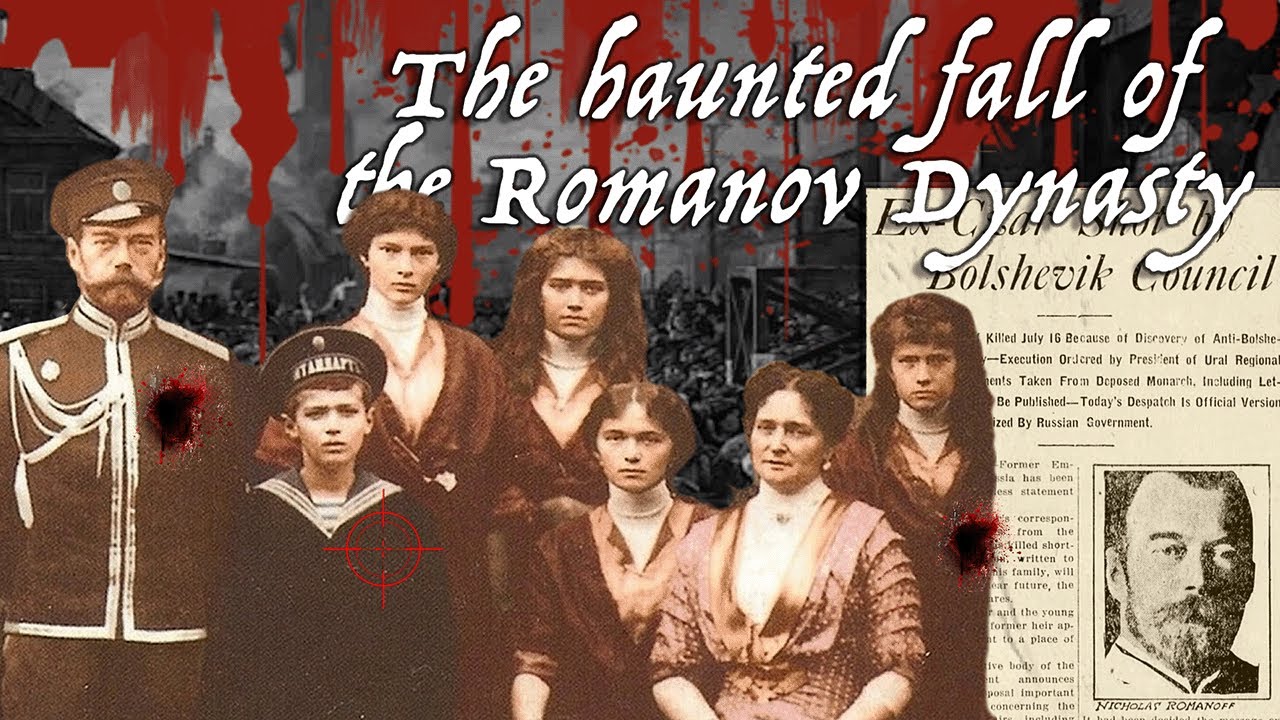
But by the time they could have reached it, they were already dead, their bodies mutilated beyond recognition. Their crime was being the Romanovs, the disgraced rulers of an old Russia that had been on the brink of collapse for decades, and whose patriarch, Nicholas II, had watched it die. The Russia that Nicholas II inherited in 1894 was fragile. Revolution had been simmering beneath the surface for decades.
Nicholas’s grandfather, Alexander II, had abolished serfdom in 1861, warning that it was better to abolish it from above than to wait until the serfs began to liberate themselves from below. The system, which had existed since 1649, had given landowners complete control over the peasants living on their property. The abolition came after Russia’s ambitions were embarrassingly quashed in the Crimean War. Military failure, food shortages, and industrial stagnation were seen as symptoms of the country’s biggest disease: the archaic system itself.
However, the legislative changes meant that landowners were generously compensated for their loss, while the former serfs were left to purchase expensive, often unproductive plots of land that yielded little profit, condemning them to a worse fate, at least initially. After Alexander II was assassinated by a bomb that tore his body apart, the reforms of the previous three decades were abandoned. The hope for constitutional representation was revoked. As both his son, soon-to-be Alexander III, and his grandson Nicholas watched the tsar bleed out in the palace where abolition was officiated, they promised themselves they would never let the same fate befall them.
As Nicholas said just three years into his own reign, “Only autocracy can save Russia,” and so autocracy it was. Following Alexander III’s premature death from kidney disease in 1894, the 26-year-old Nicholas II was left a restless and dissatisfied empire. “What will happen to Russia now? ” he asked his confidants.
“I’m not yet prepared to be tsar. I cannot govern an empire. ” He stood at a crossroads: on one side was a Russia demanding more liberties and parliamentary representation; on the other stood a 300-year-old dynasty whose autocracy was supposedly protected by God. Nicholas was born on May 18, 1868, in the Alexander Palace.
He grew up close to his parents, following a standard royal upbringing of yearly trips to Denmark and service as a junior officer in Imperial Russia’s most revered regiments. As a 16-year-old, at the wedding of his uncle Grand Duke Sergey, he watched the bride’s youngest sister, Alex, quiet and withdrawn on a pew. The 12-year-old princess had become a surrogate daughter to Britain’s Queen Victoria after her own mother died of diphtheria. By the time Alex returned to St.
Petersburg five years later, Nicholas was smitten, though he knew the match was politically dangerous. In 1890, he wrote in his diary that he had loved her for a long time, but even more deeply since the winter she spent in Petersburg, fighting his feelings and trying to deceive himself with the impossibility of his cherished dream coming true. On an early diplomatic tour in 1891, a 22-year-old Nicholas arrived in Japan with his cousin Prince George of Greece. After nearly two weeks, he was taken on a tour of Ōtsu.
As a procession of rickshaws rolled through the narrow streets, one of the constables on guard suddenly jumped forward, brandished his sword, and struck the Russian heir on the head. Prince George managed to block a second blow with his cane. Nicholas was left with a nine-centimeter scar on the right side of his head. Fearing the incident could provide a pretext for a Russian military response, Emperor Meiji himself boarded a train to visit Nicholas, and tens of thousands of calling cards were sent to his hotel by the mortified Japanese public.
By 1894, Alexander III was dying. For the sake of a peaceful succession, Nicholas was finally granted permission to ask for Alex’s hand in marriage. It proved a challenge to convince Alex, raised as a devout Protestant, to convert to Russian Orthodoxy as required by the Russian monarchy. She finally conceded, and Nicholas was overjoyed, scribbling in his diary that “the whole world changed for me in an instant.
”
Alexander died on November 1st. Alex was quickly received into Russian Orthodoxy, taking the name Alexandra Feodorovna. With a pressing desire to wed, Nicholas insisted the ceremony be brought forward, and just weeks after his father’s death, the court organized what would be the last ever wedding for tsarist Russia. The understated ceremony was held in the Winter Palace’s Imperial Chapel.
Alexandra wore a lace veil designed by her grandfather Prince Albert and a 475-carat necklace with earrings that had originally been owned by Catherine the Great. There was no reception and no honeymoon. A shadow of sadness seemed to hang over the entire ceremony. Although there had been hope that a new tsar could herald a new era of constitutional monarchy, just weeks after coming to the throne, a delegation of workers and peasants arriving at the Winter Palace to request reform were met with a stern no.
Nicholas responded that he would devote all his strength to maintain the principle of absolute autocracy as firmly as his late lamented father. The coronation period was planned for 20 days, and amidst the preparation, Moscow was transformed. But the festivities wouldn’t last long. A public feast held on May 30, 1896, in a field outside Moscow ended in a massive stampede that killed 1,389 people and left at least another thousand with severe injuries.
The field, primarily used as a military training ground, was riddled with trenches and uneven terrain. Despite the bad omens, Nicholas attended the French ambassador’s gala that same night as planned, instead of visiting the victims or apologizing. The newly crowned couple’s first child, Olga, was born in November 1895, followed by Tatiana, Maria, and Anastasia. Finally, in August 1905, Alexei was born—a boy, the desperately hoped-for heir to the Russian throne.
Yet the newborn was born against the backdrop of war. In February of that year, Japan had struck the Russian Far East Fleet at Port Arthur in a surprise attack. Russia had been attempting to expand southward beyond Siberia, and Nicholas’s expansionism in Asia had become ever more active. After the Boxer Rebellion, Russia continued to pour troops into Manchuria.
Without a declaration of war, the main Japanese Fleet struck Port Arthur and imposed a blockade, trapping Russia’s Far East Fleet in the harbor. The Baltic Fleet was sent east, but the journey took nine grueling months, by which time Port Arthur had already collapsed. The Baltic Fleet was caught in a scandal when Russian ships mistakenly fired at British civilian trawlers off the Dogger Bank, thinking they were Japanese torpedo boats. Only an immediate apology and promise of compensation prevented an all-out war between Britain and Russia.
As the Russian Fleet approached southern Korea, Japanese ships attacked, sinking two-thirds of Russia’s naval force over the course of just two days. The Russo-Japanese War was concluded with the Treaty of Portsmouth, which formalized a ceasefire, acknowledged Japanese claims in Korea, and demanded the evacuation of Russian troops from Manchuria. Throughout the conflict, Nicholas was largely left in the dark about the state of Russia’s performance, persistently believing in the supposed racial and technological superiority of the Russian Empire. After the war finished in September 1905, a demoralized, economically drained, and utterly humiliated Russia was teeming with discontent unmistakably propped up by an undercurrent of revolution.
On the eve of the 1905 Russian Revolution, Nicholas’s downfall had, in retrospect, already been secured.