On the 7th of May 1925, a small private train carried a coffin to a wooded station on the Wirral. Inside Port Sunlight, the soap kettles fell silent for the first time in 37 years. Eight hundred brick cottages stood quiet behind their hedges, and a choir of factory workers sang in the lane as the body of William Hesketh Lever passed. The man in the coffin built Port Sunlight, the most celebrated model village in Britain, complete with cottages, schools, an art gallery, and a church.
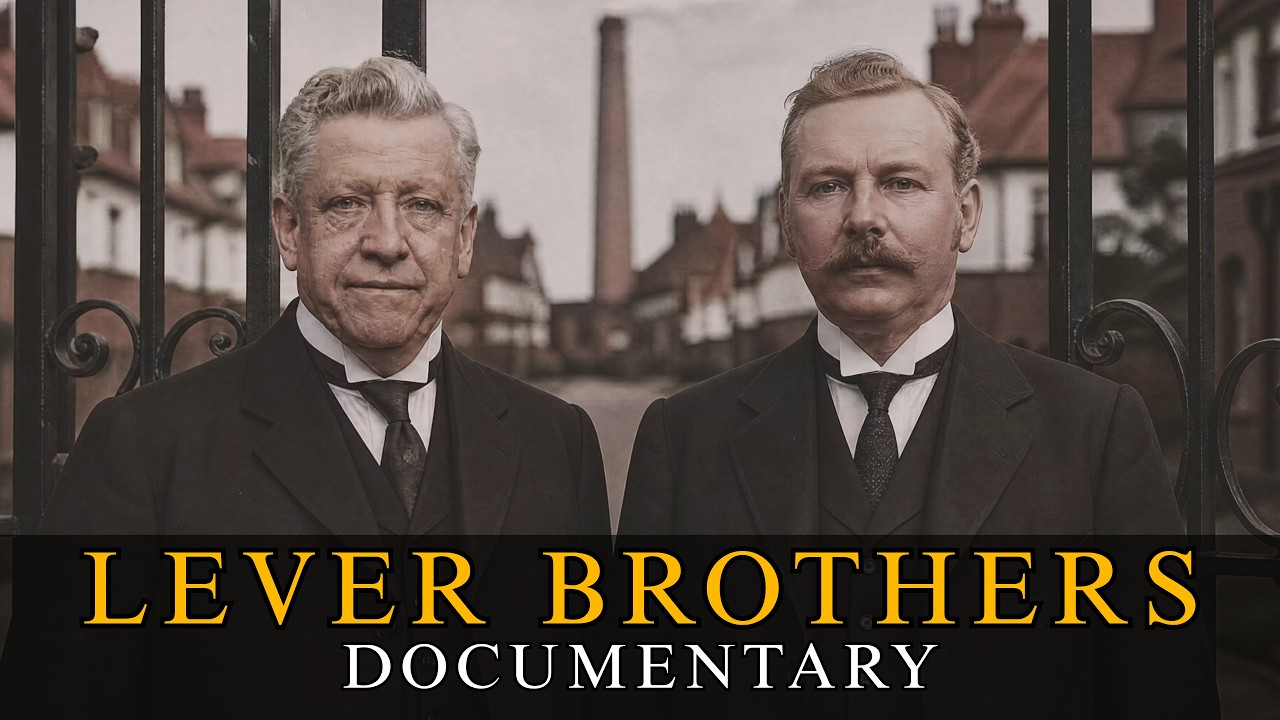
At the same time, 4,000 miles away, he had signed his name to a system in the Belgian Congo that flogged villages for missing a quota of palm nuts. Both the model village and the labor camp came out of the same balance sheet. Lever was born in Bolton in 1851, the seventh of ten children of a strict Congregationalist grocer. He left school at 15 and joined his father’s business, learning one lesson above all others: the man who turned over his stock fastest made the most money, even with the smallest margin.
He rose at five each morning, took cold baths year-round, slept in an open-air bedroom, and never drank or smoked. In 1874, he married Elizabeth Ellen Hume, a woman he had known since infancy. The marriage lasted until her death in 1913, but Elizabeth left almost no public mark on his life. He gave her one son, William Hume Lever, born in 1888.
In 1884, Lever leased a small soap works at Warrington with £4,000 advanced by his father and set up Lever Brothers with his brother James. He hired a chemist, William Hough Watson, who produced a yellow bar made from vegetable oils instead of animal tallow. Lever named it Sunlight Soap and registered the trademark in November 1884, creating the first packaged household soap brand in Britain. The packaging was as important as the soap.
Bars were cut to a uniform 16-ounce weight, wrapped in greaseproof paper, and sold in colored cartons with the word “Sunlight” in block letters. For the first time, a housewife in Glasgow could buy the same soap as a housewife in Bristol and be certain it would behave the same way. Lever advertised on a scale no British grocer had attempted, spending around £40,000 a year at his peak. Within three years, the Warrington works could not keep up.
In 1887, he bought 56 acres of muddy creek land on the Wirral between Bebington and Bromborough. He laid out a new factory and, beside it, something stranger: a planned village. He had studied the Cadbury works at Bourneville and Titus Salt’s Saltaire, but he wanted more than housing. He wanted, in his own phrase, to share with his workers the profits of their labor by giving them better houses than they could otherwise afford.
In March 1888, Elizabeth Lever cut the first sod with a silver spade. Within months, the site was named Port Sunlight. Over the next 30 years, around thirty different architects contributed designs, producing a village where no two adjacent blocks are alike. By 1914, there were approximately 800 dwellings on 130 acres, each with its own garden, indoor bathroom, kitchen, and parlor.
Around the houses Lever built a complete township: a school, a temperance inn, a swimming pool, a hospital, a theater, bowling greens, tennis courts, and a church. The Lady Lever Art Gallery, named in memory of Elizabeth, opened in December 1922. Inside, Lever installed his personal collection of Pre-Raphaelite paintings, Wedgwood jasperware, Chinese porcelain, and English furniture. The gallery was free to enter from the day it opened.
Foreign delegations arrived almost weekly. Henry Ford toured in 1907. King George V and Queen Mary visited in 1914. Edward, Prince of Wales, came in 1921.
To outsiders, the village was an astonishment. Infant mortality was far lower than in the surrounding Liverpool slums, and literacy was close to 100 percent. Lever had built a factory whose workers lived in good cottages, raised healthy children, and walked through a park to look at paintings. He had done it on the profits of a single brand of yellow soap, paid for, in his own description, entirely out of soap.
But there was a clause in every tenancy agreement that no visitor was ever shown. Every house was leased only for as long as the tenant remained an employee of the company. A worker dismissed for drunkenness, attempted unionization, or any other reason at a foreman’s discretion lost his house at the same instant he lost his wage. Lever did not hide the clause; he defended it openly, arguing that living in a Port Sunlight cottage should be tied to working in a Port Sunlight factory.
The company employed welfare officers, usually unmarried relatives of senior managers, who had the right to enter any cottage during the day to confirm that floors were scrubbed, children were sent to school, and windows were free of dust. The Bridge Inn served no alcohol for its first fifteen years until a residents’ referendum in 1903 voted two to one to allow beer. Female workers, almost all in the wrapping departments, were paid less than half the male rate and were dismissed automatically on marriage. Lever did not recognize trade unions.
A worker who attempted to organize could expect a warning, then a transfer to a poorer department, then dismissal. In 1906, the Daily Mail launched a sustained attack, accusing Lever of forming a soap trust to crush small competitors and raise prices. Lever sued. In July 1907, his counsel Sir Edward Carson won the principal case, and the Mail’s defense collapsed.
The agreed damages were £50,000, the largest sum ever awarded for libel in a British court at that date. By the autumn of 1907, Lever had recovered roughly £91,000 in total. He used the money to fund expansion abroad. By 1911, Lever’s eye had moved to the Belgian Congo.
The former Congo Free State had been the personal possession of King Leopold II, whose rubber regime killed an estimated 5 to 10 million Africans before the Belgian state took over in 1908. The new colonial regime promised reform. Lever argued in Brussels that the Congo’s palm forests were inefficiently harvested by what he called itinerant African labor, and proposed what he called rational exploitation. He would build mills, company towns, hospitals, and schools, and in return receive an exclusive concession to harvest palm oil.
In April 1911, Lever signed a contract with King Albert I of the Belgians, witnessed at the Royal Palace in Brussels. The concession covered 750,000 hectares of forest south of Bandundu, an area roughly the size of Wales. The company was a new Belgian subsidiary called the Huileries du Congo Belge. Lever ordered the largest mill site on the Kwilu River renamed Leverville.
The reality from the start was different. The local peoples had their own subsistence economy and saw no appeal in working twelve-hour days in a Belgian mill. The company turned to the Belgian colonial administration for help, which used a system of recognized African chiefs to deliver quotas of men. From 1913 onward, chiefs were instructed to deliver men, who were marched to the mill, issued numbered metal tags, housed in barracks, and paid in francs they could only spend at the company shop.
During the First World War, the labor regime tightened. By 1922, a Belgian decree made it a criminal offense, punishable by two to three months imprisonment, for any Congolese worker contracted to a concession company to fail to deliver his quota of palm nuts. Forced labor, formally abolished by the Belgian colonial charter, had been reintroduced in everything but name. A man who fell short of his quota could be sentenced to imprisonment with hard labor, often performed in the company building from which he had originally tried to escape.
Flogging with the chicotte, the hippopotamus-hide whip of the Leopoldian era, continued in informal use into the 1930s. The Belgian historian Jules Marchal, a former colonial administrator, documented the regime in exhaustive detail over 30 years. His four-volume work described sleeping sickness sweeping through the work camps, with mortality rates during the worst years of the 1910s running at 20 to 30 percent per year. He documented the names of victims, foremen, magistrates, and company officials.
He recorded specific years in which more men died at Leverville than were recruited. Lever visited the Congo in person in 1924 and 1925 and recorded in his journal that the Africans seemed contented and the mills were well-run. Other witnesses disagreed. The Belgian novelist Charles Pilsnier visited Leverville in 1924 and wrote of barracks where men slept on bare earth floors.
The English missionary J. H. Harris of the Anti-Slavery Society visited in 1927 and reported conditions little different in kind from those of the Leopoldian era, with the addition of better paperwork. After the First World War, Lever turned to Scotland.
In 1918, he bought the island of Lewis for £143,000, adding Harris the following year. He proposed to industrialize the herring fisheries, build canning factories, and open a national chain of fishmonger shops under the brand MacFisheries. He renamed Obbe, on Harris, Leverburgh. But the crofters of Lewis did not want his vision.
Almost 10,000 Lewis men had served in the war and had been promised land on their return. Returning servicemen occupied land owned by Lever’s farms in 1919. He demanded eviction, the Scottish land court ruled against him, and the land raids spread. The crofters looked at the most successful industrialist in the British Empire and declined to be improved by him.
Lever announced in 1923 that he would gift the parish of Stornoway and 25,000 acres of surrounding land to its inhabitants in perpetuity. The Stornoway Trust became the largest community landowner in Scotland. The rest of Lewis was sold off in small lots. The Harris project collapsed commercially.
By 1923, Lever had committed roughly £2 million to the islands with little return. In 1920, Lever paid £8 million for the Niger Company, the largest British palm oil trading house in West Africa. The purchase came at the top of a postwar commodity price boom. Prices collapsed within months, and Lever Brothers faced ruin.
An emergency overdraft of £8 million was extended by Barclays Bank on terms that effectively required a boardroom restructuring. Francis D’Arcy Cooper, an austere accountant, was appointed to the senior managerial position. Lever remained chairman but no longer ran the company. Lever’s last years were lived under management he no longer controlled.
He spent more time at Thornton Manor, traveled to the Congo on a final inspection in early 1925, and gave occasional public lectures defending paternalistic capitalism. He died of double pneumonia at Hampstead on the morning of May 7, 1925, at the age of 73. His last act the previous evening was said to be reading aloud a passage from the Psalms. The funeral was the largest industrial funeral in British history.
The Lever Brothers factory closed for the only full day in its 37-year history. The choir of the works sang in the lane. He was buried beside Elizabeth in the small mortuary chapel at Christ Church, Port Sunlight. The Times called him the greatest industrial figure of his age.
The Stornoway Gazette noted that many crofters were relieved at the prospect of being free of him. Within weeks, the company ordered all development on Harris to stop. Leverburgh reverted to a small fishing village. At the Congo, the Huileries du Congo Belge continued under new management.
The quotas continued. The criminal penalties continued. The deaths in the work camps continued. The structures Lever had set up in 1911 operated without their founder.
Four years after his death, in September 1929, Lever Brothers merged with a Dutch margarine combine to form Unilever, the largest consumer goods business in the world, employing roughly 250,000 people across more than 50 countries. The merger distributed the company’s moral inheritance across two parent entities, one British and one Dutch. There was no longer one man whose statue could be petitioned. There was a company whose press office could be telephoned.
The criminal penalty for missing palm nut quotas was formally abolished in 1947. The full transition to free wage labor came in stages through the 1950s, and the Congo achieved independence in June 1960. Unilever continued to own the plantations under renamed companies. In 2009, Unilever sold its remaining Congolese plantations to the Canadian firm Feronia.
Subsequent reports by the Oakland Institute and Human Rights Watch found improvements in some respects but documented ongoing land disputes, low wages, and violent incidents, including plantation workers killed during protests in 2011 and 2015. Port Sunlight changed as well. From the early 1960s, Unilever began to sell off individual cottages to sitting tenants. By 2000, the majority were in private ownership.
The Lady Lever Art Gallery was transferred to the nation in 1978. Since the English publication of Marchal’s work in 2008, the interpretive panels at the gallery have increasingly addressed the Congo question. There is now a quotation from Marchal, a photograph of African workers waiting at a company mill for their tags, and a discreet acknowledgment that the gallery was funded by the same balance sheet that funded the mill in what is now Lusanga, the former Leverville. The site of the former Leverville is now the Lusanga International Research Center for Art and Economic Inequality.
The statues of Lever in Liverpool, Bolton, and Port Sunlight have each been petitioned for removal during the 2010s and 2020s. Each has been reviewed by the local authority, and each has been kept in place, sometimes with new interpretive plaques. Surveys in Bolton supported retaining his statue by a margin of roughly two to one. The Leverhulme Trust, founded from his personal will in 1925, continues to make grants of more than £100 million a year in research funding.
In 2024, it announced it would fund a major research project into the colonial history of its founder’s company. Sunlight Soap is still sold in dozens of countries, principally in South Asia and sub-Saharan Africa. The factory at Port Sunlight still makes soap. The unbroken commercial line from the £4,000 lease at Warrington in 1884 to the modern Unilever balance sheet runs for nearly a century and a half, and it includes both the Stornoway gift and the Leverville quotas in its books.
Both villages, the model town and the labor camp, were the same company. They were planned, financed, accounted for, and managed by the same head office. Lever did not turn bad. He believed with absolute conviction to the moment of his death that the gospel of soap was the gospel of civilization.
He believed in his Congolese mill the way he believed in his Wirral cottage. The cost of that belief, multiplied by his energy, his cash, his autocracy, and his empire, is what the panels at the Lady Lever Art Gallery now invite visitors to count. The grandeur of the Wirral is preserved.
The grandeur of the rainforest is silent.