Lina Heydrich was born Lina Mathilde von Osten on June 14, 1911, in Fehmarn, then part of the German Empire. Her father, Jürgen, was an impoverished German nobleman of Danish origin who worked as a country teacher, while her mother was a homemaker.
The von Osten family was strongly right-wing, and Lina showed herself from an early age to be a convinced National Socialist and a fervent antisemite. She attended school in Oldenburg and in 1928 began training in Kiel to become a commercial teacher.
It was at a rowing club ball in Kiel that she met a naval lieutenant two years later, on December 6, 1930. He was known as ambitious, arrogant, and passionate about women. His name was Reinhard Heydrich.
A spark passed between them, and less than two weeks later, on December 18, 1930, they announced their engagement. Heydrich abandoned the daughter of a senior naval officer whom he had previously promised to marry.
A military court of honor, scandalized by his disrespectful conduct during the hearing, stated that he had dishonored the officer corps of the Reich Navy and forced him to leave service in April 1931. Heydrich was left without career prospects.
The dismissal devastated him, but under the influence of Lina and her deeply nationalist family, Heydrich — to whom party politics had initially been indifferent — moved closer to National Socialism. Lina's brother Hans had been a member of the Nazi SA since 1928, and Lina herself joined the Nazi Party a year later, shortly after attending a party rally at which Adolf Hitler spoke.
Reinhard Heydrich joined the Nazi Party and the SS in June and July 1931. Around that time, Heinrich Himmler, the head of the SS, was trying to build an internal intelligence service for the Nazi Party. Himmler agreed to an interview with Heydrich but canceled their meeting at the last moment.
Lina, a fanatical supporter of the Nazi Party, ignored the news, packed Heydrich's suitcase, and sent him to Munich to see Heinrich Himmler. Heydrich immediately impressed Himmler with his blond hair and blue eyes — he had the look of the perfect Aryan. Himmler took him into the SS intelligence service in August 1931, and in December of that year Lina and Heydrich married.
Four children were born from the marriage: two boys, Klaus and Heider, and two girls, Silke and Marte. Reinhard Heydrich was by then working for Himmler, who tasked him with building the Security Service, the SD.
By January 1933, the SD was operating under Heydrich as the Nazi Party's intelligence agency. Adolf Hitler and his Nazi Party came to power in January 1933. Soon after taking power, Nazi leaders began fulfilling their promises and started persecuting German Jews.
When Himmler was appointed commander of the political police in Bavaria on April 1, 1933, he named Heydrich his deputy. Lina triumphantly described the humiliation of the Bavarian government and the continuing waves of arrests in a letter to her parents.
In it she wrote that in the evenings the SA and SS had special pleasure, tasked with arresting all political opponents they knew of and taking them to the Brown House. She wrote that this was something for the boys, that they could finally take revenge for all the injustice done to them, for all the beatings and injuries, and for their fallen comrades.
More than 200 people were arrested, she wrote, some of them Jews. The interior minister stood in the hall in his socks and nightshirt, surrounded by a crowd of SA and SS men who did not know where to go because they were laughing. Then they came and stepped with heavy boots on the crying interior minister's thumb, so that he hopped from one foot to the other. She asked her parents to imagine the scene.
Next, she wrote, it was the turn of the Jewish Levy. They gave him a short trial, took his shoes and stockings, and he had to walk barefoot to his home in the company of SS members.
Reich SS leader Himmler was appointed Reich Leader of Police on June 17, 1936, and nine days later he named Heydrich chief of the newly established Main Office of the Security Police, which united the Gestapo, the secret police, and the detective branches of the criminal police into a single office.
After this appointment by Hitler, Himmler and his de facto deputy Heydrich became the two most powerful men in Germany's internal administration. Lina Heydrich did not get along well with Margarete Himmler, the wife of Heinrich Himmler, among other things reproaching her for stinginess, which showed in her overly simple household management. Lina Heydrich herself enjoyed the luxury lifestyle that her husband's rising position allowed.
On the night of November 9 to 10, 1938, Nazis from the SA, SS, Hitler Youth, and German civilians destroyed Jewish homes, businesses, synagogues, hospitals, and schools throughout Germany, annexed Austria, and in the Sudetenland in Czechoslovakia, which German troops had recently occupied. Ninety-one Jews were murdered. One of the main organizers of the Kristallnacht pogrom was Reinhard Heydrich.
Lina actively stood by her husband and encouraged him to do even more for the Reich. In the following year, 1939, it was Heydrich who turned the Salon Kitty, a first-class brothel in a wealthy Berlin district, into an operation for espionage purposes, with hidden cameras and microphones throughout the building.
Heydrich had a large sexual appetite and was a regular visitor to Berlin brothels. During his inspection visits to Salon Kitty, all microphones had to be turned off. Not only Reinhard Heydrich but also Lina herself was said to have had several love affairs, because Reinhard Heydrich's duties meant he had to work a great deal and was often away from home.
Lina later said: "I was married for 10 years, seven of them he was not at home."
Franz Stofel, an official by profession and a fanatical member of the Nazi SS from the age of 20, first served at Dachau and then became commander of a subcamp of the Mittelbau complex, also used to produce V-weapons such as the V1 flying bombs and V2 rockets. At the end of the war, Stofel was co-responsible for the murders of prisoners during brutal death marches.
The Second World War began on September 1, 1939, when Nazi Germany attacked Poland. After the invasion of the Soviet Union in June 1941, the previously dormant communist resistance movement in the Protectorate of Bohemia and Moravia launched sabotage actions, and Hitler sidelined Reich Protector Konstantin von Neurath, sending him on leave because of his leniency toward Czechs.

In September 1941, Hitler appointed Heydrich as acting Reich Protector. For the family, Heydrich's appointment meant a rise on the social ladder. Until then he had practically never taken part in meetings with Hitler and had always been only in Himmler's shadow. As the first representative of the Protectorate, however, he dealt directly with the Führer and was of course at the top of the power hierarchy in Bohemia and Moravia.
When Heydrich arrived in Prague, he told his people to Germanize first. He ordered a wave of terror narrowly aimed at real and imagined opposition leaders in the Czech lands. In October and November 1941, Protectorate special courts sentenced 342 people to death and handed 1,289 over to the Gestapo. Heydrich's brutal policy at this time quickly earned him the nickname "the Butcher of Prague."
Heydrich also established the Terezín ghetto, which existed for three and a half years, from November 24, 1941, to May 9, 1945, and served primarily as a transit camp for Jews on their way to extermination camps.
After her husband's appointment as acting Reich Protector of Bohemia and Moravia, the family moved from Prague Castle, where they had lived for several months, to the luxurious and idyllic Panenské Břežany castle near Prague. The castle had already been taken from the Jewish owner Ferdinand Bloch-Bauer after the German invasion and was adapted to Lina Heydrich's satisfaction.
As the protector's wife, Lina enjoyed a status of which her impoverished aristocratic parents had not even dreamed. Lina later wrote of this time: "I am a princess and I live in a fairy-tale land."
Heydrich was so sure that his pacification program in the Protectorate had succeeded that he ostentatiously ignored security measures and traveled through Prague in an open car. On May 27, 1942, Heydrich was riding in his Mercedes convertible when Czechoslovak paratroopers Josef Gabčík and Jan Kubiš managed to throw a hand grenade under his car and wound the Nazi architect of the Holocaust.
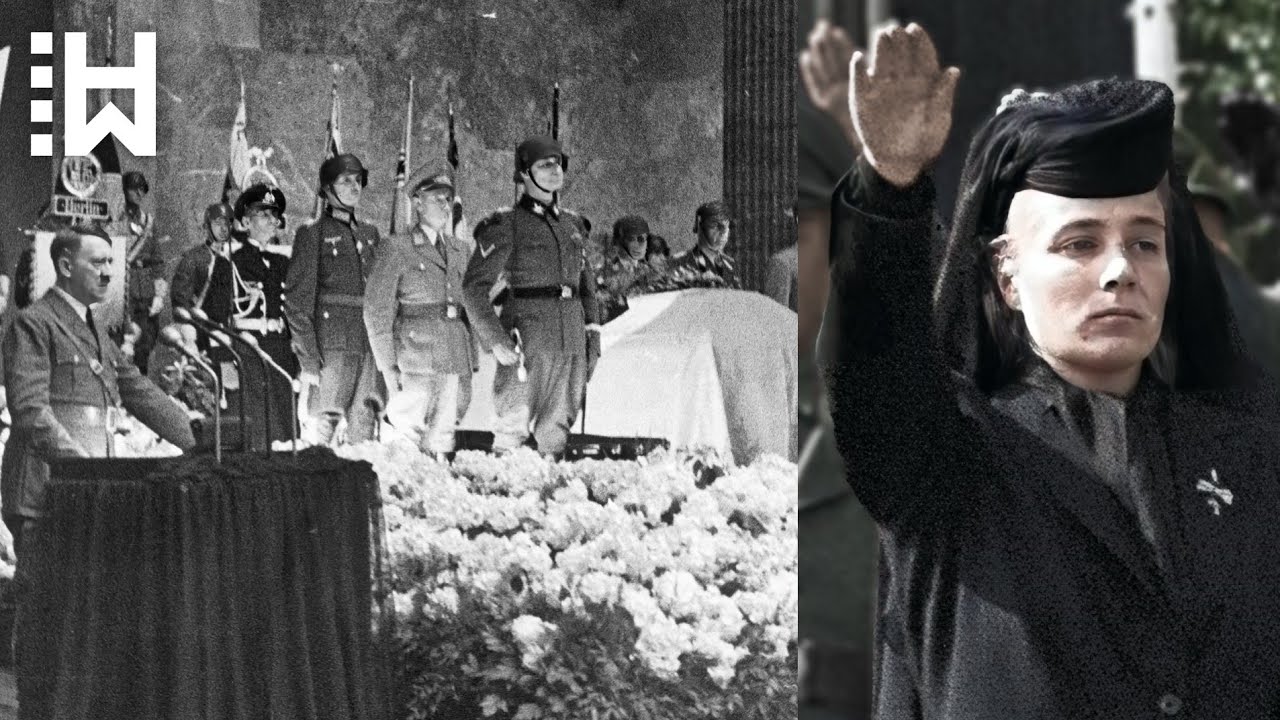
Shortly afterward, Heydrich was taken to the emergency room with a pale face and screaming in pain. He developed fevers, had a drain in his wound, and suffered great pain. Although the explosion itself did not fatally wound Heydrich, grenade fragments in his leg and lower back led to the development of an infection that killed the 38-year-old Heydrich on June 4, 1942.
Lina did not attend the funeral because of her pregnancy. Their fourth child, daughter Marte, had been born on July 23, 1940, shortly after her father's death.
For her husband's services to the Nazi cause, especially for coordinating the Final Solution of the Jewish Question — the code name for the systematic, deliberate, and physical liquidation of European Jews — Hitler gave Lina Heydrich the castle at Panenské Břežany. She also received a high lifelong pension and insurance that made her a wealthy woman.
She had a playground and swimming pool built, and decided to destroy the English park with its rare trees. She sold the wood and planted potatoes and other vegetables, which she then sold to German soldiers in Prague. To be able to trade, she needed workers, and in the castle grounds she established a miniature labor and concentration camp.
About 150 prisoners from the Terezín ghetto lived in the former stables and worked for Lina Heydrich in miserable conditions, receiving little food. According to witness testimony, Lina physically abused and mistreated the forced laborers. According to later testimony, she watched the workers through binoculars and had SS members whip those who worked too slowly, spat on them, or beat them when she felt their behavior was not sufficiently respectful.

It was not until February 1944 that prisoners from the Terezín ghetto stopped serving at Panenské Břežany entirely. Lina Heydrich, however, obtained at least some compensation from Himmler. From Flossenbürg she received a group of 15 Jehovah's Witnesses. She repeatedly refused requests from their home concentration camp in Flossenbürg to pay proper rent for them. The matter eventually went so far that Himmler himself began making payments on her behalf from his own account.
On October 24, 1943, Klaus, one of Heydrich's four children, died as a result of a traffic accident. He was riding a bicycle with his brother Heider in the courtyard of Panenské Břežany castle. Klaus noticed that the gate to the street was open and rode out, where he was struck by a small truck driving along the road.
Immediately after the accident, a Jewish doctor who was in the work group at the castle gave the boy first aid, but his injuries were fatal and Klaus died that same afternoon. Lina decided to bury Klaus in the castle garden, and Jewish prisoners dug the grave. On the eve of the funeral, however, Lina decided that the resting place of her Aryan child must not be dug by Jews, and by morning German soldiers had dug and decorated a new grave.
Lina then wanted to have the driver, Karel Kašpar, and all the passengers shot, but the investigation found the driver innocent. After the war, one eyewitness recalled seeing Lina Heydrich standing with guests in front of the castle entrance and saying "Ist alles meine," which means "It is all mine."
She was mistaken. The family lived at the castle until April 1945, when they left the area along with many other Germans and fled before the advancing Soviet Red Army. Before leaving, Lina had the rabbits, geese, and chickens killed and took jars of canned meat with her. She shook hands with each of the castle employees and promised them a pension, because she believed she would return to her castle.
That never happened. In the second half of 1945, Lina finally arrived with her children in her native Fehmarn. In 1948, a Czechoslovak extraordinary people's court sentenced her in absentia to life imprisonment. For two years Lina had to hide from the authorities for fear she might be extradited to Czechoslovakia. British authorities ultimately rejected the Czechoslovak government's request for her extradition.
Over the next 10 years Lina had only a limited income. Her house in Fehmarn, temporarily confiscated by the British after the war, was returned to her. She repeatedly applied for a general's pension, although Heydrich, as an SS general, was not a soldier according to German authorities but a war criminal. In the end, however, she was granted a widow's pension.
In 1965 she met Finnish theater director Mauno Manninen, whom she married so she could change her surname. Lina then ran Reinhard Heydrich's former summer house in Fehmarn as a restaurant and inn. A considerable part of her clientele consisted of former supporters of the Nazi regime reminiscing about the old good times. The restaurant burned down in February 1969, and her husband Mauno Manninen died in September of the same year.
In 1976 she published her memoirs, titled "My Life with Reinhard." She recalled the period of life in the Protectorate repeatedly with nostalgia, and even at the end of her life she showed no remorse and refused to admit any guilt on her husband's part for Nazi crimes. Of the atrocities in the Nazi camps she declared: "It was all a fairy tale."
When Lina died on August 14, 1985, in Fehmarn, she was 74 years old. In 1979, six years before her death, she said: "National Socialism was a faith, and that I will never renounce."
No tears were shed for Lina Heydrich.