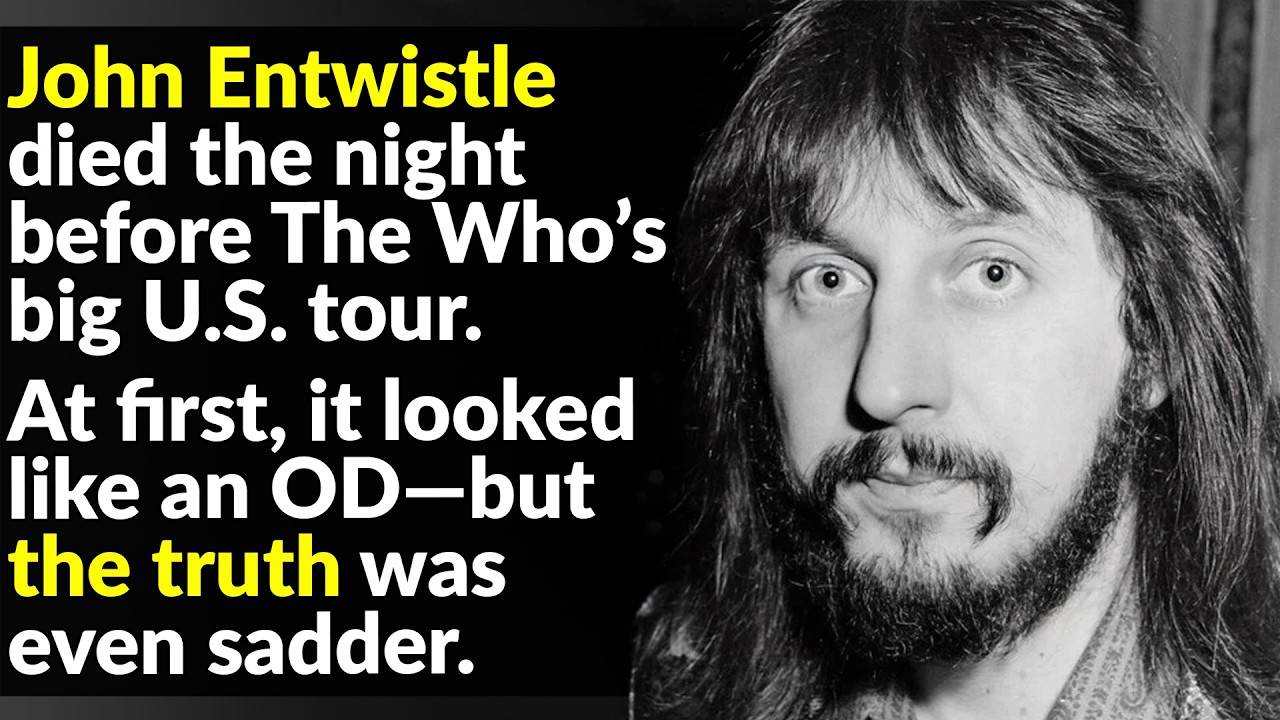
John Entwistle, the legendary bassist of The Who, died suddenly on the night before the band was set to launch a major American tour. At first, his death appeared to be the result of an overdose, but years later, his biographer revealed a far more tragic explanation. Known as “Thunderfingers” for his explosive bass playing, Entwistle was also called “The Ox” because of his stubborn nature and solid build. Born John Alec Entwistle on October 9, 1944, in Hammersmith, his arrival into the world was marked by chaos—a German bomb exploded near the family home while his mother was giving birth.
According to family lore, he was born with a birthmark shaped like a shell fragment on his leg. As the only child of a trumpet-playing father and a mother with musical roots, Entwistle seemed destined for a musical life. But his parents divorced shortly after his birth, and he went to live with his grandparents. The split turned him into a withdrawn and solitary child, and music became his only escape.
Between the ages of five and six, his grandfather took him to a local club and encouraged him to sing. Entwistle performed classic songs loudly while his grandfather collected payment. His musical career had begun. At seven, he started piano lessons, though the experience was unusual.
He later described his piano teacher as extremely old, with a room full of cats and fingers like spoons. Four years later, he switched to the trumpet. By age eleven, while attending Acton County Grammar School, he auditioned for the Middlesex School Orchestra. With too many trumpet players in the group, he moved to the French horn.
A new friendship would soon change his path completely. At Acton County, Entwistle became friends with Pete Townshend, and the two formed a traditional jazz band called The Confederates. The group was short-lived, performing only one show—two songs for ten people at a local church. Entwistle was already searching for his next project, and he found it in rock and roll.
He abandoned the French horn for guitar, but his large fingers made it difficult to play. Inspired by musicians like Duane Eddy, he then switched to bass guitar, determined to play it his own way. Unable to afford a new instrument, he built one himself, carving a piece of mahogany to resemble a Fender bass, wiring it up, and preparing to make as much noise as possible. That homemade bass caught the attention of Roger Daltrey, a former Acton County student known for his troublemaking reputation.
Daltrey had heard Entwistle play and invited him to join his band, The Detours. Entwistle agreed, but only on one condition: Daltrey had to replace his current drummer with Pete Townshend. Daltrey accepted, and The Who was born. The band quickly found success, with their agent booking up to six shows a week across London.
Entwistle wanted the whole city to hear him. To amplify his already loud playing, he searched for a unique amplifier. Townshend took him to Jim Marshall’s music shop, where the budding entrepreneur was quietly developing the amplifier that would bear his name. Entwistle became one of Marshall Amplifiers’ first customers, buying a new speaker cabinet.
The sound was tremendous. Townshend later recalled that Marshall’s amplification made Entwistle’s playing extremely loud. Instead of turning down, the other band members responded by buying even more amplifiers to compete. What followed was an intense escalation in amplification that permanently redefined the volume of rock and roll.
In February 1964, the band faced an identity crisis. After seeing another group called The Detours on television, they renamed themselves The Who. A public relations manager, Peter Meaden, briefly renamed them The High Numbers, but when their single “Zoot Suit” failed, Meaden’s control slipped away. The band returned to the name The Who for good.
At the height of The Who’s fame, Townshend became known for a signature look—a Union Jack sleeveless jacket. But a lesser-known fact is that Entwistle wore the Union Jack jacket first. As the band tried to position themselves as leaders of the mod culture, it was the bassist who debuted the iconic outfit. Entwistle carried two lasting nicknames.
“The Ox” reflected his strong build and ability to outdo his bandmates in eating, drinking, and everything else. “Thunderfingers” described the ferocity of his playing. Bill Wyman, bassist of The Rolling Stones, summed him up as the quietest man in private but the loudest man on stage. He was also the most musically educated member of The Who, the only one with formal training.
Beyond bass, his instrumental arsenal included the French horn, trumpet, piano, tuba, and even the Jew’s harp. He arranged the brass sections on tracks like “5678,” assembling the parts himself. One of The Who’s most famous songs, “My Generation,” featured Entwistle’s stunning 55-second bass solo. The song reached number two on the British charts.
To achieve the intended effect, he needed a Danelectro bass with thin strings that produced a sharp sound. But those thin strings couldn’t withstand the pressure of his fingers—he broke three full sets before mastering the solo on his fifth attempt. The final performance was recorded on a new Fender Jazz Bass with tape-wound strings. In 1966, while still chasing that elusive Danelectro tone, Entwistle collaborated with James How of Rotosound.
Together they discovered the problem was not the winding but the core of the strings. They developed the RS66 roundwound string sets, which Entwistle later said were the first strings that vibrated correctly. Thanks to him, the RS66 became an industry standard for rock bassists worldwide. Entwistle’s contributions to The Who’s albums were significant but erratic.
His first song, “Whiskey Man,” was a cautionary tale about heavy drinking. His second came from a night out with Bill Wyman. As Entwistle explained, they began talking about spiders and how they frighten people—that’s where the idea came from. “Boris the Spider” became the most requested song in The Who’s catalog, despite its morbid subject matter.
His compositions were unique among the band’s work: grotesque, steeped in dark humor, and filled with what one writer described as deviants and depressives. The Who’s first American tour arrived in the spring of 1967, though it was unclear whether their 10-day run turned a profit. While staying at the Drake Hotel, Entwistle and drummer Keith Moon celebrated with champagne, lobster, caviar, and brandy. That June, The Who announced themselves to America at the Monterey Pop Festival alongside Jimi Hendrix and Janis Joplin.
The British band made an impression when Moon exploded his drum kit at the peak of “My Generation,” sending debris flying and cutting his arm. Entwistle stood amid the chaos expressionless—witnesses described him as looking bored. At least one thing could make him smile. On his twenty-first birthday, Entwistle proposed to his childhood sweetheart, a woman named Alison Wise.
In the summer of 1967, they married, with his father serving as witness. The couple settled into a semi-detached home, choosing a more modest life than most rock stars. When The Who took the stage at Woodstock in the early hours of August 1969, it was a miracle they made it to the stage at all. Just before their performance, someone laced the drinking water backstage with a powerful hallucinogenic drug.
Entwistle later admitted: “I took a dose of the drug backstage. I passed out and woke up half an hour before we were due on stage. ” Daltrey later described it as the worst show they ever played. Their next live recording told a different story.
When The Who appeared at Live at Leeds in May 1970, the band was captured at the height of its power, and Entwistle’s bass playing at its most dominant. Critics noted that his playing alone made The Who sound closer to heavy metal before the term even existed. The album is still considered one of the greatest live recordings ever made. Yet Entwistle’s frustration with his secondary role in The Who had been quietly building for years.
He could add a song or two to each album, but there was a recurring problem. As he put it: “My problem was, I wanted to sing the songs myself, not let Roger sing them. ”
That frustration had only one outlet. In May 1971, John Entwistle became the first member of The Who to release a solo album.
“Smash Your Head Against the Wall” featured Keith Moon and even a contribution from Freddie Mercury in some form. Entwistle recorded the album on the same piano Mercury would later use for “Bohemian Rhapsody. ” Despite all this, the album failed to chart in the American top 100 and made no impact in Britain. Regardless of success or failure, Entwistle spent his rock star money freely, collecting a fleet of cars even though he never held a driver’s license.
His wife Alison remembered him as wasteful, buying six pairs of shoes at once instead of one. His third solo album, released in May 1973, was completed in under three weeks but at enormous expense: $10,000 for the studio and a $4,000 drinks bill. The BBC banned the album. Entwistle returned to arranging brass parts for The Who’s massive 1973 double album.
Yet the problem that drove him to a solo career remained. Despite its success, that album is the only Who studio recording to which he contributed no original songs. On the following tour, internal tensions escalated sharply. Townshend and Daltrey came to blows.
When Townshend’s punch missed its target, Daltrey responded with a powerful blow that knocked Townshend to the floor, unconscious. Entwistle watched the chaos unfold with his usual coolness. But after growing tired of Daltrey’s habit of telling the album’s story between songs, Entwistle exploded: “Cut the crap. Let’s play.
”
He needed time for his other hobbies. True to his habit of multitasking, Entwistle compiled The Who’s 1974 rarities collection, “Odds & Sods,” and designed the cover for their 1975 album, “The Who by Numbers,” drawing caricatures of himself and his bandmates. He later boasted the cover cost him only 30 pounds. The money he saved went straight into his stage setup.
His bass rig grew into a towering fortress of equipment, racks, and flashing lights that insiders called “Little Manhattan. ” His justification was simple: “I just wanted to be louder than anybody else. I was really annoyed when other people could turn their guitar amps up and play louder than me. ”
Daltrey begged him to turn down.
Entwistle turned up. The volume battle reached its peak at a London concert in 1976, where The Who recorded a deafening 126 decibels—earning a Guinness World Record for the loudest rock concert ever recorded. His life offstage was expanding too. In 1978, flush with rock and roll earnings, Entwistle bought a 55-room Victorian hunting lodge on roughly 40 acres of countryside.
He filled it with suits of armor, a skeleton reclining on a Regency chair, three birdcages full of parrots, and one of the largest private guitar collections in the rock world. Then his personal life took a sharp turn. While working on a documentary in Los Angeles, Entwistle met Maxine Harlow, a 22-year-old cocktail waitress. His marriage to Alison collapsed.
The Who was also on the verge of breaking up. When original drummer Keith Moon died in late 1978, the band continued with Kenney Jones. They even managed to release “Face Dances” and “It’s Hard” before Townshend announced his retirement from touring. A decade later, The Who received a different kind of recognition.
On January 18, 1990, The Who was inducted into the Rock and Roll Hall of Fame. For a band that once played two songs for ten people in a church youth club, it was a long journey. But Entwistle’s story wasn’t over. In 1991, he and Maxine Harlow made their relationship official.
Their wedding was pure rock and roll: a small Las Vegas chapel, with an Elvis Presley impersonator serving as witness. The ceremony was theatrical, spontaneous, and perfectly in character. The marriage lasted six years, ending in divorce in 1997. By then, his finances were in serious trouble.
One day before The Who was scheduled to begin a U. S. tour on June 27, 2002, Entwistle died. The woman he had spent the previous night with woke to find him unconscious in room 658 of the Hard Rock Hotel and Casino in Paradise, Nevada.
He was 57 years old. The cause of death revealed a complex story. The Clark County coroner concluded that a powerful blow caused the fatal heart attack. But a senior British forensic toxicologist provided a crucial clarification at the subsequent inquest.
Cocaine alone would not have killed him. The level of toxicity would not have been fatal had it not affected his damaged heart. His heart had been suffering from serious health problems for years. An autopsy revealed one artery was completely blocked, and another was about 75 percent blocked.
His son said they were told it would only have been detected by an ECG, which was never performed because it wasn’t considered necessary. His biographer later suggested that a thorough check would have revealed three blocked arteries and might have saved his life. The surviving members of The Who came together one last time to say goodbye.